

The era of sodium-ion experimentation has officially ended, replaced by a mandate for industrial-scale reliability. As global supply chains face continued volatility in lithium-iron phosphate markets, procuring sodium ion batteries for commercial projects has shifted from a speculative hedge to a strategic necessity for resilient energy infrastructure. You need more than just a promising chemistry; you require a procurement framework that stands up to the scrutiny of project finance and rigorous safety standards.
We recognize the challenges inherent in moving toward new storage technologies, particularly when safety certifications and manufacturer track records often feel opaque. This guide provides the technical and logistical clarity you need to master the 2026 procurement landscape with absolute confidence. We'll examine the essential checklist for identifying bankable manufacturers with proven heritage, explore how intelligent Energy Management Systems optimize sodium-ion performance in diverse climates, and verify the hardware availability required to move your large-scale deployments from the drawing board to the grid.
Key Takeaways
- Identify the 2026 transition from experimental pilots to utility-scale commercial availability for sodium-ion technology.
- Evaluate the performance advantages of NFPP chemistry to balance energy density with maximum safety in C&I environments.
- Establish a robust strategy for procuring sodium ion batteries for commercial projects by prioritizing manufacturers with a 30-year heritage.
- Understand the role of AI-driven Energy Management Systems in optimizing unique sodium-ion discharge curves and predicting state-of-health.
- Secure project bankability through end-to-end engineering consulting and strategic global partnerships that ensure grid-code compliance.
The 2026 Commercial Landscape for Sodium-Ion Procurement
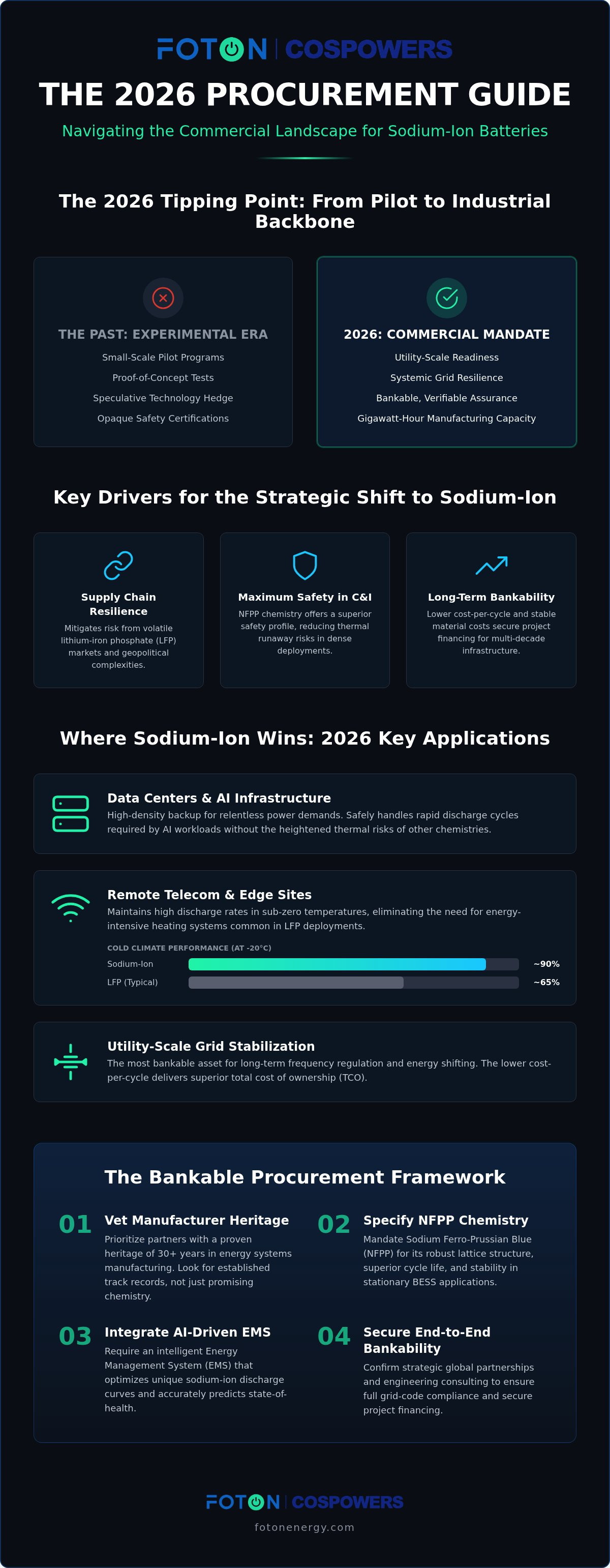
2026 marks the definitive transition of sodium-ion technology from laboratory curiosity to industrial backbone. While previous years were defined by small-scale pilot programs and proof-of-concept tests, the current landscape is one of utility-scale readiness. For organizations currently procuring sodium ion batteries for commercial projects, the primary motivator is no longer just curiosity; it's systemic resilience. The volatility of the lithium-iron phosphate (LFP) supply chain has forced a strategic pivot toward more abundant, cost-stable raw materials. This shift represents a fundamental realignment of how we approach large-scale energy storage.
Strategic procurement in 2026 is driven by the need for "bankable" assurance. Developers and investors are looking past the hype to find manufacturers with the heritage and scale to support multi-decade infrastructure. Sodium-ion offers a unique hedge against the geopolitical and environmental complexities of lithium mining. By utilizing abundant salt-based electrolytes, project managers can meet aggressive "Green Mandates" and sustainability targets without compromising on the operational reliability of their battery energy storage systems (BESS).
Market Maturity: Moving Beyond the Lab
Manufacturing capacity in 2026 has finally caught up with the industry's ambitious projections. We've moved into an era where Tier-1 manufacturers are delivering gigawatt-hours of capacity specifically for stationary storage applications. Engineering, Procurement, and Construction (EPC) firms now include sodium-ion options in their standard Request for Proposals (RFPs) for Commercial and Industrial (C&I) projects. This shift is supported by a deeper understanding of Sodium-ion battery technology, which offers a safer, more sustainable alternative to traditional chemistries. For a detailed breakdown of current supply levels, you can consult our analysis on The 2026 State of Sodium-Ion Battery Commercial Availability.
Key Applications: Where Sodium-Ion Wins in 2026
The 2026 market has identified specific sectors where sodium-ion isn't just an alternative but the preferred choice. These applications leverage the unique thermal and chemical properties of sodium to solve operational bottlenecks that have historically plagued LFP systems.
- Data Centers and AI Infrastructure: The relentless power demand of modern AI requires high-density backup systems that can handle rapid discharge cycles without the heightened thermal runaway risks associated with other chemistries.
- Telecom Backup for Remote Sites: Remote installations benefit from sodium-ion's superior performance in cold climates. Unlike LFP, which often requires energy-intensive heating systems to maintain functionality, sodium-ion maintains high discharge rates in sub-zero temperatures.
- Utility-Scale Grid Stabilization: In projects where physical footprint is less constrained than the total cost of ownership, the lower cost-per-cycle of sodium-ion makes it the most bankable asset for long-term frequency regulation.
Ultimately, procuring sodium ion batteries for commercial projects in 2026 is about securing a position in a more stable energy future. It's about choosing a path that prioritizes availability, safety, and long-term value over the unpredictable fluctuations of the lithium market.
Technical Selection Criteria for Commercial Sodium-Ion Hardware
Technical excellence in 2026 is defined by chemical stability and long-term asset security. While several chemistries have competed for market share over the last decade, NFPP (Sodium Ferro-Prussian Blue) has emerged as the dominant choice for stationary storage. It provides a superior cycle life that rivals high-capacity LFP, making it the primary focus when procuring sodium ion batteries for commercial projects. This chemistry's robust lattice structure allows for rapid ion transport without the structural degradation common in lower-tier alternatives, ensuring your investment maintains its performance over thousands of cycles.
Finding the "sweet spot" for Commercial and Industrial (C&I) BESS involves a calculated trade-off between energy density and safety. While sodium-ion cells generally possess lower energy density than lithium counterparts, their safety profile allows for tighter packing within containerized systems. This denser system-level integration effectively offsets cell-level limitations. It results in a footprint that is often comparable to LFP systems but with significantly lower risks of thermal runaway. Engaging with an engineering consulting partner early in the design phase ensures these technical criteria align with project bankability and site-specific constraints.
Simplified cooling architecture is another massive operational win for the 2026 hardware generation. Sodium-ion maintains stability across a much broader thermal window than traditional chemistries. This reduces the parasitic load on the BESS because the HVAC systems don't have to work as hard to maintain optimal operating temperatures. Much of the commercial momentum for sodium-ion is driven by this reduction in balance-of-system costs, which directly improves the project's net present value.
Performance Metrics for EPC Evaluation
Verification of cycle life is mandatory for any utility-scale or C&I deployment. You must compare sodium-ion modules directly against LFP benchmarks using standardized testing protocols. Sodium-ion shines in discharge efficiency, especially in extreme temperatures where it retains over 90% capacity at -20°C. When reviewing a data sheet, look for red flags such as manufacturers who omit depth-of-discharge (DoD) correlations or fail to provide third-party verification of round-trip efficiency. Unrealistic discharge rates without corresponding thermal data are a clear sign of unproven hardware.
Safety and Certification Standards
UL 9540A is non-negotiable for 2026 deployments. This certification proves that even in a worst-case thermal runaway event, fire will not spread between cells or modules. While many manufacturers make bold non-flammability claims, you must verify these through large-scale burn test results. Proper integration with a large scale battery safety architecture ensures that your fire suppression protocols and Energy Management Systems (EMS) are unified. This creates a multi-layered defense that protects both the hardware and the surrounding infrastructure.
Wholesale Procurement Strategies and Supply Chain Logistics
Wholesale procurement for 2026 and 2027 project cycles requires a fundamental shift from transactional buying to strategic supply chain alignment. Success in procuring sodium ion batteries for commercial projects depends on navigating the logistical nuances of a rapidly scaling market. While manufacturing capacity has increased, you'll still need to account for lead times that require a 12 to 18-month planning horizon for utility-scale deployments. Factory Acceptance Testing (FAT) serves as your primary safeguard during this process. It ensures that every containerized module meets rigorous performance and safety benchmarks before it ever departs the manufacturing facility, preventing costly delays during on-site commissioning.
A reliable procurement strategy also demands a sophisticated approach to quality control. You shouldn't just rely on data sheets; you need to verify the end-to-end production line. This includes inspecting the purity of raw material inputs and the precision of the electrode coating process. By establishing clear KPIs for the FAT phase, you can ensure that the hardware arriving at your site is identical to the units that passed your initial feasibility studies. This methodical approach transforms procurement from a point of uncertainty into a pillar of project stability. For those interested in how these rigorous oversight principles translate to other industries in the region, you can visit PowerSweet Fashion to see how they handle garment production.
Evaluating Manufacturer Bankability
Lenders and EPCs prioritize bankable assets backed by long-term durability and proven manufacturing heritage. The 30-year heritage of a manufacturer like Cospowers provides a level of security that newer market entrants simply cannot match. This history is critical when evaluating the validity of 10 or 20-year warranties. Third-party bankability reports from entities like DNV are essential for project financing because they verify that manufacturing processes and quality controls meet international standards. Having an exclusive global strategic partner like Foton Energy (Foton Pty Ltd) ensures that your technical support and warranty claims are handled with local expertise, removing the friction of cross-border logistics.
Logistics and Site Integration
Containerized BESS solutions have standardized the modular energy storage architecture, making site integration more predictable and scalable. Sodium-ion technology offers a distinct logistical advantage over lithium-based systems: cells can be shipped and handled at zero volts. This significantly reduces the fire risk during transit, which can lower insurance premiums and simplify international shipping requirements. By partnering with a utility scale BESS procurement specialist, you ensure that these logistical efficiencies are fully integrated into the project's feasibility study. This collaboration streamlines the transition from the port to the pad, ensuring your storage assets are grid-ready on schedule.
Integrating Sodium-Ion with AI-Driven Management Systems
Hardware excellence requires algorithmic intelligence. When procuring sodium ion batteries for commercial projects, the focus must shift from the cell to the system controller. Sodium-ion chemistries exhibit unique discharge characteristics that traditional, lithium-centric Energy Management Systems (EMS) often fail to interpret accurately. Without a specialized software layer, you risk underutilizing capacity or miscalculating the state-of-health (SOH). This is why the integration of AI is no longer a luxury; it's a fundamental requirement for large-scale energy storage.
Real-time monitoring goes beyond simple data logging; it's about active asset protection. By using AI to predict state-of-health, operators can move from reactive to proactive maintenance schedules. This transition reduces O&M costs by identifying anomalies in cell temperature or internal resistance before they manifest as hardware failures. On the revenue side, intelligent software maximizes ROI by optimizing discharge for peak shaving and demand charge management. When procuring sodium ion batteries for commercial projects, this synergy between high-performance chemistry and intelligent control defines a bankable 2026 deployment.
The Software Layer: AI Driven EMS
Standard EMS platforms struggle with the sloping voltage curves inherent in sodium-ion cells. An AI driven energy management system uses machine learning to adapt to these curves, ensuring SOC and SOH data remain precise throughout the asset's life. This intelligence also extends to dynamic thermal management. By predicting load spikes, the AI can pre-cool or adjust thermal settings, maintaining high-density storage within its optimal operating window. This level of optimization is particularly critical in cold climates where sodium-ion excels but requires precise thermal adjustments to maintain peak efficiency.
Achieving Grid-Code Compliance
Grid stability is the benchmark for utility-scale success. Engineering these systems for frequency response and voltage control requires a deep understanding of local regulatory environments. Technical consulting ensures that your BESS architecture isn't just functional but fully compliant with regional grid codes. This alignment is vital for securing renewable energy grid code compliance in global markets. Our end-to-end consulting services bridge the gap between technical hardware specifications and the operational demands of modern power networks. To ensure your project meets these rigorous standards, you can consult with our engineering team for a comprehensive feasibility analysis.
Foton and Cospowers: Your Bankable Sodium-Ion Partner
Foton Energy (Foton Pty Ltd) serves as the definitive global bridge to Cospowers, a Tier-1 manufacturer with a 30-year legacy of excellence. This exclusive strategic partnership provides the stability and manufacturing backbone required for large-scale infrastructure. When procuring sodium ion batteries for commercial projects, the primary concern for financiers is the long-term viability of the technology provider. Foton Energy (Foton Pty Ltd) addresses this by grounding every deployment in the proven heritage of a foundational pillar in the battery industry. This collaboration ensures that your project is not just a pilot but a bankable asset supported by international certifications and operational excellence.
Scaling your BESS deployments globally requires a partner who understands the complexities of different regulatory environments and grid requirements. Through the Foton Energy (Foton Pty Ltd) Channel Partner Program, we empower EPCs and developers to bring sodium-ion technology to new markets with speed and precision. This program provides the logistical support and technical training necessary to maintain high-performance standards across diverse geographic locations. It's about creating an interconnected ecosystem where innovation is always backed by reliability and a supportive, accessible partnership.
Foton Energy (Foton Pty Ltd)’s End-to-End Engineering Services
Our commitment to project success extends far beyond the delivery of hardware. Foton Energy (Foton Pty Ltd) provides professional engineering consulting and system design services tailored to the specific needs of Commercial and Industrial (C&I) clients. This includes technical support for commissioning and ongoing asset management to ensure your BESS operates at peak efficiency. We specialize in customizing a sodium-ion battery for data centers, where the AI power crunch demands high-density, high-safety storage solutions. Our engineering team works directly with yours to align technical architecture with long-term operational goals.
Strategic Procurement Next Steps
The path to a successful 2026 deployment begins with a rigorous technical feasibility study. This initial phase allows us to analyze your site requirements, load profiles, and grid-code compliance needs before any hardware is procured. By leveraging Foton Energy (Foton Pty Ltd)’s global marketing and distribution network, you gain access to a streamlined supply chain that minimizes lead times and optimizes logistics. We invite you to take the next step in your energy transition by engaging with our technical experts today. Partner with Foton Energy (Foton Pty Ltd) for your next commercial BESS project to secure a future-ready, bankable energy storage solution.
Securing Your Lead in the 2026 Energy Transition
The industrial landscape for stationary storage has fundamentally shifted, placing a premium on chemical stability and raw material independence. As we've explored, successfully procuring sodium ion batteries for commercial projects requires a holistic strategy that balances advanced NFPP chemistry with the logistical security of proven manufacturing lines. By integrating these systems with AI-driven management software, your organization can achieve a level of grid-code compliance and operational resilience that traditional lithium-based architectures struggle to match in volatile markets.
Foton Energy (Foton Pty Ltd) stands ready to facilitate this transition, offering the bankable assurance that large-scale infrastructure investments demand. By combining the 30-year manufacturing heritage of Cospowers with our specialized engineering consulting and intelligent EMS solutions, we ensure your storage assets are optimized for long-term performance. The strategic frameworks provided in this guide are designed to help you navigate the 2026 procurement cycle with precision and confidence.
Secure your Tier-1 Sodium-Ion supply chain with Foton Energy (Foton Pty Ltd) today. We invite you to join us in establishing a more resilient and high-performance energy future for your global commercial deployments.
Frequently Asked Questions
Is sodium-ion battery technology bankable for commercial projects in 2026?
Yes, sodium-ion technology has achieved bankability through established Tier-1 manufacturing heritage and rigorous international certifications. For developers procuring sodium ion batteries for commercial projects, bankability is secured by partnering with entities like Foton, who leverage Cospowers’ 30 years of industrial experience. This foundation provides the financial and technical assurance that lenders require for multi-decade infrastructure investments.
How does sodium-ion procurement cost compare to LFP for utility-scale BESS?
Sodium-ion typically offers a more stable cost structure due to the abundance of sodium raw materials compared to the volatile lithium supply chain. While initial cell costs are becoming increasingly competitive, the true value lies in the reduced total cost of ownership. Lower insurance premiums and simplified thermal management systems often result in a more favorable net present value for utility-scale stationary storage.
What are the specific safety certifications required for commercial sodium-ion batteries?
UL 9540A is the non-negotiable standard for assessing thermal runaway fire progression in commercial battery systems. In addition to this, project managers must verify UN38.3 for transport safety and regional grid-code compliance. These certifications serve as the technical proof points necessary to satisfy insurance underwriters and local regulatory authorities during the site permitting process.
Can sodium-ion batteries be integrated into existing Energy Management Systems?
Integration is achievable, but it requires a specialized software layer to accurately interpret sodium-ion’s unique discharge curves. Most legacy EMS platforms are optimized for the flat voltage profiles of lithium, which can lead to inaccuracies in state-of-charge reporting for sodium systems. Utilizing an AI-driven EMS ensures precise monitoring and maximizes the operational life of the hardware.
What is the expected lead time for wholesale sodium-ion battery modules in 2026?
Current market projections for 2026 suggest a lead time of 12 to 18 months for large-scale wholesale orders. This timeframe accounts for custom engineering consulting, factory acceptance testing, and international logistics. Securing manufacturing slots early in the project lifecycle is essential for maintaining deployment schedules for utility-scale and data center applications.
How do sodium-ion batteries perform in extreme cold climates compared to lithium?
Sodium-ion outperforms traditional lithium chemistries in sub-zero environments, maintaining over 90% capacity at -20°C. This thermal resilience is a major factor when procuring sodium ion batteries for commercial projects in northern latitudes or high-altitude sites. It significantly reduces the parasitic load on the system by minimizing the need for energy-intensive internal heating elements.
What manufacturing heritage should I look for in a Tier-1 sodium-ion supplier?
Prioritize manufacturers with at least 30 years of experience in industrial battery production to ensure long-term warranty reliability. A deep manufacturing heritage, such as that provided by Cospowers, indicates a stable operational history and a commitment to rigorous quality control. This longevity is the best indicator that a partner will remain available to support the asset throughout its 20-year lifecycle.
Are there specific fire suppression requirements for containerized sodium-ion systems?
Containerized sodium-ion systems must adhere to NFPA 855 standards, although their inherent chemical stability often allows for more streamlined safety architectures. While the risk of thermal runaway is significantly lower than with lithium-ion, fire suppression systems should still be integrated with intelligent AI monitoring. This multi-layered approach ensures proactive hazard mitigation and protects the high-value infrastructure of the BESS.


