

A single oversight during the high-voltage energization phase can transform a multi-million dollar infrastructure asset into a significant liability overnight. You're likely managing the intense pressure of compressed timelines while facing the most stringent grid-code compliance requirements the industry has ever seen. It's a complex balancing act where construction delays often eat into the critical testing windows needed to ensure long-term stability. We understand that your goal isn't just to get online; it's to secure a bankable, high-performance asset that meets the rigorous NFPA 855 standards of 2026. Mastering the utility scale BESS commissioning process is the only way to bridge the gap between hardware delivery and decades of reliable grid service.
This article provides the strategic framework you need to navigate this journey with absolute precision. We'll guide you through the end-to-end process, from initial cold commissioning to final grid connection, ensuring every safety architecture and thermal management system performs exactly as engineered. By following this roadmap, you'll reduce project risks, lower insurance premiums, and verify the round-trip efficiency guarantees that underpin your investment's value. Let's explore how to turn technical complexity into a streamlined path toward operational excellence and grid-code compliance.
Key Takeaways
- Rigorous commissioning data is a fundamental requirement for securing favorable insurance premiums and ensuring long-term asset bankability in an evolving regulatory landscape.
- A structured utility scale BESS commissioning process minimizes project risk by bridging the gap between mechanical completion and live grid integration through multi-level behavior simulations.
- Precision in sequential energization and battery string balancing is critical for maintaining grid stability and ensuring system safety during high-voltage operations.
- Verification of Round-Trip Efficiency (RTE) during the final Site Acceptance Test provides the physical proof required to validate your project's financial performance model.
- Strategic alignment with Tier-1 hardware partners and AI-driven EMS expertise accelerates the journey to Commercial Operation Date while ensuring long-term operational resilience.
The Strategic Importance of BESS Commissioning for Asset Bankability
Commissioning is the strategic bridge between hardware procurement and 20-year asset performance. It represents the transition from a physical construction site to a high-performance, revenue-generating power plant. While some stakeholders view it as a final electrical check, true excellence in the utility scale BESS commissioning process involves a comprehensive validation of the system's performance against its theoretical design. Financiers and insurers now demand granular, transparent data to confirm that the asset is "Tier-1" in operation, not just on paper. This data provides the "bankable" assurance required to move forward with confidence.
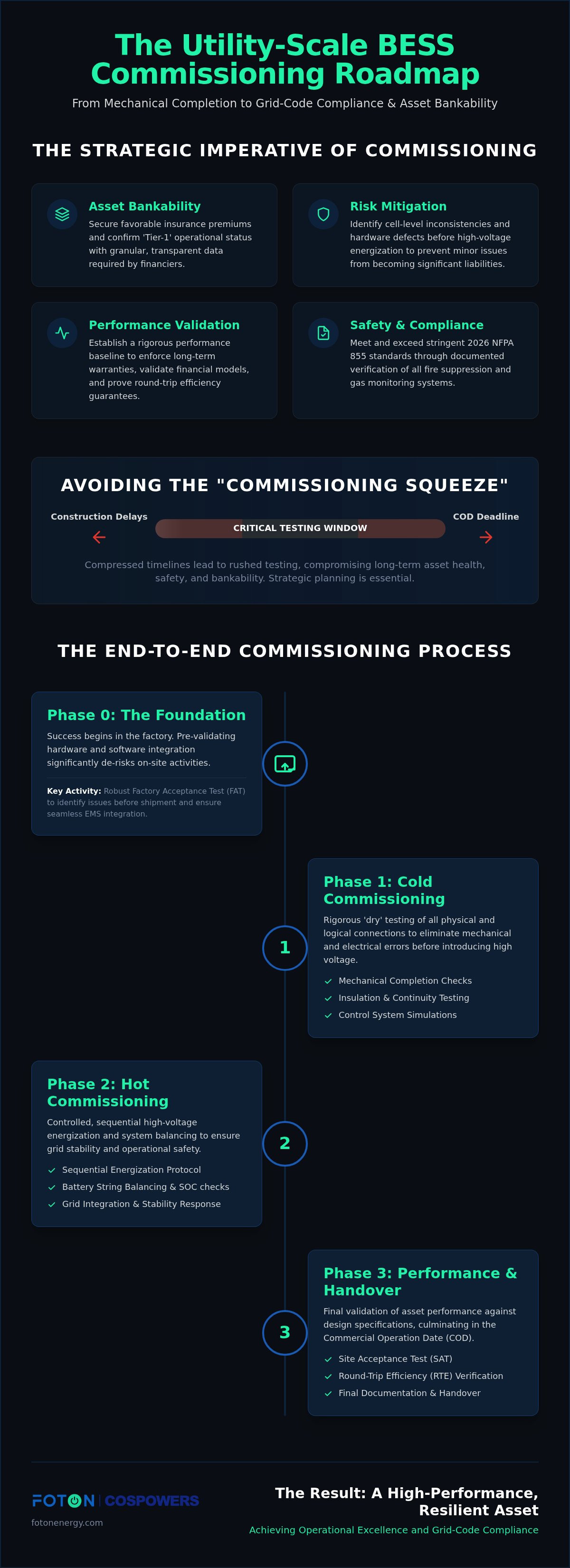
This phase is critical for long-term warranty enforcement and protecting the project's financial model. Without a rigorous baseline established during commissioning, proving capacity degradation or thermal management failures later in the asset's life becomes an uphill battle. For projects utilizing Lithium Iron Phosphate (LFP) chemistry, which accounts for nearly 95% of new awards, precision in initial balancing directly impacts cycle life and long-term ROI. We must align the goals of the EPC, developer, and integrator early to avoid the "commissioning squeeze." This occurs when construction delays lead to rushed testing that compromises safety and long-term asset health.
Commissioning as a Risk Mitigation Tool
Early-stage testing serves as your first line of defense against manufacturing defects that could lead to operational failures. By identifying cell-level inconsistencies or communication errors before full-scale operation, you prevent minor issues from escalating into significant liabilities. This process establishes the essential performance baseline for utility-scale battery storage plants, providing the data needed to satisfy 2026 NFPA 855 safety standards. Documented verification of fire suppression and gas monitoring systems doesn't just ensure safety; it actively reduces insurance premiums by proving the project's resilience through technical proof points.
The Link Between Procurement and Commissioning
Success on-site begins in the factory. Sourcing hardware from a Tier-1 energy storage manufacturer significantly simplifies the utility scale BESS commissioning process by ensuring high-quality standards from the start. A robust Factory Acceptance Test (FAT) serves as a critical dress rehearsal, identifying hardware and software incompatibilities before containers ever reach the field. When you partner with a provider like Foton Energy, you leverage 30+ years of manufacturing heritage through Cospowers. This ensures that the integration between the AI-driven EMS and the physical battery strings is seamless, optimized, and ready for immediate grid connection upon arrival.
Phase 1: Pre-Commissioning and Cold Commissioning Protocols
Cold commissioning represents the critical period where we verify every physical and logical connection before introducing high-voltage energy. It's a period of rigorous "dry" testing designed to eliminate mechanical and electrical errors without the risk of thermal events. The utility scale BESS commissioning process formally begins here, moving from simple visual inspections to complex multi-level simulations. We model system behavior under various grid conditions, ensuring the controls react correctly to simulated voltage dips or frequency deviations. This proactive approach ensures that the life-cycle process for a successful utility BESS project remains on schedule and within safety margins.
Mechanical completion is the first milestone. We don't just confirm installation; we verify that every torque specification on high-voltage busbars is met and that all thermal management seals are airtight. Following this, we perform insulation resistance (meggering) and continuity testing for both DC and AC circuits. These tests are vital for identifying manufacturing or installation defects, such as pinched cables or moisture ingress, before the system is energized. By establishing these baselines now, we create a "gold standard" for the asset's physical integrity that will support warranty claims for years to come.
Site Readiness and Safety Architecture
Safety isn't just a policy; it's a built-in architecture. We establish restricted access zones and enforce strict NFPA 70E safety protocols to protect the commissioning team. Every fire suppression system and gas detection sensor must be operational and triggered to verify they communicate correctly with the central emergency stop (E-stop) circuit. Environmental controls, including HVAC and liquid cooling systems, undergo pressure tests and flow verification to ensure they can handle the thermal loads of full-scale operation. Ensuring these systems are flawless is a hallmark of high-performance utility-scale storage deployments.
Communication and Control Network Verification
The system's intelligence must be fully active before the battery strings are brought online. We test the fiber optic backbone and internal SCADA network to ensure zero-latency communication across the site. It's essential that the AI driven energy management system can "see" and command every individual module, rack, and string. Verification protocols include:
- Mapping every Modbus or DNP3 point to the central controller for accurate data reporting.
- Testing remote monitoring links to ensure real-time visibility for off-site operators.
- Validating cybersecurity firewalls and encryption protocols to protect against external threats.
Once the control network is stable and the physical installation is verified, the project is ready to transition from a static construction site to a dynamic energy asset.
Phase 2: Hot Commissioning and Grid Integration
Hot commissioning is the definitive transition to live operations. It's a high-stakes environment where theoretical models meet physical reality. We initiate sequential energization starting from the substation, moving through the transformers, and finally reaching the Power Conversion System (PCS). This methodical approach minimizes the risk of catastrophic failures during the first introduction of high-voltage current. Once the AC side is stable, we focus on battery string balancing and initial state-of-charge (SOC) synchronization. Ensuring every rack is aligned is vital for preventing circulating currents that could damage the cells.
Integrating an AI-driven EMS during this stage provides a distinct advantage often overlooked in standard guides. This intelligent layer doesn't just log data; it actively optimizes energy flows and thermal responses during the first discharge cycles. By leveraging EPRI's Energy Storage Commissioning Guide, we ensure that every step of the utility scale BESS commissioning process aligns with global best practices for grid integration. This is where bi-directional power flow is verified, confirming the system's ability to both absorb and inject power with precision.
Grid-Code Compliance and Stability Testing
Compliance is the non-negotiable gateway to the grid. We execute rigorous Frequency Control Ancillary Services (FCAS) response tests to prove the system can stabilize the network within milliseconds. Voltage regulation and reactive power (VAR) support are verified to ensure the project contributes to local grid strength rather than taxing it. For 2026 projects, meeting AEMO standards for harmonic distortion and fault ride-through is mandatory. These tests confirm the BESS remains connected and supportive during external grid disturbances, fulfilling the requirements for a stable, bankable asset.
Thermal Management Performance Under Load
Thermal stability is the cornerstone of LFP safety. We monitor high-density storage modules during high-rate discharge cycles to verify that cooling systems maintain optimal temperatures. Stress testing the system at maximum rated power allows us to identify potential "hot spots" in the battery containers or PCS cabinets before they become operational hazards. This phase validates the Tier-1 safety architecture provided by partners like Foton Energy and Cospowers, ensuring the thermal management system effectively protects the battery's cycle life under real-world load conditions.
Achieving COD: Performance Verification and Handover
Reaching the Commercial Operation Date (COD) is the ultimate milestone for any energy storage project. The final Site Acceptance Test (SAT) provides the definitive proof of system performance. It is the moment where every preceding phase of the utility scale BESS commissioning process is validated under the eyes of owners, insurers, and grid operators. During this stage, we verify usable energy capacity and discharge duration at the Point of Interconnection (POI). We must calculate Round-Trip Efficiency (RTE) against the project's original financial model to ensure the asset is capable of meeting its specific revenue targets. Success is documented. It is not assumed.
This phase also formalizes the transition from the EPC team to the Asset Management team. A smooth handover is essential for maintaining the operational continuity required for high-performance infrastructure. It ensures that the technical nuances discovered during the "hot" phase are properly communicated to the long-term operators. This transition marks the shift from a construction mindset to an optimization mindset. If you are looking to ensure your project hits these critical milestones on schedule, our team provides the utility-scale storage expertise needed for a seamless transition.
KPIs for Successful COD
We focus on several critical KPIs to secure a successful COD and satisfy grid requirements. Response time latency is measured from the moment a grid signal is received to the actual point of power delivery, confirming the system can participate in high-value frequency regulation markets. We also scrutinize auxiliary power consumption with precision. Parasitic loads from thermal management and control systems must stay within specified limits to protect the project's net energy yield and overall profitability. Finally, a trial operation period verifies system availability and uptime guarantees, proving the BESS is ready for two decades of reliable service.
Data Documentation and Digital Twins
The digital legacy of the project begins at the point of handover. We create an "as-built" digital twin that mirrors the physical system, enabling predictive maintenance and advanced failure analysis for the life of the asset. A comprehensive commissioning report is finalized for financiers and the BESS engineering consulting services team. This document acts as the technical foundation for the asset's bankability, providing proof of compliance with all safety and performance standards. We also configure the long-term performance monitoring dashboard, ensuring that AI-driven optimization remains active and visible to all stakeholders.
The Foton Advantage: Engineering Excellence and Tier-1 Hardware
Navigating the final hurdles of a utility-scale project requires more than just high-quality cells. It demands a partner who understands the intricate interplay between hardware, software, and grid-code compliance. Foton Energy’s strategic partnership with Cospowers provides exactly this level of integrated assurance. Leveraging over 30 years of manufacturing heritage, we deliver Tier-1 hardware designed for superior site reliability and long-term asset performance. Whether you're deploying traditional LFP or pioneering Sodium-ion modular architectures, our systems are pre-engineered to simplify the utility scale BESS commissioning process. This foundation of stability is what makes a project truly bankable in the eyes of global investors.
We provide end-to-end support that extends far beyond the delivery of hardware. Our involvement begins with rigorous feasibility studies and continues through every phase of final grid connection. This holistic approach ensures that the "Tier-1" promise isn't just a label but a physical reality verified during operation. By aligning our manufacturing expertise with your project’s specific goals, we create a resilient energy asset capable of thriving in the complex markets of 2026. Our focus remains on intelligence, optimization, and the long-term value of your infrastructure investment.
Expert Consulting for Complex Deployments
Specialized engineering support is critical for navigating the labyrinth of local grid regulations. Foton acts as the essential bridge between global hardware standards and local EPC execution, ensuring that technical specifications translate perfectly to site-specific requirements. This technical oversight is essential for maintaining the integrity of the utility scale BESS commissioning process when facing complex multi-stakeholder requirements. By utilizing our pre-integrated safety architecture, partners have successfully reduced commissioning timelines by 15%. This efficiency allows assets to reach their Commercial Operation Date faster while bypassing the typical delays associated with on-site system troubleshooting.
Global Reach, Local Expertise
Our commitment to excellence supports utility projects in Australia and across more than 70 countries. We understand that the "hot" phase of commissioning is the most critical window for project success. That’s why we provide direct access to Tier-1 technical support during this period, ensuring that any integration challenges are resolved with professional confidence. This global reach, combined with deep local expertise, makes Foton a trusted partner for large-scale infrastructure investments. We invite you to participate in a shared vision of a cleaner, more resilient energy future backed by proven manufacturing stability.
Contact Foton Energy for expert commissioning support on your next utility project.
Securing the Future of Grid-Scale Infrastructure
A successful Commercial Operation Date is the result of technical precision and strategic foresight. By mastering the utility scale BESS commissioning process, you move beyond basic installation to create a high-performance asset that financiers and insurers can trust. This journey requires the perfect alignment of Tier-1 hardware, AI-driven energy management, and rigorous grid-code compliance. We've shown how pre-integrated safety architectures and meticulous verification turn technical complexity into long-term operational stability.
Choosing the right partner is the final piece of the bankability puzzle. At Foton Energy, we combine our strategic partnership with Cospowers and 30+ years of manufacturing heritage with global engineering consulting expertise to ensure your project exceeds 2026 standards. Our AI-driven thermal and energy management systems are designed to protect your investment for decades. We're ready to help you navigate the complexities of modern energy storage with confidence and professional assurance.
Partner with Foton for Bankable Utility-Scale BESS
Let's build a more resilient and sustainable energy landscape together.
Frequently Asked Questions
What is the typical duration of the utility-scale BESS commissioning process?
The physical site phase of the utility scale BESS commissioning process typically spans four to eight weeks. This timeline assumes that mechanical completion is already finalized and that grid connection infrastructure is ready for energization. Larger or more complex multi-GWh projects may require up to three months to complete the full sequence of hot commissioning and performance verification tests.
What are the most common causes of delays during BESS commissioning?
Delays often stem from construction bottlenecks, such as incomplete civil works or late arrival of balance-of-plant components. Complex grid-code compliance negotiations and communication failures between the EMS and the local SCADA network are also frequent culprits. Rushed timelines frequently lead to overlooked torque specs or thermal seals, which then require time-consuming remediation during the high-pressure energization phase.
How does BESS commissioning differ for Sodium-ion vs. LFP batteries?
The primary differences lie in the thermal management thresholds and voltage-response curves unique to each chemistry. Sodium-ion cells often exhibit different discharge characteristics at low temperatures, requiring specific adjustments to the EMS control logic during the initial state-of-charge synchronization. While LFP remains the industry standard for cycle life, Sodium-ion commissioning focuses heavily on validating performance across a wider operating temperature window without compromising safety.
What safety certifications are required for utility-scale commissioning in 2026?
Utility-scale projects in 2026 must adhere to the latest NFPA 855 standards, which mandate rigorous fire testing and gas monitoring protocols. UL 9540 certification for the integrated system and UL 9540A for thermal runaway propagation are standard requirements for securing permits and insurance coverage. Global projects must also meet IEC 62933 standards to ensure electrical energy storage systems comply with international safety and performance benchmarks.
Does the EPC or the system integrator lead the commissioning process?
The system integrator or a specialized technical consultant typically leads the battery-specific testing, while the EPC oversees the broader site infrastructure and civil works. It's a collaborative effort where the EPC ensures site readiness and the integrator manages the delicate logic of the utility scale BESS commissioning process. Clear division of responsibility is essential to avoid the commissioning squeeze and ensure all performance guarantees are physically verified.
What role does the Energy Management System (EMS) play in grid-code compliance?
The Energy Management System (EMS) acts as the brain that translates grid signals into precise power responses. It manages the millisecond-level reaction times required for Frequency Control Ancillary Services (FCAS) and ensures the system maintains voltage stability. Without a sophisticated, AI-driven EMS, a BESS cannot reliably meet the harmonic distortion and fault ride-through requirements mandated by modern grid operators.
What happens if a BESS fails to meet its RTE guarantee during commissioning?
Failure to meet Round-Trip Efficiency (RTE) targets usually triggers a mandatory remediation period where the integrator must identify and fix parasitic loads or software inefficiencies. If the system still falls short after re-testing, contractual liquidated damages are often applied to compensate for the lost revenue over the asset's life. In extreme cases, the project may require additional battery strings to meet the promised energy capacity and discharge duration.
Is remote commissioning possible for utility-scale energy storage projects?
Remote commissioning is possible for software configuration, control logic updates, and initial communication mapping, but high-voltage energization requires a physical presence. On-site teams are essential for verifying mechanical torque, inspecting thermal management seals, and ensuring safety protocols are followed during live testing. A hybrid approach is the most efficient model, combining remote technical support with experienced on-site engineering teams for maximum safety and speed.


