

In 2026, the viability of a remote power system is no longer defined by the sheer volume of energy stored, but by the strategic intelligence governing its distribution. You understand the immense pressure of maintaining grid stability in isolated regions where logistics are costly and renewable variability is high. Implementing effective microgrid solutions for remote communities requires more than just hardware; it demands a synergy between rugged durability and predictive optimization to overcome the traditional barriers of high CAPEX and technical complexity.
This guide provides the framework to deploy Tier-1 battery hardware and AI-driven management systems that transform remote energy projects into bankable assets. We'll examine how to integrate high-performance storage with sophisticated Energy Management Systems (EMS) to secure long-term ROI and operational resilience. From navigating site logistics to mastering complex renewable integration, you'll learn the exact technical architecture needed to build a stable, future-ready infrastructure for both industrial and community applications.
Key Takeaways
- Identify the optimal hardware for your specific environment by evaluating the high cycle life of LFP against the cold-climate resilience of emerging Sodium-Ion technology.
- Transition from passive monitoring to predictive AI-driven Energy Management Systems to maximize battery state-of-health and secure consistent project ROI.
- Master the engineering requirements for bankability to ensure your microgrid solutions for remote communities meet rigorous international certifications and grid code compliance.
- Leverage modular, containerized BESS architectures to reduce the logistical complexity and high CAPEX typically associated with remote site deployment.
- Utilize Tier-1 manufacturing heritage and DNV-verified standards to bridge the gap between initial project design and reliable, long-term operational performance.
The Evolution of Microgrid Solutions for Remote Communities in 2026
By 2026, the energy landscape has shifted from experimental pilots to mature, bankable infrastructure. Microgrid solutions for remote communities are now the cornerstone of global efforts to provide reliable power where traditional utility grids can't reach. At the center of this shift is the Microgrid Energy Storage System (MESS). It's no longer just a passive backup. Instead, it's a sophisticated engine of grid-forming capability. Microgrid Energy Storage Systems (MESS) function as the intelligent core of decentralized networks, balancing variable renewable energy with sub-millisecond response times to maintain frequency and voltage stability.
As global fuel prices remain volatile and the demand for rural electrification surges, the economic argument for these systems has strengthened. We're seeing a transition from passive backup systems to active grid participants. These systems don't just sit idle; they engage in revenue stacking by providing frequency regulation and peak shaving. Understanding what a microgrid is in this modern context requires looking at it as a self-sufficient ecosystem rather than a temporary fix. This evolution is driven by the urgent need for stability in regions where the cost of diesel logistics can make traditional power generation prohibitively expensive.
Strategic Objectives: Resilience and Energy Independence
Resilience and energy independence are the primary drivers for remote deployments. For many isolated regions, a break in the fuel supply chain means a total blackout. Modern microgrid solutions for remote communities provide a vital buffer against these disruptions. By integrating high-penetration solar and wind, operators can drastically reduce their reliance on expensive, shipped-in fossil fuels. This doesn't just lower operational costs. It ensures that essential services remain online regardless of external logistics or utility grid failures, allowing communities to thrive on their own terms.
Storage as a Strategic Asset for Remote Industry
Industrial operations like mining and large-scale agriculture face unique challenges in weak grid areas. In 2026, storage is viewed as a strategic asset rather than an expense. It allows these facilities to reduce heavy demand charges by discharging during peak loads. Additionally, high-performance storage enhances power quality, protecting sensitive industrial machinery from voltage sags common in remote locations. These systems also play a critical role in meeting 2026 ESG mandates, providing a documented path toward decarbonization for remote industrial sites while maintaining operational excellence.
LFP vs. Sodium-Ion: Hardware Selection for Remote Microgrids
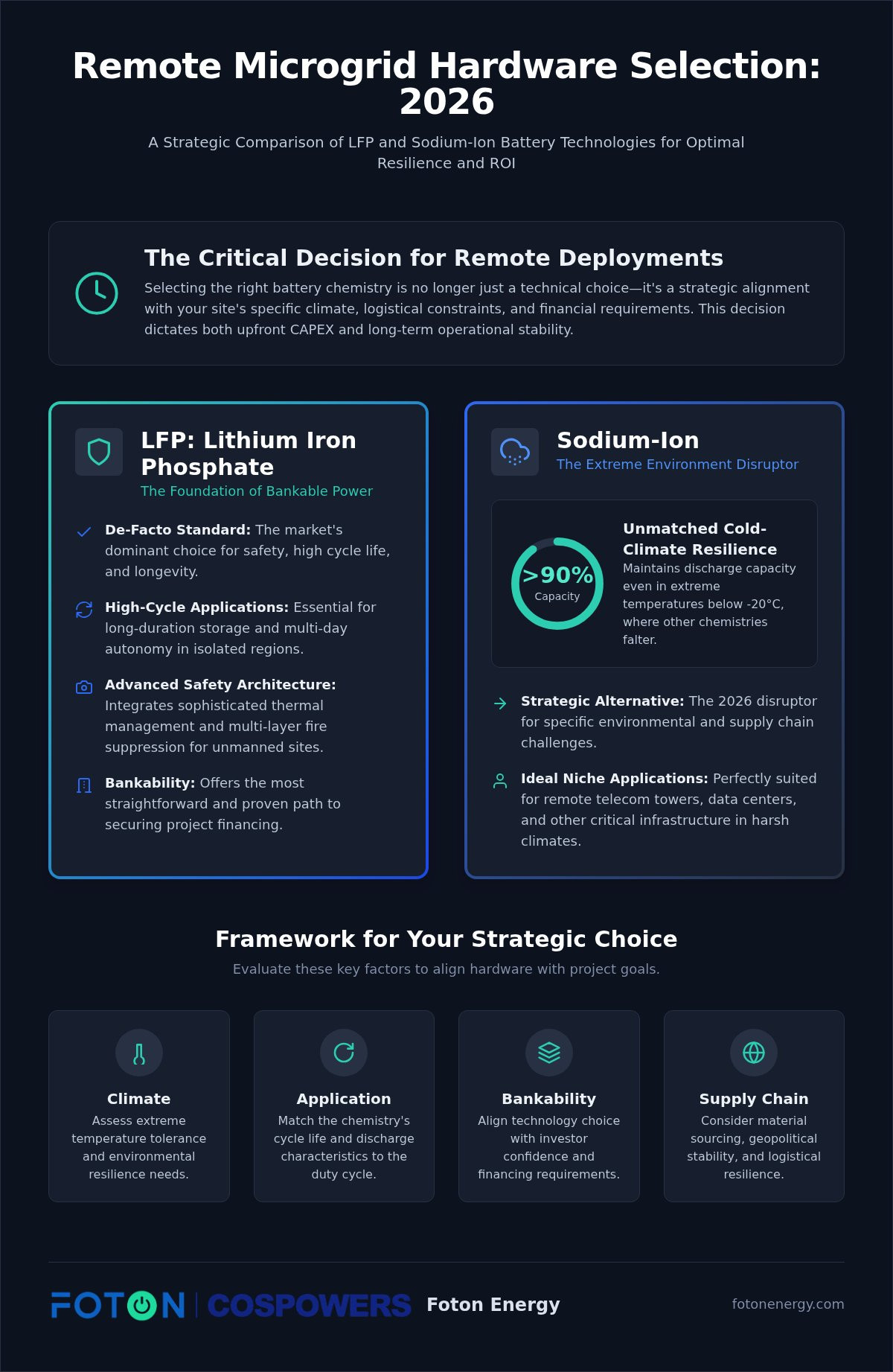
Selecting the right hardware is a critical decision for microgrid solutions for remote communities, as the choice dictates both upfront CAPEX and long-term operational stability. In 2026, the market has bifurcated into two primary chemistries. Lithium Iron Phosphate (LFP) remains the dominant choice for high-cycle applications, while Sodium-Ion has emerged as a strategic alternative for specific environmental and supply chain challenges. Balancing energy density against cost-effectiveness is no longer a simple calculation; it's a strategic alignment with the site's specific climate and logistical constraints.
LFP: The Foundation of Bankable Remote Power
LFP is the de-facto standard for safety and longevity. High-capacity LFP battery modules are essential for long-duration storage requirements, providing the stability needed for multi-day autonomy in isolated regions. Tier-1 LFP systems integrate advanced thermal management and multi-layer fire suppression architecture to ensure safety in unmanned sites. For developers, this chemistry offers the most straightforward path to financing. You can explore how these modules integrate into larger commercial and industrial BESS solutions to meet rigorous performance standards.
Sodium-Ion: Advantages for Remote and Extreme Environments
Sodium-Ion technology has become the 2026 disruptor, particularly for remote telecom and data center microgrids. Its primary advantage lies in its environmental tolerance and supply chain resilience. Sodium-ion batteries maintain over 90% of their discharge capacity even in extreme temperatures below -20°C, a threshold where traditional chemistries often require energy-intensive heating. This makes them ideal for Arctic or high-altitude installations where auxiliary heating loads would otherwise drain the system. If you're evaluating these technologies for an upcoming project, our C&I BESS platforms offer a tested foundation for both chemistries.
- Supply Chain Stability: Sodium is abundant and avoids the geopolitical volatility associated with Lithium procurement.
- Safety Profile: Inherent stability during transport and storage reduces logistical risks for remote site delivery.
- Performance: Superior power delivery in cold climates compared to LFP.
Understanding the 2026 state of sodium-ion battery commercial availability is vital for planning your procurement timelines. As you design microgrid solutions for remote communities, consider which chemistry aligns with your environmental risks and financial goals. Integrating these hardware choices with intelligent management is the next step in securing your investment's future.
AI-Driven EMS: Optimizing Remote Microgrid Stability
Intelligence is the differentiator. In 2026, relying on reactive SCADA systems is no longer sufficient for complex microgrid solutions for remote communities. While SCADA provides visibility, AI-driven Energy Management Systems (EMS) provide foresight. These systems leverage predictive analytics to anticipate load spikes and weather-driven renewable fluctuations before they destabilize the network. By providing synthetic inertia through grid-forming inverters, storage assets can now mimic the rotational inertia of traditional synchronous generators, ensuring frequency stability in islanded remote networks.
AI algorithms dynamically analyze market signals and load profiles to optimize revenue stacking by precisely balancing energy arbitrage with high-value frequency regulation services. This level of optimization ensures that every kilowatt-hour is utilized where it provides the highest financial or operational value. Real-time monitoring extends beyond simple voltage checks; it provides granular insights into the battery state-of-health (SOH), allowing operators to adjust discharge depths to preserve the long-term integrity of the asset.
Smart Energy Management for Remote Utilities
Deploying AI driven energy management systems allows for seamless coordination of diverse distributed energy resources (DER). This intelligence is vital for reducing O&M costs through predictive maintenance. By detecting early signs of cell degradation or thermal anomalies, the system can trigger alerts before a minor issue becomes a catastrophic failure. In high-demand environments like remote data centers, dynamic load balancing ensures that critical infrastructure stays powered without overstressing the battery modules.
Distributed Energy Resource Management (DERMS)
Effective DERMS coordination is what makes continuous operation possible in islanded mode. When solar or wind production drops suddenly, the BESS must step in instantly to maintain frequency. These systems also provide essential black-start capabilities, allowing a microgrid to restart from a total blackout without needing an external grid connection. By optimizing microgrids with distributed energy resources, remote operators can achieve a level of autonomy that was previously impossible. This integration transforms microgrid solutions for remote communities from simple backup setups into resilient, self-healing power ecosystems.
Designing for Bankability: Engineering and Compliance for Remote Projects
Bankability isn't a vague concept; it's a rigorous technical requirement that dictates whether a project moves past the boardroom. In 2026, lenders demand Tier-1 hardware backed by DNV verification and warranties that span the full operational lifecycle of the asset. Microgrid solutions for remote communities often face harsh environmental stressors, making these certifications even more critical for risk mitigation. Achieving grid code compliance in isolated jurisdictions requires a deep understanding of local technical standards, which can vary significantly between regions. Safety architecture is the foundation of this trust. Systems must strictly adhere to NFPA 855 standards, utilizing integrated fire suppression and robust physical enclosures to protect the investment in areas where emergency response times are naturally extended. A comprehensive BESS project feasibility study requires a detailed load profile analysis, a site-specific environmental impact assessment, and a rigorous multi-year financial model.
Technical Consulting and Project Feasibility
Precise system sizing is the first step toward long-term financial viability. You must balance power (kW) to handle peak demand spikes against energy (kWh) for sustained duration, ensuring the system matches the unique load profile of the remote community or industrial site. High-density storage containers require sophisticated thermal management to prevent cell degradation in extreme climates, whether they're deployed in desert heat or arctic cold. Engineering for long-term performance guarantees means planning for future augmentation and maintenance from the first day of design. If you're ready to move from initial concept to a bankable deployment, our team provides expert Engineering Consulting to streamline the process.
Tier-1 Certifications and Global Standards
Financiers prioritize Tier-1 energy storage manufacturers like Cospowers because of their 30-year manufacturing heritage and proven stability in the global market. These manufacturers provide the "bankable" assurance needed to unlock large-scale infrastructure capital for complex projects. Navigating UL 9540A and IEC 62933 standards is non-negotiable for global remote deployments. These certifications prove the system's safety and performance under rigorous stress testing. Utilizing specialized BESS engineering consulting services is the most efficient way to secure project financing. It ensures your microgrid solutions for remote communities are built to global standards while remaining tailored to local needs, bridging the gap between high-level manufacturing and on-site engineering excellence.
Scaling Remote Infrastructure with Foton’s Tier-1 BESS Solutions
Scaling infrastructure in isolated regions requires more than just high-quality hardware; it demands a partner who can bridge the gap between Tier-1 manufacturing and local site realities. Foton Energy serves as this strategic link. We provide exclusive access to Cospowers Tier-1 energy storage systems, ensuring that your microgrid solutions for remote communities are built on a foundation of 30 years of industrial heritage. Our containerized systems are engineered for rapid modular deployment. This approach minimizes on-site construction time and logistical complexity, which are the primary drivers of cost in remote project execution. By utilizing pre-integrated enclosures, we ensure that every component is tested and certified before it even reaches the site.
Wholesale Procurement and Global Supply Chain
Direct procurement through Foton Energy provides a significant advantage for EPCs and developers. You gain access to a global marketing network spanning 70 countries, ensuring that both LFP and Sodium-ion technologies are available when and where you need them. Whether your project requires high-cycle LFP for long-duration storage or Sodium-ion for extreme cold-climate performance, our supply chain is optimized for reliability and bankability. We don't just sell components; we provide a stable procurement path for large-scale infrastructure. For those managing larger portfolios, our guide on utility-scale BESS procurement offers deeper insights into securing grid-scale assets in 2026.
End-to-End Partnership: From Feasibility to Commissioning
Success in remote environments depends on technical support that extends from initial design to final commissioning. The Foton Energy Channel Partner Programme is designed to empower resellers, EPCs, and developers with the technical depth required for complex installations. We've proven our architecture in remote telecom towers, isolated data centers, and rural utility networks across the globe. Our engineering team works collaboratively with you to design bespoke microgrid solutions for remote communities that meet specific local grid codes and performance requirements. We invite you to consult with our engineering team to review your bespoke architecture needs. Contact us today to begin a professional BESS project feasibility study and secure the future of your remote energy infrastructure.
Securing the Future of Remote Power Infrastructure
The transition toward intelligent, decentralized energy isn't just a trend; it's a strategic necessity for regional stability. By 2026, the success of microgrid solutions for remote communities depends on the seamless integration of predictive AI management and high-performance, Tier-1 hardware. You've seen how hardware selection, whether utilizing LFP for longevity or Sodium-ion for extreme climates, must align with specific environmental realities to ensure long-term ROI. Bankability is no longer a hurdle when projects are built on rigorous international certifications and a 30-year manufacturing heritage.
As the exclusive strategic partner of Cospowers, Foton provides the Tier-1 manufacturing status and AI-driven safety architecture required to de-risk large-scale infrastructure investments. We're ready to serve as your guiding hand, moving your project from a feasibility study to a fully commissioned, high-performance asset. It's time to transform grid instability into a resilient, self-sustaining power ecosystem that drives progress in the world's most isolated regions. Let's build a more reliable future together.
Partner with Foton for Bankable Microgrid Infrastructure
Frequently Asked Questions
What are the primary components of a microgrid energy storage system for remote areas?
The core components include high-performance battery modules, bi-directional power conversion systems (PCS), and an intelligent Energy Management System (EMS). These systems also integrate advanced thermal management, fire suppression enclosures, and specialized switchgear for islanded operation. In remote regions, these components must be ruggedized to withstand logistical stressors and extreme environmental conditions, ensuring the microgrid remains a reliable heart for decentralized power networks that don't rely on traditional utility infrastructure.
How does a microgrid BESS differ from a standard backup battery?
A microgrid BESS functions as an active grid-forming asset, whereas a standard backup battery typically remains passive until a power failure occurs. Modern microgrid solutions for remote communities utilize storage to provide synthetic inertia and frequency regulation, mimicking the stability of traditional generators. This active participation allows the system to balance variable renewable inputs in real-time, maintaining a stable voltage and frequency profile that a simple backup system can't replicate.
Can Sodium-ion batteries be used in remote microgrids in 2026?
Sodium-ion batteries are a commercially viable alternative in 2026, particularly for environments where temperatures drop below -20°C. They offer superior discharge characteristics in extreme cold compared to LFP, making them ideal for high-altitude or arctic remote sites. Beyond climate performance, Sodium-ion provides a strategic hedge against lithium supply chain volatility, offering developers a bankable path toward long-term energy independence in isolated jurisdictions where fuel logistics are often difficult.
What is the expected ROI for a commercial microgrid energy storage project in a remote community?
ROI for remote microgrid projects is primarily driven by the displacement of expensive diesel fuel and the reduction of peak demand charges. By utilizing AI-driven optimization, operators can also access revenue stacking through energy arbitrage and frequency regulation services. While specific figures depend on local fuel logistics and load profiles, the financial viability of microgrid solutions for remote communities is strengthened by the 2026 shift toward high-efficiency, Tier-1 hardware.
How do AI-driven EMS improve the lifespan of remote microgrid batteries?
AI-driven EMS significantly extends battery lifespan by utilizing predictive analytics to manage discharge depths and thermal cycles. Instead of following rigid schedules, the AI adjusts operations based on forecasted renewable generation and load demand, preventing unnecessary cell stress. This proactive approach includes granular state-of-health (SOH) monitoring, allowing operators to detect and rectify minor anomalies before they lead to permanent degradation or system failure in unmanned, isolated locations.
Is grid-code compliance mandatory for islanded remote microgrids?
Grid-code compliance is mandatory for islanded microgrids to ensure the safety of connected equipment and personnel. Even without a permanent utility connection, following standards like IEEE 1547 or local equivalents prevents damaging voltage fluctuations and ensures frequency stability. Maintaining compliance also simplifies the process if the remote site eventually integrates with a larger regional grid, protecting the long-term bankability and technical relevance of the infrastructure investment you've made.
What safety standards should I look for in containerized energy storage for remote sites?
When selecting containerized storage for remote applications, you should prioritize systems that meet NFPA 855 and UL 9540A safety standards. These certifications ensure the system has undergone rigorous large-scale fire testing and includes integrated suppression technology. In remote sites where emergency response is delayed, multi-layer safety architecture, including aerosol suppression and gas detection, is a critical requirement for protecting both the local community and the high-value energy assets.
How does Foton support EPC partners in remote BESS procurement?
Foton serves as a strategic bridge for EPC partners by providing direct access to Cospowers Tier-1 manufacturing heritage. We support the procurement process through specialized engineering consulting, ensuring that system sizing matches the specific load profiles of remote communities. Our partners benefit from a global marketing network that streamlines logistics and provides the technical documentation necessary to secure project financing, from initial feasibility studies to final commissioning on-site.


