

Relying on diesel generators for remote power is no longer just an environmental burden; in 2026, it's a strategic financial risk. This dependency jeopardizes the long-term viability of off-grid infrastructure. You understand that the high costs of fuel logistics and frequent outages in harsh conditions create a cycle of instability that makes securing infrastructure financing a constant challenge. By integrating advanced microgrid solutions for remote communities, developers can finally break this cycle and transition toward a more stable operational model. We're entering an era where energy independence is backed by Tier-1 manufacturing heritage and sophisticated, grid-ready intelligence.
Discover how Tier-1 battery energy storage and AI-driven management systems are transforming remote community power from diesel dependency to bankable, clean resilience. This 2026 guide examines the critical role of sodium-ion technology in sub-zero environments and the latest NEC 2026 standards for power control systems. You'll learn how to leverage international certifications and grid-code compliance to build assets that are as commercially stable as they are technically advanced. We'll outline the path to achieving a lower levelized cost of energy through system longevity and strategic procurement, ensuring your infrastructure remains a foundational pillar of progress for decades.
Key Takeaways
- Transition from volatile diesel dependency to stable, self-sufficient energy ecosystems by implementing advanced microgrid solutions for remote communities.
- Harness AI-driven Energy Management Systems (EMS) to solve renewable intermittency and ensure real-time grid stability in isolated environments.
- Evaluate the technical advantages of Sodium-Ion versus LFP chemistries to maintain high performance in extreme temperatures and harsh operational conditions.
- Secure infrastructure financing by utilizing Tier-1 certified hardware and DNV-verified standards that guarantee long-term asset bankability.
- Align with strategic procurement partners to bridge the gap between global manufacturing heritage and local engineering requirements for faster project deployment.
The Evolution of Remote Power: Why Microgrid Solutions are Essential in 2026
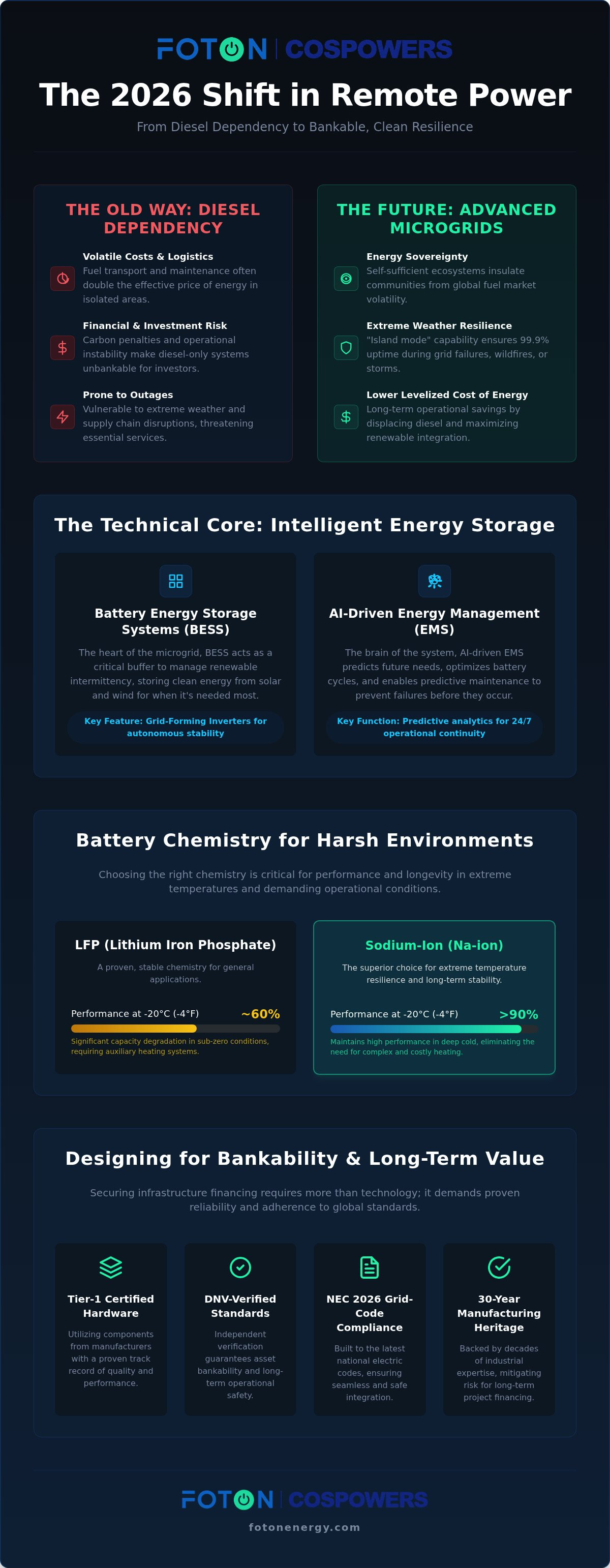
Remote power has moved beyond the era of simple backup generators. Today, a Microgrid represents a sophisticated, self-sufficient energy ecosystem that integrates diverse distributed energy resources (DERs) like solar, wind, and battery storage. In 2026, these systems aren't just secondary failsafes; they've become the primary grid architecture for off-grid regions. This shift fosters true energy sovereignty, allowing communities to build localized wealth while insulating themselves from the volatility of global fuel markets. We're seeing a fundamental transition where localized power serves as the backbone of industrial resilience and community growth.
Breaking the Diesel Cycle
Diesel dependency is a financial anchor. The hidden costs of fuel transport, specialized maintenance, and storage logistics often double the effective price of energy in isolated areas. Additionally, 2026 environmental mandates and carbon penalties have made diesel-only systems increasingly unbankable for large-scale investors. Developers now prioritize the "Diesel Displacement Ratio" as a key metric for ROI. This ratio measures the percentage of traditional fuel consumption replaced by renewable integration, directly correlating to long-term operational savings. By implementing advanced microgrid solutions for remote communities, operators can eliminate the logistical nightmare of fuel delivery while meeting strict sustainability standards.
Resilience Against Extreme Weather
Extreme weather is no longer an anomaly. Modern microgrids utilize "island mode" to maintain power during regional grid failures or environmental catastrophes. By employing modular architecture, these systems allow for rapid deployment and scalability in disaster-prone areas. Remote communities in high-risk zones are now maintaining 99.9% uptime despite wildfires or severe storms. This level of reliability turns energy from a vulnerability into a strategic advantage, supporting essential services when they're needed most. A well-designed microgrid ensures that even when the surrounding infrastructure fails, the community's heart remains powered and operational.
The transition to these systems is driven by a need for "bankable" assurance. Investors require systems backed by a 30-year manufacturing heritage and international certifications to mitigate risk. As we move further into 2026, the focus has shifted from mere survival to optimized performance. This evolution ensures that remote communities don't just have power, but have a stable, scalable, and clean foundation for future development.
The Technical Core: Battery Energy Storage (BESS) and AI-Driven EMS
Battery Energy Storage Systems (BESS) are the definitive heart of modern microgrid solutions for remote communities. They act as the critical buffer that manages the inherent intermittency of solar and wind resources. Without high-performance storage, renewable energy is often wasted or unreliable during peak demand. Grid-forming inverters represent a massive leap forward in this space; they enable these systems to set their own frequency and voltage autonomously. This capability is essential for stable operation in "island mode," providing a level of reliability that traditional backup systems simply can't match.
Intelligence is the differentiator in 2026. AI-driven EMS platforms don't just react to current conditions; they predict future needs. By analyzing historical load data and real-time inputs, these systems identify cell degradation before a failure occurs. This predictive maintenance is vital for remote sites where logistical delays for spare parts are common. Implementing a Robust Design of Microgrids ensures that these technical layers work in harmony to maintain 24/7 operational continuity. We focus on building systems that are both technologically advanced and commercially stable.
Intelligent Energy Management Systems (EMS)
Modern AI driven energy management systems are the brains behind the battery. They optimize charge and discharge cycles based on sophisticated load forecasting. By integrating local weather data, the EMS can preemptively manage community energy demand, ensuring the system is prepared for cloudy days or sudden usage spikes. These advancements are what make microgrid solutions for remote communities truly resilient. Remote monitoring capabilities also reduce the need for expensive on-site technical visits, allowing engineering teams to troubleshoot issues from thousands of kilometers away with precision.
Thermal Management and Safety Architecture
Environment is the greatest challenge for remote hardware. Batteries in extreme desert heat or arctic sub-zero temperatures require active thermal management to maintain longevity. Liquid cooling and integrated heating elements ensure the cells stay within their optimal operating window, preventing premature capacity loss. Safety is equally paramount in high-density storage. Units now feature integrated fire suppression systems that meet stringent international standards. Modular BESS containers simplify the entire process. They're designed for easy transport via sea, rail, or truck, making installation in isolated regions significantly more efficient. If you're planning a deployment in a challenging climate, consulting with a technical partner can help you select the right architecture for your specific needs.
Chemistry Comparison: LFP vs. Sodium-Ion for Remote Environments
Selecting the right battery chemistry is a pivotal decision for the long-term viability of off-grid infrastructure. While Lithium Iron Phosphate (LFP) remains the established industry standard, Sodium-Ion (Na-ion) has emerged in 2026 as a formidable alternative for specific environmental profiles. According to the U.S. Department of Energy on Microgrids, reliability and resilience are the primary drivers for system adoption, and the choice of storage chemistry directly impacts these outcomes. For developers deploying microgrid solutions for remote communities, the trade-off between energy density and temperature tolerance dictates the project's bankability and operational success.
LFP: The Workhorse of Utility-Scale Storage
Lithium Iron Phosphate continues to dominate the market due to its exceptional safety profile and high cycle life. When analyzing utility scale battery energy storage systems using LFP modules, we see gravimetric energy densities reaching up to 200 Wh/kg. This density, combined with a cycle life that often exceeds 6,000 cycles, is critical for 15-year community projects that require consistent daily cycling. Financiers favor LFP because it's a proven asset with decades of operational data. It offers a "bankable" assurance that the system will perform as modeled throughout its entire lifecycle, even under heavy industrial loads. In temperate climates where high energy density is the priority, LFP remains the superior choice for maximizing return on investment.
Sodium-Ion: Solving the Temperature Challenge
Sodium-Ion technology represents a significant breakthrough for extreme environments. The sodium-ion battery commercial availability in 2026 has changed the landscape for remote highlands and arctic regions. While LFP capacity can drop to 70% in freezing conditions, Na-ion cells maintain over 90% capacity retention at -20°C. This makes them ideal for microgrid solutions for remote communities in sub-zero climates where traditional batteries would require energy-intensive heating systems. Beyond temperature tolerance, Na-ion offers a robust safety profile with lower thermal runaway risks compared to many traditional chemistries. By utilizing abundant sodium salts, these systems significantly reduce the industry's strategic reliance on critical minerals like lithium and cobalt, which are often subject to supply chain volatility and environmental concerns. This shift toward sodium-based chemistries provides a more sustainable and cost-efficient path for projects that don't require the absolute highest energy density but demand unwavering reliability in the face of nature's harshest elements.
Designing for Bankability: What EPCs and Financiers Must Know
Bankability is the cornerstone of successful infrastructure. For microgrid solutions for remote communities, it represents the difference between a funded project and a stranded asset. Financiers look for "bankable" assurance, which means every component must meet rigorous international standards and come from manufacturers with proven staying power. It's about reducing long-term risk through technical excellence and operational history. A project that lacks this foundation will struggle to secure private finance, regardless of its environmental benefits.
Tier-1 Manufacturing Heritage
In 2026, the definition of "Tier-1" has evolved to include financial stability, highly automated production lines, and robust global service networks. A manufacturer's heritage, such as the 30-year legacy of Cospowers, provides a critical safety net for investors. This extensive experience prevents catastrophic site failures by ensuring that cells and systems have undergone decades of iterative testing and refinement. Reliability is paramount when hardware is deployed thousands of kilometers from the nearest service hub. Warranty assurance is equally vital. Securing 10-20 year performance guarantees is only possible when the manufacturer has the balance sheet to back them. For remote communities, where maintenance logistics are complex, this reliability is non-negotiable and dictates the overall project risk profile.
Feasibility and Grid Integration
Professional engineering is the bridge between a conceptual design and a functional grid. Utilizing BESS engineering consulting services is essential for accurate system sizing and seamless integration of distributed energy resources (DERs). These services ensure that microgrid solutions for remote communities meet specific grid-code compliance requirements, even when operating in isolation or preparing for future interconnection. A checklist for technical due diligence should include DNV verification and adherence to international standards like UL and IEC. These certifications prove to insurers and lenders that the asset will perform as modeled throughout its entire lifecycle.
Technical support must be local and accessible. Global deployments require a steady, guiding hand that understands both the manufacturing source and the local regulatory landscape. This dual presence ensures that the system is not only built to standard but is also optimized for the specific challenges of the site. Achieving true bankability requires a holistic approach to design, procurement, and integration. If you're ready to secure your infrastructure investment, consult with our engineering team to ensure your project meets the highest global standards for bankability and performance.
The Foton & Cospowers Advantage for Remote Microgrids
Foton Energy stands as the exclusive strategic partner of Cospowers, a Tier-1 manufacturer with more than 30 years of manufacturing heritage. This partnership combines elite global manufacturing with Australian engineering excellence. We deliver microgrid solutions for remote communities that are both technically superior and commercially bankable. We streamline the supply chain through wholesale procurement, ensuring that developers access high-performance hardware without the logistical hurdles of international sourcing. Our global reach extends to over 70 countries, supporting resilient energy deployments that transform how isolated regions access power. We act as a critical link, ensuring that advanced technology is matched with local operational stability.
Integrated Hardware and Software Solutions
We provide a unified architecture by integrating Cospowers hardware with our Intelligent EMS for turnkey microgrids. This creates systems that manage everything from load balancing to predictive maintenance autonomously. Our custom thermal management systems are specifically engineered for the harshest remote climates. Whether your project faces sub-zero arctic conditions or extreme desert heat, our systems maintain optimal performance and longevity. Scalability remains a core feature of our design. We support everything from small community clusters to large-scale industrial microgrids, allowing your infrastructure to grow as community demand increases. This flexibility ensures that your investment remains relevant as the local economy evolves.
Strategic Partnership for EPCs
Resellers and installers require more than just hardware; they need a partner that ensures long-term project success. Foton supports EPCs by offering Tier-1 bankable hardware backed by rigorous international certifications and 30 years of proven experience. We offer end-to-end technical consulting, from initial feasibility studies to final system commissioning. Our team specializes in grid-code compliance and project optimization for commercial and industrial BESS solutions, ensuring every deployment meets the technical requirements of modern energy networks. This collaborative approach reduces project risk and accelerates the transition to clean, resilient power.
We invite you to leverage our manufacturing heritage and engineering expertise for your next development. Our goal is to provide the steady, guiding hand required for large-scale infrastructure success. Partner with Foton Energy for your next remote microgrid project.
Empowering the Future of Remote Energy
The transition toward sustainable infrastructure is no longer a visionary goal; it's a commercial necessity. By prioritizing microgrid solutions for remote communities, developers can replace volatile diesel logistics with bankable, high-performance assets. We've explored how AI-driven EMS and specialized chemistries like Sodium-ion provide the resilience needed for nature's harshest environments. Success in this evolving landscape requires more than just hardware. It demands a strategic alignment with proven manufacturing heritage and rigorous international safety standards that ensure long-term asset performance.
Foton Energy stands as the exclusive strategic partner of Cospowers, bringing a Tier-1 manufacturing heritage that dates back to 1993. With a global support network spanning over 70 countries, we provide the stability and technical expertise required for large-scale energy investments. Our collaborative approach ensures your project is optimized for both technical performance and financier approval. We're ready to help you navigate the complexities of grid-code compliance and system integration. It's time to build a cleaner, more independent future for off-grid regions.
Secure Tier-1 BESS Hardware for Your Remote Project
Frequently Asked Questions
What is a microgrid and how does it benefit remote communities?
A microgrid is a localized energy system that can operate independently from the main electrical grid. It integrates renewable sources like solar or wind with battery storage to provide a stable, clean power supply. This technology eliminates the logistical challenges and high costs associated with diesel fuel transport. Communities gain energy sovereignty, ensuring that essential services remain powered even during regional outages or severe weather events.
Is sodium-ion or LFP battery storage better for remote areas?
The choice depends on the specific environmental conditions and energy density requirements of the site. LFP is the established industry standard for high cycle life and proven bankability in temperate climates. However, Sodium-ion technology is superior for extreme cold, maintaining over 90% capacity retention at -20°C. Developers often select Sodium-ion for high-altitude or arctic regions where traditional batteries require significant energy for thermal management.
How much does it cost to install a microgrid for a small community?
Total investment for microgrid solutions for remote communities varies significantly based on load requirements, energy mix, and geographic isolation. Factors such as the distance for hardware transport and the complexity of local grid-code compliance influence the final project budget. While industry reports suggest LFP cell costs have stabilized in 2026, developers should focus on the levelized cost of energy (LCOE) and long-term operational savings rather than initial capital expenditure.
Can a microgrid completely replace diesel generators?
Modern systems are designed to achieve 100% renewable penetration, though many projects retain diesel as an emergency tertiary backup. Advanced grid-forming inverters allow microgrids to maintain frequency and voltage stability without a rotating generator. By optimizing the "Diesel Displacement Ratio," communities can transition from continuous diesel combustion to a model where generators only run during exceptionally rare periods of prolonged low renewable generation or system maintenance.
What is the typical lifespan of a remote microgrid BESS?
High-quality Tier-1 battery systems are typically engineered for a 15 to 20 year operational life. This longevity is largely determined by the cycle life of the cells, with LFP modules often exceeding 6,000 cycles at 80% depth of discharge. To ensure this lifespan, systems must include robust thermal management and be backed by an Intelligent EMS that prevents overcharging and monitors cell health in real-time to prevent premature degradation.
How do AI-driven EMS improve microgrid reliability?
AI-driven Energy Management Systems use predictive analytics to anticipate load changes and renewable fluctuations before they occur. By integrating local weather data, the software optimizes charge and discharge cycles to ensure maximum storage availability during peak demand. This intelligence also enables predictive maintenance, identifying potential cell issues remotely. This reduces the need for expensive on-site technical visits and prevents unplanned system outages in isolated regions where logistics are difficult.
Are there government incentives for remote microgrid projects in 2026?
Many jurisdictions offer strategic incentives to support the decarbonization of off-grid infrastructure. For example, projects in the United States may be eligible for expanded Investment Tax Credits (ITC) if they meet specific construction commencement deadlines. We recommend consulting with local energy authorities or specialized engineering consultants to identify current grants, tax credits, and low-interest financing programs available for microgrid solutions for remote communities in your specific region to maximize project bankability.
What safety standards should I look for in remote battery storage?
Reliability in isolated areas requires adherence to international safety certifications like UL 9540A and IEC 62619. These standards ensure the system has undergone rigorous testing for thermal runaway and fire suppression. Investors should also prioritize hardware with DNV verification, which provides a third-party assessment of technical bankability. Choosing Tier-1 manufacturers with a long heritage ensures that the safety architecture is based on decades of iterative testing and real-world performance data.


