

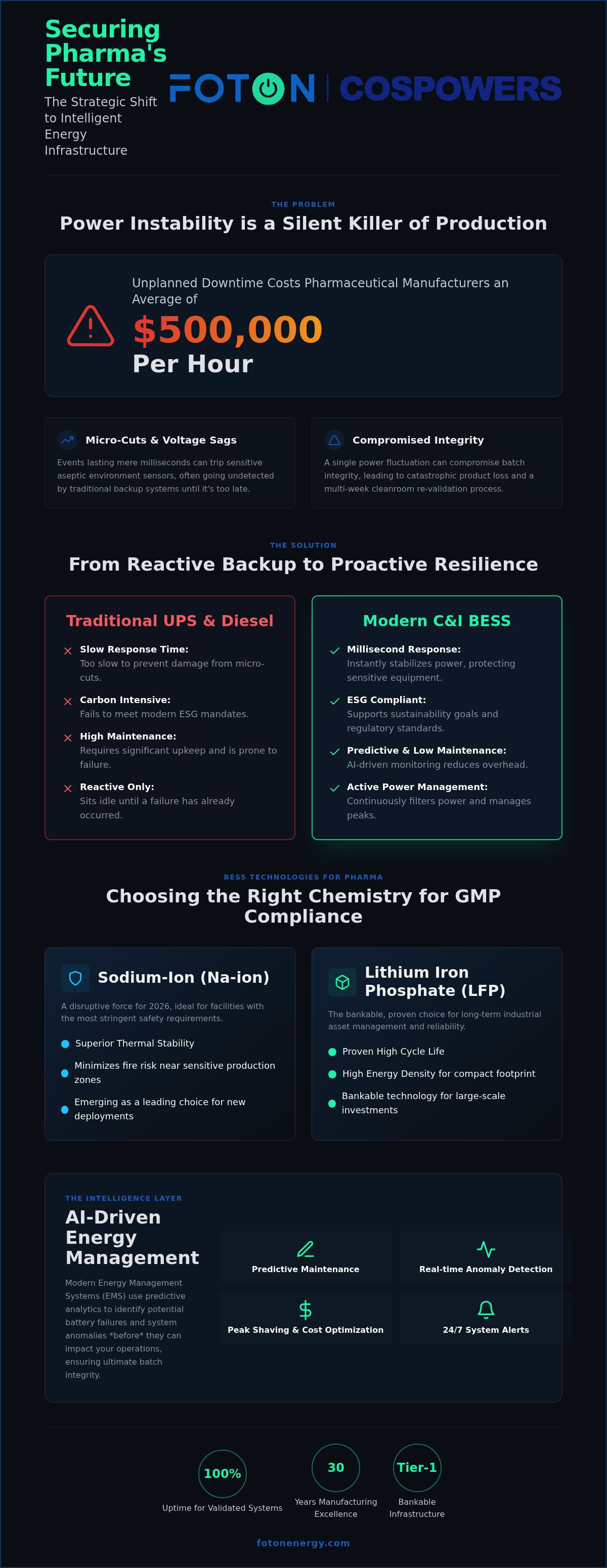
Unplanned downtime in pharmaceutical manufacturing now costs an average of $500,000 per hour. For global industry leaders, this figure represents more than just financial loss; it signifies the catastrophic compromise of batch integrity and the exhaustive, multi-week process of cleanroom re-validation. You understand that traditional UPS systems often lack the intelligence to manage the volatility of a modernizing grid. Securing reliable power for pharmaceutical manufacturing requires a strategic transition from reactive backup to a sophisticated, intelligent energy architecture.
Resilience demands a shift toward intelligent, bankable energy infrastructure. This article demonstrates how Tier-1 battery energy storage systems (BESS) and AI-driven management protect your operations from power instability while supporting critical ESG mandates. We'll examine the strategic integration of bankable Sodium-Ion and LFP technologies that meet rigorous global safety standards. By the end of this guide, you'll understand how to achieve 100% uptime for validated systems through high-performance infrastructure designed for the 2026 regulatory landscape. We invite you to explore these advancements in industrial resilience and operational excellence together.
Key Takeaways
- Identify how micro-cuts and voltage sags, often overlooked by traditional backup systems, trigger expensive cleanroom re-validations and regulatory delays.
- Evaluate the strategic shift from reactive UPS units to active C&I BESS architectures utilizing high-performance LFP and Sodium-Ion chemistries.
- Understand the role of Tier-1 manufacturing heritage in ensuring reliable power for pharmaceutical manufacturing while meeting stringent FDA and GMP compliance standards.
- Discover how AI-driven Energy Management Systems (EMS) utilize predictive maintenance to identify potential battery failures before they impact your batch integrity.
- Learn how leveraging 30 years of manufacturing excellence through strategic partnerships provides the bankable infrastructure required for large-scale pharmaceutical investments.
The High Cost of Power Instability in Pharmaceutical Manufacturing
Power quality is a silent killer of production efficiency. In 2026, industry benchmarks indicate that unplanned downtime in pharmaceutical manufacturing costs upwards of $500,000 per hour. While catastrophic grid failures are obvious, the more insidious threat comes from micro-cuts and voltage sags that last only milliseconds. These events are often too brief for traditional backup systems to detect, yet they're long enough to trip sensitive sensors in aseptic environments. You can't afford the risk of a "successful" backup that only kicks in after the cleanroom has already lost pressure.
Traditional diesel generators and lead-acid UPS systems often fail to meet 2026 ESG mandates and modern reliability standards. They're slow to respond, carbon-intensive, and require high maintenance. High-performance Battery Energy Storage System (BESS) technology provides the millisecond response times required to maintain validated process parameters. This transition transforms energy infrastructure from a reactive expense into a strategic manufacturing asset, ensuring your site remains operational through grid transients that would otherwise halt production.
Micro-cuts and Voltage Fluctuations in Aseptic Processing
Aseptic processing relies on precise environmental controls. Lab equipment operates within exceptionally narrow voltage windows, where even a 100ms interruption can force a complete cleanroom reset. These resets don't just stop the line; they trigger weeks of re-validation and testing to ensure sterility wasn't compromised. Implementing a high-speed BESS response ensures that validated systems remain stable, effectively shielding the facility from grid volatility. By stabilizing the power feed at the point of entry, you protect every bioreactor and centrifuge from the erratic behavior of an aging utility grid. For those looking to source high-quality medical equipment and supplies for their lab operations, click here.
Micro-cuts and Voltage Fluctuations in Aseptic Processing
Securing reliable power for pharmaceutical manufacturing is a financial imperative. When you calculate the ROI of an advanced energy storage system, the protection of a single high-value batch can justify the entire infrastructure investment. The financial ripple effect extends far beyond the initial loss. It impacts supply chain commitments, market reputation, and your ability to meet rigid delivery timelines. Documented power reliability also provides significant insurance and compliance benefits. It proves to regulators that your facility maintains total control over its manufacturing environment. This control is particularly critical for high-precision systems such as the industrial separation technology and centrifuges provided by Sacor, where power stability is essential for maintaining batch integrity. Adopting bankable technology like Sodium-Ion or LFP storage allows you to move toward 100% uptime, fulfilling both operational goals and global safety standards without the overhead of inefficient legacy systems.
Beyond UPS: Modern BESS Architectures for Pharma Facilities
Reactive UPS systems are no longer sufficient for the complexities of modern drug production. While traditional units sit idle until a failure occurs, active Commercial and Industrial (C&I) BESS solutions participate in the facility's energy ecosystem by managing peaks, filtering harmonic noise, and providing seamless bridge power. This proactive stance is essential for maintaining reliable power for pharmaceutical manufacturing, where even minor voltage fluctuations can affect sensitive batch telemetry and instrumentation. By utilizing an active architecture, you transform energy storage from a dormant backup into a foundational pillar of operational resilience.
LFP vs. Sodium-Ion: Safety and Performance in 2026
Sodium-Ion technology has emerged as a disruptive force in 2026, particularly for facilities with stringent safety requirements. Unlike traditional chemistries, Sodium-Ion offers superior thermal stability, making it ideal for placement near sensitive production zones where fire risk must be minimized. For long-term industrial asset management, LFP remains a bankable choice due to its proven cycle life and high energy density. Adherence to Current Good Manufacturing Practice (CGMP) regulations dictates that power systems must be as rigorously validated as the production equipment they support. You can explore a deeper technical breakdown in our strategic analysis of The 2026 State of Sodium-Ion Battery Commercial Availability.
Containerized and Modular Energy Storage Systems
Scalability is a core requirement for expanding pharma campuses that must adapt to changing market demands. Modular, containerized BESS units allow for rapid deployment without the need for extensive civil works or lengthy onsite assembly. These "plug-and-play" modules integrate seamlessly with existing building management systems (BMS), providing facility managers with real-time visibility into energy health and discharge capacity. Footprint efficiency is critical in space-constrained sites; therefore, high-density storage modules are engineered to deliver maximum capacity within a minimal physical profile. Modern architectures include several key technical features:
- Millisecond response times for instantaneous load transition during grid transients.
- Integrated liquid cooling systems to maintain optimal cell temperature and prolong asset life.
- Multi-stage fire suppression architectures that exceed global safety standards.
- Advanced power conversion systems (PCS) for superior power quality and load balancing.
Each module is designed to grow alongside your facility, allowing for incremental capacity increases without disrupting established workflows. Engaging in strategic engineering consulting can help you identify the optimal balance between footprint and capacity for your specific site, ensuring your infrastructure remains future-ready as production scales.
Regulatory Compliance and the 'Bankability' of Power Systems
Bankability represents the foundation of any large-scale infrastructure investment in the life sciences sector. For pharmaceutical financiers and stakeholders, a power system's value isn't just measured in kilowatt-hours; it's measured in risk mitigation and regulatory alignment. Achieving reliable power for pharmaceutical manufacturing requires hardware that carries the weight of international certifications and proven manufacturing heritage. Partnering with a Tier-1 manufacturer like Cospowers, which brings over 30 years of manufacturing excellence, ensures that the underlying technology is both commercially stable and technically superior. This level of bankability is essential for securing project financing and meeting the long-term operational goals of a high-performance facility. You can find more on these requirements in our Strategic Guide to Commercial and Industrial BESS Solutions.
Grid-code compliance and third-party verifications, such as DNV certification, serve as critical proof points for technical due diligence. These standards ensure that the BESS can interact safely with the utility grid while maintaining the strict power quality parameters required by aseptic production lines. When you invest in Tier-1 infrastructure, you aren't just buying batteries; you're securing a verified asset that satisfies the rigorous demands of both insurance providers and global health authorities.
Commissioning and Qualification (IQ/OQ/PQ) for BESS
Validation is the cornerstone of pharmaceutical quality. When integrating a BESS into a validated zone, the system must undergo rigorous Installation Qualification (IQ), Operational Qualification (OQ), and Performance Qualification (PQ). This process documents that the energy storage architecture operates exactly as specified under all conditions, providing the data integrity required for regulatory audits. Our BESS engineering consulting services play a critical role in this stage, bridging the gap between electrical engineering and pharmaceutical compliance. We help you design a system that doesn't just provide backup but serves as a fully qualified component of your GMP environment.
Safety Architecture and Fire Suppression Standards
Designing for zero-risk is a non-negotiable standard in industrial battery systems. Modern BESS units utilize sophisticated safety architectures that include multi-stage fire suppression and real-time thermal monitoring at the cell level. Navigating international safety certifications is vital for ensuring long-term asset security and personnel safety. By focusing on Tier-1 hardware procurement, you ensure that every module meets the highest global standards for durability and safety. This methodical approach protects your high-value production assets, creating a resilient ecosystem that thrives under the scrutiny of both internal safety officers and external regulatory bodies. It's about building a partnership grounded in operational excellence and shared strategic ambition.
AI-Driven Energy Management: The Future of Pharma Resilience
Intelligence is the new standard for industrial resilience. While traditional power systems operate as passive safeguards, AI-driven energy management transforms your infrastructure into a proactive, self-optimizing asset. Securing reliable power for pharmaceutical manufacturing no longer depends on manual inspections or reactive maintenance. Instead, advanced AI algorithms analyze thousands of data points per second to identify potential battery cell failures long before they impact production. This predictive capability ensures that your facility remains inspection-ready and operational, even during periods of grid instability. By monitoring power quality in real-time, the system can detect subtle harmonic distortions and load imbalances, correcting them instantaneously to protect sensitive lab telemetry. You can explore the technical architecture behind these systems in our AI Driven Energy Management Systems: The 2026 Strategic Guide.
Intelligent EMS for Mission-Critical Reliability
A sophisticated Energy Management System (EMS) acts as the brain of your BESS. It manages complex variables, such as thermal loads and state-of-charge (SoC), to maximize battery longevity and performance. AI-driven EMS platforms automate grid-interactive functions, allowing for seamless participation in frequency regulation or demand response programs without compromising the primary backup mandate for validated zones. This level of automation is essential for maintaining strict compliance standards, as the system provides comprehensive data logging and automated reporting for regulatory audits. It's a methodical approach to power quality that balances efficiency with absolute security, ensuring that every batch remains within its validated environmental parameters regardless of external grid behavior.
Behind-the-Meter Optimization for Cost Recovery
Strategic energy management allows you to transition power infrastructure from a necessary cost center to a revenue optimizer. By utilizing peak shaving, your facility can discharge stored energy during periods of high tariff demand, significantly reducing demand charges and offsetting the initial BESS investment. This "behind-the-meter" optimization is particularly effective when integrated with on-site renewables like solar or wind. The AI orchestrates the flow of energy to ensure that your most critical loads are always prioritized, while excess capacity is used to lower operational overhead. It's a visionary pragmatism that aligns financial performance with technical excellence, creating a sustainable energy ecosystem that provides reliable power for pharmaceutical manufacturing while meeting both ESG mandates and bottom-line requirements. To begin optimizing your facility's energy profile, contact us for a technical BESS consultation today.
Strategic Partnership: Foton Energy and Cospowers for Pharma
Success in large-scale infrastructure depends on the strength of your partners. Foton Energy serves as the strategic link between world-class manufacturing and local operational requirements. By leveraging Cospowers' 30 years of manufacturing excellence, we provide the foundational stability required for mission-critical pharmaceutical sites. This partnership offers a single point of contact for end-to-end solutions, moving from initial technical consulting to wholesale hardware procurement. You gain access to a global industrial ecosystem while benefiting from local Australian engineering expertise that understands specific grid-code compliance and site-specific challenges.
Our collaborative model ensures that every project is grounded in visionary pragmatism. We don't just supply hardware; we integrate bankable technology into your existing industrial ecosystem. This approach minimizes the friction of procurement and installation, ensuring that your transition to advanced energy storage is both efficient and commercially stable. It's about providing reliable power for pharmaceutical manufacturing through a steady, guiding hand that prioritizes operational excellence and long-term value.
The Foton Advantage: Tier-1 Bankability
Bankability isn't just a financial term; it's a promise of performance and durability. We provide exclusive access to Cospowers’ advanced LFP and Sodium-Ion modules, ensuring your facility utilizes the most stable and efficient chemistries available in 2026. Our professional engineering services handle the complexities of site compliance and grid integration, allowing your team to focus on production rather than power quality. We take a collaborative approach to long-term asset management, ensuring that your BESS remains a high-performance asset throughout its lifecycle. This methodical oversight protects your investment and guarantees that your infrastructure meets the highest global safety standards.
Next Steps for Facility Leaders
Moving from legacy power systems to modern energy storage requires a methodical evaluation. The transition from inefficient VRLA batteries and diesel generators to Sodium-Ion or LFP technology is a strategic upgrade that pays dividends in both reliability and ESG compliance. We recommend beginning with a comprehensive site-specific power quality and resilience audit. This feasibility study identifies your facility's unique load profiles and vulnerabilities, providing a data-driven roadmap for BESS integration. It's time to replace the invisible risk of power instability with the bankable assurance of a Tier-1 system.
Contact Foton Energy today to schedule your strategic BESS integration and procurement session. Our team is ready to help you navigate the complexities of procurement, ensuring you secure the right hardware for your specific manufacturing needs. Let's build a future where batch integrity is never compromised by grid volatility. Explore our engineering consulting services to start your resilience journey.
Securing the Future of Pharmaceutical Infrastructure
Resilience is a strategic imperative. Operational excellence in the pharmaceutical sector begins with an uncompromising approach to energy stability. You've discovered how the shift from reactive backup to intelligent energy storage protects batch integrity and simplifies regulatory compliance. By leveraging Tier-1 bankability and sophisticated AI-driven safety architecture, your facility can eliminate the invisible risk of power quality fluctuations while optimizing operational costs. This strategic alignment between technical innovation and manufacturing heritage ensures that your site remains a foundational pillar of the global industrial ecosystem.
Technical expertise drives stability. Securing reliable power for pharmaceutical manufacturing requires a partner who understands the high stakes of aseptic production. Foton Energy brings over 30 years of manufacturing heritage to every project as the exclusive global partner of Cospowers; we ensure your infrastructure is both technologically advanced and commercially stable. We invite you to participate in a shared vision for a more resilient, high-performance future. It's time to transform your energy architecture into a strategic asset that guarantees total uptime for your most critical validated systems.
Partner with Foton Energy for Your Pharma Power Resilience Strategy
Frequently Asked Questions
Why is Sodium-Ion battery storage safer for pharmaceutical plants than Lithium-Ion?
Sodium-Ion technology offers superior thermal stability compared to traditional Lithium-Ion chemistries, making it significantly less prone to thermal runaway in high-density industrial environments. This enhanced safety profile is critical for pharmaceutical facilities where sensitive production zones require minimized fire risks. Because Sodium-Ion modules can operate safely across a wider temperature range, they provide a secure energy storage solution for aseptic environments without the extreme cooling requirements of older technologies.
How does a BESS prevent cleanroom resets during minor grid fluctuations?
A BESS prevents resets by providing millisecond response times that bridge the gap during voltage sags or micro-cuts. These brief interruptions often trigger pressure loss or sensor trips in cleanrooms, but high-speed power conversion systems stabilize the feed before equipment detects a fault. This instantaneous transition ensures reliable power for pharmaceutical manufacturing, shielding validated systems from grid transients that traditional backup systems are often too slow to catch.
Can an industrial BESS replace a diesel generator for pharma backup?
An industrial BESS can replace or augment diesel generators, offering a cleaner and faster-responding alternative for mission-critical sites. While generators take several seconds to start, a BESS provides immediate power, eliminating the "dark start" period that compromises batch integrity. For facilities targeting ESG mandates, transitioning to battery storage reduces carbon footprints and eliminates the maintenance complexities of fuel storage while providing the same level of long-duration resilience.
What are the regulatory requirements for power reliability in drug manufacturing?
Regulatory bodies like the FDA require that manufacturing processes remain under total control, which includes maintaining validated environmental parameters at all times. Current Good Manufacturing Practice (CGMP) standards dictate that any power interruption affecting product quality must be documented and investigated. While specific grid-code compliance varies by region, the overarching requirement is that power systems must be as rigorously qualified as production hardware to ensure consistent batch safety.
How long is the typical ROI for a C&I BESS in the pharmaceutical sector?
The ROI for a C&I BESS in the pharmaceutical sector is often realized through the prevention of a single high-value batch loss. While specific financial timelines depend on site energy costs, the system pays for itself by avoiding the multi-million dollar costs of cleanroom re-validation and production delays. Additionally, using BESS for peak shaving and demand charge reduction provides ongoing operational savings that shorten the payback period for large-scale infrastructure investments.
What is the difference between a traditional UPS and a modern BESS?
Traditional UPS systems are reactive, sitting idle until a power failure occurs, whereas a modern BESS is an active participant in the facility's energy management. Modern systems offer much higher energy density, longer cycle lives, and the ability to perform grid-interactive functions like peak shaving. While a UPS provides short-term bridge power, a BESS functions as a strategic manufacturing asset that optimizes energy costs while ensuring reliable power for pharmaceutical manufacturing.
Does Foton Energy provide technical consulting for BESS project feasibility?
Yes, Foton Energy provides comprehensive engineering consulting for project feasibility, system design, and grid-code compliance. Our professional services cover the entire project lifecycle, from initial power quality audits to technical support during commissioning. We help facility leaders evaluate the transition from legacy systems to advanced Sodium-Ion or LFP architectures, ensuring that every deployment is grounded in technical excellence and meets the stringent safety standards of the pharmaceutical industry.
How does AI-driven EMS improve the reliability of pharmaceutical power systems?
AI-driven Energy Management Systems (EMS) improve reliability through predictive maintenance and real-time optimization of battery health. By analyzing cell-level telemetry, the AI identifies potential failures before they occur, allowing for proactive servicing without downtime. The system also automates load balancing and thermal management, ensuring the BESS operates at peak efficiency. This intelligent oversight provides a level of operational security that manual monitoring cannot match, protecting critical batches from unforeseen infrastructure failures.


