

What if the primary obstacle to your EV infrastructure rollout isn't vehicle adoption, but a grid connection date scheduled years into the future? Many operators today face the harsh reality of high-power charging, where prohibitive substation upgrade costs and utility fees erode every cent of potential profit. Utilizing BESS for EV charging station demand management allows you to reclaim control over your site's power profile and project timelines. You likely recognize that waiting for the grid to catch up is no longer a viable business strategy, and securing your network requires a strategic shift in how energy is managed at the edge.
This article demonstrates how Battery Energy Storage Systems serve as a "virtual transformer," allowing you to deploy 350kW+ ultra-fast chargers on existing, limited grid connections. You'll discover how to bypass multi-year utility delays, eliminate peak demand charges through intelligent peak shaving, and secure the bankability of your infrastructure. We'll preview the 2026 strategic framework, covering everything from AI-driven energy management to the commercial emergence of Sodium-ion technology, providing a clear roadmap to a resilient, high-performance charging ecosystem. Let's align your infrastructure with the demands of tomorrow.
Key Takeaways
- Learn how to bypass multi-year grid upgrade timelines by using BESS as a virtual transformer to support 350kW+ ultra-fast charging infrastructure.
- Master the mechanics of BESS for EV charging station demand management, utilizing peak shaving and load balancing to eliminate prohibitive utility fees.
- Evaluate the strategic shift between LFP and Sodium-ion chemistries to ensure your hardware meets the high-cycle demands of modern charging hubs.
- Discover how AI-driven energy management systems transition your site from static load limits to predictive, real-time optimization and grid resilience.
- Secure your infrastructure investment by leveraging Tier-1 bankability and end-to-end engineering consulting to ensure long-term operational excellence.
The Grid Constraint Crisis: Why BESS is Essential for EV Charging in 2026
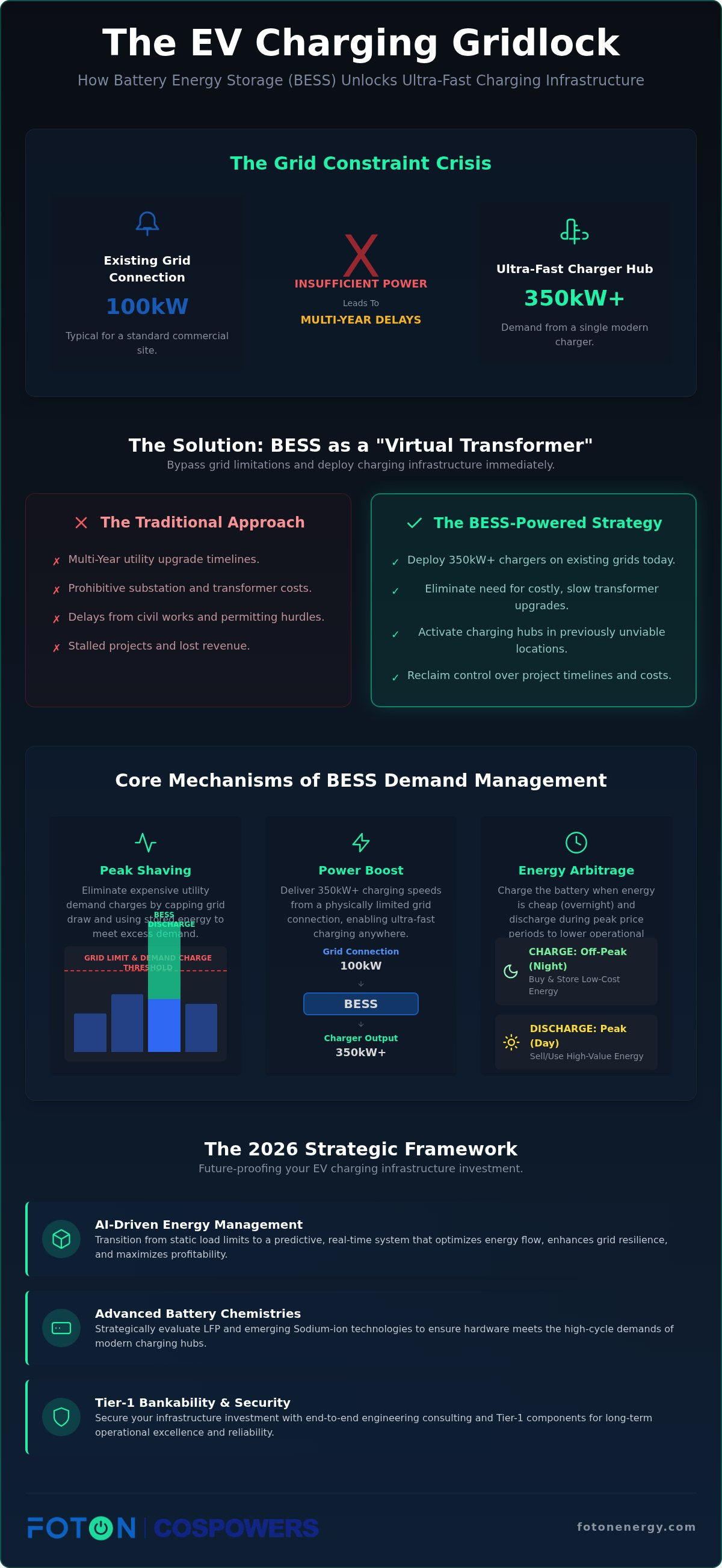
Legacy electricity grids weren't designed for the concentrated, high-power surges required by modern ultra-fast chargers. While a standard commercial site might operate on a modest 100kW connection, a single 350kW ultra-fast charger exceeds that capacity the moment it's activated. This physical limitation creates a bottleneck that stalls infrastructure projects for years as developers wait for utility providers to approve substation upgrades. Integrating a Battery Energy Storage System (BESS) allows operators to decouple their charging capacity from the grid's immediate supply limits. By acting as a high-performance power buffer, the system stores energy during periods of low activity and discharges it when multiple vehicles plug in simultaneously.
The economic argument for this technology is equally compelling. For C&I charging sites, utility demand charges often represent the largest portion of the monthly operational expenditure, sometimes exceeding the cost of the energy itself. Strategic use of BESS for EV charging station demand management enables grid deferral, allowing you to deploy high-performance sites today without waiting for multi-million dollar transformer replacements. It transforms the grid from a rigid barrier into a flexible partner in your infrastructure rollout.
Understanding Demand Charges and Peak Loads
Simultaneous charging of several electric vehicles creates massive peak spikes that trigger expensive utility penalties. These charges are typically calculated based on the single highest point of consumption within a billing cycle, meaning one busy hour can destroy a month's profit. BESS technology mitigates this by capping the site's energy draw to a pre-set threshold, automatically discharging stored power to meet any demand that exceeds that limit. Demand management in EV infrastructure is the strategic orchestration of energy flows to ensure site-wide consumption never exceeds the local grid's capacity or triggers expensive peak tariffs.
The Virtual Transformer Concept
A BESS effectively mimics the capacity of a physical transformer upgrade without the associated civil works, permitting hurdles, or utility delays. This "virtual transformer" approach allows developers to activate new charging hubs in locations where the utility provider cannot immediately guarantee high-voltage access. By reducing the required grid connection size for new hubs, you can secure sites that were previously considered unviable. This strategy is particularly vital for fleet operators who must electrify depots on aggressive timelines. Instead of waiting years for a grid expansion, you can install containerized storage to provide the necessary power boost for a full fleet of heavy-duty vehicles. It's a pragmatic, bankable solution for immediate scalability in a constrained market.
Core Mechanisms of BESS Demand Management for Charging Stations
Effective BESS for EV charging station demand management relies on the precise orchestration of hardware and software. Systems must react in milliseconds to fluctuating charger loads while maintaining grid stability. Implementing advanced control and optimization algorithms ensures that energy is dispatched exactly when needed, preventing expensive peak excursions. This technical depth allows operators to move beyond simple backup and into active asset management. It's about creating a responsive energy ecosystem that anticipates demand rather than just reacting to it.
Power Boost and Energy Arbitrage represent the dual pillars of operational flexibility. Power Boost allows a site to deliver 350kW charging speeds even when the grid connection is physically capped at a lower level. Meanwhile, Energy Arbitrage leverages time-of-use tariffs to charge the battery when energy is cheapest, typically overnight, and discharge it during high-traffic afternoon periods. This strategy directly lowers the levelized cost of energy for the entire site. It also provides a hedge against fluctuating spot market prices, ensuring that your operational margins remain stable even during volatility. By buying low and discharging high, you turn a storage asset into a revenue optimizer.
Peak Shaving vs. Load Shifting
While often used interchangeably, these tactics serve different financial goals. Peak shaving is a tactical maneuver designed to smooth out brief, intense spikes in demand that trigger high utility fees. Load shifting is a broader strategy that moves bulk energy consumption from one time period to another. High-performance commercial and industrial BESS solutions provide the depth required to execute both simultaneously. Financial modeling in high-tariff regions shows that capping demand just 20% below peak can result in five-figure annual savings for a medium-sized charging hub. This makes the ROI of these operations exceptionally clear for project financiers who prioritize steady, predictable cash flows.
Integrating On-Site Renewables
Modern charging hubs are increasingly required to meet Net Zero mandates, making on-site solar integration a strategic necessity. BESS acts as the central hub for this ecosystem, capturing solar oversupply during the day to power evening charging sessions. This maximizes self-consumption and reduces reliance on the external grid, insulating the site from market volatility. It's a critical step toward achieving true energy independence. Our team can help you evaluate your site's potential through strategic engineering consulting to ensure your renewable integration is both efficient and bankable.
Hardware Selection: LFP vs. Sodium-Ion for High-Cycling EV Hubs
Selecting the appropriate battery chemistry is a decision that dictates the long-term bankability of your infrastructure. Unlike standard stationary storage, BESS for EV charging station demand management requires hardware capable of handling high C-rates and frequent daily cycling. When multiple vehicles plug in at 350kW, the system must discharge rapidly and recover quickly to maintain site readiness. Round-Trip Efficiency (RTE) becomes a critical metric here; even a minor percentage difference in efficiency can translate into significant operational losses over a ten-year horizon. You need a solution that balances energy density with the thermal resilience required for rapid, back-to-back charging events.
Sodium-Ion: The 2026 Strategic Advantage
Sodium-ion has transitioned from a theoretical alternative to a commercially viable asset. Analyzing sodium-ion battery commercial availability reveals its growing role in EV infrastructure, highlighted by the first commercial sale of a Cospowers 100kW / 200kWh Sodium-ion BESS in August 2026. This technology offers potentially 30% lower production costs compared to traditional LFP, making it an attractive option for large-scale rollouts. Its superior thermal stability and non-flammable properties provide a high safety profile for public-facing sites. For operators in colder climates, Sodium-ion maintains its discharge rates in temperatures where LFP performance typically drops, ensuring consistent service regardless of the season.
LFP Reliability and Tier-1 Standards
Lithium Iron Phosphate (LFP) remains the global benchmark for high-density energy storage due to its proven track record and competitive pricing. In 2025, average LFP pack prices reached $81/kWh, offering a cost-effective path for high-cycling fleet depots. However, the hardware is only as reliable as its manufacturing heritage. Foton’s partnership with Cospowers leverages 30+ years of manufacturing experience to deliver Tier-1 modules that meet rigorous UL 9540 and NFPA 855 standards. These systems feature advanced safety architecture, including module-level fire suppression and liquid cooling, to prevent thermal runaway. For heavy-use environments like bus depots or highway hubs, this level of engineering ensures that your BESS for EV charging station demand management remains an elite, dependable pillar of your energy strategy. It's about securing an asset that performs under pressure while maintaining the highest safety certifications.
Optimizing EV Hubs with AI-Driven Energy Management Systems
Static load management is no longer sufficient for the complexities of 2026 infrastructure. Modern hubs require a transition to dynamic, AI-optimized systems that treat energy as a fluid, manageable asset. Effective BESS for EV charging station demand management leverages high-speed data processing to balance local supply with fluctuating charger loads in real time. This intelligence creates a closed-loop communication system between the BESS, the EV chargers, and the utility grid, ensuring that power delivery remains seamless. It also assists operators in meeting the 99% reliability standards increasingly required for rapid charging networks by predicting and preventing system overloads before they occur.
Beyond local site balance, these systems enable automated participation in Frequency Control Ancillary Services (FCAS). This transforms a cost-saving tool into a proactive revenue generator by allowing the BESS to respond to grid frequency fluctuations in milliseconds. It's a strategic shift from simple peak shaving to comprehensive energy orchestration. By integrating hardware and software into a single, cohesive architecture, you ensure your site remains both resilient and profitable.
Predictive Analytics for Charging Spikes
Machine learning models now analyze historical charging data alongside external variables like local traffic patterns and weather forecasts to predict design-day loads with high accuracy. This allows the system to pre-charge the BESS during low-cost windows in anticipation of a high-demand event. "By precisely modulating discharge depths and current rates based on forecasted demand, AI-driven algorithms extend asset longevity while significantly reducing the thermal stress that typically accelerates battery degradation." This predictive approach ensures that the site is always prepared for peak traffic without over-relying on the grid or incurring unnecessary demand charges.
Revenue Stacking Opportunities
A sophisticated AI driven energy management system enables revenue stacking by combining demand management with various grid services. During periods of grid instability, your charging station can function as a Microgrid asset, providing backup power or demand response capacity to the utility provider. This multi-layered approach is essential for large-scale fleet orchestration, where energy must be balanced across multiple depots to ensure operational uptime. It moves the site from a passive consumer to an active, bankable participant in the larger energy market. Partner with our specialists to design an EMS architecture that maximizes your infrastructure's long-term value.
Future-Proofing EV Infrastructure: The Foton-Cospowers Strategic Advantage
Stability in the energy storage market is defined by the depth of a manufacturer's heritage. As infrastructure requirements shift toward ultra-fast charging, the reliability of your hardware becomes the primary driver of project longevity. Foton Energy bridges the gap between visionary infrastructure goals and operational reality through an exclusive global strategic partnership with Cospowers. This alliance leverages 30+ years of manufacturing experience to deliver systems that are both technologically advanced and commercially stable. Utilizing BESS for EV charging station demand management requires more than just a battery; it demands a resilient supply chain and Tier-1 hardware that has been proven through decades of rigorous testing and international certifications.
Our approach centers on providing a steady, guiding hand for large-scale investors and technical partners. We offer end-to-end BESS engineering consulting services that span from initial feasibility studies to final commissioning. This ensures that every component, from the cell chemistry to the intelligent EMS, is strategically aligned with the site's specific power profile. By securing Tier-1 hardware procurement, we eliminate the supply chain risks that often stall ambitious EV rollouts. It's a bankable assurance that protects your capital investment against the volatility of an evolving market.
Bankability and EPC Partnership
Financiers and insurers prioritize assets that meet global standards for safety and performance. Project bankability depends on hardware being DNV-verified and compliant with the latest UL 9540 and NFPA 855 standards. We support EPCs and developers by ensuring every installation meets these strict grid-code requirements, reducing project risk from the outset. Our safety-first architecture includes advanced thermal management and module-level fire suppression, providing the security necessary for large-scale infrastructure financing. This collaborative model allows our partners to deploy BESS for EV charging station demand management with total professional confidence.
Scaling for the 2030 Mandates
The transition from light passenger vehicles to heavy-duty electric trucking will require a massive increase in site-wide power capacity. Modular, containerized architecture allows operators to scale their storage capacity as demand grows without needing to redesign the entire site. This future-ready design ensures that a hub commissioned today can easily integrate additional modules to support the 1MW+ charging speeds expected in the coming years. Preparing for 2030 mandates requires a pragmatic, scalable framework that grows alongside adoption. Contact Foton Energy today for a technical consultation to secure the ROI of your next high-power EV charging project.
Securing the Future of High-Power Charging Infrastructure
The transition to high-power EV charging is no longer limited by grid capacity, but by the strategic application of energy storage technology. Implementing BESS for EV charging station demand management transforms a site from a passive grid consumer into a dynamic, revenue-generating asset. By utilizing AI-driven energy management and Tier-1 hardware, operators can eliminate prohibitive demand charges while ensuring long-term asset bankability. This framework allows you to deploy ultra-fast charging today, bypassing multi-year utility delays and securing your position in a competitive market.
As the exclusive strategic partner of Cospowers, Foton Energy brings over 30 years of manufacturing heritage and global distribution across 70+ countries to every project. We provide the stability and technical expertise required for large-scale infrastructure investments. Partner with Foton Energy for Tier-1 BESS Infrastructure and align your network with the 2026 standards for performance and resilience. Let's build a cleaner, high-performance future together.
Frequently Asked Questions
What is the primary benefit of BESS for EV charging stations?
The primary benefit is the ability to decouple high-power charging demand from the physical limitations of the local electricity grid. A BESS acts as a high-speed energy buffer that stores power during low-use periods and releases it when multiple vehicles plug in simultaneously. This ensures that site operators provide a consistent user experience without overwhelming local infrastructure. It transforms a volatile load into a predictable, manageable energy profile.
How does BESS help avoid expensive grid upgrades?
BESS avoids expensive upgrades by functioning as a virtual transformer that supplements existing grid capacity. Instead of waiting for a utility provider to install new substations or high-voltage lines, you can deploy storage to bridge the gap between your available connection and your required charging speeds. This approach reduces immediate CAPEX requirements and allows projects to reach commissioning years ahead of traditional utility timelines.
Can BESS really reduce monthly demand charges for EV charging hubs?
Yes, utilizing BESS for EV charging station demand management significantly reduces monthly operational costs by capping peak energy draw. Most utilities calculate demand charges based on the single highest point of consumption in a billing cycle. A BESS automatically performs peak shaving by discharging stored energy when demand approaches a pre-set threshold. This prevents expensive tariff spikes and can save medium-sized hubs tens of thousands of dollars annually.
Which battery chemistry is better for EV charging: LFP or Sodium-ion?
Both chemistries serve specific strategic roles in a 2026 infrastructure framework. Lithium Iron Phosphate (LFP) remains the bankable industry standard for high-density applications and long cycle life in heavy-use fleet depots. Sodium-ion has emerged as a cost-effective alternative that excels in extreme cold and offers superior thermal stability. Foton Energy provides both through our Tier-1 manufacturing partnership, ensuring your hardware selection aligns with your site's specific environmental and financial goals.
What is the role of an EMS in EV charging demand management?
An Energy Management System (EMS) acts as the intelligent brain of the charging hub, orchestrating real-time power flows between the BESS, chargers, and the grid. Modern AI-driven systems use predictive analytics to forecast charging spikes based on historical traffic and weather data. This optimization prevents battery degradation by managing discharge depths and enables additional revenue through participation in grid services like Frequency Control Ancillary Services (FCAS).
Is BESS for EV charging considered a bankable asset for financing?
A BESS is considered a bankable asset when it's produced by a Tier-1 manufacturer with a proven heritage, such as our partner Cospowers. Project financiers require hardware that meets rigorous UL 9540 and NFPA 855 safety standards and carries DNV verification. Foton's engineering consulting services further secure financing by providing detailed feasibility studies and grid-code compliance documentation, reducing the perceived risk for large-scale infrastructure investors and lenders.
How long does a BESS last when used for high-frequency EV charging?
Modern LFP systems typically maintain 80% capacity after 6,000 to 8,000 cycles, translating to over a decade of service in high-frequency environments. The actual lifespan depends on the depth of discharge and thermal management protocols managed by the EMS. For Sodium-ion systems, 2026 data indicates robust performance in high-discharge scenarios. Proper engineering and proactive maintenance are critical to maximizing the operational life of these high-cycling assets.
Can BESS support ultra-fast charging (350kW+) on a limited grid connection?
Yes, BESS technology is specifically designed to support 350kW+ ultra-fast charging on sites with restricted grid connections. Through Power Boost capabilities, the storage system discharges at high C-rates to supplement the grid supply during a charging event. This allows a site with a standard 100kW connection to deliver the peak power required for multiple ultra-fast chargers simultaneously, making high-performance infrastructure viable in locations previously deemed underpowered.


