

A failed R1 submission isn't just a technical delay. It's a fundamental threat to your project's financial close. As of August 2026, the Australian Energy Market Operator (AEMO) has significantly increased the technical threshold for BESS grid code compliance Australia, specifically targeting the integration of grid-forming capabilities to replace retiring coal assets. With the National Electricity Rules now reaching version 251, the precision required in PSS/E and PSCAD modeling has become a decisive factor in project survival.
You likely recognize that the connection process is the most volatile variable in your deployment timeline. It's a complex landscape where technical excellence meets rigid regulatory demands. This guide empowers you to master these complexities, ensuring your large-scale project remains bankable, resilient, and ready for immediate connection. We'll explore the latest NER amendments, the impact of the July 2026 General Power System Risk Review on system strength, and the strategic importance of choosing a hardware partner with a deep compliance heritage. Let's build a roadmap that transforms regulatory hurdles into a competitive advantage for your utility-scale storage assets.
Key Takeaways
- Identify the core regulatory stakeholders within the National Electricity Market (NEM) to streamline your project’s alignment with AEMO and Network Service Providers.
- Implement high-fidelity dynamic modeling and ride-through protocols necessary to achieve BESS grid code compliance Australia under the latest 2026 NER versions.
- Quantify the direct link between Generator Performance Standards (GPS) and project bankability, focusing on debt-sizing and Marginal Loss Factor stability.
- Follow a structured EPC roadmap for the R1/R2 connection process to mitigate the risk of AEMO rejection and costly commissioning delays.
- Leverage the synergy between Tier-1 BESS hardware and specialized engineering consulting to bridge the gap between global manufacturing and local regulatory demands.
The Landscape of BESS Grid Code Compliance in Australia (2026)
Grid stability in Australia has reached a critical inflection point. As the National Electricity Market (NEM) transitions rapidly away from synchronous coal generation, the burden of maintaining system frequency and voltage has shifted to inverter-based resources. Achieving BESS grid code compliance Australia is no longer a secondary project milestone; it's the primary determinant of a project's commercial viability. By mid-2026, with the NEM targeting 24 GW of storage capacity by 2030 according to AEMO's draft ISP, the technical requirements have become significantly more stringent to ensure the grid remains resilient during extreme events.
Before diving into the regulatory specifics, it's essential to understand what is a BESS and how its role has evolved from simple energy shifting to providing critical synthetic inertia and fault current services. To better understand the high-level requirements of this process, watch this helpful video:
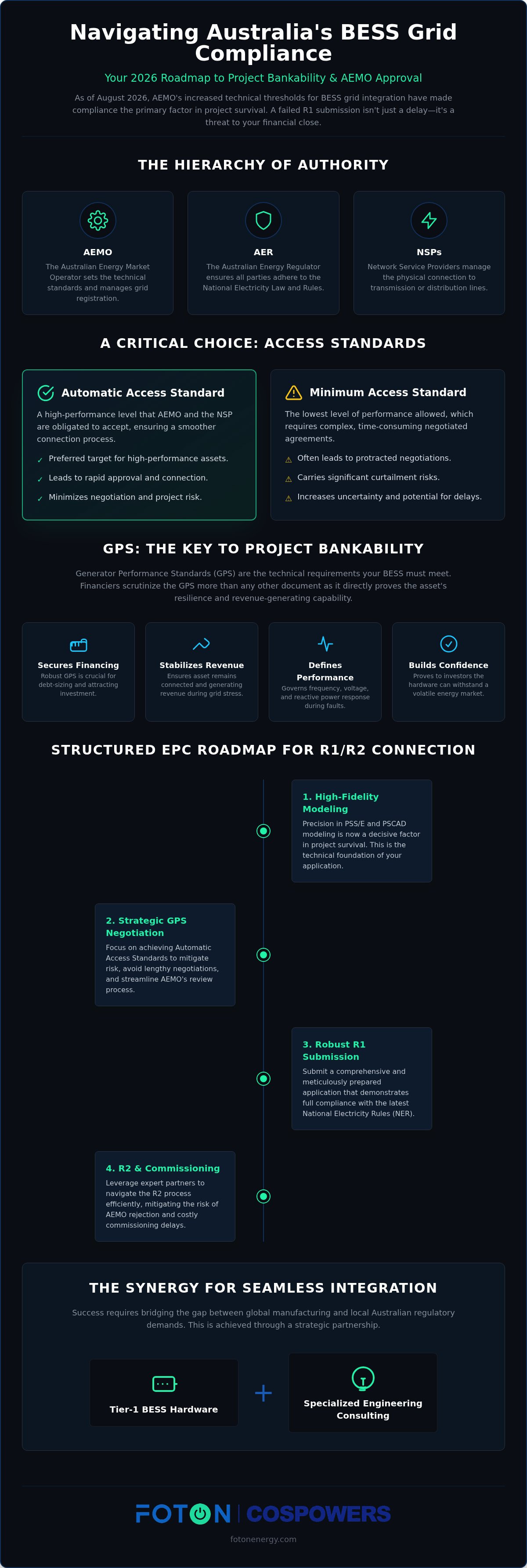
Connecting to the grid requires navigating a strict hierarchy of authority. The Australian Energy Market Operator (AEMO) sets the technical standards and manages registration, while the Australian Energy Regulator (AER) ensures adherence to the law. On the ground, Network Service Providers (NSPs) manage the physical connection to the distribution or transmission lines. Understanding these relationships is vital. Your project must satisfy both the overarching market rules and the local technical constraints of the NSP to secure a connection agreement.
The distinction between "Automatic" and "Minimum" Access Standards is where many developers encounter significant friction. An Automatic Access Standard represents a performance level that AEMO and the NSP must accept. A Minimum Access Standard is the lowest level of performance allowed, which requires a complex negotiated agreement. In 2026, aiming for the Minimum standard often leads to protracted negotiations and potential curtailment risks. This makes the Automatic standard the preferred target for high-performance assets seeking rapid approval.
Understanding the National Electricity Rules (NER)
The National Electricity Rules (NER) serve as the legal constitution of the Australian power system. Within this framework, Chapter 5 dictates the complex process of connection and the negotiation of performance standards. It provides the legal basis for how every asset interacts with the NEM. For BESS operators, the NER governs everything from frequency response to the technical details of how a system must respond to grid disturbances. Staying aligned with the latest version, such as version 251 released in July 2026, is essential for maintaining regulatory standing.
The Role of Generator Performance Standards (GPS)
The Generator Performance Standards (GPS) are the specific technical requirements your battery must meet to remain connected. These standards, particularly the S5.2.5 clauses, define how the system manages frequency, voltage, and reactive power during normal operations and faults. Financiers scrutinize the GPS more than any other technical document. It directly impacts the asset's ability to generate revenue without being disconnected during grid stress. Ensuring BESS grid code compliance Australia through a robust GPS is the only way to prove to investors that the hardware can withstand the rigors of a volatile energy market.
Core Technical Requirements for Grid-Scale Battery Systems
Technical excellence is the baseline for any successful connection in the Australian market. AEMO demands that utility-scale systems demonstrate exceptional resilience during extreme grid disturbances, particularly regarding voltage and frequency ride-through capabilities. Your system must not only survive a fault but actively support the grid's recovery. This requires a sophisticated integration of hardware and control logic that aligns with the latest BESS safety and compliance standards. Achieving BESS grid code compliance Australia depends on your ability to prove these capabilities through rigorous, high-fidelity testing before a single unit is installed on-site.
Dynamic Modeling: PSS/E and PSCAD Simulations
AEMO requires a dual-model approach to validate system performance. You must submit both Root Mean Square (RMS) models via PSS/E for wide-area stability analysis and Electromagnetic Transient (EMT) models via PSCAD for fast-acting control response. The Model Acceptance Test (MAT) process is notoriously difficult; even minor discrepancies between these two models can lead to immediate rejection. It's a non-negotiable requirement that manufacturers provide "black box" models that precisely mirror hardware behavior while protecting proprietary intellectual property. These encrypted files must demonstrate exact alignment with the physical inverter's response to ensure the R1 submission moves forward without costly revisions. If you're navigating these modeling hurdles, our engineering consulting team can help verify your model's accuracy against NEM requirements.
Grid-Forming vs. Grid-Following Capabilities
The 2026 regulatory landscape marks a definitive shift toward mandatory grid-forming technology. While traditional grid-following inverters rely on a stable voltage signal, grid-forming systems act as virtual synchronous machines. They provide the synthetic inertia and system strength necessary as coal plants retire. According to AEMO’s July 2026 General Power System Risk Review, while these systems are vital for waveform stability, they're still undergoing trials to meet protection-grade fault current levels. Integrating these features with AI driven energy management systems allows for real-time optimization of these advanced grid services, ensuring your asset provides maximum value to the network in weak grid areas.
Cybersecurity has also become a foundational pillar of technical compliance. Under the Security of Critical Infrastructure (SOCI) Act, large-scale storage assets are classified as critical energy assets. This means your project must adhere to strict reporting and security protocols to protect against digital threats. Compliance requires a holistic approach that covers both the physical hardware and the digital communication layers of your EMS. We ensure that every system we deploy meets these rigorous national security standards, providing peace of mind for long-term infrastructure investments.
The "Bankability" Factor: Why Compliance Equals Investment Security
Financial institutions view technical risk through the lens of regulatory certainty. In the current lending environment, BESS grid code compliance Australia is the primary metric used to determine project debt-sizing and interest rates. Lenders don't just evaluate projected revenue; they scrutinize the probability of the asset being curtailed or disconnected during grid stress. A project that struggles with its performance standards is a project that carries a higher risk premium. Securing favorable financing requires proving that your system can maintain stable operation under the increasingly volatile conditions of the National Electricity Market (NEM).
Revenue protection is inextricably linked to Marginal Loss Factors (MLF). AEMO's 2026 data shows a significant shift in these figures, with the median MLF for solar in New South Wales falling to 0.925. While BESS MLFs remain generally more stable, assets in Queensland and NSW are facing declines. Non-compliant systems are the first to face curtailment when system strength is low, directly eroding your Return on Investment (ROI). High-fidelity compliance ensures your asset remains a priority for dispatch, protecting your cash flow from the volatility of network constraints.
Insurance and long-term security also depend on the heritage of your hardware. Partnering with a manufacturer like Cospowers, who brings over 30 years of manufacturing heritage, provides a level of "bankable" assurance that newer entrants cannot match. This proven track record, combined with rigorous safety certifications like UL9540A, is essential for securing project insurance at competitive rates. It's about building a foundation of reliability that satisfies both technical engineers and institutional investors.
Mitigating Connection Risk for Financiers
The R1 process serves as the ultimate gatekeeper for project funding. Lenders typically won't release significant capital until the R1 model submission has been accepted by AEMO, as this confirms the project's technical viability. Our BESS engineering consulting services are designed to de-risk this stage by ensuring models are accurate from the first submission. In 2026, "DNV Verification" has also become a standard requirement for many lenders, providing an independent third-party audit of the system's performance and safety protocols.
Compliance Nuances for Sodium-Ion Technology
As we navigate the sodium-ion battery commercial availability in the Australian market, new compliance challenges emerge. While sodium-ion offers excellent safety profiles, it requires specialized thermal management to maintain performance in high-density configurations across Australia's varied climates. Safety architecture for these systems differs significantly from LFP, particularly for sensitive data center and telco backup applications. Ensuring your sodium-ion project meets Australian standards for fire safety and grid interaction is critical for maintaining bankability as this technology scales.
The EPC Roadmap: Navigating the R1/R2 Connection Process
Success in the Australian energy market requires a disciplined, multi-stage approach to connection. The lifecycle of a project is defined by its progression through the R1 and R2 stages, which serve as the technical gatekeepers for the National Electricity Market. Navigating BESS grid code compliance Australia is a chronological journey that begins long before hardware arrives on-site. It starts with initial engagement with the Network Service Provider (NSP) to define the specific constraints of the local grid. This early collaboration is essential to reduce iteration cycles and align technical expectations before the detailed design phase begins.
The roadmap follows four distinct milestones:
- Stage 1: Pre-feasibility. This phase involves initial network studies and establishing the connection point with the NSP to assess capacity.
- Stage 2: R1 Model Submission. This is the most critical hurdle, where detailed PSS/E and PSCAD models are submitted to AEMO for formal registration.
- Stage 3: Construction and Hold Points. During commissioning, the system passes through "hold points," where performance is tested at increasing capacity levels (e.g., 5MW, 20MW, 100MW).
- Stage 4: R2 Final Validation. Post-commissioning data is used to validate the initial R1 models, leading to full commercial operation approval.
Pre-commissioning Modeling and Benchmarking
Conducting a System Strength Impact Assessment (SSIA) early in the design phase is now a mandatory step for large-scale assets. This assessment identifies whether the BESS will adversely affect the local network's stability, particularly in weak areas of the grid. You must also account for inter-regional constraints within the NEM, as congestion in one state can impact the dispatchability of your asset in another. Early collaboration with NSPs is the only way to ensure that these complex variables are addressed before they become project-stopping issues. If you need support navigating these technical milestones, our engineering consulting team provides the expertise needed to streamline your connection timeline.
Post-Connection Compliance and AI Monitoring
Compliance doesn't end once the project is energized. The Australian Energy Regulator (AER) requires a robust Compliance Monitoring Plan (CMP) to ensure the asset maintains its GPS performance over its 20-year lifespan. We utilize AI-driven EMS to provide continuous, real-time monitoring of every performance metric. This technology identifies subtle drifts in response times or frequency control before they lead to regulatory breaches. Predictive maintenance becomes a strategic tool here; by analyzing performance data, we can optimize thermal management and battery health to ensure the system consistently meets its registered standards. This proactive approach protects your asset from penalties and ensures long-term operational excellence.
Strategic Partnership: How Foton Ensures Seamless Grid Integration
Foton Energy operates as a critical link in the Australian energy ecosystem. We bridge the gap between Tier-1 manufacturing excellence and the rigorous technical demands of AEMO. Our "Compliance-First" engineering philosophy ensures that every C&I and utility project is designed with the end goal of R2 validation in mind. This strategic alignment minimizes technical friction and accelerates the path to commercial operation for our partners. By integrating hardware and engineering from the outset, we simplify BESS grid code compliance Australia and provide a steady, guiding hand through the complexities of the National Electricity Market.
Our exclusive partnership with Cospowers provides access to hardware backed by over 30 years of manufacturing heritage. This isn't just about energy density; it's about integrated thermal management and safety architecture specifically engineered for the harsh Australian climate. We provide utility scale BESS solutions through wholesale procurement strategies that prioritize long-term asset health and grid stability. This collaborative approach ensures that your project is not only bankable but also optimized for the evolving requirements of the 2026 grid environment.
Tier-1 Cospowers Manufacturing Standards
Cospowers maintains a global leadership position in cell chemistry and module integration. Their hardware is inherently compliant with international safety standards, providing a stable foundation for project bankability and insurance. We offer deep customization options, allowing us to tune inverter responses to meet the specific fault level and synthetic inertia requirements of local Network Service Providers (NSPs). This precision ensures that BESS grid code compliance Australia is built into the hardware layer, reducing the risk of project rejection at the R1 stage.
End-to-End Engineering and AI Optimization
Foton Energy provides holistic support that spans the entire project lifecycle. We guide partners from initial feasibility and System Strength Impact Assessments (SSIA) through to the final R2 validation and commercial operation. Our proprietary AI-driven EMS optimizes grid interaction in real-time, enabling sophisticated revenue stacking while maintaining strict adherence to Generator Performance Standards (GPS). This intelligent optimization ensures that your asset remains resilient and profitable over its 20-year lifespan. For those looking to scale their impact in the NEM, we invite you to join Foton Energy’s channel partner program for exclusive engineering support and priority access to our technical architecture. Let's build a shared vision for a stable, high-performance energy future together.
Securing Your Project’s Future in the National Electricity Market
Success in the 2026 energy landscape requires a proactive approach to the National Electricity Rules. We've explored how high-fidelity modeling and grid-forming capabilities are no longer optional but essential for long-term operational ROI. By aligning technical performance with Generator Performance Standards from the pre-feasibility stage, you protect your asset's bankability and ensure a smoother path through the AEMO registration process. Achieving BESS grid code compliance Australia is a complex but manageable journey when backed by the right technical expertise and Tier-1 hardware heritage.
Foton Energy stands as your strategic partner, offering an exclusive collaboration with Cospowers and 30 plus years of manufacturing excellence. Our expert engineering consulting for NEM projects, combined with advanced AI-driven EMS integration, provides the stability required for large-scale infrastructure investments. We bridge the gap between global manufacturing standards and local regulatory demands, ensuring your project is both resilient and high-performing. Consult with Foton’s engineers for your BESS grid compliance strategy and take the first step toward a seamless connection. The transition to a battery-supported grid is accelerating; let's ensure your project is ready to lead it.
Frequently Asked Questions
What are the main causes of grid connection delays for BESS in Australia?
Connection delays primarily stem from technical discrepancies between PSS/E and PSCAD models and the high volume of applications saturating AEMO's review capacity. Projects often stall during the R1 stage when dynamic models fail to align with physical hardware performance under specific network constraints. Early engagement with NSPs and rigorous pre-submission benchmarking are the only ways to avoid multi-month setbacks that threaten financial close.
Does a BESS project need both PSS/E and PSCAD models for AEMO approval?
AEMO requires both PSS/E and PSCAD models for all large-scale BESS registrations within the National Electricity Market. PSS/E provides wide-area RMS stability analysis, while PSCAD handles the fast-acting EMT simulations necessary for inverter-based resources. Achieving BESS grid code compliance Australia requires these models to be perfectly synchronized; any deviation in their response to grid faults will lead to a rejection of the Model Acceptance Test.
How has the 2026 grid-forming inverter mandate changed BESS procurement?
Procurement strategies have shifted to prioritize inverters with advanced virtual synchronous machine capabilities to meet AEMO's 2026 stability requirements. Developers now seek hardware that can provide synthetic inertia and fault current to support weak grid areas. This change necessitates selecting Tier-1 partners who offer proven grid-forming firmware that's already undergone successful field trials in the Australian network to ensure long-term asset reliability.
What is the difference between R1 and R2 compliance in the Australian grid?
R1 compliance involves the submission and approval of theoretical performance models before the project is connected to the grid. R2 compliance is the final validation phase, where real-world data collected during commissioning is used to prove that the physical asset matches the approved R1 models. Full commercial operation isn't granted until the AER and AEMO are satisfied that the R2 data confirms the system's registered performance standards.
Can sodium-ion batteries meet the same grid code requirements as LFP?
Sodium-ion batteries can meet the same grid code requirements as LFP, provided they're paired with compliant power conversion systems and intelligent EMS. The electrochemical differences don't inherently change the Generator Performance Standards, though the thermal management systems must be tuned for sodium-ion's specific discharge profiles. Ensuring BESS grid code compliance Australia for sodium-ion involves rigorous testing of the integrated system's response to frequency and voltage disturbances.
How does an Energy Management System (EMS) help with ongoing grid compliance?
An intelligent EMS maintains ongoing compliance by monitoring every performance metric against the project's registered GPS in real-time. It acts as a digital safeguard, adjusting inverter output to prevent frequency or voltage breaches that could lead to AER penalties. By utilizing predictive algorithms, the EMS can optimize dispatch while ensuring the system stays within the technical boundaries defined in its negotiated connection agreement.
What role do Network Service Providers (NSPs) play in the BESS connection process?
Network Service Providers (NSPs) manage the physical connection to the grid and conduct the System Strength Impact Assessment for your project. They work alongside AEMO to ensure that your BESS doesn't negatively affect the local network's stability or existing users. Collaborative engagement with your NSP is vital for negotiating realistic performance standards and understanding the specific thermal or voltage constraints of your local connection point.
Is grid code compliance different for "Behind the Meter" vs "Front of the Meter" BESS?
Compliance requirements differ significantly based on the system's scale and its impact on the distribution or transmission network. Front-of-the-Meter (FTM) systems must adhere to the full suite of NER Chapter 5 requirements and AEMO registration. Behind-the-Meter (BTM) systems generally follow simpler NSP-led standards, though larger C&I installations—often supported by electrical and cooling specialists like Redlec Energy Solutions—may still face rigorous modeling if they intend to participate in FCAS or other wholesale market services.


