
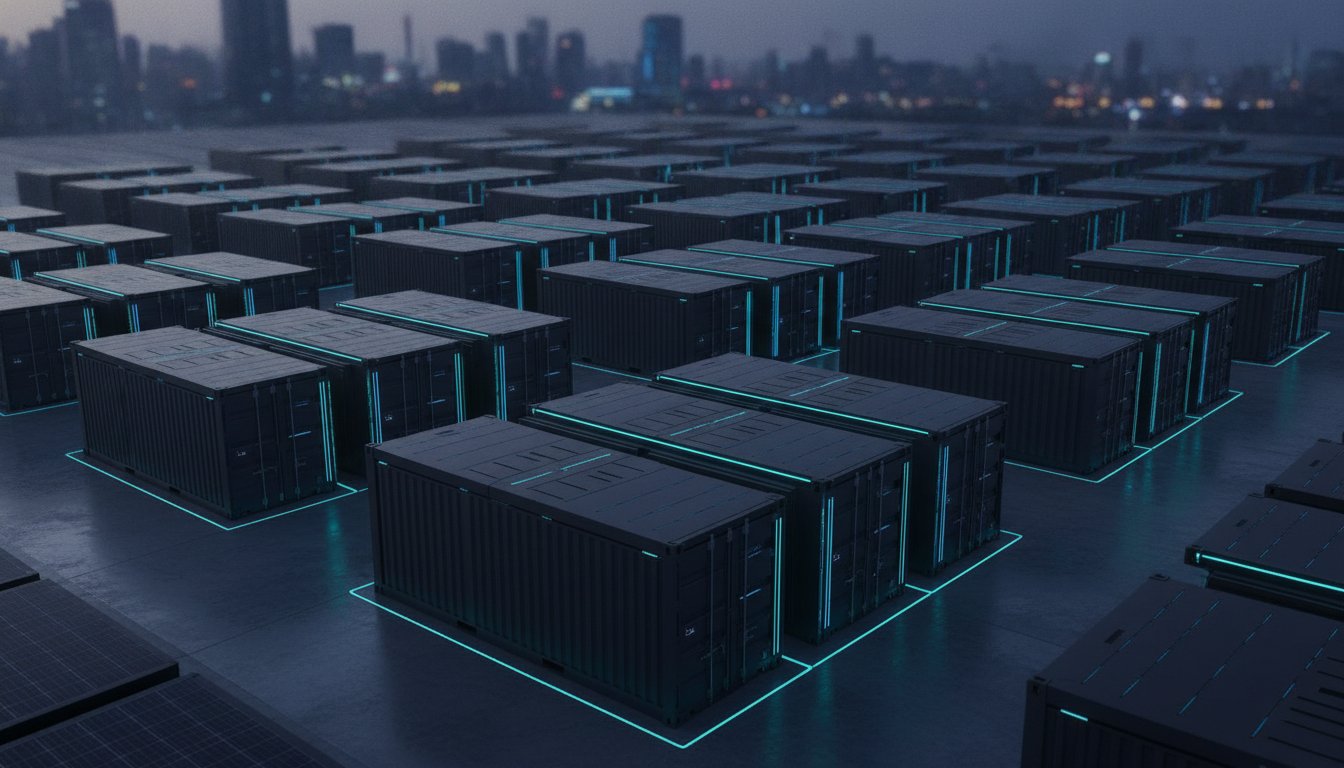
By 2026, the era of treating battery storage as a simple hardware purchase has ended. It's now a high-stakes play in modular infrastructure and global bankability. You likely recognize that while the promise of 10,000 cycle lives is transformative, the path to actual deployment remains fraught with supply chain volatility and tightening grid-code compliance. Securing reliable containerized energy storage systems requires more than just comparing spec sheets; it demands a deep understanding of how modular architecture and fire safety standards like UL 9540A influence your project's long-term viability.
This strategic guide helps you master the technical nuances and bankability factors of modern BESS to de-risk your large-scale energy investments. We'll explore the shift toward liquid-cooled LFP chemistry, the necessity of AI-driven energy management, and the procurement strategies required to integrate these assets with existing wind or solar portfolios. From verifying Tier-1 safety standards to optimizing thermal management for 2026 market demands, you'll gain the clarity needed to lead your infrastructure projects with confidence and precision.
Key Takeaways
- Transition from fragmented custom builds to standardized modularity by adopting 20ft and 40ft ISO container formats for rapid infrastructure scalability.
- Master the "Power in a Box" architecture of modern containerized energy storage systems to effectively integrate LFP chemistry with sophisticated power conversion units.
- Secure project financing by prioritizing bankability through rigorous safety protocols, including multi-level gas detection and advanced fire suppression architectures.
- Optimize deployment for specific revenue streams by distinguishing between front-of-the-meter and behind-the-meter configurations during the feasibility phase.
- Harness AI-driven Energy Management Systems (EMS) to serve as the intelligent link between Tier-1 hardware and real-time grid optimization.
What are Containerized Energy Storage Systems in 2026?
Energy infrastructure has reached a pivotal turning point. In 2026, What are Containerized Energy Storage Systems? They're no longer just experimental battery clusters. These systems represent a sophisticated, pre-engineered turnkey infrastructure solution designed for immediate integration. The industry has moved decisively away from custom-built sheds toward 20ft and 40ft modular ISO containers. This shift ensures that containerized energy storage systems can be shipped, installed, and scaled with the same efficiency as global freight, providing a bankable foundation for the next generation of power grids.
To better understand the scale and engineering behind these modern units, watch this demonstration of a 1MWh industrial system:
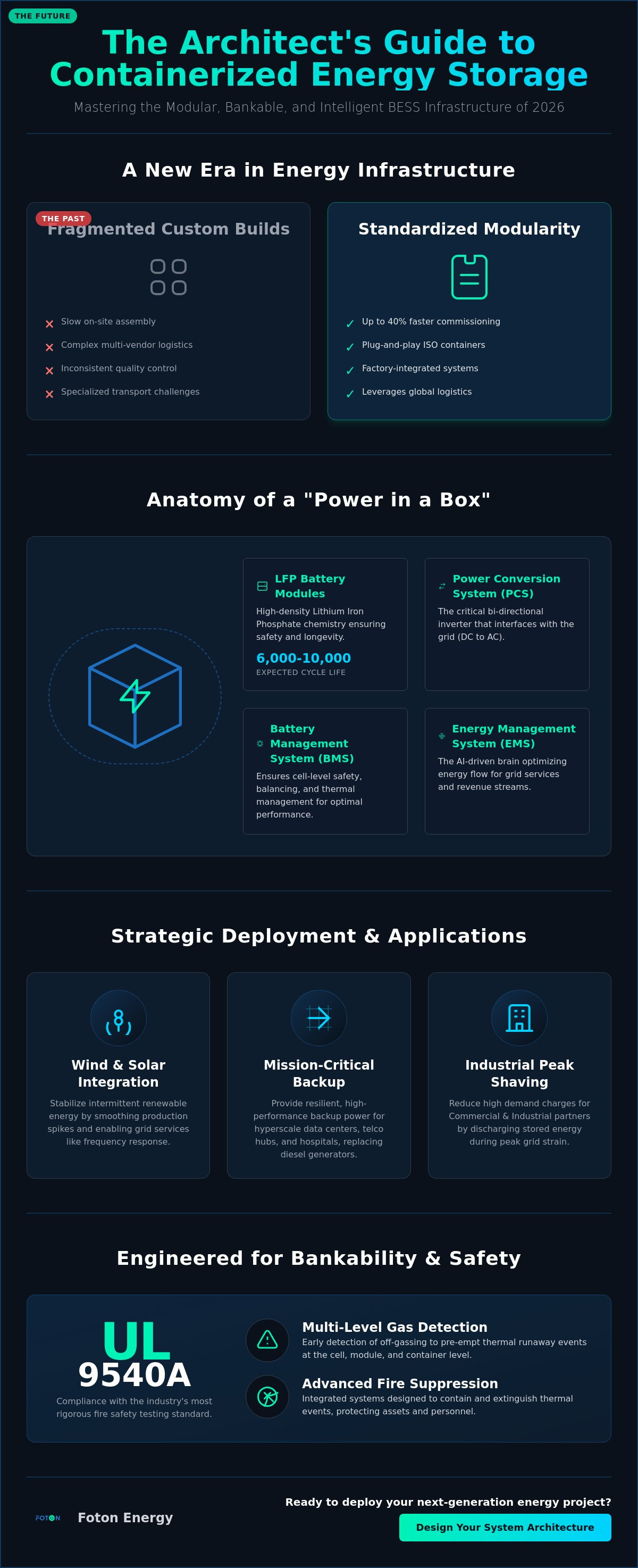
Speed is the new currency in energy project execution. The "plug-and-play" model is essential because it can reduce on-site commissioning times by up to 40% compared to traditional on-site assembly. By integrating the batteries, power conversion systems, and thermal management at the factory, developers avoid the logistical headaches of multi-vendor coordination on active construction sites. This streamlined approach allows for rapid deployment across utility, C&I, and data centre applications, ensuring that capital begins generating a return as quickly as possible.
The Evolution of Modular Energy Storage Architecture
The transition from rudimentary lead-acid racks to high-density lithium and emerging sodium-ion modules has redefined energy density. Modern modularity allows for "hot-swappable" maintenance. This means technicians can replace individual battery modules without forcing a total system shutdown. Standardized shipping containers also leverage existing global logistics networks. This ensures that Tier-1 hardware reaches remote project sites without the need for specialized transport permits, reinforcing the brand's commitment to reliability and global reach.
Key Applications: From Wind Farms to Mission-Critical Data Centres
Scalability is the core value proposition for three primary sectors. In large-scale wind and solar farms, containerized energy storage systems stabilize intermittent renewable energy by smoothing out production spikes. For hyperscale data centres and telco hubs, they provide a resilient, high-performance backup that replaces traditional diesel generators. Finally, C&I partners utilize these systems for industrial peak shaving. This strategy reduces high demand charges by discharging stored energy during periods of maximum grid strain, optimizing operational costs with intelligent precision.
Technical Architecture: Beyond the Battery Modules
Engineering a high-performance BESS requires looking past the steel enclosure. A true "Power in a Box" solution integrates four critical pillars: the battery modules, the Power Conversion System (PCS), the Battery Management System (BMS), and the Energy Management System (EMS). According to the U.S. Grid Energy Storage Factsheet, the efficiency of these integrated sub-systems determines the net energy yield and total cost of ownership over the project's lifespan. For modern containerized energy storage systems, the synergy between hardware and software is what transforms a simple asset into a grid-responsive powerhouse.
Reliability isn't built overnight; it's forged through decades of manufacturing excellence. Cospowers' 30-year legacy in energy storage manufacturing provides the "bankable" assurance that large-scale investors and EPCs require in 2026. When you specify these systems, you're investing in a heritage of rigorous testing and proven performance. High-capacity LFP battery modules now define the system's ROI, with expected cycle lives reaching 6,000 to 10,000 cycles. If you're evaluating hardware for a utility-scale project, our team can help you design a system architecture tailored to your specific grid requirements.
LFP vs. Sodium-Ion: Choosing the Right Chemistry for Your Container
Lithium Iron Phosphate (LFP) continues to dominate the 2026 market due to its established safety track record and superior energy density. It remains the default choice for most containerized energy storage systems because it balances cost with long-term durability. However, Sodium-ion is emerging as a viable alternative for specific use cases, particularly in cold-climate regions where its discharge rates remain stable at sub-zero temperatures. While LFP remains the global standard for high-density safety, Sodium-ion exhibits superior thermal stability in extreme high-density configurations due to its inherent resistance to thermal runaway at elevated temperatures. Choosing between them depends on your project's geographic location and raw material budget constraints.
The Power Conversion System (PCS) and Battery Management System (BMS)
The PCS acts as the gateway between the battery and the grid. It manages bi-directional AC/DC flow, ensuring that energy transitions seamlessly from storage to the network during peak demand. Without a high-efficiency PCS, even the best battery modules lose significant energy during conversion. Working in tandem with this is the BMS, which provides cell-level monitoring to prevent overcharge or deep discharge scenarios. It's the primary line of defense for maintaining cell health and ensuring the system reaches its full rated lifespan. For a deeper dive into maximizing these components, see our guide on Optimising LFP Battery Cycle Life for Utilities. This level of granular control is what separates Tier-1 infrastructure from generic hardware.
Engineering for Bankability: Safety and Compliance
Bankability is the ultimate filter for energy infrastructure projects in 2026. For EPCs and developers, a system's technical prowess is secondary to its ability to secure financing and insurance. Lenders now demand rigorous proof of safety through international certifications like UL 9540A and IEC 62619. These aren't just checkboxes; they're the foundation of a de-risked investment. Containerized energy storage systems that lack DNV verification or fail to meet NFPA 855 standards often face insurmountable hurdles during the due diligence phase, potentially stalling critical infrastructure timelines.
Safety architecture must be proactive rather than reactive. It's not enough to manage a fire; the system must prevent the chemical conditions that lead to one. We implement a defense-in-depth strategy that utilizes multi-level gas detection and structural fire ratings. This ensures that every module remains within safe operational limits. By prioritizing these standards, you transform a hardware purchase into a long-term, stable asset that meets the highest global safety benchmarks. This meticulous approach to compliance is what defines a truly "bankable" solution in the modern market.
Advanced Fire Suppression and Safety Architecture
Modern safety requires the integration of aerosol or clean-agent fire suppression systems directly at the module level. These systems are paired with passive safety features, such as explosion relief panels and structural fire ratings, to contain any potential incidents. This architecture is a core component of Grid-Connected Energy Storage Engineering. By isolating faults early, you protect the surrounding infrastructure and ensure the continuity of your energy supply.
Thermal Management: Maintaining Optimal Performance
Intelligent cooling systems are the lifeblood of high-density storage. In 2026, liquid cooling has become the industry standard for large-scale systems because it offers superior temperature uniformity compared to traditional forced air. This is particularly vital in harsh climates, such as the Australian outback or Middle Eastern deserts, where ambient temperatures can degrade battery health rapidly. Thermal runaway is an uncontrollable self-heating cycle within a battery cell that can lead to fire, and modern safety architecture prevents it through rapid heat dissipation and cell-level electrical isolation. Maintaining uniform cell temperatures not only prevents these risks but also significantly extends the system's operational ROI.
Strategic Deployment: EPC and Developer Considerations
Strategic planning precedes hardware delivery. Successful deployment of containerized energy storage systems begins long before the first unit arrives on site. It's a process of meticulous engineering where a comprehensive feasibility study serves as your primary risk-mitigation tool. Engineering consulting plays a critical role here; experts must optimize system sizing and site layouts to match specific land constraints and grid requirements. Without this foundational analysis, developers risk over-specifying hardware or failing to meet the peak discharge requirements of their chosen revenue model.
Financial models drive technical specifications. Choosing between front-of-the-meter and behind-the-meter configurations is a financial decision as much as a technical one. Front-of-the-meter systems focus on utility-scale services like wholesale energy arbitrage and grid frequency regulation. Behind-the-meter setups prioritize industrial peak shaving and demand charge reduction for C&I partners. Each application requires a specific design for containerized energy storage systems to ensure that the discharge duration and cycle frequency align perfectly with the target revenue stream.
Grid Integration and Code Compliance
Grid stability relies on precision integration. Managing frequency response and voltage regulation is essential for maintaining network equilibrium. Our technical teams work closely with distribution partners to ensure that every unit achieves renewable energy grid code compliance across varying global jurisdictions. For a deeper look at utility-scale applications, explore our Front of the Meter Battery Storage: A Strategic Guide. This collaborative approach ensures seamless commissioning and avoids the delays often associated with complex interconnection studies.
Wholesale Procurement and Supply Chain Management
Direct procurement mitigates supply chain volatility. Direct-from-manufacturer partnerships offer a distinct advantage for large-scale infrastructure projects. By bypassing intermediaries, EPCs can mitigate lead-time risks and secure strategic Tier-1 hardware procurement. Reliability is secured through long-term asset management and technical support agreements that guarantee performance over the system's 20-year lifecycle. Evaluating these supply chain factors early allows you to lock in pricing and ensure that your project remains on schedule despite global market shifts. If you're ready to optimize your site layout for maximum ROI, reach out to our engineering consulting team for a detailed feasibility assessment.
The Foton Advantage: Intelligent EMS and Tier-1 Heritage
Foton serves as the decisive link between world-class Tier-1 manufacturing and complex global project execution. While the hardware provides the physical capacity, our expertise ensures that containerized energy storage systems operate as high-performance financial assets. We don't just deliver units. We provide a comprehensive suite of services ranging from initial feasibility assessments to rigorous grid-code compliance. This end-to-end consulting model removes the integration complexity that often plagues large-scale energy transitions, allowing developers to focus on long-term strategic growth without technical friction.
The intelligence of a BESS resides in its Energy Management System (EMS). We consider this the "brain" of the operation. Our AI-driven EMS utilizes sophisticated machine learning to perform real-time optimization, balancing load demands with available capacity with millisecond precision. Beyond simple operation, the system employs predictive maintenance protocols. By analyzing cell-level data, the AI identifies potential degradation patterns before they impact system performance or safety. It's a shift from reactive repairs to data-backed foresight. This proactive approach ensures that your investment maintains its peak efficiency throughout its multi-decade lifecycle, maximizing the total energy throughput and protecting your capital.
AI-Driven Optimization for Maximum ROI
AI algorithms have redefined how we approach peak shaving and energy arbitrage. For C&I applications, the system automatically discharges during high-tariff periods, while utility-scale assets pivot between frequency regulation and wholesale market participation based on real-time price signals. Mission-critical environments, such as hyperscale data centres, rely on our real-time monitoring and reporting to ensure zero-latency backup transitions. You can explore the technical depth of these capabilities in our guide on AI Driven Energy Management Systems. This level of automation is essential for navigating the volatile energy markets of 2026.
A Global Strategic Partnership: Foton and Cospowers
Our strength is anchored in a global strategic partnership with Cospowers, leveraging over 30 years of manufacturing excellence for every deployment. This collaboration combines the precision of Australian-based engineering with the immense scale of global manufacturing. It's a synergy that guarantees every containerized deployment meets the most stringent international standards while remaining adaptable to local grid requirements. When you partner with us, you aren't just buying batteries; you're securing a future-ready energy ecosystem backed by decades of proven reliability. Consult with Foton's engineers on your next containerized energy storage project to ensure your infrastructure is built for the demands of the next decade.
Securing Your Energy Infrastructure for a High-Performance Future
Strategic energy leadership requires a shift in perspective. In 2026, the most successful infrastructure projects treat energy storage as a sophisticated, de-risked financial asset rather than a simple hardware purchase. We've explored how standardized containerized energy storage systems provide the modularity needed for rapid scaling, while DNV-verified safety architectures and rigorous international certifications ensure long-term bankability. By integrating AI-driven EMS, you transition from passive storage to intelligent, real-time grid optimization that maximizes ROI through predictive maintenance and smart arbitrage.
Reliability is the foundation of every large-scale investment. We leverage over 30 years of manufacturing excellence through our exclusive partnership with Cospowers to deliver hardware that meets the highest global standards. This heritage, combined with our specialized engineering consulting, ensures your project is optimized for performance and grid-code compliance from day one. Partner with Foton for Tier-1 Containerized BESS Solutions to secure a future-ready energy ecosystem backed by proven stability. Let's collaborate to build a resilient and highly optimized energy landscape together.
Frequently Asked Questions
What is the typical lifespan of a containerized energy storage system?
A typical system lasts between 15 and 20 years. This operational duration is largely determined by the cycle life of the battery modules, which in 2026 often exceeds 6,000 to 10,000 cycles. Intelligent EMS and proper thermal management are critical for reaching these end-of-life targets without premature degradation. Regular software updates and predictive maintenance schedules ensure the system maintains its rated capacity over its entire operational tenure.
How do containerized BESS handle extreme weather conditions?
Modern units utilize C5-rated corrosion-resistant enclosures and advanced liquid cooling systems to maintain internal stability. These features allow containerized energy storage systems to operate efficiently in ambient temperatures ranging from -30°C to +55°C. High-grade insulation and IP65-rated seals further protect sensitive power electronics from humidity, salt mist, and dust ingress, making them suitable for coastal or desert environments.
What are the fire safety requirements for installing a BESS container near buildings?
Installing a system near buildings requires strict compliance with NFPA 855 and local building codes. These regulations typically mandate a minimum separation distance of 10 feet (3 meters) and the inclusion of UL 9540A tested fire suppression. Structural fire ratings for the container walls and dedicated explosion relief panels are also standard requirements for high-density urban or industrial sites to protect surrounding infrastructure.
Can containerized systems be expanded after the initial installation?
The modular architecture of a BESS allows for seamless capacity expansion after the initial installation. You can add additional ISO containers to the existing cluster or perform "battery augmentation" by installing new modules into reserved rack space. This flexibility is vital for developers who wish to scale their storage capacity in line with growing renewable energy generation or changing market demands.
What is the difference between AC-coupled and DC-coupled containerized systems?
AC-coupled systems connect to the grid via their own dedicated inverters, making them ideal for retrofitting existing wind or solar farms. DC-coupled systems share a common inverter with the renewable source, which reduces conversion losses and improves overall round-trip efficiency. Choosing the right coupling depends on whether your priority is grid-service flexibility or maximum energy harvest from a co-located renewable asset.
How does sodium-ion compare to LFP in containerized applications?
Sodium-ion offers superior performance in sub-zero temperatures and lower raw material costs, while LFP remains the gold standard for energy density. LFP is currently the most bankable choice for most containerized energy storage systems due to its extensive safety data. Sodium-ion is increasingly specified for projects in extreme cold where LFP would require significant auxiliary heating energy to maintain performance.
What certifications are required for a BESS to be considered 'bankable'?
A bankable system must carry UL 9540 at the system level, IEC 62619 for safety, and UN38.3 for transport. Lenders also look for IEEE 1547 compliance for grid interconnection and DNV-verified performance reports. These documents provide the rigorous technical proof required to secure project financing and insurance coverage at competitive rates, ensuring the project is a de-risked investment.
How long does it take to commission a containerized BESS on-site?
On-site commissioning typically takes between two to four weeks. Because these units are pre-assembled and factory-tested, the plug-and-play design reduces on-site labor by up to 40%. The timeline is often dictated more by the utility's final grid-connection tests and SCADA integration than by the physical hardware installation, allowing for rapid project execution once the site is prepared.


