
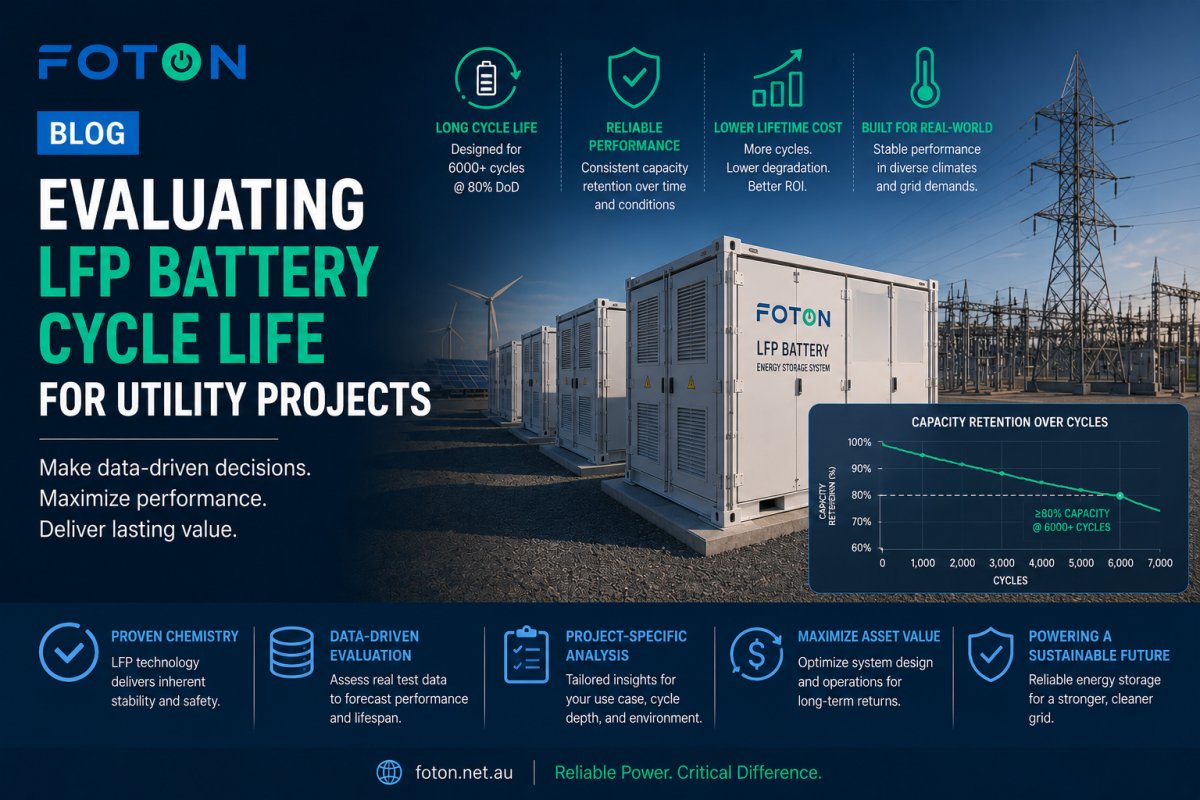
Nearly 95% of new utility-scale battery awards globally now specify LFP chemistry, yet a fundamental gap often remains between laboratory performance and field reality. You're likely facing intense pressure from financiers to guarantee a 15 to 20 year asset life, even as the complexity of managing thermal stress in high-density containers increases. Mastering the technical variables of LFP battery cycle life for utilities is no longer just a technical requirement. It's a foundational pillar of project bankability.
We'll bridge that gap by providing a clear framework to evaluate cycle life claims against real-world degradation. You'll gain the technical confidence to navigate the impact of Intelligent EMS on longevity and the strategic insight to source Tier-1 hardware that delivers on its promises. This guide details how to transform technical variables into long-term financial security for your energy storage infrastructure. It's time to move beyond lab data and secure the operational excellence your stakeholders demand.
Key Takeaways
- Master the relationship between State of Health and the Levelized Cost of Storage to optimize your project's long-term financial performance.
- Identify the critical operational thresholds for Depth of Discharge and C-rates that maximize LFP battery cycle life for utilities.
- Compare the durability profiles of LFP against sodium-ion alternatives to select the most resilient chemistry for your grid-scale requirements.
- Develop a rigorous procurement framework that uses DNV verification and independent testing to validate Tier-1 performance claims.
- Access a manufacturing heritage of thirty years to implement high-capacity modules designed for over 10,000 cycles in demanding environments.
Defining LFP Battery Cycle Life: The Core Metric for Utility Bankability
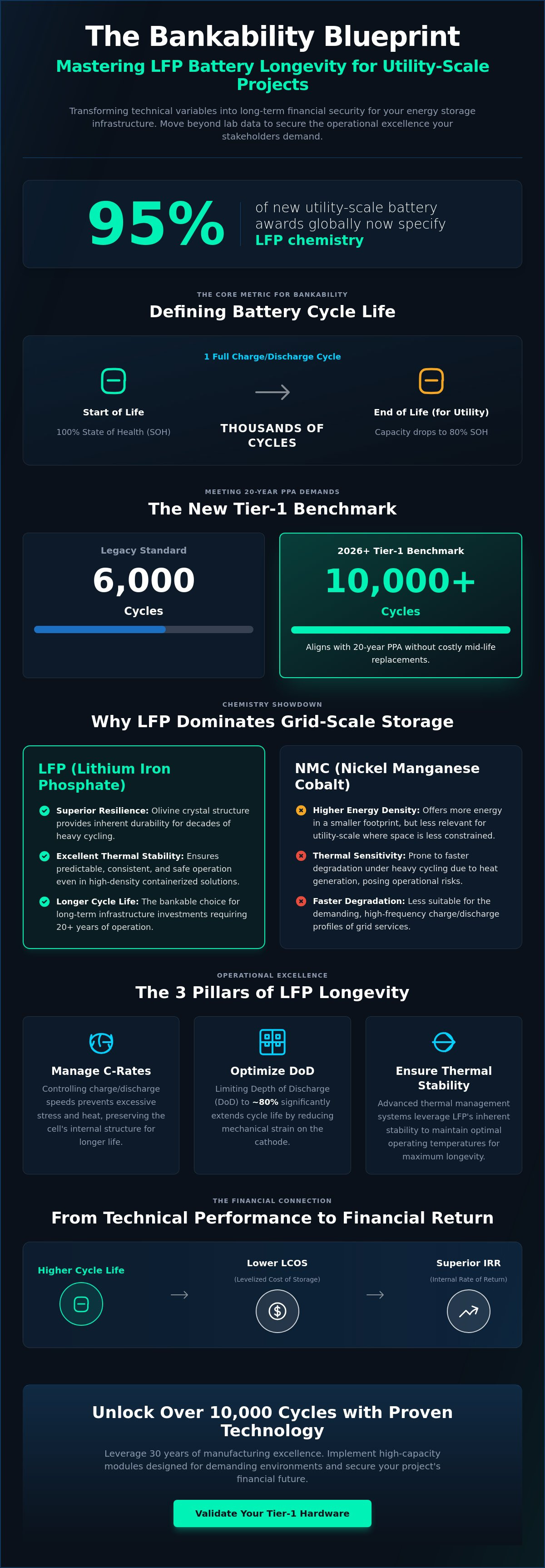
Utility-scale energy storage reliability is built on a single, uncompromising metric. Cycle life represents the total number of full charge and discharge sequences a system can perform before its capacity drops to 80% of its original State of Health (SOH). In the context of LFP battery cycle life for utilities, this 80% threshold marks the standard "End of Life" for primary frequency response or energy shifting. While the cells may still hold a charge, they no longer meet the rigorous performance requirements of high-stakes grid contracts. Understanding Lithium iron phosphate (LFP) battery technology is essential because its olivine crystal structure provides the inherent durability required for decades of service.
To better understand the fundamental chemistry and architecture behind these systems, watch this helpful video:
The industry has evolved rapidly. By 2026, the benchmark for Tier-1 hardware has shifted from the traditional 6,000 cycles to 10,000 or more. This evolution directly supports 20 year power purchase agreements (PPAs). It allows developers to align battery longevity with the typical lifespan of solar or wind assets without the need for costly, mid-life cell replacements that can derail project economics.
The Financial Impact of Degradation
Capacity fade is more than a technical loss; it's a direct revenue leak. As SOH declines, your ability to participate in high-value grid services like peak shaving or ancillary markets diminishes because the system simply cannot move as much energy. The "replacement trigger" usually occurs when the BESS can no longer fulfill the discharge requirements specified in the PPA. High cycle counts improve the Levelized Cost of Storage (LCOS) by spreading the initial capital expenditure across a much larger volume of delivered megawatt-hours. This efficiency is what ultimately drives a superior Internal Rate of Return (IRR) for investors.
LFP vs. Other Chemistries
LFP has effectively displaced NMC (Nickel Manganese Cobalt) in utility settings due to its superior resilience. While NMC offers higher energy density, its thermal sensitivity leads to faster degradation under the heavy cycling demands of the grid. LFP's thermal stability ensures that even in high-density containerized solutions, cycle consistency remains predictable and safe. LFP cycle life is a function of chemical stability and operational environment, determined by how effectively the system manages heat and discharge depth. This chemistry provides the bankable assurance that large-scale infrastructure investments require to remain profitable over two decades of operation.
Technical Drivers of LFP Longevity: C-Rates, DoD, and Thermal Stability
Longevity in utility-scale storage isn't an accident of chemistry; it's a result of precise engineering. While the lithium-iron phosphate crystal structure is inherently robust, it remains subject to mechanical and chemical stress during every cycle. Early in a cell's life, the formation of the Solid Electrolyte Interphase (SEI) layer is critical. A stable, uniform SEI layer acts as a protective barrier on the anode, preventing further electrolyte decomposition. If a system is operated aggressively during its initial deployment, this layer can become unstable, leading to accelerated capacity fade that haunts the project for years.
Managing Depth of Discharge (DoD)
Depth of Discharge remains one of the most influential levers for LFP battery cycle life for utilities. Although LFP is often marketed as a chemistry capable of 100% DoD, the physics of lithium intercalation suggest a more nuanced approach. Pushing a cell to its absolute voltage limits creates internal mechanical strain that can lead to micro-fracturing of the cathode. A PNNL analysis on LFP cycle life indicates that limiting DoD to 80% significantly extends the total cycle count compared to frequent deep discharges.
Strategic "oversizing" of the BESS is now a standard practice to manage this variable. By installing more capacity than the PPA requires, operators can stay within a 10% to 90% State of Charge (SoC) window. Modern projects utilize Intelligent EMS to manage these trade-offs in real time. These systems don't just set static limits; they use AI to dynamically adjust DoD based on grid demand and revenue potential. If market prices are low, the EMS restricts discharge to preserve cell health. It only permits deeper cycles when the financial returns outweigh the marginal cost of degradation. If you're looking to refine these operational parameters, our Engineering Consulting team can provide the modeling needed to balance performance and longevity.
The Criticality of Thermal Management
Thermal management is the second pillar of asset resilience. Heat is the primary catalyst for the parasitic reactions that consume active lithium. Maintaining the "Goldilocks zone" between 15°C and 30°C is essential for reaching 10,000+ cycles. In high-density containers, liquid cooling has largely superseded air cooling because it offers superior temperature uniformity. This is vital for preventing "hot spots" that cause specific cells to age faster than the rest of the string. Integrating expert grid connected energy storage engineering ensures that thermal equilibrium is maintained across every rack, regardless of external ambient conditions. When every cell operates at the same temperature, the entire system degrades at a predictable, bankable rate.
C-rates also play a decisive role. Rapidly forcing ions into the phosphate host structure during high C-rate events creates heat and structural stress. For most utility applications, keeping routine operations at 0.5C or lower preserves the integrity of the crystal lattice. This methodical approach to charging and discharging ensures the hardware remains an active, revenue-generating asset for its full intended lifespan.
Comparative Degradation: LFP vs. Emerging Sodium-Ion for Grid-Scale Assets
Strategic diversification is the hallmark of a resilient utility portfolio in 2026. While LFP remains the dominant chemistry for stationary storage, sodium-ion has transitioned from a laboratory promise to a commercial reality. Choosing between them requires a granular understanding of how their degradation profiles align with specific grid applications. Premium LFP battery cycle life for utilities has now reached a benchmark of 10,000+ cycles at 80% Depth of Discharge. In contrast, first-generation commercial sodium-ion systems typically offer between 4,000 and 6,000 cycles. This disparity creates a clear divide in asset deployment strategy. LFP is the undisputed leader for high-frequency energy shifting, where maximizing total lifetime energy throughput is the primary driver of project bankability.
The decision isn't based solely on cycle count. Environmental resilience plays a decisive role in chemistry selection. LFP cells are highly sensitive to extreme cold, requiring energy-intensive thermal management to prevent lithium plating and capacity loss. Sodium-ion excels in these harsh conditions, maintaining structural stability and cycle consistency in temperatures that would significantly degrade LFP performance. For utilities operating in northern climates, the reduced need for active heating can offset the lower cycle life, resulting in a more efficient system overall.
Sodium-Ion’s Role in Utility Portfolios
Sodium-ion is increasingly utilized for ancillary services and short-duration applications where lower CAPEX is prioritized over absolute cycle longevity. With sodium-ion cell costs at approximately $59/kWh in 2026, they offer a hedge against lithium supply chain volatility. We've seen the successful application of these principles in other sectors, such as the sodium-ion battery for data centers, where safety and material abundance are paramount. On the utility grid, these assets can handle rapid, shallow bursts for frequency regulation, preserving the high-cycle LFP assets for deeper daily energy arbitrage.
The Future of Hybrid Chemistries
The next frontier in utility-scale storage is the hybrid BESS architecture. By mixing LFP and sodium-ion modules within a single integrated system, operators can balance the 10,000+ cycle durability of LFP with the cost-effective resilience of sodium-ion. This approach allows the Intelligent EMS to dispatch the most appropriate chemistry based on the specific grid event. Looking toward 2027 to 2030, we predict a shift where chemistry is no longer a binary choice but a spectrum of optimization. Mastering the integration of these two chemistries ensures that your infrastructure remains future-ready, stable, and commercially viable across its entire twenty year operational life.
Strategic Procurement: Verifying Tier-1 Cycle Life Claims and DNV Verification
Procurement for LFP battery cycle life for utilities requires a move beyond the face value of manufacturer data sheets. In 2026, the definition of a Tier-1 manufacturer has shifted. It is no longer just a measure of manufacturing volume but a testament to commercial bankability and technical transparency. Verification from independent bodies like DNV and UL provides the necessary proof that a system can actually sustain its 15 to 20 year performance claims. Reliability is a product of experience. A manufacturing heritage of over 30 years ensures that a provider has navigated the long-term degradation cycles that newer entrants are only beginning to model. This deep historical data allows for precision in predicting end-of-life SOH, ensuring that projects remain operational and profitable for their intended duration.
The Verification Checklist for EPCs
Precision in procurement minimizes risk. EPCs must look deeper than the cycle count listed in a brochure to understand the testing conditions that produced those numbers. A robust verification process includes three critical steps:
- Reviewing testing protocols: Distinguish between standard laboratory cycles and accelerated aging tests. Accelerated testing must be validated against real-world performance data to ensure accuracy.
- Assessing warranty backing: A 20 year cycle life claim is only as strong as the balance sheet behind it. Evaluate the manufacturer's ability to honor long-term performance guarantees.
- Verification of thermal integration: Ensure the thermal management system is integrated into the performance model. DNV-RP-0043 (GRIDSTOR) provides a framework for this, ensuring the cooling architecture can maintain the "Goldilocks zone" discussed in previous sections.
Achieving Bankability for Financiers
Financiers view technical degradation as a financial liability. Lenders look for "bankable" assurance that the system will meet its revenue targets without premature capacity fade. Mitigating this performance risk requires the selection of Tier-1 hardware that has undergone rigorous third-party validation. This level of scrutiny ensures that the debt service coverage ratio remains stable over the project’s life. For a deeper look at how to structure these investments, consult our guide on commercial and industrial BESS solutions. By aligning technical excellence with financial rigor, you can secure the long-term trust of your investment partners. If you are ready to evaluate Tier-1 hardware for your next deployment, explore our Utility-Scale Storage options designed for maximum bankability.
Transparency in the supply chain is the final pillar of procurement. Knowing the origin of every cell and the consistency of the manufacturing process reduces the likelihood of "infant mortality" in the field. When you source hardware backed by decades of proven manufacturing, you aren't just buying a battery. You're investing in a legacy of stability and performance that has been tested across global markets.
The Foton-Cospowers Advantage: 30 Years of Manufacturing Excellence
Reliability in utility storage isn't built on promises; it's built on proven manufacturing lineage. Foton Energy’s exclusive partnership with Cospowers provides direct access to 30 years of LFP heritage. This isn't just a marketing statistic. It represents three decades of refining the chemical stability and structural integrity needed to maximize LFP battery cycle life for utilities. While many market entrants are still validating their first decade of field performance, our hardware is backed by millions of operational hours in diverse global environments. This extensive history allows us to provide the grounded, bankable assurance that large-scale infrastructure investments require.
Technical performance is the bedrock of our utility-scale offering. Our high-capacity LFP modules are engineered to deliver 10,000 or more cycles at 0.5C/0.5C charging rates. This performance is sustained through our Intelligent EMS, which utilizes AI-driven predictive degradation control to manage the stresses of grid-scale operations. By analyzing real-time data, our systems ensure that the crystal structure of every cell is preserved. This proactive management extends the asset's bankability well into its second decade, ensuring that your project meets its long-term financial targets.
Tier-1 Hardware for Utility Scale
Our containerized LFP solutions are designed for rapid deployment and maximum density without compromising safety. Each unit features a proprietary safety architecture that includes advanced fire suppression technology and multi-level battery management systems. Cospowers’ extensive manufacturing heritage ensures exceptional cell-to-cell consistency, which is vital for preventing the localized hot spots that can lead to premature system failure. This uniformity allows for a predictable degradation curve across the entire BESS, simplifying long-term financial modeling. When every cell performs to the same rigorous standard, the entire system remains a stable pillar of the grid.
Partnering for Long-Term Success
We provide more than just hardware; we deliver integrated engineering intelligence. From wholesale procurement to custom technical consulting, we support EPCs in navigating the complexities of grid-code compliance and asset longevity. Our global engineering team works collaboratively with you to design systems that meet specific local requirements, ensuring every project is optimized for its unique operational environment. Consult with Foton Energy for your next utility-scale BESS deployment to leverage our expertise in building resilient, high-performance energy infrastructure. We invite you to participate in a shared vision of a stable, renewable future backed by thirty years of operational excellence. Our team is ready to provide the Engineering Consulting and Utility-Scale Storage solutions your project demands for 2026 and beyond.
Securing the Future of Utility-Scale Infrastructure
The landscape of energy storage is shifting toward long-term operational stability. Achieving a 10,000+ cycle count requires more than just choosing the right chemistry. It demands a rigorous integration of AI-driven thermal management, precise depth-of-discharge control, and the selection of hardware with a proven manufacturing pedigree. By mastering these technical and commercial variables, you ensure that your investment remains a bankable asset for its entire twenty year lifespan.
Optimizing LFP battery cycle life for utilities is the definitive path to lowering the Levelized Cost of Storage and securing project financing in an increasingly competitive market. Foton Energy stands as your strategic link to this future. As the exclusive global partner for Cospowers, we offer 30+ years of manufacturing heritage and a DNV-verified performance architecture that transforms technical claims into operational reality. Partner with Foton Energy for Tier-1 Utility Storage Solutions and build your next project on a foundation of proven excellence. Let's redefine grid resilience together.
Frequently Asked Questions
What is the typical cycle life of a utility-scale LFP battery in 2026?
Modern utility-grade LFP batteries typically deliver between 4,000 and 6,000 cycles at 80% Depth of Discharge. However, premium Tier-1 systems have pushed these boundaries, with high-performance modules achieving 8,000 to 10,000 cycles in 2026. This higher threshold is essential for projects targeting a 20 year operational life without mid-life cell replacements, ensuring the long-term bankability of the asset.
How does depth of discharge (DoD) affect LFP battery longevity?
Depth of Discharge has a direct impact on degradation because deeper cycles increase the mechanical strain on the lithium-iron phosphate crystal lattice. By restricting DoD to 80% instead of 100%, operators can significantly preserve LFP battery cycle life for utilities. This conservative approach reduces micro-fracturing in the cathode and slows the consumption of active lithium during the intercalation process.
Can AI-driven EMS really extend the life of a utility BESS?
AI-driven Energy Management Systems extend asset life by dynamically adjusting charging rates and thermal thresholds based on real-time cell health data. These systems prevent the formation of hot spots and optimize intercalation speeds to minimize the growth of the resistive SEI layer. This proactive control ensures the battery operates within its most stable electrochemical window, effectively delaying capacity fade.
Is Sodium-ion a viable alternative to LFP for high-cycle utility applications?
Sodium-ion is a viable alternative for specific use cases but currently lacks the high-cycle endurance of premium LFP. With sodium-ion cycles typically ranging from 4,000 to 6,000, it's better suited for long-duration storage or environments with extreme temperature swings. For high-cycle frequency applications like primary frequency control, LFP remains the superior choice for maximizing total lifetime energy throughput.
What does "End of Life" mean for a utility-scale battery system?
End of Life in a utility context refers to the point where a battery’s State of Health drops to 80% of its original nameplate capacity. While the system remains functional, it can no longer reliably meet the discharge requirements of most Power Purchase Agreements. At this stage, the BESS is usually decommissioned or moved to secondary applications with lower performance demands.
How do temperature fluctuations impact LFP cycle life in Australian conditions?
Australian temperature fluctuations present a significant risk because ambient heat above 30°C accelerates the parasitic chemical reactions that cause capacity fade. Maintaining LFP battery cycle life for utilities in these regions depends on high-performance liquid cooling systems. These systems keep internal cell temperatures within the 15°C to 30°C zone regardless of external desert or tropical heat conditions.
What certifications should I look for to verify LFP cycle life claims?
You should prioritize DNV-RP-0043 (GRIDSTOR) and UL 9540 certifications to validate performance and safety claims. These standards provide a rigorous framework for testing and verifying the manufacturer's stated cycle life under specific operational conditions. Independent third-party verification is the only way to ensure that laboratory data translates into real-world bankability for your project infrastructure.
Why is Tier-1 manufacturing critical for battery bankability?
Tier-1 manufacturing is critical because it combines high-volume production consistency with the financial stability required to back 20-year performance guarantees. Lenders require the assurance of a strong balance sheet and extensive historical data to mitigate performance risk. A manufacturer with decades of heritage provides the technical proof points that financiers demand before committing to large-scale infrastructure debt.


