
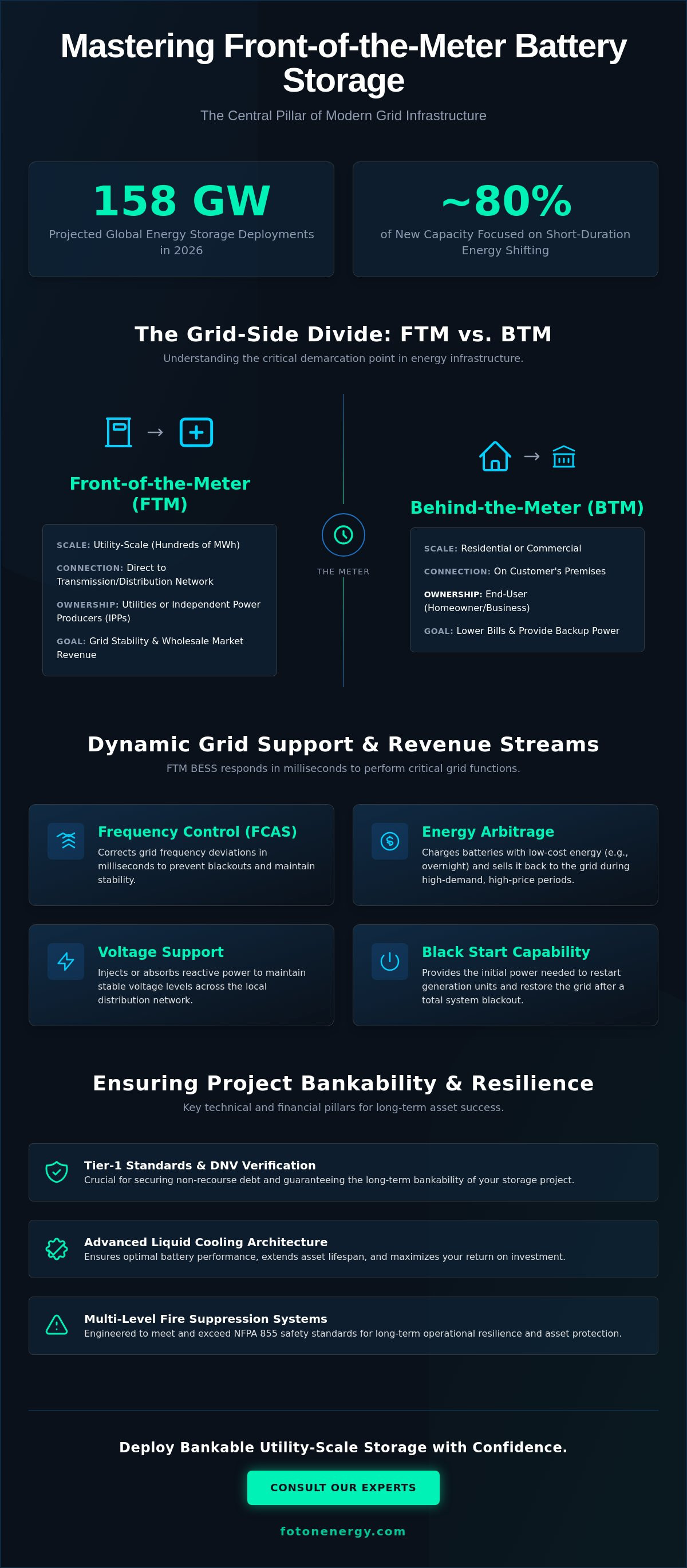
Did you know that nearly 80% of new energy storage capacity additions are now focused on short-duration energy shifting? As global deployments hit a projected 158 GW in 2026, front of the meter battery storage has transitioned from a supporting role to the central pillar of grid infrastructure. It's no longer just about balancing load; it's about deploying AI-optimized assets that can withstand the rigors of a volatile market.
You're likely facing the dual pressure of meeting complex grid-code compliance while protecting your ROI against battery degradation and supply chain shifts. It's a challenging landscape where technical precision is the only path to long-term bankability. This guide helps you master the strategic fundamentals of FTM energy storage so you can drive grid stability with confidence. We'll examine the current revenue landscape, provide a framework for evaluating Tier-1 hardware, and deliver a technical roadmap for integrating systems that meet the latest NFPA 855 safety standards.
Key Takeaways
- Distinguish between grid-side and consumer-side infrastructure to clarify the strategic placement and demarcation of utility-scale assets.
- Discover how frequency control ancillary services and energy arbitrage maximize revenue potential within the modern grid ecosystem.
- Understand the critical role of Tier-1 standards and DNV verification in securing non-recourse debt for front of the meter battery storage projects.
- Evaluate advanced liquid cooling architecture and multi-level fire suppression systems to ensure long-term asset resilience and operational safety.
- Leverage strategic manufacturing partnerships and end-to-end engineering consulting to streamline the journey from feasibility to commissioning.
Defining Front of the Meter (FTM) Battery Storage in 2026
In 2026, the energy landscape is defined by its ability to manage intermittency with surgical precision. Front of the meter battery storage refers to utility-scale systems connected directly to the transmission or distribution network. These aren't located on a customer's premises to lower individual monthly bills. Instead, they operate as independent power plants or grid-support assets that provide the necessary stability to keep the lights on for entire regions. We've moved past the era of centralized gas-peaker plants, favoring distributed, modular arrays that offer faster response times and lower operational costs.
The "meter" in this context serves as the legal and physical demarcation point. It separates utility-owned infrastructure from the end-user's consumption. On one side, you have the wide-scale grid; on the other, you have the homes and businesses that consume that energy. A modern Battery Energy Storage System (BESS) sits firmly on the grid side. These projects are typically deployed by utilities themselves or by Independent Power Producers (IPPs) who sign long-term agreements to provide capacity and stability to the network.
To better understand how these systems differ from consumer-side units, watch this helpful video:
FTM vs. Behind the Meter (BTM): The Core Differences
Ownership is the most distinct factor when comparing these two architectures. BTM systems are owned by residential or commercial users to manage their own specific loads. FTM systems are massive installations, often exceeding hundreds of megawatt-hours (MWh) in capacity. While a BTM unit focuses on demand charge reduction or local backup power, FTM assets generate revenue through wholesale market participation and frequency regulation. They operate at a scale where they influence the stability of the entire grid rather than a single building.
The Role of FTM in Modern Grid Decarbonization
As variable renewable energy (VRE) sources like wind and solar increase, the grid needs a "shock absorber" to handle sudden fluctuations. Front of the meter battery storage provides this by soaking up excess energy during peak production and releasing it when the sun sets or the wind dies down. While Lithium Iron Phosphate (LFP) remains the dominant chemistry, 2026 is seeing the rise of hybrid fleets. These systems often incorporate Sodium-ion technology for specific long-duration applications. Front of the meter battery storage is a critical infrastructure pillar for 2026 grid resilience, serving as the primary bridge between volatile renewable generation and reliable power delivery.
Technical Mechanisms: How FTM BESS Stabilizes the Modern Grid
Modern grid stability depends on speed. While traditional thermal plants take minutes to ramp up, front of the meter battery storage responds in milliseconds. This rapid response is essential for maintaining the delicate balance between power generation and consumption. These systems aren't just passive backups; they're dynamic assets that perform four critical functions simultaneously:
- Frequency Control Ancillary Services (FCAS): Correcting deviations in grid frequency to prevent blackouts.
- Energy Arbitrage: Shifting bulk energy from periods of oversupply to periods of high demand.
- Voltage Support: Injecting or absorbing reactive power to stabilize local distribution networks.
- Black Start Capabilities: Acting as the jump start for the grid during a total system restart.
Utility-scale assets operate under intense scrutiny from grid operators. They must meet rigorous technical standards to ensure they don't compromise system integrity. Leading Grid Energy Storage Research from institutions like PNNL confirms that BESS provides a more accurate and faster response curve than traditional spinning reserves, making it the preferred choice for grid modernization.
Frequency Regulation and Ancillary Services
Frequency regulation requires sub-second precision. Lithium Iron Phosphate (LFP) battery modules are uniquely suited for this because they can switch from full charge to full discharge almost instantly. This performance isn't just about the cells; it's about the integration. Implementing grid connected energy storage engineering is vital for meeting regional standards like those set by AEMO. Without precise engineering, a BESS might fail to synchronize with the grid, leading to disconnection at the very moment it's needed most.
AI-Driven Energy Management Systems (EMS)
The brain of any utility-scale project is its Energy Management System. In 2026, AI has become the standard for optimizing these assets. An intelligent EMS predicts grid stress by analyzing weather patterns, market pricing, and historical load data. It doesn't just manage energy flow; it protects the hardware. By integrating real-time thermal management data, Foton Energy (Foton Pty Ltd)’s intelligent EMS ensures that cells operate within their optimal temperature range. This proactive approach extends asset life and maximizes revenue capture by ensuring the system is always ready for high-value dispatch events. If you're looking to optimize your project's technical architecture, our Engineering Consulting team can provide the necessary feasibility analysis.
The Bankability Framework: Tier-1 Standards and DNV Verification
Cheap hardware is the most expensive mistake you can make in utility-scale deployment. In the complex landscape of front of the meter battery storage, the upfront purchase price represents only a fraction of the total cost of ownership. Low-tier equipment frequently lacks the thermal stability and cycle resilience required for decade-long operations. This leads to premature degradation that destroys project margins. For institutional investors and developers, the priority isn't the lowest bid; it's the long-term reliability that ensures a project remains profitable through 2035 and beyond.
Bankability represents a manufacturer's ability to provide the security needed for sophisticated project financing, particularly when you're seeking non-recourse debt. Lenders require absolute certainty that the technology will perform as promised for 15 to 20 years without catastrophic failure or unexpected capacity fade. This assurance is built on rigorous third-party verification from entities like DNV and BloombergNEF. Understanding the Economics of Grid-Scale Energy Storage is essential for any developer who must balance initial capital expenditure with the stringent performance requirements of debt providers.
Tier-1 Manufacturing and Global Certifications
EPCs must demand uncompromising safety and performance standards to protect their investments. Compliance with UL9540A and IEC 62619 isn't just a regulatory checkbox; it's a fundamental requirement for grid-scale safety and insurance eligibility. Through our strategic partnership, Foton Energy (Foton Pty Ltd) provides exclusive global access to Tier-1 Cospowers hardware, which is backed by over 30 years of manufacturing heritage. This deep industrial pedigree ensures that your project utilizes bankable energy storage for financiers, reducing risk premiums and streamlining the path to a successful financial close. We help you navigate the energy storage supply chain by ensuring every component meets the highest international benchmarks for durability and resilience.
Maximizing Asset Life and Cycle Performance
Your ROI is inextricably linked to how you manage the battery’s state of health over time. Depth of discharge (DoD) directly impacts how many cycles a system can deliver before hitting its end-of-life threshold, making precise operational control vital. We provide specific, data-driven guidance on optimising LFP battery cycle life for utilities to ensure your asset remains a high-performing grid contributor for its entire planned duration. By aligning discharge depth with market opportunities, you can maximize revenue without sacrificing the physical integrity of the cells. Bankability is a function of manufacturing heritage and verified cycle life.
Critical Engineering Considerations for Utility-Scale Deployment
Engineering excellence is the cornerstone of any resilient grid-scale project. For front of the meter battery storage, the transition from high-level strategy to physical deployment requires a meticulous focus on hardware durability and safety architecture. In 2026, the industry has shifted away from monolithic, one-size-fits-all installations toward modular, containerized solutions. These systems, typically housed in 20ft or 40ft enclosures, allow for rapid commissioning and easier site scalability. Stability is non-negotiable. Every component must be engineered to withstand high-performance cycles while maintaining strict adherence to the latest NFPA 855 (2026 Edition) standards.
Thermal management is the most significant technical hurdle in high-density BESS design. While air cooling remains a legacy option for lower-intensity applications, liquid cooling has become the 2026 benchmark for utility-scale assets. Liquid systems provide superior temperature uniformity across the battery racks, which is vital for preventing the localized hot spots that accelerate cell degradation. By maintaining an optimal thermal environment, you don't just protect the hardware; you ensure the predictable performance levels required by your off-take agreements.
Thermal Management and Safety Systems
Safety in modern utility storage is a multi-layered architecture. We utilize both active and passive measures to mitigate risk. Active safety involves advanced sensors and automated fire suppression systems that can neutralize a threat before it spreads. Passive safety focuses on physical isolation and thermal barriers between cells and modules to prevent thermal runaway. By integrating advanced sensors with an AI-driven predictive maintenance layer, we can detect anomalous cell behavior weeks before it escalates into a failure. This proactive engineering approach is essential for protecting both the physical asset and the surrounding grid infrastructure.
Grid Integration and Interconnection Engineering
Connecting a massive energy asset to the distribution network introduces complex electrical challenges. Large-scale deployments must manage harmonic distortion and voltage flicker to avoid disrupting local power quality. Meeting these stringent utility requirements requires a deep understanding of renewable energy grid code compliance across different global jurisdictions. Professional engineering is the only way to navigate these complexities without facing costly delays during the commissioning phase. To ensure your project meets these rigorous standards from day one, explore our Engineering Consulting services for a comprehensive feasibility audit and technical roadmap.
Strategic Procurement: Scaling FTM Infrastructure with Foton and Cospowers
Procuring utility-scale assets requires more than a purchase order; it demands a strategic partnership with a proven manufacturing heritage. Foton Energy (Foton Pty Ltd) serves as the exclusive strategic link to Cospowers’ Tier-1 manufacturing capacity, providing a direct pipeline to bankable hardware that meets global standards. With a presence in over 70 countries, we understand that scaling front of the meter battery storage requires a localized approach to logistics and site-specific integration. We don't just deliver containers; we provide a foundation for long-term grid stability and investor confidence.
Our collaborative approach ensures you have end-to-end engineering support from the initial feasibility study to final commissioning. Whether you're developing a utility-scale wind farm, a remote telecom network, or a high-density data center, our systems are customized to your specific load profile. We leverage the established industrial pedigree of Cospowers to deliver high-performance solutions like the liquid-cooled CP Thor or the air-cooled CP Zeus. These systems are designed for high-performance duty cycles and can be scaled for projects up to 200 MWh, ensuring you have the capacity needed for future grid expansion.
Wholesale Hardware Procurement and Integration
Reliable supply chain management is the difference between a project that meets its target date and one that faces costly delays. By working with Foton Energy (Foton Pty Ltd), you gain direct access to high-capacity LFP and sodium-ion battery modules without the volatility of traditional procurement channels. We manage the complexities of global logistics to reduce lead times and ensure your hardware arrives site-ready. Partnering with Foton Energy (Foton Pty Ltd) for commercial and industrial BESS solutions allows you to leverage our technical expertise and manufacturing scale to secure your project's future.
The Future of Sodium-Ion in FTM Applications
Sodium-ion technology is emerging as a strategic choice for long-duration energy storage. Its superior thermal stability and performance in extreme temperatures make it an ideal candidate for front of the meter battery storage in diverse climates. As the industry looks toward 2026, integrating sodium-ion into data center ups battery replacement strategies is becoming a priority for operators seeking to balance cost with resilience. This chemistry offers a sustainable alternative to lithium while maintaining the high discharge rates required for critical infrastructure. If you're ready to secure your grid assets with Tier-1 technology, partner with Foton Energy (Foton Pty Ltd) for your next utility-scale FTM project.
Securing the Future of Utility-Scale Energy Assets
Deploying front of the meter battery storage in 2026 requires a transition from viewing storage as a simple buffer to managing it as a sophisticated, AI-optimized grid asset. Success in this sector is built on three pillars: technical precision in frequency regulation, uncompromising safety architecture, and the financial security of Tier-1 bankability. It's clear that the difference between a high-performing project and a stranded asset often lies in the manufacturing heritage and the rigor of third-party verification.
Foton stands as the exclusive global partner of Cospowers, bringing over 30 years of manufacturing expertise and global distribution to your project. Our systems feature DNV-verified bankability and AI-driven safety protocols, ensuring your investment is protected against both physical and financial volatility. We're ready to help you navigate the complexities of grid-code compliance and hardware procurement. Consult with our FTM engineering experts for your next utility-scale project and take the first step toward building a more resilient, high-performance energy ecosystem. The path to a stable and profitable grid starts with the right strategic partner.
Frequently Asked Questions
What is the difference between Front of the Meter and Behind the Meter storage?
Front of the meter assets connect directly to transmission or distribution networks, whereas behind the meter systems reside on the customer’s side of the utility meter. While residential units focus on local backup and bill reduction, front of the meter battery storage operates as a grid-scale power plant. These installations are designed to provide bulk services to the utility provider or wholesale market rather than serving a single facility.
How does Front of the Meter battery storage generate revenue for developers?
Developers generate revenue through a combination of energy arbitrage, frequency regulation, and capacity market participation. By charging during periods of low demand and discharging during peak price windows, these assets capture market spreads. Additionally, providing ancillary services like voltage support and frequency control offers stable, contract-based income streams that are essential for long-term project bankability.
Why is Tier-1 manufacturing status important for FTM bankability?
Tier-1 status serves as a proxy for financial stability and manufacturing excellence, which are critical for securing non-recourse debt. Lenders require proof that a manufacturer will exist for the duration of a 20-year project to honor warranties and provide technical support. High-tier status, backed by third-party verification, reduces the perceived risk for institutional investors and lowers the cost of capital.
Can sodium-ion batteries be used for Front of the Meter grid storage?
Sodium-ion technology is increasingly utilized for long-duration storage and applications in extreme thermal environments. Its lower cost profile and superior safety characteristics make it a viable alternative to lithium for specific grid-support roles. While LFP remains the dominant choice for high-cycle applications, sodium-ion offers a resilient solution for assets that require high stability and reduced supply chain risk.
What are the main safety requirements for utility-scale battery containers?
Utility-scale systems must adhere to rigorous standards, including NFPA 855 and UL 9540A, to ensure operational safety. These requirements mandate advanced fire suppression, explosion venting, and thermal runaway detection systems. Modern engineering also prioritizes physical separation between battery modules to prevent a single cell failure from cascading into a full-scale thermal event across the container.
How does an Energy Management System (EMS) optimize FTM battery performance?
An EMS acts as the central intelligence of the BESS, balancing market dispatch signals with the physical health of the battery cells. It uses predictive algorithms to determine the most profitable times to charge or discharge while maintaining optimal thermal conditions. This dual focus on revenue and health ensures that the front of the meter battery storage asset achieves its maximum possible lifespan.
What is the typical lifespan of a Front of the Meter LFP battery system?
A well-managed LFP system typically offers an operational life of 15 to 20 years. This longevity is highly dependent on the depth of discharge and the effectiveness of the liquid cooling systems. By utilizing advanced energy management, operators can slow the rate of capacity fade, ensuring the system remains a productive grid asset well into its second decade of service.
How do FTM batteries support renewable energy integration on the grid?
These batteries mitigate the intermittency of wind and solar by storing excess generation for later use. They provide the "inertia" and fast-frequency response that renewable sources naturally lack, preventing grid instability when weather conditions change. This capability allows grid operators to increase the percentage of renewables in the energy mix without compromising the reliability of the power supply.


