
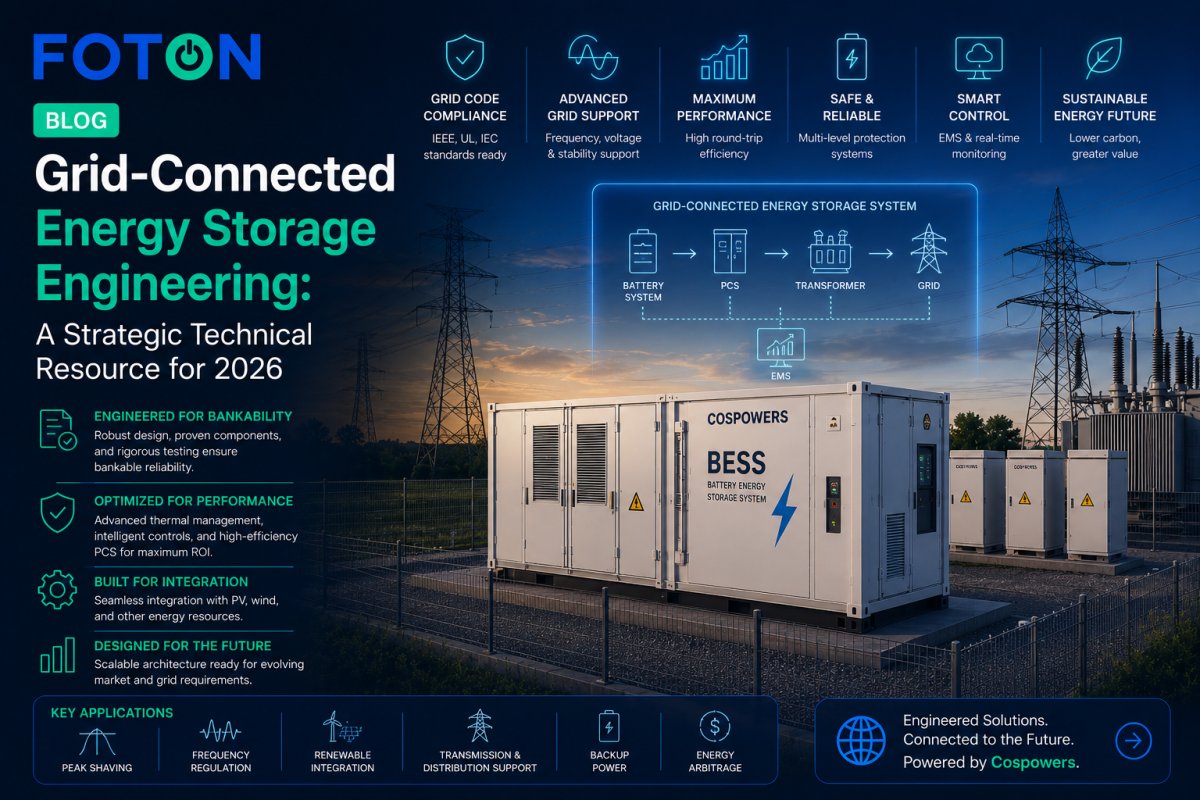
With the U.S. alone projected to install 15 GW of new battery capacity in 2026, the margin for technical error in utility-scale deployment has effectively vanished. You likely recognize that the transition to Grid 2.0 demands more than just high-capacity hardware. It requires a sophisticated approach to grid connected energy storage engineering that balances high-density LFP safety with increasingly rigid regional compliance. As thermal runaway risks and complex grid-code requirements become more pronounced, the difference between a high-performing asset and a stranded one lies in the precision of its architecture.
We're here to provide the technical clarity you need to master bankable storage deployments. This resource delivers a comprehensive framework for engineering principles, Tier-1 safety architectures, and the grid-code requirements essential for 2026. We'll explore a clear roadmap for BESS integration, moving from AI-driven optimization strategies to the practical commercial engineering of sodium-ion cells. By the end of this guide, you'll have the strategic insights necessary to secure long-term value and operational resilience in a rapidly evolving energy ecosystem.
Key Takeaways
- Learn how to integrate batteries, PCS, and EMS into a cohesive system to transition from legacy mechanical storage to high-performance modular BESS.
- Identify the multi-layered safety protocols necessary to manage thermal risks at the cell and container levels for utility-scale deployments.
- Analyze the strategic advantages of LFP versus sodium-ion chemistries to ensure your grid connected energy storage engineering remains competitive through 2026.
- Discover how AI-driven Energy Management Systems facilitate sub-second response times and automate compliance with complex regional grid codes.
- Recognize the value of combining Tier-1 manufacturing with expert engineering consulting to achieve bankable results for large-scale infrastructure projects.
Defining the Role of Grid-Connected Energy Storage in Modern Infrastructure
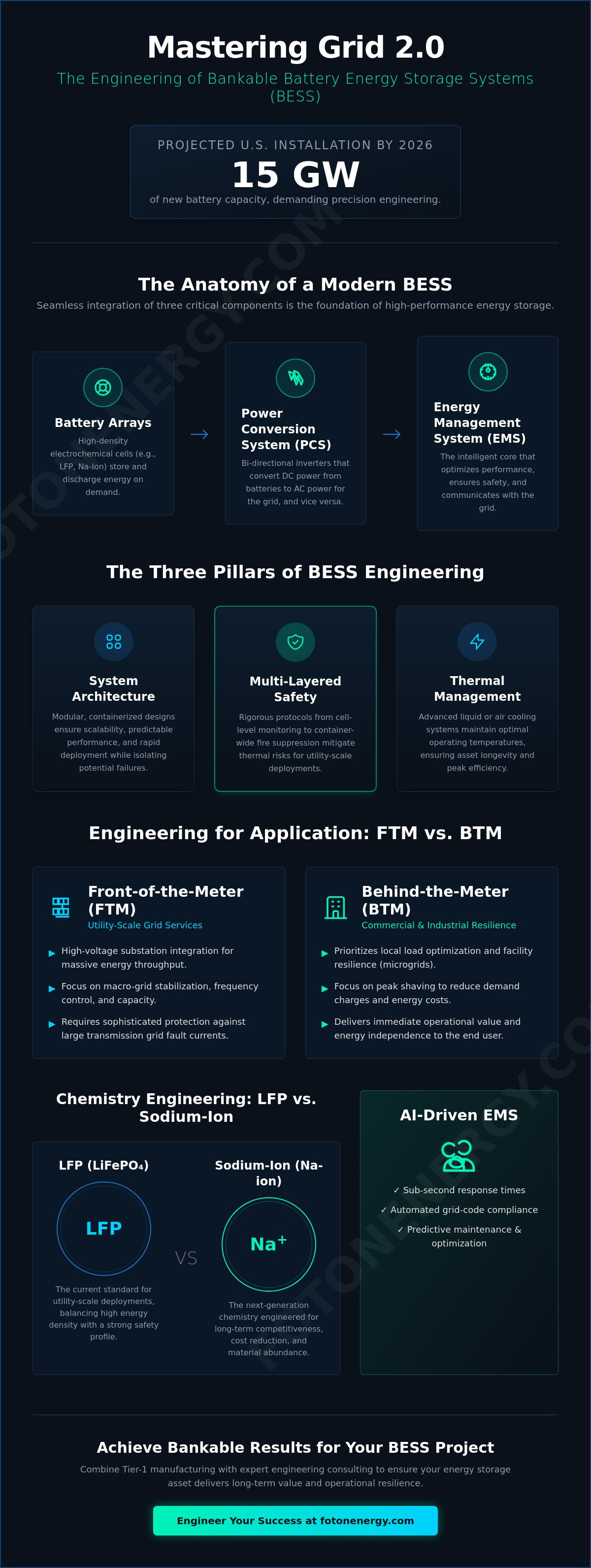
Modern energy infrastructure is no longer defined by static generation but by dynamic flexibility. At its core, grid connected energy storage engineering involves the seamless integration of three critical components: high-density battery arrays, bi-directional Power Conversion Systems (PCS), and intelligent Energy Management Systems (EMS). This integrated approach represents a fundamental departure from legacy mechanical storage. As we evaluate the evolution of Grid energy storage technologies, the focus has shifted from massive, geographically constrained projects toward modular, containerized electrochemical solutions that offer rapid scalability and geographic independence.
To better understand the components and functionality of these systems, watch this helpful video:
The primary engineering objective in 2026 is twofold. First, systems must provide sub-second frequency response to stabilize the grid during transient events. Second, they must manage long-duration energy shifting to align renewable generation with peak demand. Achieving this balance requires a relentless focus on "bankability." In the engineering context, bankability isn't just a financial metric; it's a design standard. It means designing for a 20-year lifecycle with predictable degradation, rigorous safety certifications, and a technical architecture that institutional investors can trust. Advanced grid connected energy storage engineering ensures that these resources aren't just connected to the grid; they're foundational to its survival.
Grid Stability and Ancillary Services
Designing for Grid 2.0 means engineering for stability in a landscape dominated by Inverter-Based Resources (IBRs). Modern BESS must provide Frequency Control Ancillary Services (FCAS) and precise voltage regulation. Since wind and solar lack the physical inertia of traditional rotating turbines, engineers now implement synthetic inertia within inverter software. This allows the system to mimic traditional grid behavior. These systems prevent blackouts through rapid response and provide essential black start capabilities, allowing the grid to recover after a total system failure without relying on external power sources.
Front-of-the-Meter (FTM) vs. Behind-the-Meter (BTM) Engineering
The technical requirements for storage vary significantly based on the point of interconnection. Front-of-the-Meter (FTM) utility-scale arrays focus on high-voltage substation integration and massive energy throughput. These projects require sophisticated protection coordination to handle the immense fault currents of the transmission grid. Conversely, Behind-the-Meter (BTM) industrial microgrids prioritize local optimization. These C&I applications focus on peak shaving and demand charge reduction, ensuring individual facilities maintain resilience. While FTM projects stabilize the macro grid, BTM engineering delivers immediate operational value to the end user by managing localized load profiles and reducing energy costs.
The Three Pillars of BESS Engineering: Architecture, Safety, and Thermal Management
Designing a utility-scale asset is an exercise in rigorous risk mitigation. In the field of grid connected energy storage engineering, the system architecture serves as the foundation of long-term bankability. We've seen a decisive shift from centralized, site-built systems toward modular, containerized configurations. This modularity isn't just about ease of transport; it's about isolating failures and ensuring that a single module's downtime doesn't compromise the entire 100 MWh array. By utilizing standardized containers, engineers can achieve predictable performance while streamlining the interconnection process.
Safety architecture must be multi-layered, moving from the internal chemistry of the cell to the external housing of the container. The industry now relies on the IEC 62933-5-4:2026 standard, published in May 2026, which outlines the most current safety test methods for lithium-ion systems. This level of verification, alongside DNV and UL certifications, provides the grounded assurance that institutional investors demand. For developers looking to integrate these complex layers into a single, high-performance asset, professional engineering consulting can bridge the gap between initial design and bankable deployment.
Modular Architecture and Containerized Solutions
Modular systems offer unparalleled scalability for the modern grid. By engineering containerized LFP and sodium-ion units, developers can deploy multi-MW/MWh arrays with significantly reduced onsite labor. These systems are designed for a 20-year lifecycle, allowing for "augmentation" or the addition of new modules as capacity naturally degrades over time. Integrating Power Conversion Systems (PCS) directly into these modules minimizes DC cable runs and reduces electrical losses, ensuring maximum round-trip efficiency.
Safety and Fire Suppression Technology
Modern safety engineering prioritizes thermal runaway prevention through high-fidelity Battery Management Systems (BMS). These systems monitor cell-level voltage and temperature in real-time, triggering protective disconnects before a fault escalates. Compliance with NFPA 855 is now a baseline requirement for large-scale BESS. Engineering teams must integrate multi-gas detection sensors and active fire suppression systems, such as Novec 1230 or water-mist arrays, to ensure the system remains safe even in high-density urban environments.
Advanced Thermal Management Strategies
Thermal management is the critical link between safety and longevity. While air cooling remains cost-effective for some applications, the high-density arrays of 2026 increasingly rely on liquid cooling to manage intense thermal loads. This trend is supported by advanced research in power systems, which demonstrates that precise temperature control significantly extends cycle life. Engineers must balance cooling performance with energy efficiency, as excessive parasitic loads from cooling pumps can quickly erode the project's overall ROI.
Chemistry Engineering: Comparative Analysis of LFP and Sodium-Ion for Grid Stability
Selecting the optimal cell chemistry is a foundational pillar of grid connected energy storage engineering. In 2026, the industry has moved decisively away from cobalt-based chemistries in favor of Lithium Iron Phosphate (LFP) and the rapidly commercializing Sodium-Ion. This shift is driven by a requirement for "bankable" safety and long-term cycle resilience. LFP remains the dominant standard, on track to claim nearly half of the North American battery market by 2030. With average pack costs at approximately $81 per kWh as of early 2026, LFP provides a mature, reliable architecture for utility-scale assets.
While LFP leads in market share, Sodium-Ion is no longer an experimental technology. It has moved into active commercial deployment, particularly for stationary applications where cost and material abundance are paramount. As we navigate the Utility-Scale Energy Storage Technologies and Challenges, engineers must weigh the lower energy density of sodium-ion against its superior performance in extreme temperatures and its lower cost profile. Sodium-ion cell costs currently range between $46 and $62 per kWh, offering a sustainable alternative for projects where footprint is less constrained than capital expenditure.
Engineering for specific discharge rates, or C-rates, is critical for grid stability. Utility-scale projects typically require a balance between high-power (1C or higher) for frequency regulation and high-energy (0.25C to 0.5C) for four-hour energy shifting. LFP excels in high-cycle, high-depth-of-discharge (DoD) environments, while sodium-ion demonstrates remarkable discharge efficiency and safety during rapid power delivery. This comparative analysis ensures that the chosen chemistry aligns with the specific ancillary services the asset will provide to the grid.
Engineering for LFP Cycle Life and Degradation
Maximizing the ROI of an LFP asset requires sophisticated predictive modeling of capacity fade. Engineers now design for 6,000 to 10,000 cycles, assuming a managed depth of discharge. We focus on balancing energy throughput with thermal stability to ensure the asset maintains its "bankable" status over a 20-year lifespan. For a deeper look at these requirements, see our Strategic Guide to C&I BESS Solutions.
Sodium-Ion Implementation in Grid Engineering
Sodium-ion batteries are solving specific engineering challenges in 2026, particularly for infrastructure that demands resilience in cold climates. Unlike lithium-ion, sodium cells maintain high efficiency at sub-zero temperatures without extensive parasitic heating loads. This makes them ideal for decentralized assets, such as telco towers and data centers. Learn more about these applications in our report on the Sodium-Ion Battery for Data Centers in 2026.
Grid-Code Compliance and the Engineering of Seamless Interconnection
Grid-code compliance is the definitive technical bridge between a successful installation and a stranded asset. In grid connected energy storage engineering, the Point of Common Coupling (PCC) serves as the critical interface where system performance meets utility requirements. This isn't merely about electrical continuity. It's about managing harmonic distortion and reactive power to ensure the BESS doesn't degrade the power quality of the wider network. Engineers must conduct rigorous grid connection studies, including load flow and short-circuit analysis, to verify that the system can operate within the specific constraints of the local substation.
Achieving sub-second response times in frequency regulation markets is no longer a luxury. It's a standard requirement for participation in high-value ancillary services. This level of precision requires a deep alignment between the battery modules and the Power Conversion System (PCS). For developers navigating these technical complexities, our Intelligent EMS and engineering services provide the necessary oversight to ensure seamless grid integration and long-term compliance.
AI-Driven Energy Management Systems (EMS)
The next generation of Energy Management Systems (EMS) utilizes machine learning to optimize dispatch strategies in real-time. By analyzing volatile energy market data alongside predictive maintenance alerts, an AI-driven EMS ensures maximum ROI while protecting the battery's health. This intelligence layer interfaces directly with the utility-scale SCADA system, allowing for automated response to grid signals. It ensures that the BESS operates within its safe operational envelope while meeting the sub-second demands of frequency regulation.
Achieving Regulatory and Grid-Code Compliance
Compliance starts with the IEEE 1547-2018 standard, which dictates the mandatory requirements for interconnection and interoperability. The 1547a-2020 amendment provides further flexibility for abnormal operating performance, a critical factor for systems deployed in unstable regions. In markets like Australia, adhering to AEMO’s strict grid-code standards requires exhaustive testing and commissioning protocols. As distributed energy resources (DERs) become more interconnected, engineering for cybersecurity is paramount. Protecting the communication network between the BESS and the utility operator is essential to preventing unauthorized access and ensuring grid stability.
Collaborative Engineering: Scaling Bankable BESS with Foton and Cospowers
Engineering excellence is the definitive differentiator in a market projected to reach $151.2 billion by 2029. While previous sections detailed the technical requirements of hardware and software, the execution of these systems requires a partner who bridges the gap between high-spec manufacturing and operational reality. Foton provides this critical link through end-to-end engineering consulting and strategic hardware procurement. As the exclusive distributor for Cospowers in Australia and Ireland—a partnership solidified in September 2025—we combine Tier-1 manufacturing heritage with sophisticated grid connected energy storage engineering expertise to deliver assets that are both high-performing and finance-ready.
Our impact extends across a global network. Through the Foton Channel Partner Programme, we support EPCs, developers, and system integrators in over 70 countries. We don't just supply components; we foster strategic alliances that ensure large-scale infrastructure investments are grounded in rigorous testing and international certifications. This collaborative framework allows our partners to navigate complex regional requirements with the confidence of a global leader, ensuring that every project achieves long-term value and technical resilience.
End-to-End Engineering Consulting
Success in utility-scale deployment begins long before the first container arrives on site. We provide comprehensive feasibility studies and site assessments to ensure every project is optimized for its specific grid environment. Our consulting services include custom system design, where we refine thermal management and safety architectures to meet the highest standards. We offer dedicated technical support for commissioning and grid-code certification, ensuring your asset meets the sub-second response requirements of modern frequency regulation markets.
Wholesale Procurement and Supply Chain Resilience
Securing a reliable supply of Tier-1 modules is essential for maintaining project timelines and bankability. We provide direct access to high-capacity LFP and sodium-ion modules, leveraging Cospowers' advanced manufacturing capabilities to ensure quality and durability. With LFP pack costs averaging $81 per kWh in early 2026, our procurement strategies focus on maximizing ROI while maintaining supply chain resilience for large-scale infrastructure projects. We manage the complexities of global logistics so you can focus on deployment.
Partner with Foton for your next grid-connected project to secure the engineering expertise and hardware reliability your utility-scale investment demands.
Securing the Next Generation of Grid Resilience
The technical complexity of utility-scale deployment in 2026 demands a decisive shift from simple hardware procurement to integrated, high-performance grid connected energy storage engineering. We've examined how the synergy between modular safety architectures, advanced LFP and sodium-ion chemistries, and AI-driven grid-code compliance creates a truly bankable asset. By prioritizing sub-second frequency response and Tier-1 safety standards, developers ensure long-term stability in an increasingly decentralized energy landscape.
As the exclusive global partner of Tier-1 manufacturer Cospowers, Foton bridges the gap between manufacturing heritage and strategic engineering consulting. Our global network, spanning over 70 countries, utilizes intelligent EMS for real-time grid optimization; this ensures your infrastructure remains resilient against volatile market conditions. Success in this evolving sector belongs to those who build on a foundation of proven expertise and visionary pragmatism.
Scale your infrastructure with Foton's engineering expertise and lead the transition toward a more stable, sustainable future.
Frequently Asked Questions
What is grid-connected energy storage engineering?
Grid-connected energy storage engineering is the technical discipline focused on the seamless integration of battery storage systems into the electrical utility network. It encompasses the selection of electrochemical cells, the design of bi-directional power conversion systems, and the implementation of sophisticated control software. Engineers in this field must balance physical site constraints with rigid electrical performance requirements to ensure long-term reliability and system stability.
How do you ensure grid-code compliance for a BESS project?
Ensuring grid-code compliance requires a combination of early-stage grid connection studies and the deployment of high-fidelity control systems. Engineers must adhere to international standards such as IEEE 1547-2018 while meeting specific regional requirements for frequency response and voltage regulation. Utilizing an intelligent Energy Management System (EMS) allows for real-time monitoring and automated adjustments to maintain the system within the mandated operational parameters.
What is the difference between AC-coupled and DC-coupled storage engineering?
The primary difference lies in the point of electrical interconnection. AC-coupled systems connect the battery and solar arrays via separate inverters, which makes them ideal for retrofitting existing generation sites. DC-coupled engineering integrates both resources behind a single inverter. This configuration reduces conversion losses and simplifies the control architecture for new utility-scale solar-plus-storage projects where efficiency is a primary design goal.
How does thermal management affect the bankability of a utility-scale battery?
Thermal management is a core pillar of grid connected energy storage engineering because it directly dictates the asset's cycle life and safety profile. Maintaining optimal temperatures prevents accelerated capacity fade and mitigates the risk of thermal runaway. Institutional investors view robust cooling systems, particularly liquid-cooling architectures, as a prerequisite for bankability, as they ensure the system reaches its projected 20-year operational lifespan.
Why is sodium-ion becoming a preferred choice for grid-connected telco backup?
Sodium-ion is gaining traction in telco backup because it offers superior performance in extreme temperatures and high discharge efficiency without the cost of lithium. These batteries maintain high capacity in sub-zero environments, which reduces the need for energy-intensive heating systems at remote tower sites. Their reliance on abundant raw materials also provides a more stable supply chain for large-scale telecommunications infrastructure rollouts.
What role does AI play in grid-connected energy storage engineering?
AI serves as the intelligence layer that optimizes energy trading and predictive maintenance in modern BESS. By analyzing historical market data and real-time system health, AI-driven algorithms determine the most profitable times to charge or discharge while minimizing cell degradation. This capability allows operators to participate in volatile frequency regulation markets with sub-second precision, significantly enhancing the project's overall return on investment.


