

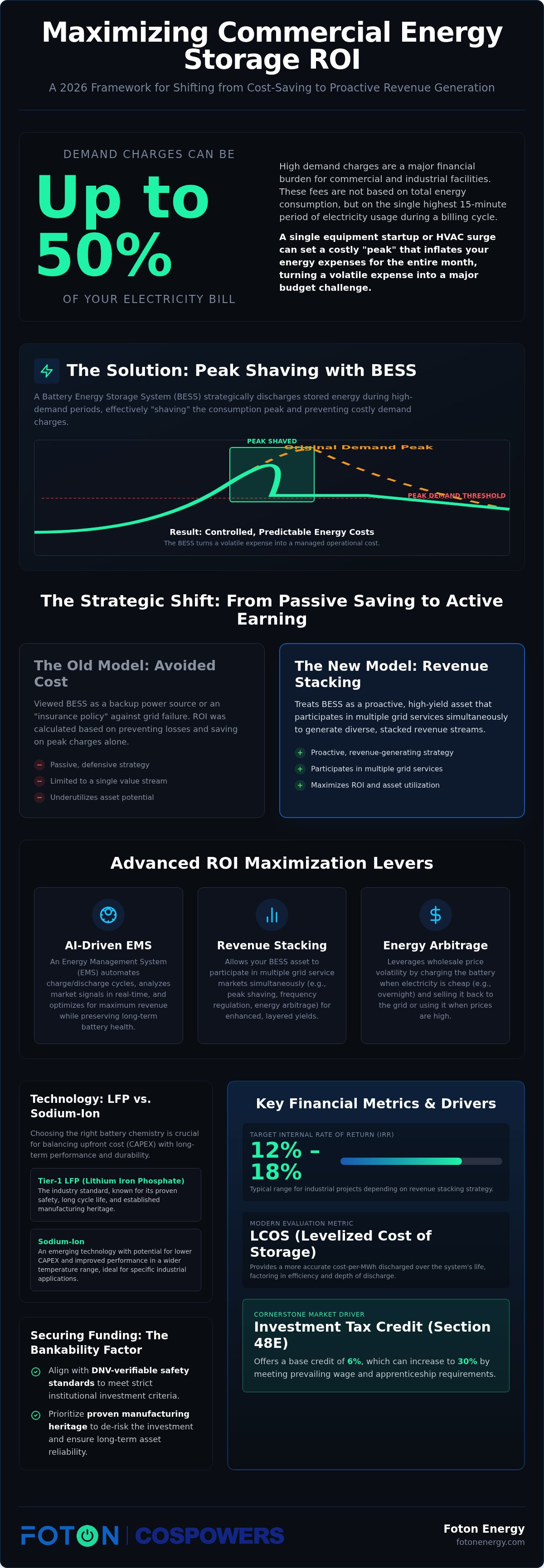
Demand charges now account for up to 50% of the average commercial electricity bill, making the pursuit of a strong commercial energy storage roi a financial necessity rather than just a sustainability goal. While the necessity of energy independence is clear, the path to achieving it often feels obscured by high upfront CAPEX and the technical complexity of grid service integration. You've likely questioned the long-term bankability of hardware or worried about the rapid degradation of assets in high-demand environments. These are valid concerns for any strategic leader looking to secure a resilient energy future while navigating the shift toward a decentralized grid.
This guide provides a definitive framework for calculating your returns in 2026, moving beyond simple arbitrage to unlock sophisticated revenue stacking. We'll examine how AI-driven Energy Management Systems (EMS) optimize performance in real-time, ensuring your investment remains a high-yield asset. You'll gain a deep understanding of how Tier-1 LFP and sodium-ion technologies provide the durability required for industrial-scale applications. Let's explore the financial architecture and technical proof points that turn energy storage into a foundational pillar of your corporate strategy.
Key Takeaways
- Master the transition from traditional "avoided cost" models to modern revenue stacking, allowing your asset to participate in multiple grid services simultaneously for enhanced yields.
- Analyze the impact of demand charge management on your commercial energy storage roi, specifically focusing on how mitigating 15-minute peak events stabilizes monthly cash flows.
- Evaluate the financial trade-offs between Tier-1 LFP and sodium-ion chemistries, focusing on CAPEX requirements and cycle-life performance across different industrial applications.
- Leverage AI-driven Energy Management Systems (EMS) to automate discharge cycles, ensuring optimal revenue capture while preserving long-term battery health and system bankability.
- Streamline the project financing process by aligning with DNV-verifiable safety standards and proven manufacturing heritage to meet strict institutional investment criteria.
The Shift in Commercial Energy Storage ROI: Beyond Simple Savings
Traditional energy models are giving way to a more dynamic financial reality. For years, businesses viewed energy storage primarily as a safety net, a silent insurance policy against grid failure. In 2026, that perspective has shifted toward a proactive, revenue-generating strategy. Calculating a modern commercial energy storage roi requires a departure from basic 'avoided cost' spreadsheets. You must now account for complex interactions between CAPEX, ongoing OPEX, and the sophisticated practice of revenue stacking. This transition from a backup-power mindset to an active-asset mindset is what separates a standard utility project from a truly bankable investment.
To understand this shift, one must first grasp the technical foundation. What is a Battery Energy Storage System (BESS) in a commercial context? It's no longer just hardware. It's an intelligent node within a larger industrial ecosystem that manages demand charges, which can account for 30% to 50% of a facility's monthly utility bill. Behind-the-meter (BTM) systems allow C&I operators to shave these peaks with precision. By discharging stored power during 15-minute intervals of high demand, a BESS prevents the expensive "ratchet" effects that often ruin monthly operational budgets. This isn't just about saving energy; it's about strategic load management.
Key Financial Metrics for BESS Evaluation
Financial leaders are moving beyond LCOE (Levelized Cost of Energy) toward LCOS (Levelized Cost of Storage). This metric provides a more accurate picture of the cost per megawatt-hour discharged over the system's life, factoring in depth of discharge and cycle efficiency. In the current market, industrial projects often target an Internal Rate of Return (IRR) between 12% and 18%, depending on the aggressiveness of the revenue stacking strategy. For mission-critical data centers, the 'Value of Resiliency' adds a layer of non-market value. This metric quantifies the immense cost of potential downtime, often justifying the investment even before grid service revenue is considered.
Market Drivers Influencing Payback Periods
Regulatory frameworks have stabilized, providing the bankable assurance that large-scale investors require. The commercial investment tax credit (Section 48E) remains a cornerstone of the 2026 market. It offers a base credit of 6% that can increase to 30% when meeting specific prevailing wage and apprenticeship requirements. While wholesale price volatility continues to drive arbitrage profits, initial investments must also account for grid-code compliance. These technical standards ensure your system integrates safely with the utility network. Although they increase upfront engineering costs, compliance is mandatory for securing the grid-connection agreements that make long-term commercial energy storage roi possible.
Primary Revenue Streams: Peak Shaving and Demand Charge Management
Maximizing your commercial energy storage roi starts with neutralizing demand charges. These fees, often based on the highest 15-minute window of electricity usage, can account for 30% to 50% of a total industrial utility bill. A single heavy machinery startup or a cooling cycle surge during a heatwave can set a peak that dictates your costs for the entire month. By deploying energy storage to meet these spikes, you effectively "shave" the peak, ensuring your facility never crosses a costly threshold. It's a precise, automated process that transforms a volatile expense into a predictable line item.
The financial impact varies by sector, but the logic remains consistent. Manufacturing plants with intermittent, high-power equipment benefit most from rapid-response peak shaving. Conversely, cold storage facilities, which maintain a high base load, find greater value in load shifting to avoid time-of-use (TOU) premium rates. Analyzing these Primary Revenue Streams reveals that the most successful projects don't just save energy; they strategically time its consumption to align with the lowest possible tariff structures.
Strategic Peak Shaving Implementation
Success in peak shaving requires a delicate balance between aggressive discharge and long-term asset health. Automated Energy Management Systems (EMS) set discharge thresholds based on real-time load monitoring. If you discharge too frequently to shave minor peaks, you risk accelerating battery degradation, which can negatively impact your long-term returns. However, when managed correctly, heavy industrial users have seen peak demand reductions of 30% or more. For these demanding environments, Ana-Digi Systems provides the industrial automation and energy optimisation expertise needed to integrate storage with complex plant operations. This level of performance requires Tier-1 hardware that can handle frequent cycling without compromising the system's State of Health (SoH).
Modern energy strategy involves more than just reacting to peaks. It's about proactive load shifting. By charging your BESS during low-cost periods, such as mid-day solar peaks, and discharging during expensive evening ramps, you capture the price spread. This arbitrage is particularly effective when integrating commercial and industrial BESS solutions with existing on-site solar PV. Instead of exporting excess solar to the grid for minimal credit, you store it to offset peak evening rates, significantly accelerating your commercial energy storage roi. Modeling these complex cycles is essential for bankability, and seeking expert engineering consulting ensures your system is sized correctly for these dual-purpose applications.
Advanced ROI Maximization: AI-Driven EMS and Revenue Stacking
Revenue stacking represents the strategic frontier of commercial energy storage roi. It's the practice of leveraging a single BESS asset to serve multiple functions, often simultaneously, to maximize the value of every kilowatt-hour. In 2026, relying solely on demand charge reduction is a missed opportunity. Modern projects integrate multiple value streams, including Frequency Control Ancillary Services (FCAS), demand response, and wholesale arbitrage. This multifaceted approach ensures that the battery is never idle, constantly pivoting to the most profitable application based on real-time grid conditions.
The technical backbone of this strategy is the Energy Management System (EMS). To achieve bankability, an asset requires more than just high-quality cells; it needs the intelligence to navigate volatile markets. Standardized data from the Grid Energy Storage Cost and Performance Assessment highlights how performance metrics have evolved to favor systems capable of high-speed response. AI-driven systems provide this by automating the decision-making process, ensuring that participation in grid services doesn't inadvertently trigger a new peak demand charge at the facility.
The Role of AI in Real-Time Optimization
Machine learning algorithms now forecast grid price spikes with significant accuracy, allowing the BESS to pre-charge before a high-value event. This predictive capability extends to maintenance. AI-driven thermal management monitors cell temperatures and cooling cycles, reducing OPEX by preventing accelerated degradation. By anticipating hardware stress, the system protects the long-term commercial energy storage roi and ensures the asset reaches its projected lifespan. For a deeper dive into the technical architecture of these platforms, consult our AI driven energy management systems guide.
Grid Services and Demand Response ROI
Virtual Power Plants (VPPs) have matured into a reliable revenue stream for C&I operators. By aggregating your storage capacity with other assets, a VPP provider can bid into utility-scale markets that were previously inaccessible. Contractual requirements in 2026 demand high availability and millisecond response times, making grid stability battery solutions a prerequisite for participation. These contracts often provide fixed monthly payments in addition to performance-based incentives, creating a financial floor for your calculations that satisfies even the most conservative institutional financiers.
The Longevity Factor: LFP vs. Sodium-Ion Financial Performance
Selecting the right battery chemistry is no longer a binary choice between cost and performance. It's a strategic calculation of the Levelized Cost of Storage (LCOS) over a 10 to 15-year horizon. While Lithium Iron Phosphate (LFP) remains the industry benchmark for heavy-duty applications, the mass production of sodium-ion modules in 2026 has introduced a compelling alternative for specific industrial profiles. To secure a bankable commercial energy storage roi, you must align your chemistry choice with your primary revenue stream, whether that involves high-frequency grid balancing or long-duration load shifting.
The financial equation extends beyond the initial purchase price. You must evaluate how different chemistries handle thermal stress and degradation, as these factors dictate the timing of expensive cell augmentations. In 2026, the ability to predict these costs with precision is what separates a speculative project from a foundational infrastructure investment. By integrating Tier-1 hardware with sophisticated thermal management, you protect the asset from premature failure and ensure the projected internal rate of return remains intact.
LFP: The High-Cycle Workhorse
Lithium Iron Phosphate continues to dominate the C&I sector due to its proven durability and extensive manufacturing heritage. High capacity LFP battery modules are engineered for heavy-cycling environments where the asset may discharge multiple times per day to capture arbitrage or manage demand spikes. Managing degradation through proprietary cooling and DNV-verifiable safety architecture is essential for maintaining the system's state-of-health (SoH). When evaluating utility scale BESS procurement, the focus remains on long-term cycle life, often exceeding 6,000 to 8,000 cycles before significant capacity loss occurs.
Sodium-Ion: The Emerging Cost-Leader
Sodium-ion technology has transitioned from pilot projects to large-scale commercial availability, driven by CATL's mass production capabilities. These systems offer a projected 30% reduction in upfront CAPEX compared to LFP, primarily because they utilize abundant sodium instead of lithium. While they possess different discharge characteristics, their inherent resilience in extreme temperatures reduces the requirement for energy-intensive active cooling, significantly lowering ongoing OPEX. This makes sodium-ion an ideal candidate for data center UPS and long-duration storage. Review the latest sodium-ion battery commercial availability trends to determine if this chemistry fits your facility's specific environmental and financial profile.
ROI calculations must also account for the decommissioning phase. As global recycling infrastructure for LFP matures, the residual value of decommissioned modules provides a final financial injection into the project's lifecycle. Conversely, the simplified chemistry of sodium-ion may offer lower disposal costs, though the secondary market is still developing. Balancing these end-of-life factors ensures your commercial energy storage roi remains robust from the first day of commissioning to the final day of operation. To determine the most bankable chemistry for your specific load profile, request a technical ROI assessment from our engineering consulting team.
Securing Funding: Bankability and the Foton/Cospowers Advantage
Achieving a bankable commercial energy storage roi requires more than a robust financial model; it demands a reduction in technical risk that satisfies institutional lenders. In 2026, financiers look beyond simple payback periods to scrutinize the underlying asset's durability and the manufacturer's reliability. As the exclusive global partner of Cospowers, Foton Energy bridges the gap between Tier-1 manufacturing excellence and localized project execution. This partnership ensures that every C&I or utility-scale project is backed by a stable supply chain and a DNV-verifiable architecture, which are critical prerequisites for securing low-interest infrastructure financing.
Technical risk mitigation is the cornerstone of project bankability. Lenders prioritize systems that feature integrated AI monitoring and professional engineering oversight, as these elements protect the asset's long-term performance. By positioning itself as a strategic engineering partner rather than a mere hardware vendor, Foton helps global EPC partners navigate the complexities of grid-code compliance and system integration. This end-to-end support minimizes the "risk premium" often attached to large-scale energy investments, ensuring your capital remains focused on generating returns rather than solving unforeseen technical hurdles.
The Value of Tier-1 Certification
Institutional investors rely on manufacturing heritage to gauge the likelihood of a 20-year asset lifespan. Cospowers brings over 30 years of manufacturing expertise to the table, providing the "bankable" assurance that lenders require. This heritage ensures supply chain transparency and consistent quality in both LFP and sodium-ion module production. Additionally, a modular energy storage architecture allows for seamless scalability. This design philosophy enables businesses to expand their capacity in phases, aligning capital expenditure with actual load growth and further stabilizing the commercial energy storage roi over time.
Engineering for Long-Term ROI
Professional oversight is essential for moving a project from the feasibility stage to successful commissioning. The role of BESS engineering consulting services involves more than just sizing hardware; it includes rigorous grid-modelling to ensure your system meets strict utility standards. Commissioning delays or grid-connection failures can erode a project's first-year revenue, significantly altering the initial financial projections. To finalize a successful ROI model, developers should utilize a comprehensive checklist that includes:
- DNV-GL or equivalent third-party safety and performance verification.
- Verified grid-code compliance for the specific local utility network.
- AI-driven EMS integration for real-time revenue stacking and thermal management.
- A clear O&M agreement that includes state-of-health (SoH) monitoring and performance guarantees.
By checking these boxes, you transform a complex energy project into a transparent, high-performance financial asset that attracts top-tier funding and delivers resilient, long-term value.
Capitalize on the 2026 Energy Transition
The landscape of industrial energy has fundamentally changed, moving from simple cost avoidance to active market participation. Achieving a superior commercial energy storage roi now requires a sophisticated blend of Tier-1 hardware bankability and AI-driven revenue stacking. By moving beyond basic peak shaving to intelligent grid services, businesses can transform energy from a passive overhead into a high-performance financial asset. Success depends on aligning your technical architecture with long-term strategic goals and verifiable safety standards.
As the exclusive global partner of Cospowers, Foton Energy provides the 30-year manufacturing heritage and advanced EMS software needed to secure institutional funding and ensure operational excellence. Our engineering consulting team is ready to help you navigate grid-code complexities and optimize your discharge cycles for maximum yield. We offer the stability of a global leader with the agility of a supportive, accessible partner.
Partner with Foton for Bankable Energy Storage Infrastructure
The transition to a resilient, decentralized grid is a significant opportunity for those with the right strategic partner. We look forward to building your energy future together.
Frequently Asked Questions
What is the typical payback period for a commercial BESS in 2026?
In 2026, most commercial energy storage systems achieve a payback period between three and five years when participating in peak shaving and virtual power plant programs. If your strategy focuses primarily on time-of-use arbitrage, the period typically extends to four to six years. These timelines are significantly shorter than previous decades due to increased electricity rates and maturing grid service markets, which accelerate the commercial energy storage roi for strategic industrial investors.
How does revenue stacking improve the ROI of industrial battery storage?
Revenue stacking improves financial performance by allowing a single battery asset to generate income from multiple sources simultaneously. Instead of only reducing demand charges, the system can participate in frequency control markets and wholesale arbitrage during idle periods. This maximizes the utilization rate of the hardware. By diversifying income streams, you reduce the project's sensitivity to any single market fluctuation, creating a more stable and predictable return on your capital investment.
Is sodium-ion or LFP better for commercial energy storage ROI?
The choice depends on your specific operational profile and environmental conditions. LFP remains the standard for heavy-cycle applications due to its proven lifespan of 6,000 to 8,000 cycles. However, sodium-ion offers a lower upfront CAPEX, potentially 30% cheaper than lithium alternatives, and performs better in extreme temperatures. For data centers or long-duration storage with fewer daily cycles, sodium-ion can offer a superior commercial energy storage roi by reducing initial investment and active cooling costs.
How does an AI-driven EMS increase the financial performance of a BESS?
An AI-driven Energy Management System increases financial performance by automating the decision-making process for charging and discharging. It uses machine learning to forecast grid price spikes and local load demands, ensuring the battery is always positioned for the highest-value event. Additionally, AI optimizes thermal management and prevents deep discharge cycles that accelerate degradation. This proactive approach extends the asset's functional life and minimizes ongoing OPEX through predictive maintenance alerts before hardware failures occur.
What are demand charges and how can battery storage reduce them?
Bankability refers to the set of characteristics that make an energy storage project attractive to institutional lenders and financiers. It's grounded in Tier-1 manufacturing status, DNV-verifiable safety architectures, and a proven manufacturing heritage, such as the 30-year track record provided by Cospowers. A bankable project also demonstrates strict grid-code compliance and utilizes high-quality components with long-term warranties. These factors reduce the perceived risk premium, allowing developers to secure lower interest rates and more favorable funding terms.
Can commercial battery storage participate in grid services like FCAS?
Yes, commercial battery storage systems are increasingly used to participate in Frequency Control Ancillary Services (FCAS) and other demand response programs. By aggregating multiple C&I assets into a Virtual Power Plant, businesses can provide the rapid-response capacity the grid needs to maintain stability. Participation often provides a combination of fixed availability payments and performance-based incentives. This creates a reliable revenue floor that complements the savings generated through behind-the-meter demand charge management and load shifting.
How do maintenance costs affect the long-term ROI of a BESS?
Maintenance costs, or OPEX, directly impact the long-term profitability by influencing the total cost of ownership. While BESS hardware has few moving parts, costs arise from HVAC system upkeep, inverter servicing, and eventual battery cell augmentation. Utilizing advanced thermal management and AI-driven monitoring can significantly reduce these expenses by preventing overheating and uneven cell wear. Factoring in a comprehensive operations and maintenance agreement ensures your financial model accounts for the entire lifecycle, protecting the project's internal rate of return.


