

In 2026, a BESS project is no longer just a collection of batteries; it's a sophisticated interplay of AI-driven thermal management and rigorous safety architecture. You're likely feeling the pressure of the updated NFPA 855 standards and the mandatory Hazard Mitigation Analysis requirements that now dictate every stage of bess engineering and design. It's a high-stakes environment where technical oversights don't just delay permits. They compromise the long-term bankability of your entire asset.
This guide provides the strategic framework you need to navigate these complexities, ensuring your systems are both grid-compliant and commercially resilient. We'll explore how to integrate disparate hardware through intelligent EMS, navigate the nuances of LFP and Sodium-ion chemistries, and deliver a permit-ready, stamped design that maximizes ROI. By aligning Tier-1 manufacturing heritage with proactive safety protocols, you can reduce commissioning risks and secure a stable, high-performance future for your energy infrastructure.
Key Takeaways
- Understand the transition of BESS from simple storage components to integrated, multidisciplinary infrastructure assets merging power electronics with AI-driven software.
- Ensure full grid-code compliance and safety by mastering the latest 2026 NFPA 855 and UL 9540A requirements within your bess engineering and design.
- Evaluate the technical trade-offs between LFP and Sodium-ion chemistries to optimize thermal management and energy density for specific utility-scale applications.
- Follow a structured engineering roadmap from initial feasibility assessments to detailed 90% design phases to mitigate commissioning risks and project delays.
- Leverage strategic consulting and Tier-1 manufacturing partnerships to secure long-term asset bankability and optimized ROI through expert system integration.
The Evolution of BESS Engineering: From Storage to Infrastructure
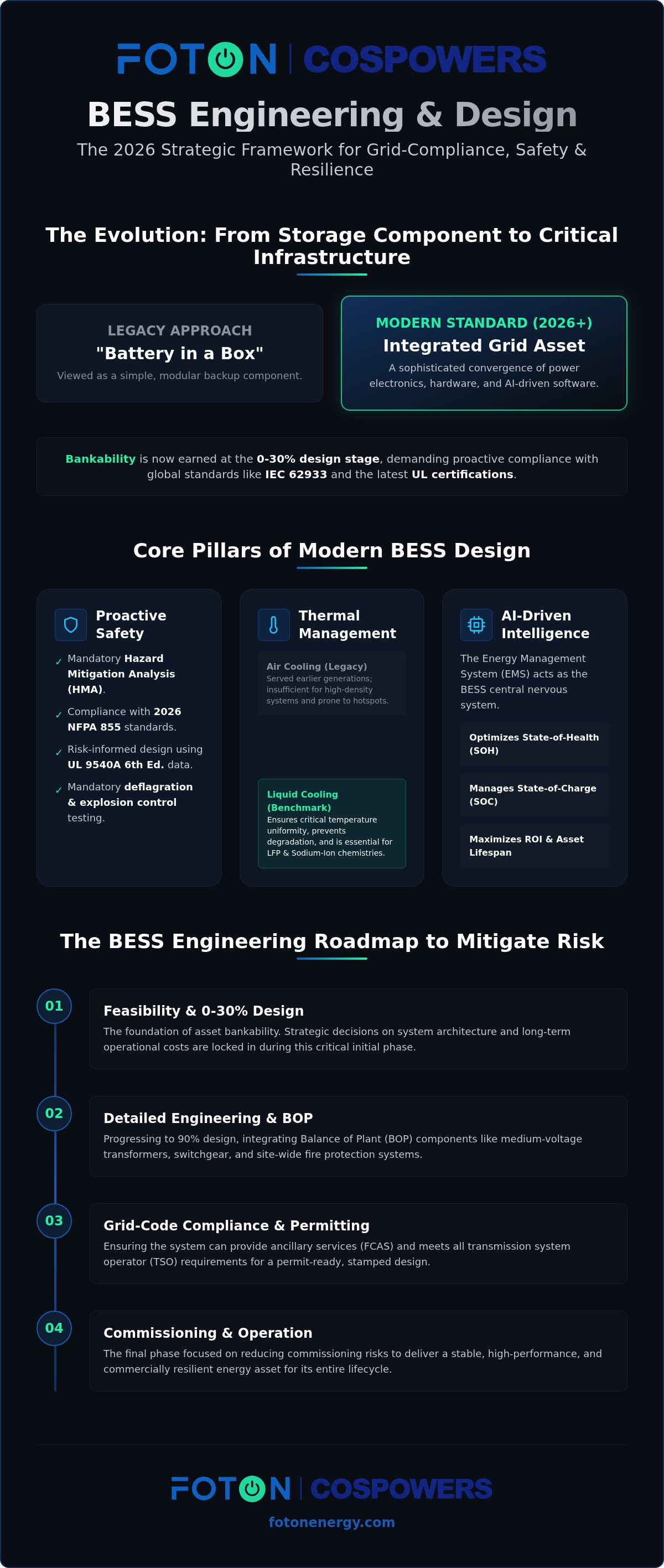
Modern energy storage has transcended its origins as a simple backup component. It's now a critical pillar of global infrastructure. BESS engineering and design represents a sophisticated convergence of electrochemistry, high-voltage power electronics, and intelligent software control. This multidisciplinary evolution reflects the industry's shift from a modular "battery in a box" toward fully integrated, grid-scale energy assets that function as the heartbeat of the modern power network.
For developers and financiers, bankability is no longer a post-construction certification. It's a status earned during the 0-30% design stage. This preliminary phase determines the project's long-term viability, as strategic decisions regarding system architecture directly influence lifetime degradation and operational costs. In 2026, adhering to international standards like IEC 62933 and the latest UL certifications provides the grounded assurance that institutional investors require to fund large-scale deployments.
Defining the Scope of BESS Design
A comprehensive Battery Energy Storage System (BESS) requires meticulous physical layout planning to optimize containerization without sacrificing safety. Engineers must balance high-density storage requirements with the necessary clearances for thermal management and maintenance access. Beyond the battery modules, the scope includes the Balance of Plant (BOP) components, such as medium-voltage transformers, switchgear, and site-wide fire protection systems. Each element must be seamlessly integrated to ensure reliable interconnection with the grid while maintaining a clean, high-performance operational environment.
The Importance of Grid-Code Compliance
Navigating the requirements of transmission system operators is a core challenge in modern engineering. Systems must be designed to support frequency control and ancillary services (FCAS), providing rapid response to grid fluctuations. In remote industrial settings or weak-grid environments, the design must maintain stability despite low short-circuit levels. Ultimately, ensuring full grid-code compliance stands as the primary hurdle for utility scale BESS procurement and successful commercial operation. This alignment between technical capability and regulatory demand ensures the asset remains a supportive, reliable partner to the broader energy ecosystem.
Core Design Pillars: Safety, Thermal, and AI Integration
Reliability is the currency of the energy transition. In 2026, bess engineering and design must move beyond reactive safety to proactive, integrated resilience. This requires a fundamental shift in how we approach thermal management and system intelligence. While air cooling served earlier generations, liquid cooling has become the benchmark for high-density LFP and Sodium-ion projects. It ensures temperature uniformity across cells, which is critical for preventing the localized hotspots that lead to degradation. When these pillars are integrated correctly, bess engineering and design creates a foundation for long-term commercial stability. This resilience is supported by high-precision hardware throughout the manufacturing process; for example, you can learn more about Contrinex and their smart sensors for complex automation and industrial applications.
Project success now hinges on navigating the 2026 edition of NFPA 855. A Hazard Mitigation Analysis (HMA) is no longer a threshold-based choice; it's the default requirement for most installations. This shift demands a risk-informed design process that integrates large-scale fire testing results from the UL 9540A 6th edition, published in March 2026. Engineers must implement multi-level protection that starts with cell-level monitoring and extends to robust container-level suppression. As noted by PNNL on BESS Community Readiness, preparing for these safety standards is essential for local acceptance and zoning approval. Proactive prevention through mandatory deflagration testing and explosion control ensures the asset remains secure throughout its lifecycle.
The Integration of AI-Driven EMS
The hardware is only as effective as the software governing it. AI driven energy management systems serve as the central nervous system of a modern BESS. These platforms optimize state-of-health (SOH) and state-of-charge (SOC) in real time, using predictive algorithms to balance grid-market participation with cell longevity. By modeling degradation patterns, AI reduces operational expenditure and enables complex revenue stacking. It transforms a passive storage unit into an active market participant. Designing for a 20+ year asset life requires this level of digital maturity to manage the complexities of modern power networks. For developers seeking to bridge this technical gap, partnering with an experienced engineering consulting partner ensures every pillar of design is optimized for bankability.
Chemistry-Specific Engineering: Designing for LFP vs. Sodium-Ion
Strategic battery selection is the cornerstone of effective bess engineering and design. While Lithium Iron Phosphate (LFP) remains the industry benchmark for utility-scale longevity, the landscape is diversifying. In 2026, engineers must account for the distinct physical and electrochemical profiles of emerging energy storage technologies. Sodium-ion has moved from the laboratory to the field, offering a compelling alternative where cold-weather resilience or raw material security is paramount. However, these chemistries aren't interchangeable. Each requires a tailored structural and thermal approach to ensure the final system remains a bankable asset.
LFP Engineering for Utility-Scale Longevity
LFP continues to dominate the market because it offers a proven path to a 20-year operational life. Engineering for these systems focuses on meticulous depth-of-discharge (DOD) management to preserve cycle life. By limiting DOD to 80% or 90%, developers can significantly extend the usable life of the modules. Modern high-capacity LFP designs utilize modular, liquid-cooled containers that maximize energy density while maintaining strict temperature uniformity. This architectural stability is particularly valuable for commercial and industrial BESS solutions, where consistent performance and predictable maintenance schedules are essential for ROI. In these applications, the mature LFP supply chain provides the cost-effectiveness needed for rapid deployment.
Sodium-Ion Design for Critical Infrastructure
The rise of sodium-ion battery commercial availability in 2026 has introduced new variables into the engineering process. Sodium-ion cells were approximately 13% more expensive than LFP at the cell level in 2025, yet they offer superior performance in extreme environments. Engineers are increasingly specifying a sodium-ion battery for data centers and telecom sites where high-discharge rates and safety in dense urban areas are critical. Because sodium-ion has a lower energy density, bess engineering and design must accommodate larger physical footprints and increased structural support. These systems excel in cold climates where LFP might struggle without intensive heating, reducing the parasitic load on the cooling system. This chemistry-specific approach ensures that the chosen technology aligns perfectly with the site's environmental constraints and operational goals.
The BESS Engineering Roadmap: From Feasibility to Commissioning
Execution excellence requires a disciplined framework. A successful project moves from abstract concepts to operational reality through a series of rigorous, data-driven milestones. bess engineering and design isn't a single event but a methodical journey that ensures every technical decision aligns with the project's financial objectives and safety requirements. By following a structured phase-gate process, developers can mitigate risks early and ensure the long-term bankability of their energy infrastructure.
Feasibility and Preliminary Design
Success begins with a deep dive into site-specific data. Engineers start with a granular load profile analysis to determine the optimal system sizing for applications like peak shaving, frequency response, or critical backup. This process isn't just about capacity; it's about economic modeling that proves ROI to financiers and partners. During this phase, we conduct initial grid-connection feasibility checks to identify potential capacity constraints or required network upgrades. This groundwork prevents costly redesigns later in the project lifecycle and establishes a realistic baseline for the entire bess engineering and design process.
Detailed Engineering and Permitting
Once feasibility is confirmed, the project moves into the detailed design cycle, typically following a 30-60-90% progression. This phase transforms high-level concepts into permit-ready, stamped construction packages that satisfy local authorities.
- Electrical Design: Developing comprehensive Single Line Diagrams (SLDs) and communication architectures that integrate the BMS, PCS, and EMS into a cohesive system.
- Structural Engineering: Designing robust foundations and enclosures that account for environmental shielding, thermal management clearances, and local seismic requirements. To ensure the integrity of these protective structures, you can learn more about Plastiques Elastomères and their high-performance industrial materials like PTFE and technical plastics.
- Permit Packages: Assembling the documentation required for Authority Having Jurisdiction (AHJ) approval, including the mandatory Hazard Mitigation Analysis (HMA) now required by the 2026 edition of NFPA 855.
The final stages involve rigorous grid-code compliance simulations to ensure the system won't destabilize the local network. After construction, the focus shifts to commissioning and Site Acceptance Testing (SAT). This verified handover process ensures the hardware meets all performance guarantees and safety protocols before the asset is officially energized. It's the final gate that transitions a project from a construction site to a bankable energy asset. To ensure your project follows this high-performance roadmap, consult with our engineering experts to bridge the gap between Tier-1 manufacturing and site-specific integration.
Strategic Engineering Partnership: The Foton-Cospowers Advantage
Strategic alignment between manufacturing and field execution is the ultimate safeguard for large-scale energy investments. Foton Energy serves as the vital link between Tier-1 manufacturing excellence and the specific technical demands of your project site. By leveraging the 30-year heritage of Cospowers, we ensure that every aspect of bess engineering and design is grounded in proven industrial performance. This partnership doesn't just provide hardware; it delivers a comprehensive ecosystem of technical assurance that spans more than 70 countries. It's a collaborative approach that transforms a standard equipment purchase into a long-term strategic asset.
Direct Tier-1 Integration
Bankability begins with the certainty of the supply chain. Through our exclusive global partnership with Cospowers, we eliminate the risks associated with disparate hardware sourcing and fragmented support. This direct integration allows us to customize battery architecture at the factory level, ensuring the physical system meets the precise needs of your application. Whether it's adjusting cell configurations for specific discharge rates or integrating proprietary AI-driven EMS, our direct line to the manufacturing floor streamlines the entire process. It's a level of control that simplifies long-term operations and maintenance (O&M) while providing a high degree of professional confidence to project financiers and stakeholders alike.
Consulting for Resellers and EPC Partners
Speed to market is a critical competitive advantage for developers and EPCs in a rapidly evolving sector. Our BESS engineering consulting services are designed to empower channel partners with the technical depth required to close complex deals. We provide the rigorous documentation and performance proof points necessary to secure project financing and regulatory approval. By acting as a steady, guiding hand, we help our partners navigate the intricacies of bess engineering and design without the need for an exhaustive in-house engineering department. This collaborative model reduces commissioning risks and ensures that every installation, from utility-scale farms to industrial backup systems, adheres to the highest global standards of safety and efficiency. We don't just sell technology; we build the foundations for a resilient energy future alongside our global network of partners.
Securing the Future of Energy Infrastructure Through Technical Excellence
The transition toward a sustainable energy landscape requires more than just hardware; it demands a sophisticated approach to bess engineering and design. We've explored how the integration of AI-driven energy management systems and rigorous adherence to the latest safety standards create the foundation for long-term grid compliance. By selecting the optimal chemistry, whether it's the proven longevity of LFP or the specialized resilience of sodium-ion, you ensure your project remains a high-performance asset for decades.
Project bankability is secured when technical excellence meets manufacturing stability. Foton Energy bridges this gap by leveraging the 30-year manufacturing heritage of our Tier-1 partner, Cospowers. With global engineering support spanning 70+ countries, we provide the steady, guiding hand needed to navigate from initial feasibility to successful commissioning. It's time to transform your energy vision into a permit-ready, operational reality. Contact our engineering team to discuss your BESS project feasibility and secure the future of your infrastructure investment. We look forward to building a resilient energy future alongside you.
Frequently Asked Questions
What is the primary goal of BESS engineering and design?
The primary goal is to transform energy storage hardware into a grid-compliant, safe, and bankable infrastructure asset. This process involves the strategic integration of electrochemistry, power electronics, and intelligent software to ensure long-term operational stability. Effective bess engineering and design prioritizes high-performance outcomes, such as optimized ROI through efficient thermal management and the reduction of commissioning risks for large-scale developers and financiers.
How does BESS engineering differ between LFP and Sodium-ion batteries?
Engineering for LFP focuses on maximizing cycle life through precise depth-of-discharge management and high-density liquid cooling systems. Sodium-ion design requires a different approach due to lower energy density, necessitating larger physical footprints and reinforced structural foundations. However, sodium-ion systems offer superior performance in cold climates and high-discharge scenarios, allowing engineers to reduce the parasitic loads typically required for heating lithium-based chemistries in extreme environments.
What are the key safety standards for large-scale BESS design in 2026?
In 2026, compliance centers on the updated NFPA 855 standard and the 6th edition of UL 9540A. These regulations mandate a comprehensive Hazard Mitigation Analysis (HMA) for most installations, regardless of size. Modern designs must incorporate large-scale fire testing results and proactive explosion control measures. Safety architecture has shifted from simple fire suppression to integrated prevention strategies that monitor cell-level health to stop thermal runaway before it begins.
How long does the BESS engineering and permitting process typically take?
The timeline generally spans six to eighteen months depending on project scale and local regulatory requirements. This roadmap includes preliminary feasibility studies, detailed 30-60-90% design cycles, and the final AHJ permit package submission. Engaging with an experienced engineering partner early in the feasibility stage helps streamline the grid-connection process and ensures that technical documentation meets the rigorous standards required for project financing and insurance approval.
What role does AI play in modern BESS engineering?
AI serves as the central intelligence of the system through proprietary Energy Management Systems (EMS). It utilizes predictive algorithms to manage battery degradation and optimize revenue stacking in real time. By modeling state-of-health and market trends, AI integration within bess engineering and design allows assets to participate in complex frequency control markets while maintaining a 20-year operational life. It transforms passive storage into an active, intelligent market participant.
Why is grid-code compliance critical for BESS engineering?
Compliance ensures that the storage system supports rather than destabilizes the local power network. It dictates how the BESS responds to frequency fluctuations, voltage drops, and fault conditions. Without meeting these strict transmission and distribution requirements, a project cannot secure an interconnection agreement. Engineers use sophisticated simulations to prove that the system can provide the ancillary services necessary for modern grid stability and commercial operation.
Can Foton Energy support BESS design for remote or off-grid locations?
Foton Energy provides specialized consulting for remote industrial sites and off-grid microgrids globally. We leverage Cospowers' 30-year manufacturing heritage to design robust systems that thrive in harsh environmental conditions. Our team specializes in tailoring thermal management and safety architecture for isolated locations where reliability is the highest priority. These projects often utilize our Tier-1 LFP or sodium-ion solutions to ensure continuous power for critical infrastructure and mining operations.
What is the difference between front-of-the-meter and behind-the-meter engineering?
Front-of-the-meter (FTM) engineering focuses on utility-scale systems connected directly to the distribution or transmission grid to provide bulk services like frequency regulation. Behind-the-meter (BTM) engineering targets commercial and industrial applications, where the system is installed on the customer's side of the utility meter. BTM design prioritizes peak shaving, backup power, and local load management, requiring different sizing strategies and interconnection protocols compared to larger utility-scale deployments.


