

A precisely configured energy management system can be the difference between a 40% revenue surplus and a stagnant asset that fails to meet its pro forma targets. You likely understand that while high-quality hardware is the foundation of any project, the real value of an ems for utility scale bess lies in its ability to navigate the volatile 2026 energy markets. It's frustrating to watch sophisticated LFP or Sodium-ion systems suffer from unpredictable degradation or remain trapped in software-hardware silos that prevent them from stacking multiple revenue streams. You've invested in the infrastructure. Now you need the intelligence to make it perform at its peak.
This guide demonstrates how AI-driven optimization software transforms static battery hardware into a dynamic, high-revenue asset while significantly extending system lifespan. We'll explore the integration of predictive thermal management, the impact of the latest NFPA 855 standards on operational safety, and how smart cycle management creates the bankable data your investors require. We'll also examine how automated revenue generation allows you to participate in complex grid service markets without compromising the physical integrity of your cells. This is your strategic roadmap for maximizing ROI through intelligent dispatch and chemical-level asset protection.
Key Takeaways
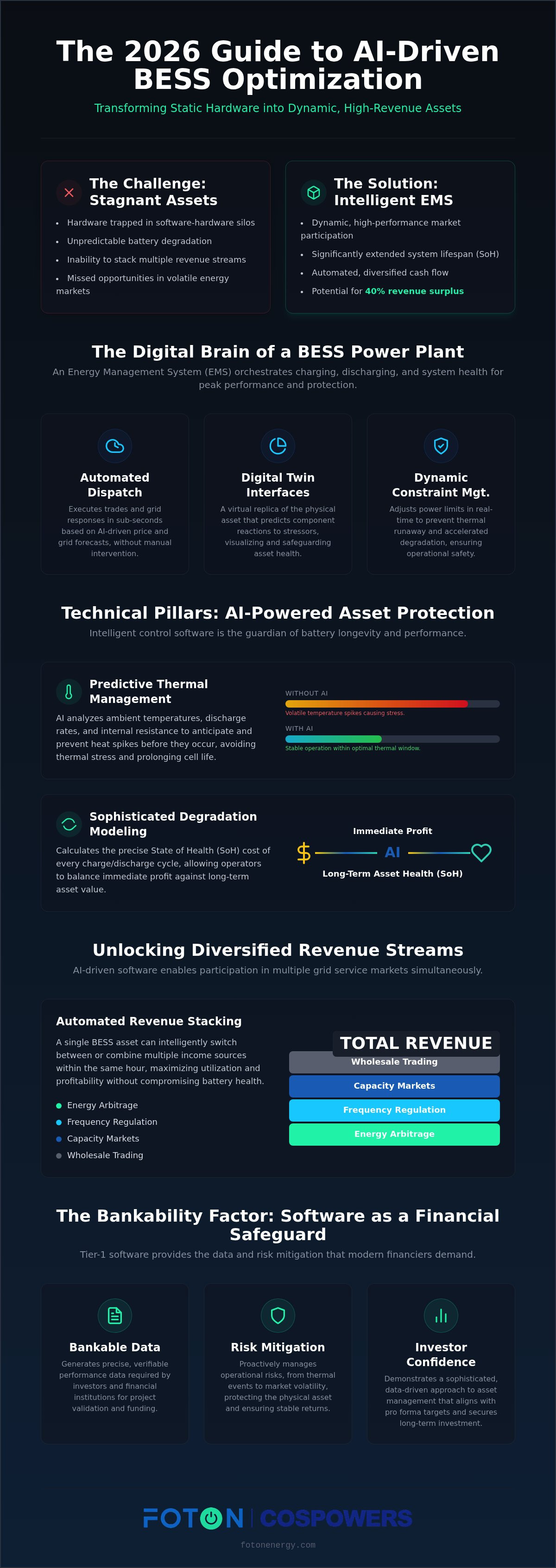
- Learn how an intelligent ems for utility scale bess serves as the critical digital brain, transforming static hardware into a high-performance market participant.
- Understand the technical pillars of predictive thermal management and degradation modeling used to safeguard State of Health (SOH) across thousands of cycles.
- Identify strategies for stacking multiple revenue streams, including energy arbitrage and frequency regulation, to ensure consistent and diversified cash flow.
- Discover how Tier-1 software integration acts as a financial safeguard, providing the bankable data and risk mitigation that modern financiers demand.
- Explore the competitive advantage of end-to-end BESS solutions that bridge the gap between Tier-1 manufacturing and advanced software optimization.
What is BESS Performance Optimization Software?
Performance optimization software serves as the digital orchestration layer that dictates how a Battery Energy Storage System (BESS) interacts with the broader grid ecosystem. It's the critical intelligence that manages charging, discharging, and overall system health. In 2026, the industry has moved beyond simple monitoring. We've entered an era where software functions as a proactive management suite, balancing aggressive market participation with deep, chemical-level asset protection. High hardware capacity is essentially meaningless without a sophisticated software strategy to direct it.
An effective ems for utility scale bess integrates several vital components to ensure operational excellence. These include the Energy Management System (EMS) for high-level logic, Power Plant Controllers (PPC) for site-level execution, and SCADA systems for comprehensive data visibility. When these elements work in harmony, they transform a collection of battery containers into a responsive, bankable power plant. This digital-first approach is what allows developers to bridge the gap between simple energy storage and true grid optimization.
The Core Functions of a Modern EMS
The primary role of an EMS is to facilitate real-time data acquisition from thousands of battery modules and inverters simultaneously. It doesn't just collect data; it interprets it to make automated decisions based on grid signals and sophisticated price forecasts. You can expect a modern system to provide:
- Automated Dispatch: Executing trades and grid responses without manual intervention.
- Digital Twin Interfaces: Visualizing asset health through a virtual replica that predicts how physical components will react to specific stressers.
- Dynamic Constraint Management: Adjusting power limits in real time to prevent thermal runaway or accelerated degradation.
Why 2026 Requires More Than Basic Monitoring
The grid environment has become significantly more volatile. With the implementation of FERC Order 2222 and the rapid rise of distributed energy resources, the windows for profitable arbitrage are shrinking while the technical requirements for grid participation are increasing. Basic monitoring tools simply can't keep up with the sub-second response times required for modern frequency control services.
Today's AI driven energy management systems provide a necessary competitive edge by forecasting market shifts before they happen. They allow operators to navigate complex "revenue stacking" scenarios where a single BESS might participate in frequency regulation, capacity markets, and wholesale trading within the same hour. This level of complexity requires a ems for utility scale bess that is both agile and deeply integrated with the underlying hardware chemistry.
Technical Pillars: How AI Optimizes Battery Health and Safety
Battery longevity isn't just a result of high-quality manufacturing; it's a product of intelligent control. An advanced ems for utility scale bess acts as a proactive guardian, ensuring that every cell operates within its optimal electrochemical window. In 2026, the focus has shifted from simple protection to predictive thermal management. By analyzing ambient temperatures, historical discharge rates, and real-time internal resistance, AI-driven software anticipates heat spikes before they occur, adjusting cooling systems or power limits in advance to prevent thermal stress.
Aggressive market participation often creates a conflict between immediate profit and long-term asset value. Sophisticated degradation modeling is now essential for managing the tradeoff between battery health and revenue. This software layer calculates the precise cost of every cycle, allowing operators to decide if a specific grid service payment justifies the marginal loss in State of Health (SOH). Furthermore, chemistry-specific tuning is a critical differentiator. While LFP remains the dominant utility-scale chemistry, the emergence of Sodium-ion requires specialized algorithms that account for its unique discharge curves and thermal characteristics. Foton's expertise in both chemistries ensures that the software logic is always aligned with the physical reality of the hardware.
Predictive Maintenance vs. Reactive Repair
Machine learning identifies cell-level anomalies that traditional monitoring systems frequently miss. By detecting subtle voltage deviations or impedance changes early, you can identify a failing module weeks before it causes a system-level fault. This allows for scheduled maintenance during periods of low market volatility, preserving your O&M budget and ensuring the system is ready for high-value events. Predictive maintenance is the primary driver for achieving 99% uptime in 2026.
Software-Defined Safety Architecture
Safety is no longer a passive feature; it's a software-defined discipline. Modern safety architecture utilizes multi-sensor data fusion to trigger automated shutdown protocols in milliseconds. These systems are designed to integrate seamlessly with physical fire suppression and active explosion control, ensuring full compliance with the latest UL9540A 6th Edition standards. For developers looking to de-risk their infrastructure, choosing a strategic partner in BESS optimization ensures that safety and performance are integrated from the start.
Revenue Streams: Arbitrage, Ancillary Services, and Beyond
Maximizing revenue in 2026 requires a shift from static operation to algorithmic agility. A high-performance ems for utility scale bess doesn't just store energy; it actively hunts for the most profitable deployment window across multiple markets. Wholesale market arbitrage remains a cornerstone of this strategy, using AI-driven price forecasting to capitalize on energy price spreads. By buying when renewable penetration is high and selling during peak demand, operators can secure predictable margins even in volatile environments.
Grid stability services offer an even more lucrative path for advanced systems. Frequency Control Ancillary Services (FCAS) provide premium payments for assets that can respond to grid imbalances in milliseconds. Capturing these high-value payments requires software that can transition between modes instantly. Deploying a robust ems for utility scale bess allows you to toggle between these revenue streams, ensuring the asset is never idle when profit opportunities arise on the local or regional grid.
Maximising Returns in the Australian Market
Navigating the National Electricity Market (NEM) involves managing intense price volatility and strict 2026 grid-code compliance standards. Automated bidding platforms now integrate directly with the EMS to execute trades at speeds impossible for human operators. While utility-scale projects often focus on wholesale markets, commercial and industrial BESS solutions utilize the same software intelligence for behind-the-meter savings. These systems reduce demand charges through peak shaving, providing a dual benefit of local cost reduction and regional stability support. Foton's engineering consulting team ensures these systems are optimized for the specific regulatory nuances of the APAC region.
The Logic of Value Stacking
Value stacking is the simultaneous execution of multiple service types to maximize IRR. The core challenge is the algorithmic selection of the most profitable service at any given second. An intelligent controller must weigh the immediate gains of an arbitrage trade against the "opportunity cost" of being unavailable for a high-value frequency event. It prioritizes grid signals against local site requirements, ensuring the asset works where it's needed most. This logic prevents the "software-hardware silos" that lead to inefficiency, creating a cohesive strategy that balances aggressive market participation with the chemical-level protection discussed in previous sections.
The Bankability Factor: Software as Financial Risk Mitigation
Financiers don't just look at the physical battery containers anymore. They require a sophisticated ems for utility scale bess to ensure the asset performs exactly as projected over a 15-year or 20-year lifespan. Without Tier-1 software, even the most reputable Tier-1 hardware is often viewed as an unquantified liability. This shift in investment criteria highlights a growing recognition that software is the primary tool for financial risk mitigation in large-scale infrastructure.
Revenue assurance provides the verifiable data trails necessary for Power Purchase Agreement (PPA) compliance. When a project must meet strict availability or throughput guarantees, the EMS serves as the ultimate record of truth. Digital twins take this a step further by allowing for complex risk modeling. By simulating thousands of performance scenarios, operators can identify potential thermal or degradation bottlenecks before they impact the bottom line. This level of software transparency directly correlates to lower insurance premiums; underwriters can quantify operational risks with far greater precision when they have access to high-fidelity simulation data.
Data Integrity and Audit Trails
Data integrity is the foundation of trust between operators and their financial stakeholders. Immutable performance logs are essential for validating warranty claims and resolving technical disputes with grid operators regarding frequency response accuracy. Cloud-native portals now offer investors real-time oversight into State of Charge (SoC), cell temperatures, and total energy throughput. Bankability is the intersection of hardware certification and software-proven performance.
Strategic Engineering and Consulting
Designing the interface between software and hardware is a high-stakes engineering challenge that requires specialized expertise. Leveraging BESS engineering consulting services ensures that your ems for utility scale bess is fully integrated and optimized from the initial design phase. This proactive approach includes simulation-based software testing to guarantee strict grid-code compliance, which is vital for securing interconnection in highly regulated markets. By aligning your digital strategy with your physical infrastructure, you create an investment-grade asset that survives the most rigorous due diligence.
If you are preparing a utility-scale project for financing, you can partner with Foton for bankable EMS solutions that protect your long-term ROI.
The Foton Advantage: Integrating Intelligent EMS with Tier-1 BESS
Foton Energy bridges the gap between raw hardware procurement and long-term market performance through a proprietary Intelligent EMS. Unlike generic control platforms, this software is engineered for deep synergy with both LFP and Sodium-ion chemistries. This specialized focus is made possible through Foton Energy's commitment to designing an **ems for utility scale bess** that offers profound integration with leading Tier-1 BESS hardware. This ensures that the software logic isn't just a layer on top of the hardware; it's deeply embedded within the system's operational DNA. This integration allows for a modular and scalable architecture that serves both high-capacity Utility-Scale Storage and complex C&I BESS projects with equal precision.
A reliable **ems for utility scale bess** must be backed by a robust global support infrastructure to maintain investor confidence. Foton provides a network that delivers 24/7 real-time monitoring and direct access to technical engineering expertise. This ensures that any performance deviations are addressed instantly, maintaining the high uptime standards expected of modern infrastructure. By combining AI-driven predictive thermal management with a stable, rigorously tested foundation, Foton provides the bankable assurance that large-scale investors require for 2026 projects.
Optimising the Next Generation: Sodium-Ion Software
Sodium-ion technology presents a unique set of discharge characteristics and thermal profiles that differ significantly from standard LFP cells. Foton's software adapts to these nuances in real time, maximizing energy throughput even in extreme temperature environments where other systems might throttle performance. This level of chemistry-specific optimization is a critical factor in utility scale BESS procurement, as it allows developers to future-proof their portfolios against shifting supply chain dynamics and environmental challenges.
End-to-End Implementation
Our collaborative approach extends from initial feasibility studies and engineering consulting to full software commissioning and long-term asset management. We ensure that the Intelligent EMS integrates seamlessly with existing energy infrastructure, whether it's a standalone utility project or a complex industrial site. This end-to-end oversight minimizes the risk of software-hardware silos and ensures that the system is ready to capture revenue from day one. Contact Foton Energy for a customised BESS software demonstration to see how our AI-driven platform can optimize your next project and extend your asset's operational life.
Future-Proofing Grid Infrastructure Through Intelligent Orchestration
The transition toward a resilient and profitable energy future depends on the synergy between robust hardware and sophisticated digital intelligence. We've established that maximizing IRR in 2026 requires more than just high capacity; it demands a high-performance ems for utility scale bess that can navigate volatile market signals while protecting chemical-level health. By integrating predictive thermal management and automated value stacking, you transform static assets into dynamic participants in the global energy transition.
Foton Energy stands at the forefront of this evolution as the exclusive strategic partner of Tier-1 manufacturer Cospowers. With a proven global reach in 70+ countries, we provide the AI-driven predictive thermal management and technical expertise necessary to ensure your infrastructure remains bankable and efficient for decades. It's time to move beyond simple monitoring and embrace a software-first approach to grid-scale storage.
Scale your energy storage strategy with Foton’s Intelligent EMS today. Together, we can build a more stable, high-performance energy landscape that delivers long-term value for investors and the grid alike.
Frequently Asked Questions
Can BESS optimization software really extend my battery's lifespan?
Yes, advanced software extends asset longevity by maintaining the battery within its ideal electrochemical window. Foton's Intelligent EMS uses AI-driven predictive thermal management to anticipate heat spikes before they damage cells. By balancing aggressive market cycles with State of Health (SOH) protection, the software prevents the excessive degradation often caused by manual or rule-based dispatch. This proactive approach ensures your system meets its 15 to 20 year performance targets.
Is performance optimization software compatible with all battery brands?
Most optimization software is designed for broad compatibility, but maximum performance requires deep hardware-software integration. Foton’s software is specifically engineered to synergize with Tier-1 LFP and Sodium-ion hardware. Our exclusive partnership with Cospowers allows for a level of technical alignment that generic, brand-agnostic platforms cannot match. This ensures that the software logic perfectly mirrors the physical capabilities and safety protocols of the underlying battery modules and containers.
How does AI-driven software improve the ROI of a commercial BESS?
AI-driven software maximizes ROI by enabling "revenue stacking," which allows a single asset to participate in multiple markets simultaneously. An intelligent ems for utility scale bess can forecast price spikes for arbitrage while maintaining capacity for high-value frequency control ancillary services (FCAS). For commercial users, the software also automates peak shaving to reduce demand charges. These combined streams significantly shorten the payback period compared to systems using basic, single-purpose monitoring tools.
What is the difference between a BMS and a BESS optimization software?
The Battery Management System (BMS) is a local controller that manages cell-level safety, balancing, and protection within the battery rack. In contrast, BESS optimization software, or the EMS, acts as the site’s "digital brain." It orchestrates the interaction between the battery, the inverters, and the grid. While the BMS prevents immediate physical failure, the EMS manages market participation and long-term asset health to ensure the project remains financially viable.
Does the software help with grid-code compliance in Australia?
Yes, Foton’s engineering consulting and software suites are designed specifically to meet 2026 grid-code compliance standards for Australian utility-scale projects. This includes ensuring your system adheres to sub-second response requirements for the National Electricity Market (NEM). We use simulation-based testing to verify that the software interface correctly handles the complex dispatch signals required by AEMO. This reduces the risk of interconnection delays and ensures your asset is grid-ready from day one.
How secure is the cloud-native BESS monitoring against cyber threats?
Security is a foundational pillar of our cloud-native monitoring architecture. Foton utilizes industry-standard encryption and multi-factor authentication to protect all data transmissions between the site and the control center. Our systems provide immutable audit trails and performance logs, which are essential for both cybersecurity and warranty verification. These protocols ensure that your utility-scale infrastructure remains protected against unauthorized access while providing investors with transparent, real-time oversight of asset performance and health.
Can the software manage both LFP and Sodium-ion batteries in the same fleet?
Foton’s Intelligent EMS is uniquely designed to manage diverse battery chemistries, including LFP and Sodium-ion, within a single operational fleet. Our software accounts for the distinct discharge curves and thermal characteristics of each chemistry. This allows operators to leverage the cost-effective nature of Sodium-ion alongside the high energy density of LFP. By using a unified software layer, you can maintain a diversified technology portfolio without creating inefficient management silos across your different assets.
How often is the AI model updated for market price forecasting?
The AI models within our EMS are updated continuously to reflect real-time grid signals and market volatility. These systems use machine learning to refine price forecasting based on historical data, weather patterns, and current demand trends. This ensures that your ems for utility scale bess makes dispatch decisions based on the most accurate information available. Constant model refinement is necessary to capture high-value opportunities in fast-moving markets where energy prices can shift significantly within seconds.


