

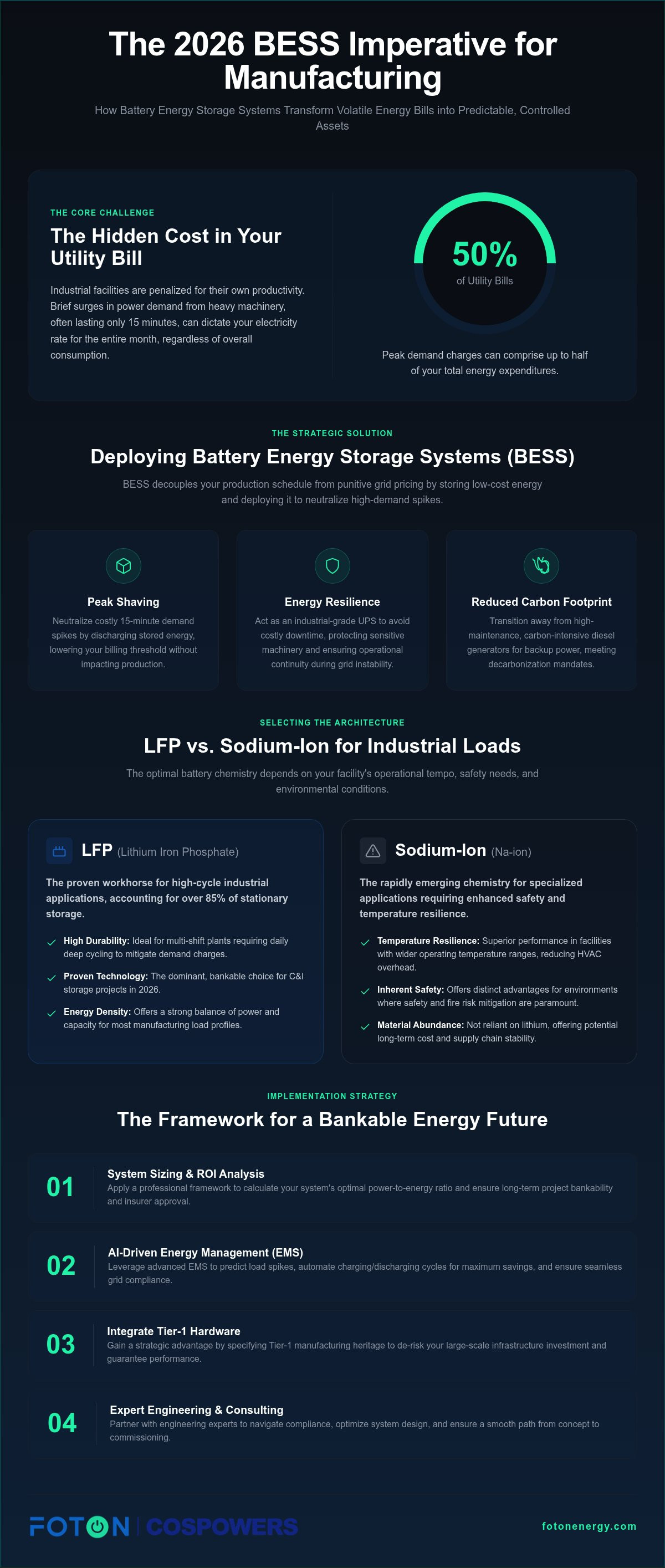
Peak demand charges now account for up to 50% of the average industrial utility bill, effectively penalizing your facility for maintaining full production capacity. For operations managers, this volatility isn't just an expense; it's a structural risk that threatens bottom-line stability. Implementing advanced battery storage for manufacturing plants has evolved from a sustainability initiative into a critical financial strategy for 2026. By decoupling your power consumption from grid-driven peak pricing, you can transform energy from a fluctuating liability into a controlled, predictable asset.
You likely recognize that relying solely on a strained grid is no longer a viable long-term strategy for high-performance manufacturing. We understand the pressure to maintain zero-downtime reliability while meeting new decarbonization mandates and strict 2026 compliance standards like the 55% Material Assistance Cost Ratio. This guide will show you how to leverage Tier-1 architectures and AI-driven management systems to eliminate unpredictable charges and secure your facility's energy future. We'll examine the latest LFP and Sodium-Ion technologies, provide a framework for calculating ROI, and outline the path to a bankable, insurer-approved energy infrastructure.
Key Takeaways
- Learn how to neutralize volatile demand charges that comprise up to half of industrial energy bills by implementing resilient battery storage for manufacturing plants.
- Compare the performance metrics of LFP and Sodium-Ion chemistries to select the optimal architecture for your facility's safety and cycle life requirements.
- Apply a professional four-step sizing framework to calculate your system's power-to-energy ratio and ensure long-term project bankability.
- Leverage AI-driven Energy Management Systems to predict load spikes and automate grid compliance for a truly autonomous energy strategy.
- Gain a strategic advantage by integrating Tier-1 manufacturing heritage with expert engineering consulting to de-risk your large-scale infrastructure investment.
The Economic Engine: Why Manufacturing Plants Need BESS in 2026
Industrial energy costs have undergone a fundamental shift. It's no longer enough to manage total kilowatt-hour consumption; you must now master the intensity of your demand. Manufacturing plants typically operate with a substantial base load, but the abrupt spikes caused by heavy machinery create a volatile load profile that utilities penalize heavily. These momentary surges often dictate your billing bracket for the entire month, regardless of your average usage. By 2026, increased electrification and aging infrastructure have made grid congestion a daily reality, forcing utilities to raise demand charges until they frequently account for nearly half of total industrial electricity expenditures.
Strategic energy management requires a buffer between your machinery and the utility. Integrating Battery Energy Storage System (BESS) technology allows you to decouple your production schedules from punitive pricing structures. This architecture acts as a shock absorber, drawing power from the grid during low-cost periods and discharging it when your facility hits its highest consumption points. It's a move toward visionary pragmatism that transforms energy from a variable overhead into a predictable, managed asset.
Mitigating the 15-Minute Peak
The startup of large motors and high-torque machinery sets an invisible ceiling on your monthly overhead. When multiple production lines restart simultaneously after a shift change or maintenance window, they create a massive, uncoordinated surge in demand. This 15-minute window of peak usage can inflate your utility costs for the next 30 days. Peak shaving is the primary ROI driver for C&I BESS, as it allows the system to discharge stored energy during these spikes. This prevents the facility from drawing excessive power from the grid, effectively lowering the billing threshold without altering operational output.
Energy Resilience and Avoided Downtime
Energy reliability is the foundation of industrial profitability. Even a brief 10-minute production outage can cost a Tier-1 facility thousands in lost labor, damaged raw materials, and delayed delivery schedules. Modern battery storage for manufacturing plants serves as a high-capacity, industrial-grade UPS for critical lines. It ensures a seamless transition during grid instability, maintaining the synchronization of sensitive robotic systems and high-precision CNC machinery. This level of resilience is essential for maintaining a high-performance atmosphere in safety-critical environments.
- Reduced Diesel Reliance: Transition away from high-maintenance, carbon-intensive diesel generators for primary backup power.
- Instantaneous Response: Sub-cycle response times protect variable frequency drives and sensitive electronics from voltage sags.
- Optimized Restart Protocols: Provide the necessary "black start" power to bring heavy equipment back online safely after a broader grid failure; utilizing generator synchronizing control panels from Tesla Electrical Company ensures these transitions are managed with technical precision.
Strategic energy management isn't just about saving pennies; it's about ensuring your facility remains an elite pillar of the global supply chain despite an increasingly unpredictable grid.
Selecting the Architecture: LFP vs. Sodium-Ion for Industrial Loads
Decisions regarding battery storage for manufacturing plants are no longer limited to a single chemistry. Your choice of architecture must align precisely with your facility's operational tempo, floor space constraints, and environmental conditions. As industrial loads become more complex, selecting between Lithium Iron Phosphate (LFP) and the rapidly emerging Sodium-Ion technology requires a balance of visionary pragmatism and technical rigor. Each chemistry offers distinct advantages in durability, safety, and temperature resilience that can significantly impact your long-term ROI.
LFP: The Workhorse of Industrial Storage
Lithium Iron Phosphate (LFP) remains the dominant choice for high-cycle applications, accounting for over 85% of stationary storage installations in 2026. For multi-shift manufacturing plants that require daily deep cycling to mitigate peak demand charges, LFP offers the necessary durability and energy density. Understanding LFP battery cycle life for utilities and industrial users is critical for calculating the total cost of ownership over a 15 to 20-year lifespan. These systems utilize sophisticated liquid cooling and advanced thermal management to maintain optimal cell temperatures in high-density containers, ensuring performance remains stable even during the most demanding production cycles.
Sodium-Ion: The Strategic Alternative
Sodium-Ion technology has matured into a compelling solution for safety-critical and thermally challenging environments. Unlike traditional chemistries, sodium-ion cells exhibit remarkable resilience in extreme temperatures, operating efficiently in high-heat manufacturing zones without the massive cooling overhead required by other systems. This chemistry is inherently stable, offering a superior safety profile for dense facilities where fire mitigation is a primary concern. The recent surge in sodium-ion battery commercial availability provides facility managers with a sustainable, cobalt-free alternative that is projected to reach cost parity with LFP by the end of 2026. It's an ideal choice for operations that prioritize safety and environmental stewardship without sacrificing operational reliability.
Reliability in the current market is grounded in Tier-1 manufacturing heritage. The 2026 regulatory landscape, including the One Big Beautiful Bill Act, demands rigorous documentation of component origins and supply chain transparency. Selecting a partner with a 30-year manufacturing heritage, such as our strategic collaboration with Cospowers, provides the "bankable" assurance that financiers and insurers require for large-scale infrastructure. This strategic alignment ensures that your energy assets are not just technical solutions, but foundational pillars of your industrial ecosystem. If you are evaluating which chemistry fits your specific load profile, our team offers professional engineering consulting to de-risk your investment and optimize your system architecture.
Sizing and ROI Analysis: Calculating System Bankability
Precision sizing is the difference between a high-yield asset and a stranded capital expense. For battery storage for manufacturing plants, bankability isn't just a marketing term; it's a rigorous financial requirement that demands technical validation. A system that is too small will fail to capture the highest peaks, leaving substantial demand charges on your bill. Conversely, an oversized system inflates your initial capital expenditure and extends your payback period unnecessarily. Achieving an optimal return on investment requires a methodical approach that aligns your facility's electrical load with the latest 2026 energy market dynamics.
Calculating the Total Cost of Ownership (TCO) over a 15-year horizon is essential for strategic planning. This analysis must account for cell degradation, anticipated maintenance cycles, and the potential for future expansion. By treating the BESS as a foundational pillar of your industrial infrastructure, you can ensure the system remains a high-performance asset that satisfies both internal financiers and external insurers. It's about moving beyond simple backup power to create a sophisticated financial buffer against grid volatility.
Interval Data Analysis: The Foundation
The sizing process begins with the extraction and interpretation of 15-minute interval data from your utility meters. This granular visibility allows us to map your facility's "Target Demand Ceiling," which is the specific kilowatt threshold where the battery begins to discharge. By identifying the exact timing of motor startups and heavy machinery cycles, we can program the Energy Management System to intercept these spikes before they trigger higher billing brackets. Oversizing a BESS can destroy industrial ROI by inflating capital expenditure without providing a proportional increase in demand charge savings. Precision is the only path to a bankable solution.
The ROI Multipliers
True profitability in 2026 is driven by benefit stacking. While peak shaving offers the most immediate reduction in monthly overhead, a well-configured system also leverages Time-of-Use (ToU) arbitrage to charge during low-cost periods and discharge when rates are highest. Many industrial facilities are now integrating grid services, such as frequency regulation, to generate additional revenue streams that further accelerate the payback period. Navigating these complex financial layers requires specialized BESS engineering consulting services to ensure every possible incentive is captured.
The optimal power-to-energy ratio, or C-rate, must be tailored to your specific machinery. A high-torque environment may require a 1C or 2C system capable of rapid, high-intensity discharge, while a facility focused on long-duration resilience might prioritize a 0.5C architecture. By stacking these technical and financial benefits, you transform your energy storage from a passive backup into an active economic engine. This strategic alignment ensures that your investment is grounded in operational excellence and long-term value.
Implementation Strategy: AI EMS and Grid Compliance
Advanced hardware provides the physical capacity for energy storage, but the intelligence layer dictates the actual return on investment. For battery storage for manufacturing plants, the Energy Management System (EMS) acts as the central nervous system, coordinating between the grid, the battery modules, and your facility's heavy machinery. Without sophisticated software, even the most robust Tier-1 cells remain a passive backup rather than an active financial asset. By 2026, the standard for industrial excellence has shifted from simple monitoring to AI-driven optimization that anticipates operational needs in real time.
Achieving grid-code compliance is a non-negotiable requirement for front-of-the-meter integration and complex industrial sites. This involves meeting stringent standards like IEEE 1547-2018 and the upcoming 1547-2026 communication protocols, which ensure your BESS can support the grid during frequency or voltage fluctuations. Safety architecture remains the foundation of this strategy. High-performance systems now incorporate multi-stage fire suppression and advanced thermal runaway prevention to protect your personnel and capital equipment from catastrophic failure. These features are essential for maintaining a secure, high-performance atmosphere in dense industrial zones.
The Intelligence Layer
Predictive analytics have transformed how facilities manage energy. An AI driven energy management system uses machine learning to analyze historical consumption patterns and external market data to forecast load spikes before they occur. This allows the system to pre-charge during low-cost windows and ensures maximum capacity is available exactly when your production lines ramp up. Integrating these systems with existing SCADA or Building Management Systems (BMS) creates a unified view of your facility's efficiency, enabling predictive maintenance protocols that identify cell degradation before it impacts your output. Named industry reports have shown that AI-optimized EMS can reduce energy usage by over 20% in large-scale manufacturing environments.
Compliance and Engineering Standards
Engineering for bankability requires a steady hand and a deep understanding of international certifications. Lenders and insurers today demand rigorous proof of compliance with UL 9540 and local AS/NZS standards to de-risk large-scale infrastructure investments. Thermal management is a critical component of this validation; choosing between active liquid cooling and passive systems depends on your facility's ambient temperature and discharge intensity. Active cooling is often the superior choice for high-density LFP containers, as it maintains the precise internal environment needed to preserve cycle life and satisfy warranty requirements. To ensure your project meets these elite standards from day one, consult with our strategic engineering team to design a compliant, high-performance architecture.
The Foton Advantage: Tier-1 Manufacturing Meets Strategic Engineering
Foton Energy acts as the essential bridge between Tier-1 manufacturing excellence and local project engineering. While many providers offer off-the-shelf hardware, we deliver a bankable framework designed for the specific rigors of heavy industry. Our exclusive global partnership with Cospowers, an entity with over 30 years of manufacturing heritage, ensures that every module meets the highest international certifications. This heritage provides a foundation of stability that is vital for large-scale infrastructure investments in an era of tightening regulations and supply chain scrutiny.
Supporting manufacturing plants in over 70 countries has given us a unique perspective on global grid-code compliance and operational resilience. We don't just sell components; we provide end-to-end consulting that guides facility managers from initial feasibility studies through to final commissioning. This methodical approach de-risks the adoption of battery storage for manufacturing plants, ensuring that your system is technically sound, commercially stable, and fully optimized for your specific load profile. It is a partnership grounded in visionary pragmatism and a shared commitment to industrial progress.
Bankable Hardware Procurement
Procuring high-performance modules requires more than just a purchase order. It demands a secure, transparent supply chain that satisfies the most stringent financier requirements. By sourcing Tier-1 LFP and Sodium-Ion modules directly through our established network, we eliminate the risks associated with third-party intermediaries and unverified origins. Our Commercial and Industrial BESS Solutions are engineered for durability and efficiency, providing the "bankable" assurance that insurers require for 15 to 20-year project horizons. This direct link to manufacturing ensures that you receive the latest technological advancements, including high-density LFP and temperature-resilient Sodium-Ion modules, with full warranty backing and technical support.
Strategic Partnership Model
Collaborative innovation is at the heart of our operations. We work closely with EPCs, resellers, and local engineering firms to deliver custom solutions for complex brownfield manufacturing sites where space and integration challenges are common. Our team provides the strategic engineering support needed to integrate advanced battery storage for manufacturing plants into existing electrical architectures without disrupting production schedules. Whether you are upgrading a legacy facility or designing a new greenfield site, we offer the technical proof points and operational excellence required to build a cleaner, more resilient future. The journey toward energy independence begins with a rigorous assessment of your current assets. To discover how our Tier-1 technology can transform your facility's financial profile, consult with Foton Energy for your manufacturing BESS project today.
Mastering the Industrial Energy Transition
The shift toward advanced battery storage for manufacturing plants represents a fundamental evolution in industrial overhead management. By decoupling production schedules from the grid's peak pricing, you can neutralize the volatile demand charges that threaten your bottom line. Whether you choose the high-cycle durability of LFP or the temperature resilience of Sodium-Ion, your architecture must be supported by an AI-driven Energy Management System to ensure long-term bankability and grid compliance. Success in 2026 requires this precise alignment of proven hardware and predictive intelligence.
Foton Energy stands as your elite pillar in this transition. As a Tier-1 Cospowers manufacturing partner with global engineering support in over 70 countries, we provide the stability and technical expertise required for large-scale infrastructure. Our AI-driven energy management systems ensure your facility remains a high-performance asset in an increasingly unpredictable market. We offer a visionary pragmatism that grounds high-level sustainability goals in rigorous testing and operational excellence.
Secure Your Industrial Energy Future with Foton Energy today. Let's work together to transform your energy usage into a strategic, controlled, and resilient asset for the decades ahead. The path to a bankable energy future starts with a single strategic partnership.
Frequently Asked Questions
How long does a typical BESS for a manufacturing plant last?
Most industrial-grade systems are designed for a 15 to 20-year operational life, depending on the depth of discharge and cycling frequency. Tier-1 LFP modules typically support 6,000 to 8,000 cycles before reaching 80% of their original capacity. This longevity is secured through advanced thermal management and precise EMS control, which prevent the accelerated degradation caused by temperature fluctuations or over-discharging in high-torque environments.
Can battery storage completely eliminate demand charges?
While a BESS can significantly reduce demand charges by up to 90%, complete elimination is rare due to the complexity of industrial load profiles. Implementing battery storage for manufacturing plants is designed to "shave" the highest peaks, keeping your facility below a specific billing threshold. Total elimination would require a massive, often non-bankable over-investment in capacity. Instead, we focus on an optimal sizing strategy that captures the most punitive charges to maximize your financial return.
Is Sodium-Ion better than LFP for industrial applications?
Sodium-Ion isn't inherently better than LFP, but it serves distinct strategic purposes. LFP remains the standard for high-density, multi-shift plants due to its proven cycle life and energy density. However, Sodium-Ion offers superior safety and performance in extreme temperatures without requiring heavy cooling infrastructure. The choice depends on whether your facility prioritizes safety-critical stability in high-heat zones or the long-term cycling heritage of established lithium technologies.
What is the average payback period for an industrial BESS in 2026?
Payback periods in 2026 typically range from three to seven years, depending on your local utility rates and available green grants. This timeline has shortened significantly due to the combination of peak shaving, Time-of-Use arbitrage, and participation in grid services. By stacking these revenue streams, manufacturing facilities can accelerate their return on investment while simultaneously securing long-term energy resilience against future grid volatility and inflationary utility pricing.
How much space is required for a containerized BESS installation?
A standard 1MWh to 2MWh system usually fits within a 20-foot shipping container, requiring approximately 15 square meters of ground space. Larger 40-foot configurations are used for multi-megawatt installations. You must also factor in a three-meter safety clearance on all sides for maintenance access and fire safety compliance. Our engineering consulting team specializes in optimizing these footprints for dense brownfield sites where available exterior space is often at a premium.
Do I need to upgrade my existing transformers to install battery storage?
You don't always need a transformer upgrade, but it depends on your facility's current spare capacity and the point of interconnection. If the BESS is designed to discharge behind the meter to offset local loads, your existing infrastructure may be sufficient. However, front-of-the-meter applications or high-intensity rapid discharge systems might require localized upgrades to ensure the grid-code compliance standards of 2026 are met without stressing legacy equipment.
How does AI improve the ROI of battery storage for manufacturing?
AI improves ROI by transforming battery storage for manufacturing plants from a reactive backup into a predictive financial asset. By analyzing historical load data and market pricing, an AI-driven EMS forecasts production spikes and pre-charges the system during low-cost windows. This ensures maximum capacity is available exactly when it's needed to prevent a demand charge breach. It's a level of optimization that manual scheduling can't match, often increasing annual savings by an additional 15% to 20%.
What safety certifications should I look for in a Tier-1 BESS?
You should prioritize systems that carry UL 9540 and UL 9540A certifications, which cover the complete BESS and its fire-spread characteristics. For 2026, compliance with IEEE 1547-2018 and the upcoming IEEE 1547-2026 standards is also critical for grid interconnection. These certifications provide the bankable assurance that financiers and insurers require, proving that the system has undergone rigorous testing for thermal runaway prevention and operational safety in dense industrial environments.


