

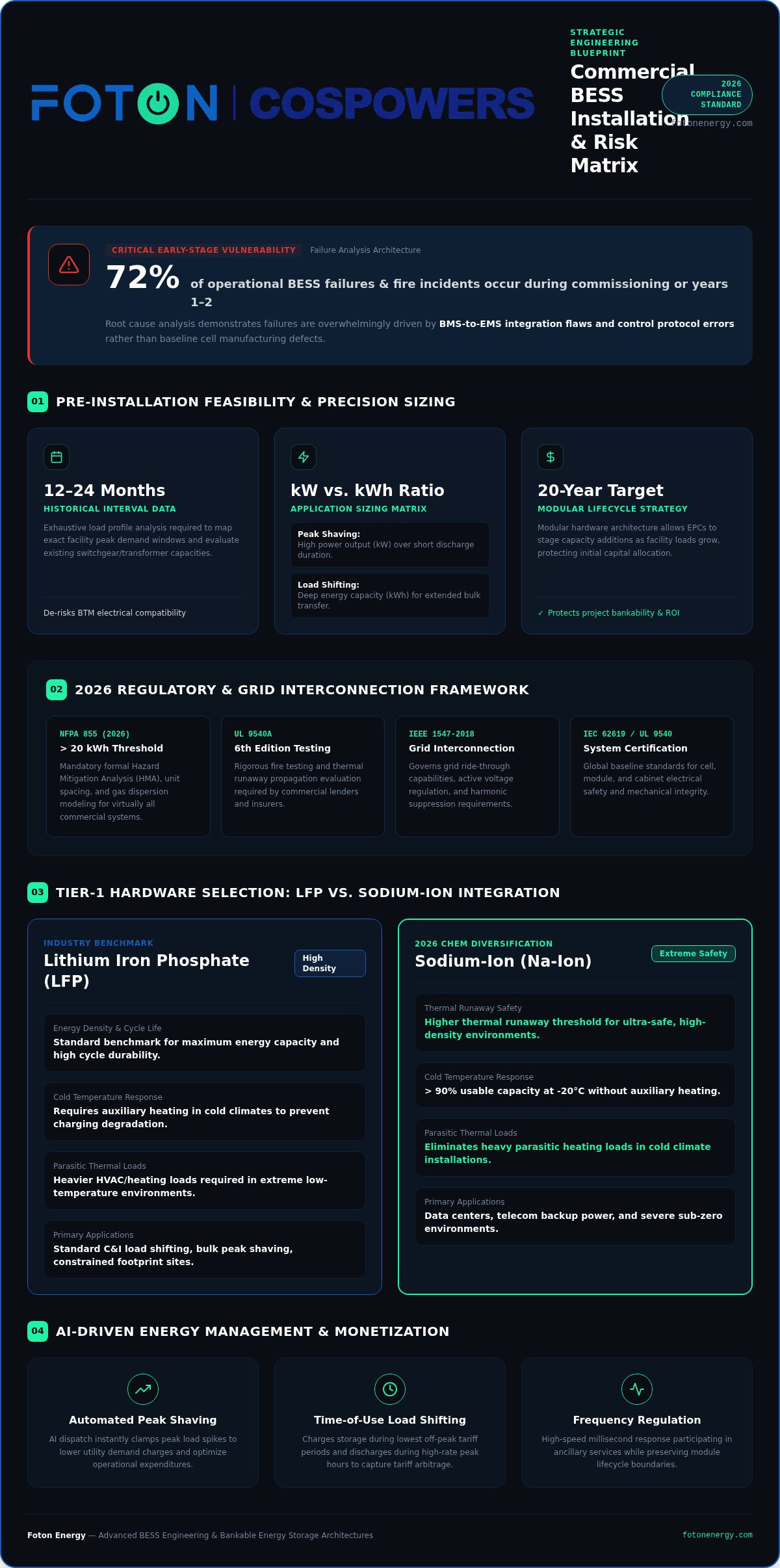
Nearly 72% of operational BESS failures and fire incidents occur during commissioning or the first two years of operation. These risks aren't typically driven by manufacturing defects but by critical failures in BMS-to-EMS integration and control protocols. For EPCs, the margin for error has vanished. This commercial battery storage installation guide serves as your strategic roadmap for navigating the 2026 landscape, where updated NFPA 855 standards now mandate a formal Hazard Mitigation Analysis for virtually every commercial system over 20 kWh.
You're likely feeling the pressure of shifting grid-code compliance and the technical demands of the 6th Edition UL 9540A fire testing. It's a complex environment that requires more than just hardware; it demands a bankable safety architecture. We'll show you how to master these complexities by aligning Tier-1 hardware with intelligent, AI-driven energy management. This guide breaks down the essential steps for site preparation, thermal management, and domestic content stacking to ensure your projects achieve maximum ROI through peak shaving while meeting the most rigorous global safety benchmarks.
Key Takeaways
- Conduct precision load profile analyses to ensure BESS sizing aligns with site-specific environmental and thermal constraints.
- Compare the technical performance of Tier-1 LFP and Sodium-Ion modules to meet 2026 global safety standards and bankability requirements.
- Follow this commercial battery storage installation guide to master civil works and electrical integration while compressing commissioning schedules.
- Deploy AI-driven Energy Management Systems to automate real-time optimization for peak shaving, load shifting, and frequency regulation.
- Implement a rigorous asset management framework designed to protect long-term project financing and ensure a 20-year lifecycle.
Pre-Installation: Project Feasibility and Site Assessment
Deployment success begins long before the first cabinet arrives on site. A robust feasibility study transforms a conceptual design into a bankable asset. This phase requires a meticulous evaluation of existing electrical infrastructure to ensure Behind the Meter (BTM) compatibility. It's about aligning physical site constraints with the operational goals of the facility. EPCs must identify potential bottlenecks in the existing switchgear and transformer capacity early to avoid expensive retrofits during the construction phase. A professional commercial battery storage installation guide emphasizes that this initial assessment is the most critical step in de-risking the entire project lifecycle.
Load Profiling and Sizing Strategies
Precision sizing prevents capital inefficiency. We start by analyzing 12 to 24 months of historical interval data to map peak demand periods. This analysis determines the critical ratio of power (kW) to energy (kWh). For instance, a facility focused on peak shaving needs high power output for short durations, while load shifting requires greater energy capacity. We recommend utilizing modular hardware configurations that allow for future-proofing. Scalable designs enable EPCs to expand capacity as facility loads grow, ensuring the system remains a high-performance asset for its entire 20-year lifecycle. This data-driven approach is a cornerstone of any commercial battery storage installation guide, as it directly impacts the projected ROI.
Regulatory and Grid Compliance Framework
Mapping the regulatory landscape is often the most significant hurdle for project timelines. Modern battery energy storage systems (BESS) must adhere to a complex hierarchy of international and local standards. You must align global benchmarks like IEC 62619 and UL 9540 against specific regional requirements, such as the updated IEEE 1547-2018 standards for grid interconnection. These standards dictate how the system interacts with the utility, covering everything from voltage regulation to frequency ride-through capabilities.
Utility interconnection applications require exhaustive technical documentation. This includes single-line diagrams, protection settings, and harmonic studies. Early engagement with utilities prevents costly delays during the witness testing phase. To streamline this process, many successful projects leverage BESS engineering consulting services. This ensures every technical submittal meets the bankable criteria required by commercial lenders and insurers. Site assessment must also account for thermal management and safety clearances. Under NFPA 855:2026, unit spacing and gas dispersion modeling are mandatory for systems over 20 kWh. Evaluating these environmental factors early prevents last-minute redesigns that can derail project timelines.
Selecting Tier-1 Hardware: LFP vs. Sodium-Ion Integration
Hardware selection serves as the foundation of project bankability. It isn't just about capacity; it's about long-term reliability and safety. A comprehensive commercial battery storage installation guide must prioritize Tier-1 manufacturing heritage. Foton Energy (Foton Pty Ltd) leverages decades of advanced engineering excellence to deliver robust energy solutions. This heritage ensures that every module meets the rigorous standards required for large-scale infrastructure. Choosing a partner with a proven manufacturing track record reduces the risk of early-stage failures that often plague unproven vendors.
Lithium Iron Phosphate (LFP) remains the industry benchmark for energy density and cycle life. However, 2026 marks a strategic shift toward chemistry diversification. Sodium-ion is gaining traction for specific C&I applications where safety and wide temperature ranges are paramount. EPCs must evaluate whether a project requires the high energy density of LFP or the resilient performance of alternative chemistries.
The Rise of Sodium-Ion in Commercial Settings
Analyzing sodium-ion battery commercial availability reveals its strategic value for data centers and telecom backup. Sodium-ion cells offer superior discharge rates and maintain over 90% usable capacity at -20°C without auxiliary heating. This eliminates the heavy parasitic heating loads required by LFP in cold climates. For high-density environments, sodium-ion's higher thermal runaway threshold, typically 20°C to 30°C higher than LFP, provides an added layer of security. It's a pragmatic choice for critical infrastructure where safety margins are non-negotiable.
Safety Architecture and Thermal Management
Thermal management is the heartbeat of system longevity. High-cycle industrial use demands active liquid cooling to maintain optimal cell temperatures. This prevents the accelerated degradation common in passive air-cooled systems. When reviewing the DOE BESS procurement checklist, EPCs should verify that hardware includes multi-level fire suppression. This includes aerosol or water-mist systems integrated at the rack level, ensuring compliance with 2026 global safety standards.
Choosing between modular cabinets and containerized systems depends on your site footprint. Modular outdoor cabinets offer flexibility for tight urban spaces and ease of scaling. Containerized systems provide a consolidated, factory-integrated solution for larger utility-scale projects. Both architectures must feature deflagration venting and explosion control to meet NFPA requirements. Selecting the right hardware is a balance of chemistry, architecture, and proven engineering. If you're evaluating options for an upcoming project, consult with Foton Energy (Foton Pty Ltd) to understand the nuances of Tier-1 integration.
The Step-by-Step C&I BESS Installation Process
Deploying a commercial BESS is a high-stakes engineering endeavor that requires far more than a simple plug-and-play approach. Unlike residential setups that might be finished in a day, industrial commissioning is a multi-week process involving rigorous safety protocols and precise electrical alignment. This commercial battery storage installation guide outlines the five critical steps to move from a vacant pad to a fully operational, bankable asset. Success depends on the seamless coordination between civil contractors, electrical engineers, and software integrators.
Civil and Structural Foundations
Step 1 begins with civil works and foundation preparation. High-density battery containers can weigh upwards of 30 tons, requiring specialized foundations that account for soil bearing capacity and precise weight distribution. It isn't just about structural integrity; foundations must facilitate proper ventilation and clearance zones to mitigate fire risks. Adhering to the NFPA 855 stationary energy storage installation standard is non-negotiable during this phase. This includes establishing mandatory unit spacing and ensuring deflagration venting is directed away from property lines or exits. For outdoor utility-scale deployments, grounding and lightning protection systems are integrated into the site's structural mesh to protect Tier-1 Cospowers modules from atmospheric surges.
Electrical Interconnection and Balance of System (BoS)
Step 2 focuses on electrical integration, including transformer and switchgear alignment. This requires the BESS to be synchronized with the facility's existing electrical backbone. In Step 3, we move to hardware mounting and multi-module interconnection. It's vital to follow strict wiring protocols for multi-stack LFP modules to ensure balanced charging across the entire string. This phase also involves installing bi-directional inverters and power conversion systems (PCS) that allow the BESS to integrate with existing solar PV or microgrid controllers. These components must be rated for the specific discharge requirements identified during your initial load profile analysis.
The final phases focus on safety and compliance. Step 4 involves safety system calibration and fire suppression testing. We live-test the aerosol or water-mist triggers to ensure they respond to thermal anomalies instantly. Finally, Step 5 concludes with grid-connection and protection relay testing. This ensures the system meets all utility-mandated frequency ride-through and voltage regulation standards. While manual commissioning historically took six weeks, utilizing AI-driven platforms can compress this schedule to just 10 to 14 days. This efficiency prevents the protocol mismatches and utility witness testing failures that often lead to project delays.
AI-Driven Integration and Software Commissioning
A high-performance BESS is only as effective as the intelligence governing its operation. While physical assembly is critical, the software commissioning phase is where an asset's true value is unlocked. Modern EPCs are moving away from manual Modbus register checks in favor of automated commissioning platforms. These systems perform real-time mapping across BMS, inverters, and SCADA gateways, compressing timelines while preventing the baseline errors that often void warranties. This commercial battery storage installation guide emphasizes that AI integration is no longer an optional upgrade; it's a requirement for project bankability.
Establishing secure, low-latency communication protocols like Modbus or CAN bus is the first step in software deployment. These channels allow for seamless data exchange between the physical hardware and the cloud-based control layer. During the commissioning phase, we conduct automated performance testing to verify that the system responds to grid signals within milliseconds. This level of precision is essential for participating in frequency regulation markets and ensuring the system operates within its safe thermal limits. It's about creating a stable, responsive link between the hardware and the energy market.
Optimizing for Revenue and Efficiency
Deploying AI driven energy management systems allows facilities to respond to real-time market price signals automatically. We program specific EMS parameters to prioritize peak shaving and load shifting based on the facility's unique demand profile. For industrial sites, this means setting up demand charge management protocols that prevent expensive utility spikes. It's also vital to verify EMS integration with existing building management systems (BMS). This interconnectedness ensures that the BESS works in harmony with HVAC and lighting loads to maximize overall site efficiency.
Predictive Maintenance and Remote Monitoring
Long-term asset health depends on granular visibility. We establish State-of-Health (SoH) monitoring at both the cell and module level to track degradation over time. By configuring remote alert systems, operators receive instant notifications for thermal anomalies or unexpected grid fluctuations before they escalate into failures. AI algorithms analyze this data to provide predictive lifecycle management, allowing for scheduled maintenance that doesn't disrupt operations. This proactive approach ensures the system remains a reliable pillar of your energy infrastructure. To explore how intelligent software can enhance your next project, partner with our engineering experts for a tailored EMS strategy.
Ensuring Long-Term Bankability and Asset Management
Bankability is the bridge between a technical design and a financed reality. For EPCs, securing institutional investment depends on proving a project's long-term viability and safety. This commercial battery storage installation guide concludes with the strategic frameworks required to maintain asset value over a 20-year lifecycle. It's about ensuring every technical decision, from hardware selection to AI integration, translates into a low-risk profile for lenders and insurers. When a system is viewed as a stable, high-performance asset, it becomes much easier to scale operations and attract top-tier financial partners.
The Bankability Framework for EPCs
Financiers and insurance underwriters prioritize hardware with Tier-1 certifications. Manufacturers like Cospowers, with a 30-year heritage, provide the grounded assurance that institutional partners demand. Verification from independent bodies like DNV or TÜV SÜD is essential for proving that the system meets rigorous safety and performance standards. Beyond hardware, AI-driven data logging plays a critical role in asset valuation. By maintaining a granular record of every charge and discharge cycle, EPCs can provide technical proof of system health during resale or refinancing events. This transparency reduces the risk premium associated with large-scale infrastructure, making it easier to leverage commercial and industrial BESS solutions for sustainable project growth.
Lifecycle Asset Management
Asset management is a continuous commitment to operational excellence. A rigorous Operations and Maintenance (O&M) schedule is vital for navigating the inevitable degradation curves of battery modules. We recommend conducting annual capacity tests to verify that the system is performing against its original nameplate specifications. This proactive testing allows for early identification of cell-level anomalies before they impact the entire string. Managing firmware updates across a global BESS fleet is equally important. Consistent software optimization ensures the system remains compatible with evolving grid codes and energy market protocols without requiring manual on-site intervention.
Strategic planning must also account for end-of-life recycling and module replacement. As the industry matures, having a clear roadmap for decommissioning and material recovery is a core component of a professional commercial battery storage installation guide. Warranty structures should be reviewed to ensure they offer long-term performance guarantees that align with the project's financial model. By integrating these asset management strategies from day one, you transform a BESS project into a resilient, high-performance pillar of the industrial ecosystem that remains profitable for decades.
Mastering the 2026 C&I BESS Landscape
Success in large-scale infrastructure requires a shift from simple hardware procurement to integrated engineering excellence. This commercial battery storage installation guide has demonstrated that mastering project feasibility and grid-code compliance is the only way to ensure long-term viability. By aligning Tier-1 hardware with AI-driven energy management, EPCs can deliver systems that optimize revenue through peak shaving while maintaining the highest global safety standards. The transition toward chemistry diversification, including sodium-ion adoption, offers new opportunities for resilience in extreme environments.
Foton Energy stands as your foundational pillar in this evolving market. As the exclusive strategic partner of Cospowers, we offer 30 years of manufacturing heritage backed by DNV-verified reliability and expert global engineering support. Our end-to-end consulting ensures your projects remain bankable from the initial load profile analysis through to the final commissioning phase. Partner with Foton Energy for Your Next Tier-1 BESS Deployment to secure a high-performance energy future. Together, we can build a more stable and efficient industrial ecosystem.
Frequently Asked Questions
How long does a commercial battery storage installation typically take?
A typical commercial battery storage installation timeline ranges from four to eight weeks from initial site preparation to final grid-connection. While the physical assembly of modular cabinets can be completed in days; the civil works, transformer alignment, and utility witness testing require more extensive scheduling. Utilizing AI-driven commissioning platforms can compress the software integration phase from the industry-average six weeks down to just 10 to 14 days.
What are the primary differences between LFP and Sodium-ion for industrial installations?
Lithium Iron Phosphate (LFP) remains the global benchmark for high energy density and mature cycle longevity in temperate climates. In contrast, Sodium-ion modules offer superior performance in extreme cold; maintaining over 90% usable capacity at -20°C without auxiliary heating. Sodium-ion also features a higher thermal runaway threshold than LFP. This makes it a pragmatic choice for high-security environments like data centers where safety architecture is the primary concern.
Do I need a separate building for a commercial BESS installation?
Most modern C&I BESS deployments utilize outdoor-rated, liquid-cooled cabinets that don't require a dedicated building. This approach avoids the complex indoor deflagration venting and compartmentation requirements mandated by updated fire safety codes. These factory-integrated enclosures feature built-in fire suppression and HVAC systems. They are designed to be installed on simple concrete pads while maintaining strict safety clearances from existing facility structures.
How does an AI-driven EMS improve the ROI of a commercial battery?
An AI-driven energy management system maximizes ROI by automating complex revenue-generating strategies like peak shaving and load shifting. By analyzing real-time market price signals and facility load profiles, the EMS ensures the battery discharges during the most expensive demand periods. This intelligence prevents costly demand charges and allows for participation in frequency regulation markets; significantly shortening the project's payback period compared to systems utilizing manual control protocols.
What grid-code certifications are required for utility-scale BESS in 2026?
By 2026, utility-scale deployments must adhere to the updated IEEE 1547-2018 standard for smart-inverter functions and grid-interconnection. This includes mandatory compliance with UL 9540A 6th Edition for large-scale fire testing to demonstrate non-propagation of thermal runaway. EPCs must also ensure hardware meets regional grid codes for Australia or the EU; which now demand advanced frequency ride-through and voltage regulation capabilities for all stationary storage.
Can I install a commercial battery system without a solar array?
You can absolutely install a commercial battery system as a standalone asset without a solar array. Standalone BESS projects are increasingly common for facilities focusing on peak shaving, demand charge management, or providing critical backup for data centers. These systems charge from the grid during off-peak hours when rates are lowest and discharge during high-cost periods. This provides immediate operational savings and energy resilience regardless of on-site renewable generation.
What is the typical maintenance schedule for an industrial BESS?
A standard maintenance schedule involves quarterly visual inspections of cooling systems and electrical connections alongside annual capacity testing. These annual tests verify the system's performance against its original degradation curves to protect project bankability. This commercial battery storage installation guide emphasizes that remote monitoring via an intelligent EMS allows for continuous state-of-health tracking; enabling predictive maintenance and automated firmware updates that ensure the system remains optimized.
How does Foton Energy support EPC partners during the commissioning phase?
Foton Energy provides EPC partners with end-to-end engineering consulting and technical support throughout the commissioning phase. Our team assists with grid-code compliance, protection relay testing, and the integration of AI-driven energy management systems. By leveraging our 30-year manufacturing heritage through Cospowers; we ensure that every commercial battery storage installation guide we support is grounded in Tier-1 reliability and meets the rigorous technical standards required for institutional financing.


