

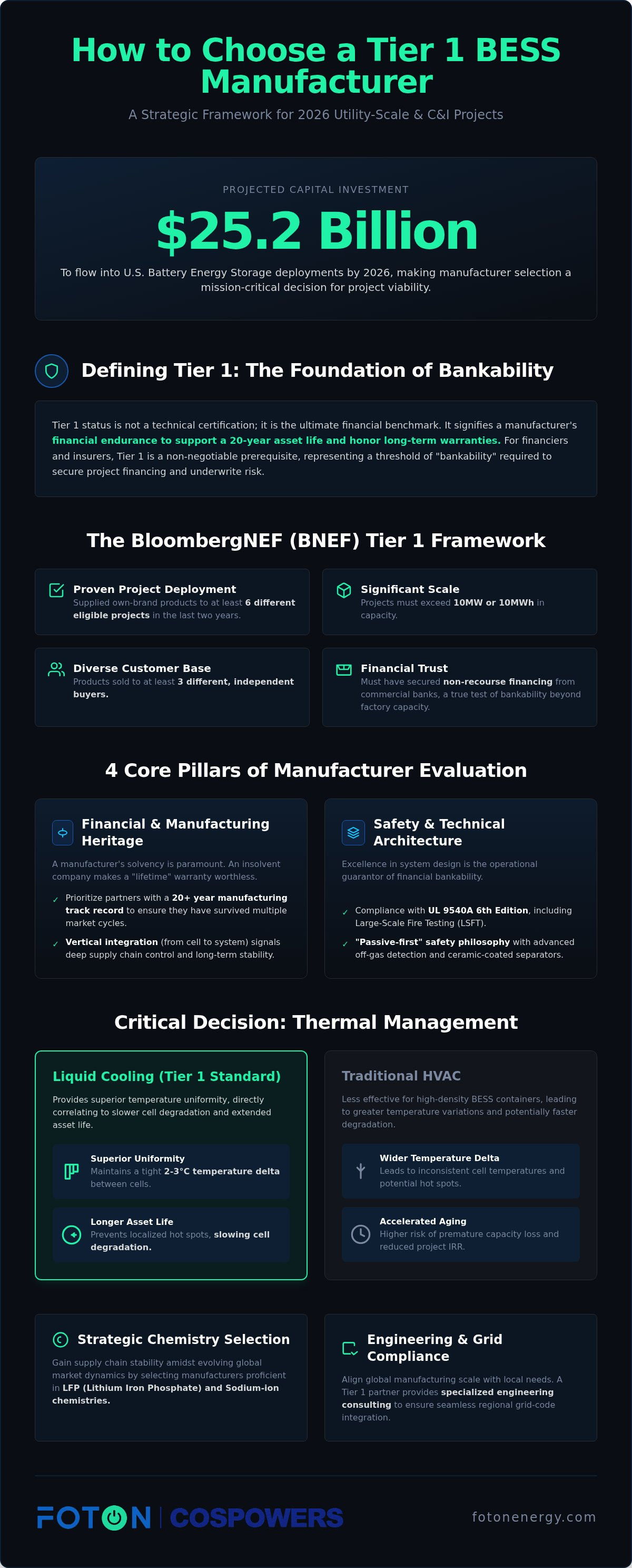
$25.2 billion in capital investment is projected to flow into U.S. battery energy storage deployments throughout 2026. This unprecedented scale of infrastructure development means that the margin for error in manufacturer selection has effectively vanished. As you determine how to choose a tier 1 bess manufacturer for your next utility-scale or C&I project, you likely recognize that this designation is no longer just a badge of quality; it's a fundamental requirement for securing project financing and managing long-term risk.
Mastering this selection process requires a sophisticated approach that balances manufacturing heritage with the latest regulatory shifts, such as the UL 9540A 6th Edition safety standards. This guide provides a clear framework for conducting due diligence that satisfies both technical engineers and institutional investors. We will analyze the critical synergy between financial stability, international safety certifications, and the operational resilience needed to manage a volatile global supply chain.
Key Takeaways
- Understand why BloombergNEF (BNEF) status serves as a critical financial benchmark for institutional bankability rather than a standalone technical certification.
- Master how to choose a tier 1 bess manufacturer by prioritizing vertical integration and long-term manufacturing heritage to ensure project longevity.
- Evaluate the necessity of passive-first thermal management and AI-driven energy management systems to meet rigorous 2026 safety standards.
- Align global manufacturing scale with regional grid-code requirements through specialized engineering consulting to ensure seamless infrastructure integration.
- Gain strategic insights into the selection of LFP and Sodium-ion chemistries to maintain supply chain stability amidst evolving global market dynamics.
Defining Tier 1: Why Bankability is the Foundation of BESS Procurement
Bankability serves as the ultimate filter in the global energy transition. For developers and institutional investors, the primary challenge isn't just finding high-performance hardware; it's identifying a partner with the financial endurance to support a 20-year asset life. When you evaluate how to choose a tier 1 bess manufacturer, you're looking for a guarantee that the company won't just exist today, but will be there to honor warranties a decade from now. This is particularly vital for a Battery energy storage system (BESS), where long-term operational resilience is the only path to a positive internal rate of return. Financiers typically mandate Tier 1 status because it represents a threshold of "bankability"—the ability of a project to secure non-recourse debt based on the manufacturer's proven performance and balance sheet strength. Since non-recourse debt relies entirely on the project’s cash flow and assets as collateral, any manufacturer failure increases the bank's risk exponentially. Consequently, insurers often refuse to underwrite projects using unproven hardware, making Tier 1 status a non-negotiable prerequisite for competitive financing terms.
The BNEF Tier 1 Framework for 2026
The BloombergNEF (BNEF) list remains the industry's most cited benchmark for financial reliability. To achieve Tier 1 status in 2026, a manufacturer must have supplied its own-brand, own-manufacture products to at least six different eligible projects in the last two years. These projects must exceed 10MW or 10MWh and involve at least three different, independent buyers. It's vital to recognize that manufacturing capacity alone doesn't grant entry to this list. A company could possess 100 GWh of factory space, yet if they haven't secured non-recourse financing from commercial banks for their projects, they remain Tier 2. This distinction ensures that a global project footprint, rather than mere scale, establishes the necessary trust for large-scale infrastructure investments.
Beyond the List: Technical Bankability
While BNEF measures financial flow, technical bankability requires deeper due diligence. Third-party verifications from firms like DNV supplement financial rankings by auditing factory conditions and cell chemistry stability. Manufacturer solvency risk is the silent killer of long-term asset management; a company's insolvency can render a "lifetime" warranty worthless overnight. We recommend prioritizing partners with a 20+ year manufacturing track record, such as the 30-year heritage offered by Cospowers, to ensure the manufacturer has survived multiple market cycles. Tier 1 bankability is the intersection of financial solvency, proven project deployment, and the technical transparency required to satisfy institutional risk committees.
Evaluating Technical Architecture: Safety, Thermal Management, and AI Integration
Technical excellence is the operational guarantor of the financial bankability discussed previously. When determining how to choose a tier 1 bess manufacturer, you must look beyond the balance sheet to the physical and digital architecture of the system. In 2026, the industry has moved past generic enclosures toward highly integrated systems where safety and efficiency are baked into the design at the cell and system levels. Achieving a high internal rate of return requires a system that maintains peak performance under diverse thermal stresses while protecting the asset from catastrophic failure.
Safety Architecture and Fire Suppression
The release of the UL 9540A 6th Edition on March 13, 2026, transformed the safety landscape by mandating Large-Scale Fire Testing (LSFT). This shift requires manufacturers to validate thermal runaway containment without relying on active suppression systems for outdoor ground-mounted units. A truly bankable manufacturer employs a passive-first philosophy. This includes proprietary safety layers such as ceramic-coated separators and advanced off-gas detection sensors that trigger before a thermal event escalates. We recommend prioritizing systems that utilize liquid cooling over traditional HVAC. Liquid cooling provides superior temperature uniformity across high-density BESS containers, which directly correlates to slower cell degradation and extended asset life. These systems ensure that the temperature delta between cells remains within a narrow 2-3 degree Celsius range, preventing localized hot spots.
AI-Driven Energy Management Systems (EMS)
The digital brain of your storage asset is just as critical as the physical cells. Modern AI driven energy management systems provide the real-time monitoring necessary to preserve battery health and maximize ROI. These platforms use machine learning algorithms to predict maintenance needs before a cell failure occurs, significantly reducing unplanned downtime. Intelligent software also allows for seamless integration with complex grid services. Whether you are performing Frequency Control Ancillary Services (FCAS) or energy arbitrage, the EMS must optimize discharge cycles to balance revenue generation with state-of-health preservation. This level of optimization is what separates a standard storage unit from a high-performance infrastructure asset.
Manufacturers now offer a choice between Cell-to-Pack (CTP) and modular architectures. CTP designs maximize energy density, which is essential for utility-scale efficiency, while modular systems offer easier field serviceability. Regardless of the choice, ensure the manufacturer holds full IEC 62933 and UL 9540 certifications. These standards provide the technical proof points that your engineering team needs to approve the procurement. If you are currently drafting your technical specifications, our engineering consultants can help you align these requirements with the latest 2026 international standards.
Sourcing Tier 1 Reliability: Manufacturing Heritage and Supply Chain Depth
Reliability in the energy storage sector isn't merely a technical specification; it's a historical record. When you analyze how to choose a tier 1 bess manufacturer, the depth of a company's manufacturing heritage serves as a primary indicator of its ability to survive market cycles and supply chain shocks. A manufacturer with a 30-year history, such as Cospowers, possesses the institutional knowledge required to navigate the complexities of cell chemistry evolution and global logistics. This longevity provides a level of stability that younger, "assembler-only" firms cannot match, ensuring that your long-term warranties are backed by a foundational pillar of the industry rather than a transient market entrant.
The Rise of Sodium-Ion in Tier 1 Portfolios
The landscape of battery chemistry is diversifying rapidly to mitigate the risks associated with lithium price volatility and resource scarcity. The current state of sodium-ion battery commercial availability is fundamentally changing procurement strategies for forward-thinking developers. While Lithium Iron Phosphate (LFP) remains the standard for high-cycle utility applications, Sodium-ion offers a compelling safety profile and superior performance in extreme temperatures. For data center and telecom backup applications, Sodium-ion's resistance to thermal runaway and lower raw material costs provide a clear cost-benefit advantage. Tier 1 manufacturers who offer both LFP and Sodium-ion solutions allow you to diversify your technology stack, ensuring that your project remains resilient against specific mineral shortages or regional regulatory changes.
Vertical Integration and Quality Control
True bankability requires a manufacturer to maintain control over the entire value chain. Many systems on the market today are "white-labeled," where an assembler sources cells from various third parties and integrates them into a proprietary enclosure. This creates significant risk for the owner; if a cell defect occurs, the assembler may lack the technical depth or financial leverage to force the original cell manufacturer to honor the warranty. We recommend prioritizing vertically integrated manufacturers who own the process from cell production to final system assembly. This integration ensures:
- Uniformity in cell degradation profiles across the entire BESS string.
- Direct accountability for warranty claims without third-party finger-pointing.
- Rigorous audit protocols that track the provenance of every raw material.
- Faster implementation of safety-related firmware updates at the BMS level.
Verifying manufacturing excellence requires more than reviewing a brochure. It involves auditing the facility's automated production lines and ensuring they meet global quality standards. A Tier 1 partner should provide transparent access to their manufacturing protocols, demonstrating the precision required to produce the millions of cells that power modern infrastructure.
The Role of Engineering Support and Grid-Code Compliance
Hardware procurement is only half the journey toward a successful energy storage deployment. A common mistake when determining how to choose a tier 1 bess manufacturer is focusing exclusively on factory gate specifications while overlooking the complexities of grid integration. A Tier 1 designation ensures financial stability, but it doesn't automatically guarantee that a system will meet the specific technical requirements of your local utility or transmission system operator. Without robust engineering support, even the most advanced hardware can become a stranded asset if it fails to secure a connection agreement. We prioritize manufacturers who view their role as a technical partner rather than a mere equipment supplier, offering the deep expertise required to navigate the final stages of project commissioning.
Navigating Grid Stability and Compliance
Grid connection requirements are becoming increasingly stringent as the penetration of inverter-based resources grows. In markets like Australia, compliance with AEMO (Australian Energy Market Operator) standards requires sophisticated modeling of BESS performance under various contingency scenarios. A bankable manufacturer must provide comprehensive BESS engineering consulting services to bridge the gap between factory settings and site-specific grid codes. This includes performing detailed project feasibility studies before hardware procurement begins. These studies ensure that the proposed system architecture can provide the necessary synthetic inertia, voltage control, and frequency response required by evolving utility standards and connection agreements.
Post-Installation Support and Asset Management
The true value of a Tier 1 partner is often revealed years after the initial installation. Asset owners must evaluate the manufacturer's local engineering presence and their ability to provide rapid technical support to reduce downtime. A global manufacturing scale is beneficial, but it must be balanced with local spare parts availability and a transparent warranty claim process. Modern asset management also relies on sophisticated remote diagnostics and secure firmware update protocols. These tools allow engineers to optimize system performance and address minor issues before they escalate into hardware failures. Furthermore, your manufacturer should offer structured training programs for EPC partners and site operators. This ensures that the personnel responsible for daily operations are fully equipped to maintain the system's health and safety throughout its 20-year lifecycle.
Successful grid integration requires a synergy between global manufacturing excellence and local technical agility. If you're looking to de-risk your project's connection timeline, our engineering consulting team can provide the modeling and compliance support needed to satisfy even the most demanding utility requirements.
The Foton & Cospowers Strategic Partnership: A Tier 1 Solution
Strategic alignment between a global manufacturing powerhouse and a localized engineering firm represents the most effective model for modern energy infrastructure. This partnership addresses the core challenge of how to choose a tier 1 bess manufacturer by combining verified financial bankability with the technical agility required for regional project success. While the hardware provides the foundation of the asset, it's the engineering layer that ensures the system is project-ready and compliant with local regulatory frameworks. Foton Energy serves as the exclusive global gateway to Cospowers' manufacturing excellence, providing developers and EPCs with a streamlined path to high-performance energy storage.
Cospowers: 30 Years of Manufacturing Excellence
Stability is the ultimate proof of bankability in a market often characterized by rapid entry and exit. Cospowers brings a 30-year manufacturing heritage to the partnership, a track record that spans the evolution of battery technology from early industrial applications to modern grid-scale solutions. This deep experience is a primary reason why Foton Energy chose Cospowers as its exclusive global strategic partner. The manufacturer has achieved critical bankability milestones, including DNV verification and consistent recognition within the BNEF Tier 1 framework. These certifications aren't just administrative markers; they represent a rigorous validation of factory automated processes, cell chemistry stability, and the financial solvency required to support 20-year infrastructure investments.
Foton Energy: Your Local Engineering and Supply Chain Partner
Global hardware requires local technical intelligence to perform optimally in diverse environmental conditions. Foton Energy bridges this gap by providing the specialized consulting and customization necessary for complex utility scale BESS procurement. We don't just deliver containers; we engineer solutions that are tailored to the specific thermal and electrical demands of your site. This includes the integration of our intelligent EMS and the customization of enclosure cooling systems to ensure maximum round-trip efficiency.
Foton simplifies the procurement process by managing the end-to-end journey from initial feasibility studies to final commissioning. Our Australian-based engineering team provides a local point of accountability, ensuring that any technical queries or grid-code modeling requirements are addressed in real-time. By coupling Cospowers' global manufacturing scale with Foton's technical agility, we provide a bankable solution that minimizes project risk and maximizes long-term asset performance. This collaborative approach ensures that your energy storage investment is backed by both manufacturing heritage and local engineering excellence.
Securing the Future of Your Energy Infrastructure
The transition to a high-capacity energy storage landscape requires more than just high-density hardware; it demands a partner with the financial endurance and technical sophistication to support a 20-year lifecycle. Understanding how to choose a tier 1 bess manufacturer involves looking beyond the BNEF list to verify manufacturing heritage and local engineering capabilities. By prioritizing vertical integration and compliance with the latest UL 9540A 6th Edition safety standards, you ensure your project remains bankable, safe, and resilient against global supply chain shifts.
As the exclusive global partner of Cospowers, Foton Energy combines 30+ years of manufacturing heritage with localized technical expertise. Our specialists provide deep knowledge in both Sodium-ion and LFP utility-scale systems, offering the end-to-end support required for complex grid-code modeling and commissioning. Partner with Foton Energy for your next Tier 1 BESS deployment to leverage our global manufacturing scale and specialized engineering consulting. We look forward to building a stable, high-performance energy future together.
Frequently Asked Questions
What is the difference between a Tier 1 cell manufacturer and a Tier 1 BESS integrator?
A Tier 1 cell manufacturer focuses on the chemical storage units, while a Tier 1 BESS integrator designs the complete system, including the enclosure and management software. BNEF maintains distinct criteria for each category, though vertically integrated partners often qualify for both. Understanding this distinction is vital when assessing who holds the primary warranty and technical responsibility for your infrastructure asset.
How often does the BNEF Tier 1 list for energy storage change?
BNEF typically updates its Tier 1 energy storage manufacturer list on a quarterly basis. These frequent updates ensure the rankings reflect the most current project financing data and manufacturer solvency. Because the list is dynamic, developers should always verify the latest 2026 reports before finalizing procurement contracts to ensure their partners remain in good standing with commercial banks.
Is Sodium-ion battery technology currently considered Tier 1?
Sodium-ion technology is increasingly integrated into the portfolios of Tier 1 manufacturers who have proven their ability to finance large-scale projects. While LFP remains the dominant chemistry, Sodium-ion systems from established manufacturers are now considered bankable for specific applications like data centers and telecom backup. This allows developers to diversify their technology stack without sacrificing the financial security required by institutional investors.
What are the most important safety certifications for a Tier 1 BESS?
The most critical certifications for 2026 include UL 9540 for the complete system and the UL 9540A 6th Edition for large-scale fire testing. International projects also require compliance with IEC 62933 standards. These benchmarks provide the technical proof points that financiers and insurers require to approve a project's risk profile, ensuring the hardware meets rigorous global safety expectations.
Why do financiers insist on Tier 1 manufacturers for large-scale energy projects?
Financiers insist on Tier 1 manufacturers because they provide the assurance that the company will remain solvent throughout the project's 20-year lifespan. This status is essential for securing non-recourse debt, where the lender's only collateral is the project itself. Without a Tier 1 partner, the cost of capital and insurance premiums often becomes prohibitively expensive due to the perceived risk of manufacturer insolvency.
How does vertical integration affect the bankability of a BESS manufacturer?
Vertical integration enhances bankability by consolidating the entire warranty and support chain under a single entity. When a manufacturer produces their own cells and integrates the final system, it eliminates the potential for disputes between different component suppliers during a performance claim. This transparency and direct accountability reduce operational risk for the asset owner and make the project more attractive to lenders.
Can a non-Tier 1 manufacturer still be bankable for smaller C&I projects?
Non-Tier 1 manufacturers may be suitable for smaller C&I projects that are self-funded or use traditional recourse loans where the manufacturer's balance sheet is less critical. However, if your goal is to understand how to choose a tier 1 bess manufacturer for utility-scale deployment, the BNEF status remains the industry's non-negotiable standard. It serves as the primary filter for institutional-grade risk management and long-term asset security.
What role does thermal management play in the long-term ROI of a BESS?
Thermal management is the primary driver of a system's round-trip efficiency and cell longevity. Advanced liquid cooling systems maintain a narrow temperature delta between cells, preventing the accelerated degradation caused by localized hotspots. This precision directly translates to higher energy throughput and a more robust return on investment over two decades by preserving the battery's state of health.


