
What if the most significant risk to your multi-megawatt energy storage investment isn't a sudden hardware failure, but a silent data gap that quietly voids your 15-year warranty? As global deployments approach 600 GWh in 2026, asset owners face the growing challenge of managing fragmented data across diverse hardware vendors. It's becoming clear that traditional SCADA systems are no longer enough to protect Tier-1 assets or ensure competitive revenue stacking in volatile markets. Selecting advanced BESS performance monitoring tools has shifted from a technical checkbox to a critical commercial strategy for maintaining bankability and operational excellence.
We understand that your priority is safeguarding large-scale infrastructure while maximizing commercial returns. This guide provides a strategic framework to evaluate next-generation monitoring platforms that bridge the gap between complex battery telemetry and AI-driven market participation. You'll discover how to implement unified dashboards that automate warranty compliance, provide predictive alerts for cell failure, and ensure your system meets the latest safety standards like NFPA 855 and UL 9540. It's time to transform your operational data into a high-performance engine for long-term ROI.
Key Takeaways
- Understand the transition from reactive SCADA logging to predictive Asset Performance Management to mitigate silent battery degradation.
- Identify the core features of next-generation BESS performance monitoring tools, including real-time State of Health tracking and predictive thermal management.
- Secure asset bankability by implementing data integrity protocols that validate warranty claims and ensure compliance with evolving safety standards.
- Explore strategies for unifying multi-vendor fleets into a single dashboard using API-first architectures for both LFP and Sodium-ion assets.
- Discover how hardware-aware Intelligent EMS and proprietary AI algorithms optimize the performance of high-density storage systems.
Beyond SCADA: The 2026 Landscape of BESS Performance Monitoring
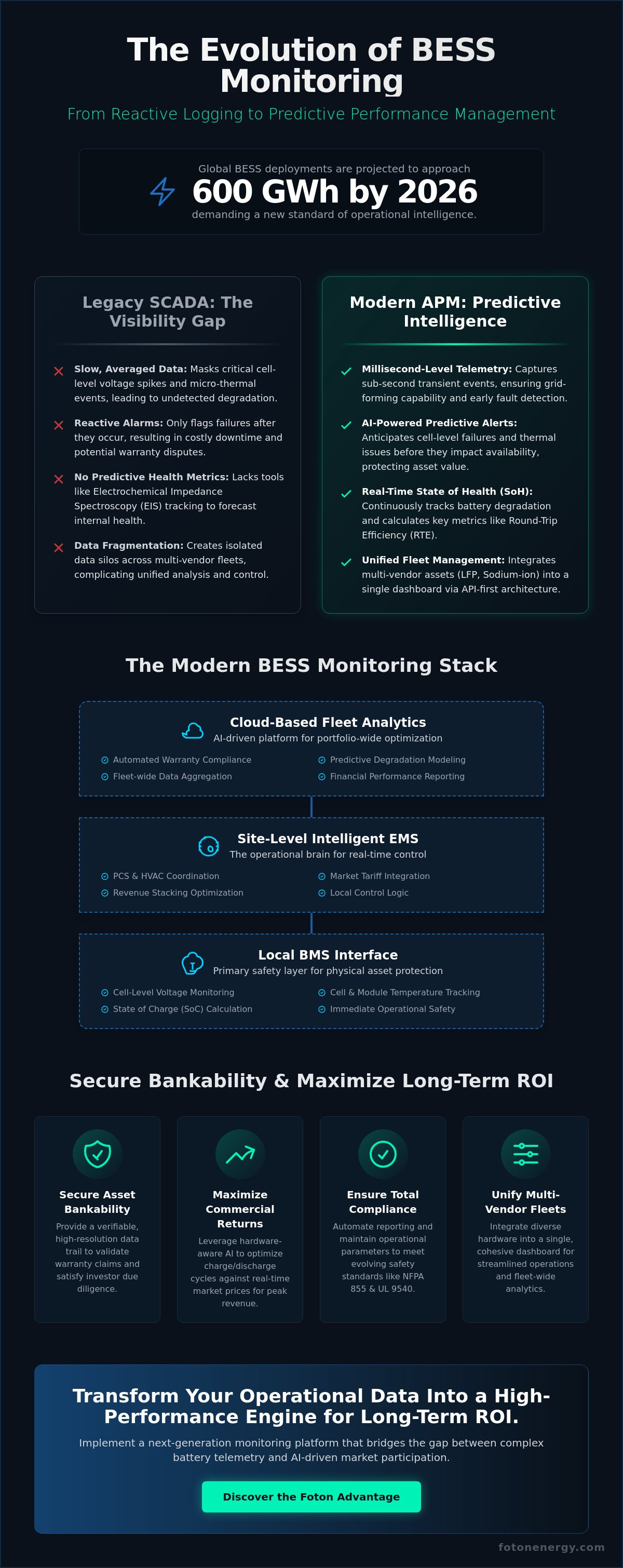
The era of passive data logging has ended. Traditional Supervisory Control and Data Acquisition (SCADA) systems were built for static infrastructure, but they lack the granular visibility required to manage the complex electrochemical behavior of a modern Battery Energy Storage System (BESS). As global deployments scale toward 600 GWh in 2026, the industry is transitioning from reactive monitoring to predictive Asset Performance Management (APM). This evolution is essential for capturing the sub-second transient events that define grid stability and battery longevity. Relying on legacy tools creates a visibility gap that endangers both safety and commercial viability.
Advanced BESS performance monitoring tools now provide the high-frequency data resolution necessary for grid-forming capabilities and sophisticated revenue stacking. While legacy platforms might record data every minute, current utility-scale requirements demand millisecond-level sampling to identify voltage anomalies or frequency deviations. This high-speed telemetry is the cornerstone of modern bankability. It allows us to move beyond basic troubleshooting toward a model where we anticipate cell-level failures before they impact availability. Hybrid cloud-edge architectures support this by maintaining critical control logic locally while leveraging cloud-based AI for fleet-wide optimization.
The Limitations of Legacy Monitoring
Legacy systems often obscure critical risks by relying on time-averaged metrics. A one-minute average can easily hide a cell-level voltage spike or a micro-thermal runaway event that precedes a major failure. These older systems generally lack the capability to track Electrochemical Impedance Spectroscopy (EIS) trends, which are vital for assessing internal resistance and health. In large-scale deployments, late-stage fault detection is an expensive failure of strategy. The resulting downtime and potential warranty complications can significantly diminish the ROI of C&I BESS and utility-scale storage projects alike.
Defining the Modern BESS Monitoring Stack
A robust monitoring architecture requires a tiered approach to data and control. We view the modern monitoring stack as an integrated ecosystem of three core layers:
- The Local BMS Interface: This layer provides the primary safety data, tracking cell-level voltage and temperature to prevent immediate operational risks.
- The Site-Level Intelligent EMS: This controller serves as the operational brain, coordinating the Power Conversion System (PCS) and optimizing energy discharge based on real-time market tariffs.
- The Cloud-Based Fleet Analytics: This platform aggregates data across diverse portfolios, using AI to automate warranty compliance and predict long-term degradation patterns.
By aligning these components, asset owners create a bankable data trail that secures long-term value and ensures every asset performs at its theoretical peak.
Critical Features of High-Performance BESS Monitoring Tools
Maximizing the lifecycle of a utility-scale asset requires a shift toward intelligence-led oversight. High-performance BESS performance monitoring tools must provide more than a simple operational overview; they must offer granular, chemistry-specific insights that protect the physical integrity of the battery modules. Modern systems now utilize specialized algorithms tailored for both Lithium-Iron Phosphate (LFP) and emerging Sodium-ion chemistries. While LFP remains the industrial standard due to its high thermal runaway threshold of 270°C, Sodium-ion assets require distinct voltage curve modeling to ensure stable performance during rapid cycling.
Beyond safety, these tools must automate financial performance metrics. Automated Round-Trip Efficiency (RTE) calculation allows operators to identify energy losses across the power conversion chain in real-time. By integrating these metrics with wholesale market signals, an Intelligent EMS can optimize discharge cycles to coincide with peak pricing. For instance, in March 2026, German day-ahead electricity prices rose to approximately €106/MWh. Systems that utilized real-time market integration were able to capture these volatility spikes while maintaining strict adherence to battery health constraints.
Advanced Analytics: SoH Mismatch and Degradation
Detecting cell-level imbalances is the first line of defense against premature system aging. State of Health (SoH) tracking is the primary driver of BESS residual value. Advanced platforms utilize "digital twin" modeling to simulate degradation under various cycling profiles. This allows technical partners to forecast capacity fade with precision. It ensures that an SoH mismatch is identified and corrected before it triggers a protective shutdown of the entire battery string, preserving the asset's long-term bankability.
Thermal and Safety Architecture Monitoring
Thermal stability is the foundation of operational security. Modern monitoring tools track coolant flow rates and internal temperature deltas with high precision to maintain optimal battery environments. By integrating smoke and gas detection sensors directly into the primary dashboard, operators gain a unified view of site safety. AI plays a critical role here. It distinguishes between harmless sensor noise and genuine thermal runaway risks. This ensures that fire suppression alerts are only triggered by verified threats, maintaining high availability for critical infrastructure like data centers and telecommunications backups.
Securing Bankability: Monitoring for Warranty and Compliance
Bankability is a function of verifiable data. For large-scale infrastructure investors, the technical health of the system must be backed by a legally defensible audit trail. Tier-1 manufacturers require precise telemetry to validate warranty claims and ensure that operational limits haven't been exceeded during the asset's life. Utilizing robust BESS performance monitoring tools transforms raw sensor outputs into a "bankable" record, providing the security needed to protect multi-million dollar investments over their 15-year lifecycle. This documented transparency directly influences project financing and can lead to reduced insurance premiums by demonstrating a commitment to proactive risk mitigation.
Data integrity must remain absolute even during system interruptions. The "Black Box" requirement is a critical feature of modern monitoring architecture, ensuring that telemetry is buffered locally during network outages and synchronized once connectivity is restored. This prevents the "data gaps" that frequently lead to disputes during annual warranty reviews. By maintaining a continuous, high-fidelity record of throughput and thermal conditions, asset owners can automate complex reporting tasks, moving from manual data collection to streamlined, investor-ready summaries. This level of automation is essential for managing the growing complexity of utility-scale storage and data center backup systems.
The Data Requirements of Tier-1 Warranties
Modern warranty contracts for grid-scale storage often mandate data granularity at 1Hz or higher. This resolution is necessary to capture transient events that could indicate cell stress or cooling system inefficiencies that lower-frequency logging might miss. Even a 15-minute data gap can become a point of contention during a capacity guarantee claim, as it leaves the manufacturer blind to the battery's state during that window. Automated "State of the Battery" reports now provide stakeholders with monthly insights into degradation trends and cycle counts, ensuring the asset remains within the specified operational bounds.
Satisfying Grid Code and Regulatory Mandates
Compliance is a moving target that requires constant vigilance. The 2026 edition of NFPA 855 and UL 9540 certifications have introduced stricter requirements for gas monitoring and explosion prevention, all of which must be integrated into the primary monitoring dashboard. By providing high-resolution telemetry on frequency response and voltage regulation, these monitoring tools ensure that assets remain compliant with stringent Australian and global grid standards. For a deeper look at how these standards impact project design, refer to our Strategic Guide to BESS Solutions. Maintaining this level of oversight ensures that your asset remains a foundational pillar of the grid while maximizing its commercial availability.
Integration Strategies for Hybrid and Multi-Vendor Fleets
Fragmented data environments are the primary obstacle to scaling complex energy storage portfolios. When a fleet consists of hardware from multiple vendors, achieving a "Single Pane of Glass" view requires more than basic software. High-performance BESS performance monitoring tools must utilize API-first architectures to bridge the technical divide between established LFP systems and emerging Sodium-ion modules. This approach ensures that performance benchmarks and data normalization remain consistent across the entire fleet, regardless of the underlying hardware chemistry or manufacturer-specific communication protocols. By centralizing these disparate data streams, asset managers can execute uniform maintenance strategies that protect the longevity of the entire portfolio.
Connectivity architecture plays a decisive role in maintaining high availability for mission-critical infrastructure. For remote telecommunications sites or hyperscale data centers, edge-to-cloud connectivity solves the inherent risks of network latency. By processing critical telemetry at the site level, the system can execute sub-second control logic to manage transient events. Simultaneously, it pushes aggregated data to the cloud for long-term fleet analytics and predictive modeling. This hybrid model ensures that local safety and operational decisions are never delayed by external network conditions, providing a stable foundation for global energy management and reliable backup power.
Harmonizing Hybrid Solar + Storage Sites
Co-optimizing hybrid sites requires a deep integration of forecasting and real-time control. Advanced monitoring software must manage common-point-of-coupling (PCC) constraints while simultaneously optimizing inverter clipping. When solar production exceeds inverter limits, intelligent software directs that excess energy into the BESS charging cycle rather than losing it to curtailment. By forecasting solar yield based on real-time weather data, the system can schedule optimal discharge windows to coincide with peak demand. This transforms intermittent renewables into a firm, dispatchable asset that maximizes the commercial value of the existing grid connection.
Cybersecurity and Data Sovereignty
Protecting industrial IoT (IIoT) energy data is a non-negotiable requirement for modern infrastructure. Monitoring tools must adhere to strict encryption standards, such as AES-256, and comply with regulatory frameworks like NERC CIP or local equivalents. For data center backup systems, the choice between "On-Premise" and "Cloud" hosting is a critical strategic decision. On-premise solutions offer maximum data sovereignty and security for sensitive operations, while cloud-based platforms provide the scalability needed for widespread C&I BESS deployments. Our team provides the engineering consulting and Intelligent EMS solutions required to navigate these complex integration challenges and secure your long-term energy future.
The Foton Advantage: AI-Driven EMS Integrated with Tier-1 Hardware
Foton Energy (Foton Pty Ltd) provides a specialized architectural approach that bridges the gap between sophisticated software and Tier-1 battery hardware. Our BESS performance monitoring tools are engineered to be "hardware-aware," meaning they're built to recognize the specific thermal and voltage characteristics of the cells they oversee. This level of technical synergy eliminates the common data silos that occur when using generic, third-party monitoring platforms. By deploying proprietary AI algorithms that are specifically tuned for high-density LFP and Sodium-ion storage, we ensure that every asset operates within its optimal electrochemical envelope, maximizing both safety and operational life.
Our end-to-end engineering support transforms technical infrastructure into a bankable commercial asset. In recent utility-scale projects across regional Australia, this integrated approach has significantly improved system availability by streamlining the communication between site-level controllers and the broader grid interface. We provide a steady, guiding hand from initial feasibility studies through to long-term asset management, ensuring that project developers and EPCs have a reliable partner for meeting complex grid-code requirements. This comprehensive oversight is what defines a truly resilient energy storage investment.
Intelligent Energy Management Systems (EMS)
Foton’s AI-driven EMS serves as the operational brain of the system, actively reducing demand charges in commercial and industrial applications. The platform executes real-time optimization for peak shaving and load shifting, adapting to volatile market signals without compromising battery health. By implementing predictive maintenance schedules, the system effectively manages depth-of-discharge and thermal stress, ensuring that the battery modules remain productive throughout their entire lifecycle. This intelligence allows owners to capture maximum value from every kilowatt-hour stored.
Global Support and Engineering Consulting
We leverage over 30 years of manufacturing heritage to provide software insights that are grounded in rigorous testing and operational excellence. This deep experience allows us to develop custom dashboards tailored to the specific reporting needs of project developers and investors. We invite you to Contact Foton Energy (Foton Pty Ltd) to discuss your project monitoring requirements and discover how our integrated technology stack can secure your next large-scale infrastructure investment. Our team is ready to help you build a more resilient and profitable energy future.
Mastering the Future of Energy Storage Performance
Deploying a utility-scale asset is a multi-decade commitment that requires more than just high-quality hardware. It demands a sophisticated software ecosystem that can anticipate risks and capitalize on market volatility in real-time. By implementing advanced BESS performance monitoring tools, you transition from simple data observation to proactive asset management, ensuring that every cycle contributes to your long-term ROI. The convergence of hardware awareness and predictive AI is the only way to safeguard your investment against the "silent" degradation that threatens unmonitored systems.
As a specialized technical partner with a global manufacturing heritage, Foton Energy (Foton Pty Ltd) is uniquely positioned to help you navigate these operational complexities. Our engineering consulting and AI-driven optimization for diverse chemistries provide the bankable assurance required for grid-scale success and long-term commercial viability. We invite you to Explore Foton’s AI-Driven EMS and Monitoring Solutions and discover how our integrated platform can protect your infrastructure and maximize your commercial returns. Let's build a more resilient and high-performance energy future together.
Frequently Asked Questions
What is the difference between BMS and BESS performance monitoring tools?
The Battery Management System (BMS) serves as the primary safety layer, managing cell-level balancing and immediate protections within the battery modules. In contrast, BESS performance monitoring tools operate at the asset or fleet level, aggregating data from the BMS, inverters, and environmental sensors. These tools provide the high-level analytics, commercial reporting, and long-term health trends necessary for strategic asset management.
How often should BESS data be sampled for warranty compliance?
Utility-scale projects typically require high-resolution data sampling at a frequency of 1Hz or higher to satisfy Tier-1 warranty conditions. Maintaining this granularity is vital because data gaps as short as 15 minutes can lead to disputes during capacity guarantee reviews. Consistent, high-frequency recording ensures that the system's operational history is fully documented for financiers and manufacturers.
Can performance monitoring tools prevent thermal runaway in lithium batteries?
Advanced monitoring platforms significantly reduce the risk of thermal runaway by integrating gas and smoke detection with real-time temperature delta analysis. By identifying abnormal heat signatures or off-gassing before they reach critical thresholds, these systems provide the early warnings necessary to trigger fire suppression. This proactive oversight is a cornerstone of compliance with safety standards like NFPA 855.
How do monitoring tools handle different battery chemistries like Sodium-ion?
Modern monitoring software utilizes chemistry-specific algorithms to account for the unique discharge profiles and voltage curves of Sodium-ion modules. Since Sodium-ion behaves differently than LFP under rapid cycling, the software must adapt its State of Charge (SoC) modeling to ensure accuracy. Intelligent platforms allow operators to manage these diverse assets within a single, unified dashboard.
What are the typical costs associated with BESS asset management software?
Annual operations and maintenance (O&M) costs for commercial storage systems are currently estimated between $15 and $25 per kW per year. Software for performance monitoring is a component of this budget, providing the predictive analytics that prevent more expensive hardware failures. We recommend consulting with an engineering partner to determine the specific software requirements for your project's scale and complexity.
Do I need a separate monitoring tool if my inverter has its own app?
A dedicated monitoring tool is essential because inverter apps are often siloed and don't provide deep visibility into the battery's electrochemical health. High-performance BESS performance monitoring tools integrate the entire power chain, including the battery modules, PCS, and thermal management systems. This holistic view is necessary for sophisticated revenue stacking and verifying fleet-wide performance targets.
How does predictive maintenance improve the ROI of a BESS project?
Predictive maintenance improves ROI by identifying sub-optimal performance before it leads to system downtime or a breach of warranty. By analyzing degradation trends, these tools allow operators to schedule maintenance during periods of low market volatility. This proactive management extends the functional life of the battery cells and ensures the asset remains a productive, bankable component of your infrastructure.
Is cloud-based BESS monitoring secure for utility-scale projects?
Cloud-based monitoring is highly secure when implemented with industrial-grade encryption standards like AES-256 and compliance with NERC CIP frameworks. Most utility-scale systems utilize hybrid architectures where critical control logic remains at the edge for immediate response. This setup ensures that data sovereignty is maintained while leveraging the cloud for complex fleet-wide analytics and long-term storage.


