
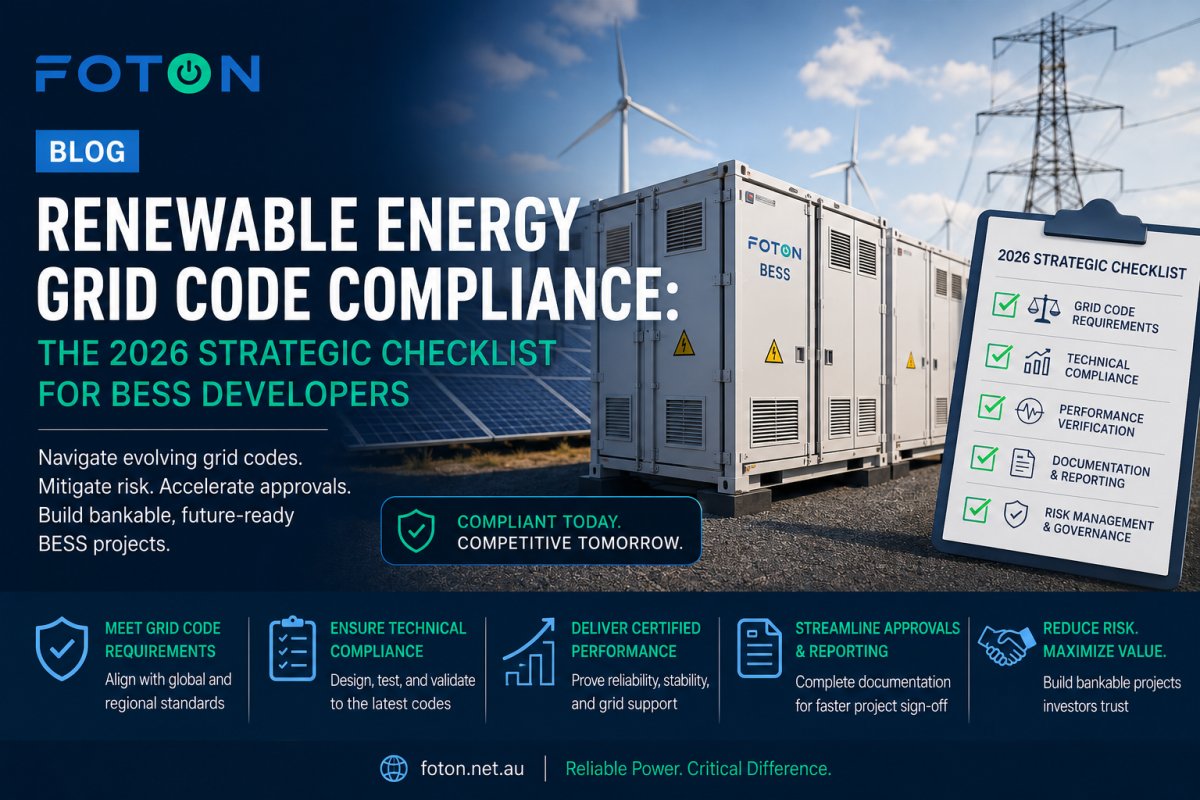
With penalties for non-compliance reaching up to $1.54 million per day, the shift toward mandatory NERC IBR registration by May 15, 2026, has transformed grid integration from a technical hurdle into a high-stakes financial priority. Achieving renewable energy grid code compliance is no longer just about meeting local standards; it's about securing the long-term bankability of your utility-scale assets. You likely recognize that the complexity of differing regional requirements, from AEMO in Australia to ENTSO-E in Europe, often leads to costly interconnection delays and hardware retrofits that erode project margins. It's a challenging landscape where technical precision is the only path to project stability.
We're here to help you navigate this transition with professional confidence. This article provides a strategic roadmap to master these technical and regulatory requirements, ensuring your energy storage projects achieve seamless interconnection. We'll examine the critical 2026 updates for NERC and EU battery regulations, while demonstrating how an intelligent EMS can reduce operational risk and satisfy the most rigorous financier demands. By aligning your hardware with these emerging global standards, you can transform regulatory hurdles into a distinct competitive advantage.
Key Takeaways
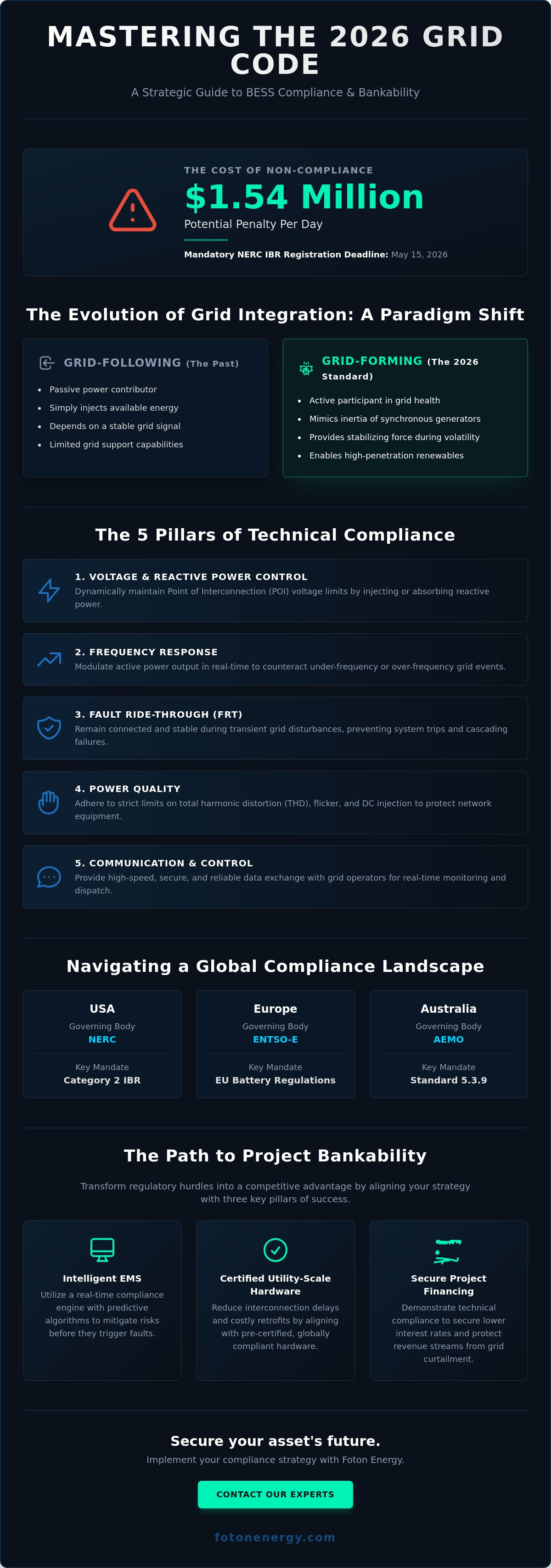
- Understand why 2026 standards demand a strategic shift from grid-following to grid-forming capabilities to ensure long-term asset stability.
- Master the technical pillars of renewable energy grid code compliance, focusing on precise voltage regulation and active power modulation for frequency response.
- Explore how an intelligent EMS utilizes predictive algorithms to act as a real-time compliance engine, mitigating risks before they trigger faults.
- Differentiate between regional requirements, such as AEMO’s 5.3.9 standards and NERC’s Category 2 IBR mandates, to streamline your global interconnection strategy.
- Align your development process with engineering consulting and pre-certified utility-scale hardware to secure project bankability for high-tier financiers.
What is Renewable Energy Grid Code Compliance for BESS?
Grid code compliance is the non-negotiable technical foundation for modern power systems. It represents the comprehensive set of rules established by Transmission System Operators (TSOs) to ensure that Inverter-Based Resources (IBRs) integrate safely and reliably into the existing electrical network. Historically, renewable assets were treated as passive contributors that simply injected power whenever it was available. However, the 2026 regulatory landscape has shifted this paradigm. Modern TSOs now view battery energy storage as an active participant in grid health, requiring systems to move beyond "grid-following" and adopt "grid-forming" capabilities. This evolution ensures that your BESS can mimic the physical inertia of traditional synchronous generators, providing a stabilizing force during periods of high volatility.
To visualize these complex technical requirements and how they impact project development, watch this overview of grid code dynamics:
The Evolution of Interconnection Standards
The industry has moved rapidly beyond the basic distribution-level requirements of IEEE 1547. We've entered an era defined by the global adoption of IEEE P2800-2022 standards, which dictate how Grid energy storage must perform during large-scale transmission events. Unlike wind or solar generation, which are often variable and passive, BESS technology provides the critical bridge between intermittent renewables and baseload stability. Modern networks now require sub-second response times to manage frequency deviations effectively. Achieving renewable energy grid code compliance ensures your system can perform these complex active power modulations, protecting the wider network from cascading failures while maximizing the utility of your stored energy.
Why Compliance Equals Project Bankability
Technical adherence is a direct driver of financial performance. Failure to meet these evolving standards creates immediate friction with financiers and insurance providers. Non-compliant assets face a high risk of "curtailment," a scenario where grid operators forcedly disconnect or limit your system's output to protect grid health, directly eroding your revenue streams. We see that technical certification acts as a primary risk mitigation tool, often helping developers secure lower interest rates on project financing. Ultimately, grid code compliance is a mandatory technical contract between the asset owner and the TSO that defines the legal and operational boundaries of the project. By prioritizing these standards during the engineering consulting phase, you ensure that your Utility-Scale Storage asset remains a high-performance, bankable investment for its entire lifecycle.
The 2026 BESS Grid Code Compliance Checklist
Strategic precision is the hallmark of a bankable energy storage project. To achieve renewable energy grid code compliance, developers must move beyond basic connectivity and embrace a rigorous technical framework. This checklist ensures your asset functions as a resilient pillar of the grid rather than a liability during peak stress. Every component, from the inverter firmware to the high-level control logic, must align with five critical performance pillars:
- Voltage and Reactive Power Control: Dynamically maintaining the Point of Interconnection (POI) within strict voltage limits through reactive power injection or absorption.
- Frequency Response: Modulating active power output in real-time to counter under-frequency or over-frequency events.
- Fault Ride-Through (FRT): Ensuring the system remains connected and stable during transient disturbances rather than tripping offline.
- Power Quality: Adhering to stringent limits on total harmonic distortion (THD), flicker, and DC injection to prevent equipment degradation.
- Communication and Control: Providing high-speed, secure telemetry that allows Transmission System Operators (TSOs) to dispatch the asset remotely.
Voltage and Frequency Regulation
Maintaining frequency stability requires more than just raw capacity; it demands intelligence at the edge. Your BESS must provide sophisticated droop control and fast frequency response (FFR) to stabilize the network within milliseconds of a deviation. This necessitates a Comprehensive Comparative Analysis of Grid Code Requirements to ensure your control settings match local TSO expectations. For instance, our C&I BESS solutions manage these complex demands at the inverter level, utilizing high-speed digital signal processing to verify dynamic reactive power support (VAR) capabilities instantly. This proactive regulation prevents local voltage collapse and ensures your project supports wider network resilience.
Advanced Ride-Through Capabilities
Resilience is truly tested during grid faults. Modern standards distinguish between Low-Voltage Ride-Through (LVRT) and High-Voltage Ride-Through (HVRT), requiring systems to stay synchronized even when the grid voltage drops to near zero or spikes significantly. A common success criterion for 2026 projects is the ability to recover to 90% of pre-fault active power within 500ms of fault clearance. Achieving this benchmark requires high-resolution performance monitoring tools that can capture sub-cycle data for post-event analysis. Without this granular visibility, proving compliance to regulators becomes nearly impossible. Engaging in detailed engineering consulting early in the design phase allows you to simulate these fault conditions, ensuring your hardware is pre-configured for the specific electrical characteristics of your interconnection site.
Leveraging AI-Driven EMS for Real-Time Compliance
Intelligence is the operational core of modern grid integration. While hardware provides the physical capacity, our Intelligent EMS serves as the strategic brain that ensures renewable energy grid code compliance in real-time. In an era where NERC Category 2 IBR registration is mandatory by May 15, 2026, relying on static controls is a significant financial risk. Our system utilizes high-fidelity telemetry and edge computing to modulate active and reactive power with microsecond precision, shielding developers from the significant daily penalties associated with non-compliance. This software-defined approach transforms a BESS from a passive asset into a resilient, grid-forming participant.
Predictive Grid Support Strategies
Proactive regulation is the new industry benchmark. By moving beyond reactive responses, our ML models anticipate grid instability before it triggers a fault condition. This foresight allows the system to adjust its state of charge and thermal profile, ensuring that the asset is always ready to provide fast frequency response (FFR). Crucially, the EMS optimization logic balances these mandatory grid services with LFP battery cycle life for utilities. This dual-focus ensures that meeting TSO demands doesn't come at the expense of your long-term ROI. Intelligent buffers allow the system to reduce peak demand charges for C&I applications while maintaining the overhead required for strict compliance dispatch.
Fleet-Wide Compliance Monitoring
Managing compliance across a diverse portfolio of utility-scale sites requires a centralized, transparent architecture. Our dashboards provide a unified view of every asset, ensuring that BESS performance monitoring tools capture 100ms granularity data as required for post-event analysis by AEMO or NERC. This high-resolution logging is essential for proving that your system successfully navigated a low-voltage ride-through event. Additionally, our platform streamlines the deployment of automated firmware updates. As regional grid codes evolve throughout 2026 and beyond, your entire fleet can be updated remotely to meet new technical standards without the need for expensive on-site hardware retrofits. This interconnectedness ensures that your safety architecture and thermal management systems remain perfectly synchronized with real-time grid-dispatch signals.
Regional Variations: Australia, USA, and Europe
Global grid integration is defined by local technical nuances. Achieving renewable energy grid code compliance requires a localized strategy that accounts for the specific topology and regulatory history of each market. While the United States focuses on standardizing transmission performance through the implementation of IEEE P2800-2022, European developers face a patchwork of national deviations within the ENTSO-E Requirements for Generators (RfG) framework. Foton’s global marketing network provides the critical expertise needed to navigate these multi-region deployment complexities, ensuring that your BESS is pre-configured for the specific demands of its destination grid.
In the United States, the regulatory pressure has intensified with the mandatory NERC IBR registration deadline of May 15, 2026. This mandate applies to any inverter-based resource with an aggregate capacity of 20 MVA or greater connected at 60 kV or higher. Across the Atlantic, the focus has shifted toward streamlining permitting through the designation of "Renewables Acceleration Areas" by February 2026 under the RED III directive. However, technical compliance remains rigorous; developers must adhere to strict fault-ride-through and frequency stability standards that vary significantly between the Nordic, Continental, and Baltic synchronous areas.
The Australian Context (AEMO & NER)
Australia presents one of the most demanding environments for grid integration due to its vast distances and "weak grid" characteristics in regional areas. The Australian Energy Market Operator (AEMO) utilizes the Generator Interconnection Procedure (GIS) to manage these risks, requiring exhaustive modeling under the National Electricity Rules (NER) 5.3.9. As an Australian energy storage infrastructure company, Foton is deeply integrated into this local engineering landscape. We guide developers through the high-stakes R1 and R2 testing phases for commercial BESS, ensuring that the hardware performance matches the dynamic models submitted to the regulator. This rigorous verification is essential in regions where grid-forming inverters are now a prerequisite for stability.
Global Standards and Bankability
Technical compliance is the first step toward financial security, but it is not the last. For global financiers, Tier-1 manufacturing heritage and third-party DNV verification serve as non-negotiable proof points of asset quality. These certifications are especially critical when deploying emerging technologies, such as sodium-ion battery solutions for data centers, which require unique safety-to-grid certifications for high-availability environments. Regional codes are the floor, while global bankability standards are the ceiling for project success. By exceeding local mandates, you protect your asset against future regulatory shifts and enhance its value in the secondary market. To ensure your next project meets these rigorous global benchmarks, partner with our engineering consulting team for a comprehensive grid impact assessment.
Implementing Your Compliance Strategy with Foton Energy
Strategic implementation is the final bridge between a planned asset and a revenue-generating reality. Achieving renewable energy grid code compliance requires more than just high-quality hardware; it demands a holistic integration of engineering precision and regulatory foresight. We provide the technical foundation you need to navigate the transition from initial feasibility to final grid connection. By combining our specialized engineering consulting with pre-certified hardware, we eliminate the friction that typically stalls large-scale energy storage projects during the interconnection phase. It's about turning regulatory requirements into a streamlined path for project delivery.
Technical Consulting and System Design
Expertise in modeling is non-negotiable. Our team conducts rigorous project modeling using PSCAD and PSS/E software to simulate how your system will interact with the local network under both steady-state and transient conditions. These engineering fees represent a critical investment in project security, ensuring that every inverter setting is optimized for local grid dynamics. We leverage an exclusive Tier-1 partnership to source Cospowers hardware that arrives with pre-certified compliance profiles, significantly reducing the time spent on field-level troubleshooting. This proactive design philosophy ensures your BESS is future-proofed against upcoming "Synthetic Inertia" mandates, allowing you to adapt as TSOs demand more sophisticated grid-support services.
Reliability is built into every layer of our architecture. We integrate proprietary safety systems and advanced thermal management to maintain long-term stability, even when the grid-dispatch signals require rapid, high-power cycling. This ensures that your system remains compliant without compromising its operational lifespan or safety profile.
Commissioning and Long-Term Asset Management
The final hurdle is the physical validation. On-site compliance testing and the subsequent TSO sign-off are often the most stressful phases for EPCs. We mitigate this risk by providing comprehensive technical support during the commissioning process. Our wholesale hardware procurement includes the specialized engineering oversight necessary to verify that the installed system performs exactly as the dynamic models predicted. Once the project is live, our O&M support ensures that your asset remains in a state of continuous compliance, protecting your bankability for the duration of the power purchase agreement. Don't leave your project's interconnection to chance. Contact our team for a BESS project feasibility study to define your path to a resilient, grid-ready future.
Secure Your Grid Integration Strategy for 2026 and Beyond
The path to grid integration has evolved into a sophisticated technical and financial discipline. We've explored how 2026 standards require a critical transition from passive grid-following to active, grid-forming capabilities. By mastering the regional nuances of NERC, AEMO, and ENTSO-E, developers can mitigate the risk of costly delays and ensure their projects remain bankable. Achieving renewable energy grid code compliance is no longer just a regulatory hurdle; it's a strategic advantage that distinguishes resilient, high-performance assets in a competitive global market.
Our team stands ready to support your strategic ambitions. As the exclusive global partner of Tier-1 Cospowers, we combine world-class hardware with an AI-driven EMS designed for real-time grid optimization. With engineering support spanning across 70+ countries, we provide the stability and technical expertise required for large-scale infrastructure success. We invite you to Consult with Foton Energy on your Grid Code Compliance Strategy to secure your project's future and ensure seamless interconnection. Let's build a more resilient and interconnected energy landscape together.
Frequently Asked Questions
What is the most common reason for BESS grid code compliance failure?
Discrepancies between digital simulations and physical hardware performance are the most frequent causes of failure. Often, the PSCAD or PSS/E models submitted during the design phase don't perfectly mirror the inverter's real-world sub-second response. This leads to rejected R1 or R2 tests, forcing developers into expensive firmware recalibrations or hardware retrofits that delay the commercial operation date.
How does IEEE P2800-2022 differ from previous BESS standards?
IEEE P2800-2022 establishes a unified technical framework specifically for large-scale Inverter-Based Resources connected to transmission networks. Unlike the older IEEE 1547 standard, which primarily addressed distribution-level integration, P2800 focuses on bulk power system reliability. It mandates rigorous performance benchmarks for voltage ride-through, frequency support, and power quality to ensure massive BESS installations contribute to transmission stability.
Can sodium-ion batteries meet the same grid code requirements as LFP?
Sodium-ion batteries can meet identical renewable energy grid code compliance standards as LFP, provided they're paired with compatible grid-forming inverters. While the chemistry differs, the grid operator cares only about the Point of Interconnection performance. Developers must ensure the power conversion system is tuned to account for sodium-ion's unique discharge curves to maintain required frequency response and voltage support profiles.
What is the role of an Energy Management System (EMS) in grid stability?
The EMS serves as the strategic intelligence layer that synchronizes the battery's output with real-time grid conditions. It processes TSO dispatch signals and manages sub-second telemetry to ensure the system stays within active and reactive power limits. Without an intelligent EMS, a BESS can't provide the predictive frequency support or automated reporting required by modern regulators like NERC or AEMO.
How long does the grid code compliance testing process typically take?
The complete testing and approval cycle generally spans six to twelve months from the initial modeling phase to final commissioning. This timeline includes the R1 modeling verification, physical on-site R2 testing, and the subsequent data review by the grid operator. Proactive engineering consulting and utilizing pre-certified hardware can often shave several weeks off this process by minimizing modeling errors.
Is grid-forming capability mandatory for all utility-scale BESS in 2026?
Grid-forming capability isn't universally mandatory yet, but it's becoming a de facto requirement for projects in weak grid areas or high-penetration renewable zones. By 2026, many TSOs will prioritize assets that provide synthetic inertia and local voltage strength. Investing in grid-forming technology today future-proofs your asset against evolving mandates and enhances its long-term bankability for financiers.
How do regional grid codes affect the ROI of commercial battery storage?
Regional codes directly influence ROI by determining which ancillary service markets the BESS can enter. Stringent compliance requirements might increase initial CAPEX for advanced inverters, but they also unlock revenue streams for fast frequency response and grid stabilization. Conversely, failing to meet local standards can lead to severe curtailment, which significantly erodes the project's projected internal rate of return.
What certifications should I look for in a Tier-1 energy storage manufacturer?
Seek manufacturers with DNV bankability reports and comprehensive UL 9540 safety certifications. For renewable energy grid code compliance, it's vital to verify that the hardware has undergone rigorous testing for IEEE P2800 or equivalent regional standards. Partnering with a Tier-1 manufacturer ensures that the equipment is backed by extensive manufacturing heritage and the technical documentation required for smooth TSO approvals.


