

Bankability is no longer a vague financial concept. It's a rigorous technical standard that determines whether your energy infrastructure attracts capital or stalls in committee. While you're likely exploring commercial battery storage financing options to mitigate high upfront CAPEX, you're also facing the challenge of proving long-term asset safety to skeptical lenders. It's frustrating to see potential IRR diluted by complex revenue stacks like FCAS and arbitrage that feel difficult to guarantee over a twenty-year lifecycle.
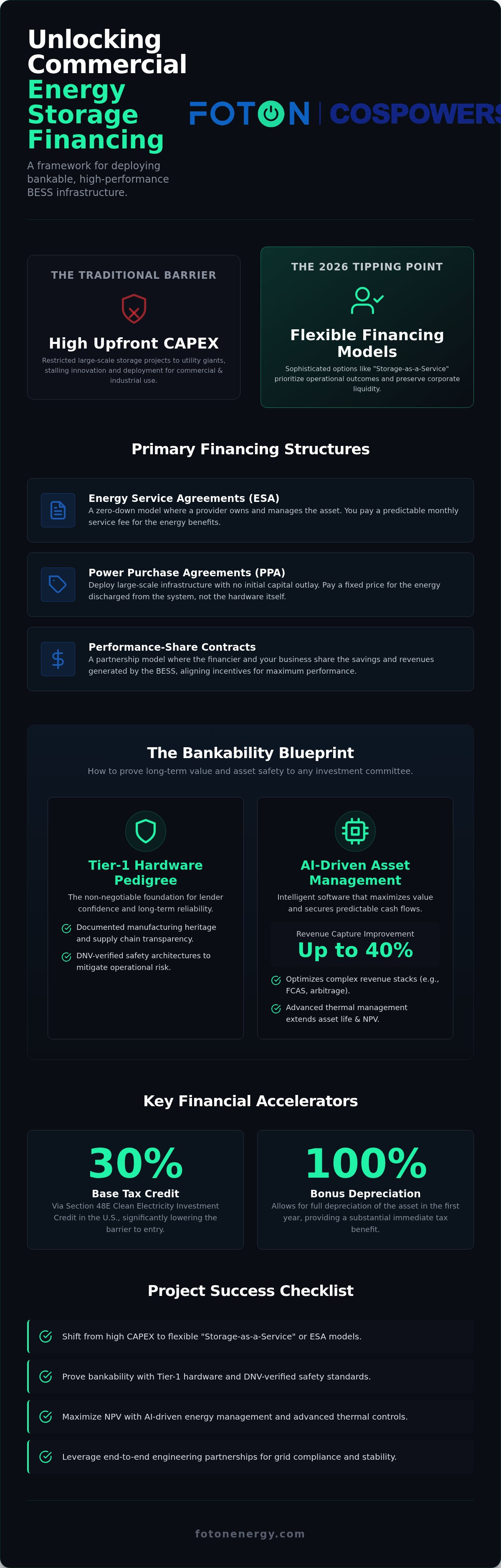
This guide empowers you to master the financial frameworks needed to deploy large-scale storage without prohibitive capital. We'll show you how to leverage Section 48E tax credits, which offer a base 30% credit, and how to utilize AI-driven energy management systems to improve revenue capture by up to 40%. You'll learn to prove bankability through Tier-1 hardware pedigree and DNV-verified safety architectures. We will explore zero-down models and strategic procurement frameworks that transform energy storage into a high-performance, resilient asset that meets the strict requirements of any investment committee.
Key Takeaways
- Shift from high CAPEX to flexible "Storage-as-a-Service" and zero-down Energy Service Agreements (ESA) to preserve corporate liquidity.
- Prove project bankability to investment committees by utilizing Tier-1 hardware with documented manufacturing heritage and DNV-verified safety standards.
- Maximize your net present value (NPV) through AI-driven EMS that optimizes revenue stacks and advanced thermal management that extends asset life.
- Evaluate diverse commercial battery storage financing options like Power Purchase Agreements (PPAs) to deploy large-scale infrastructure without initial capital outlay.
- Leverage end-to-end engineering consulting and strategic partnerships to navigate complex grid compliance and ensure long-term technical stability.
Beyond CAPEX: The Evolving Landscape of Commercial BESS Financing in 2026
Capital deployment for energy infrastructure is undergoing a fundamental transformation. For years, high upfront CAPEX acted as a gatekeeper, restricting large-scale storage to utility giants. In 2026, the market has reached a critical tipping point. We've seen a shift from simple asset ownership toward sophisticated commercial battery storage financing options that prioritize operational outcomes over hardware possession. This evolution is driven by the maturation of a battery energy storage system (BESS) as a proven asset class, backed by years of performance data and standardized safety protocols. Global deployments reached 108 GW in 2025 alone, proving to institutional investors that storage is no longer a speculative venture but a cornerstone of industrial resilience.
Modern financing has expanded to include a diverse array of structures designed to preserve corporate liquidity. These include:
- Energy Service Agreements (ESA): Zero-down models where the provider manages the asset and the business pays a monthly service fee.
- Performance-Share Contracts: Agreements where the financier and the host share the savings and revenues generated by the system.
- ESG-Linked Loans: Debt facilities with interest rates tied to the achievement of specific carbon reduction targets.
- Hybrid PPAs: Power Purchase Agreements that integrate storage to provide firm, dispatchable renewable energy.
The Rise of Performance-Based Financing
Lenders are moving away from hardware-centric loans in favor of revenue-share agreements. This shift requires a deep understanding of how a system interacts with the grid. Financiers now scrutinize the "revenue stack," assessing how effectively a system can pivot between market-facing services like Frequency Control Ancillary Services (FCAS) and internal cost-saving measures like peak shaving. In 2026, BESS bankability is defined by a precise equilibrium between Tier-1 hardware reliability and AI-driven software intelligence that secures predictable cash flows. This dual focus ensures the asset remains productive throughout its lifecycle, protecting the interests of both the operator and the financier.
Incentives and Tax Credits: The 2026 Outlook
The regulatory environment has become a powerful tailwind for project deployment. In the United States, the Section 48E Clean Electricity Investment Credit provides a robust 30% base credit for commercial projects. This federal support, combined with 100% bonus depreciation in the first year, significantly lowers the barrier to entry. In the Australian market, the Australian Renewable Energy Agency (ARENA) continues to provide critical grant funding for projects that demonstrate innovative grid support capabilities. ESG mandates are also playing a decisive role; companies with strong sustainability profiles often secure lower interest rates from institutional lenders who are eager to green their portfolios.
Primary Financing Structures for Industrial Energy Storage Projects
Selecting the right framework for energy infrastructure requires a precise alignment of technical goals with balance sheet objectives. In 2026, the diversity of commercial battery storage financing options allows organizations to deploy large-scale systems without disrupting their primary capital allocation strategies. Whether you prioritize long-term asset ownership or immediate operational savings, the structure you choose will dictate your project's internal rate of return (IRR) and its overall risk profile. Power Purchase Agreements (PPAs) remain a staple for those seeking predictable energy costs, as they allow facilities to pay for the energy discharged rather than the hardware itself. For others, the focus is on maximizing the value of the "revenue stack" through direct ownership or sophisticated leasing models.
Leasing structures offer a middle ground for many C&I facilities. Operational leases often provide the benefit of keeping the asset off the primary balance sheet, depending on specific regional accounting standards. Capital leases, conversely, are structured with an intent to own, allowing the business to claim depreciation benefits while spreading the cost over the asset's useful life. For organizations with high liquidity, direct ownership through wholesale procurement offers the highest potential IRR. This model allows you to capture 100% of market-facing revenues, though it requires internal expertise to manage the operational risks associated with degradation and grid compliance.
Energy Service Agreements (ESA) and Shared Savings
The Energy Service Agreement (ESA) has emerged as a premier zero-CAPEX solution for industrial facilities. Under this model, a third-party provider installs, owns, and maintains the BESS, while the host facility pays a service fee based on achieved savings or performance metrics. This structure effectively transfers all technical and operational risk to the provider. Lenders are increasingly comfortable with ESAs when the project utilizes an AI driven energy management system to provide verifiable, real-time data on savings and asset health. Typical 2026 contracts range from 10 to 15 years, often featuring flexible exit strategies or buy-out options that allow businesses to take control of the asset once it has reached a specific performance milestone.
Financing Emerging Tech: Sodium-Ion vs LFP
Financiers traditionally prefer Lithium Iron Phosphate (LFP) because of its extensive safety record and established residual value. However, the sodium-ion battery commercial availability in 2026 has introduced a cobalt-free alternative that is rapidly gaining traction. While lenders may initially apply a risk premium to newer chemistries, this is often mitigated by residual value guarantees and performance bonds. You can consult Federal policies and incentives to identify grants that specifically target the deployment of these emerging technologies. Foton Energy (Foton Pty Ltd) supports the bankability of these projects by providing Tier-1 hardware, ensuring the infrastructure meets the highest global standards for durability. To understand how these chemistries impact your specific project's feasibility, consult with our engineering team for a detailed technical analysis.
The Bankability Blueprint: Why Tier-1 Hardware is Non-Negotiable for Lenders
Financiers view energy infrastructure through a lens of risk mitigation rather than simple hardware acquisition. In the eyes of an investment committee, "bankability" is a technical prerequisite that ensures an asset can meet its financial obligations over a twenty-year lifecycle. When exploring commercial battery storage financing options, you'll find that lenders prioritize projects utilizing Tier-1 hardware with documented performance histories. This preference isn't arbitrary; it reflects the need for certainty in round-trip efficiency, degradation rates, and safety protocols. Accessing broader Clean energy financing options often requires demonstrating that your chosen technology meets international standards like NFPA 855 and UL 9540A. By securing hardware from established manufacturers with DNV-verified safety architectures, you significantly reduce the technical due diligence time required by institutional financiers.
Manufacturer Heritage and Long-Term Warranties
Lenders scrutinize the balance sheet strength of manufacturers to ensure warranty backstops remain valid for the duration of the loan. A manufacturer’s 30-year heritage serves as the ultimate risk mitigation tool by providing financiers with the historical performance data and balance sheet stability required to underwrite multi-decade infrastructure investments. Through Foton’s exclusive partnership with Cospowers, projects benefit from a legacy of manufacturing excellence that acts as a trust signal for global investors. This stable heritage ensures that performance guarantees aren't just contractual promises but are backed by decades of proven operational stability and industrial resilience.
Technical Due Diligence for Utility-Scale Projects
Grid-code compliance is a non-negotiable hurdle for project funding in 2026. Lenders require assurance that the BESS can seamlessly integrate with local network requirements without triggering unforeseen curtailment or penalties. Engaging professional BESS engineering consulting services during the feasibility stage provides the technical proof points that investment committees demand. These services validate that the system’s modular containerized architecture is optimized for both thermal management and rapid deployment. This level of technical rigor simplifies asset appraisal, as financiers can clearly see how the modular design facilitates easier maintenance and protects the project’s net present value. Proving technical excellence early in the procurement phase is the most effective way to unlock competitive commercial battery storage financing options and accelerate your path to a final investment decision.
Maximizing IRR: How AI and Safety Architecture Protect Your Investment
Safety architecture is a fiscal imperative, not merely a regulatory hurdle. In 2026, the financial performance of an energy asset is inextricably linked to its physical resilience. When evaluating commercial battery storage financing options, investment committees prioritize systems that demonstrate a proactive approach to risk mitigation. Advanced safety architecture, incorporating DNV-verified fire suppression and explosion testing, serves as a direct lever to reduce insurance premiums. These operational savings flow directly to the bottom line, improving the project's Debt Service Coverage Ratio (DSCR) and ensuring that debt obligations are met even during market volatility. By integrating safety at the hardware level, you transform a potential liability into a stable, bankable asset. This same dedication to hardware integrity is essential in other precision-based industries, such as the production of professional athletic equipment; read more.
Protecting your investment also requires a sophisticated approach to asset health. AI-driven predictive maintenance identifies microscopic anomalies in cell performance before they escalate into catastrophic failures. This foresight prevents unplanned downtime, which is the primary threat to revenue consistency in large-scale deployments. When lenders see a project backed by intelligent monitoring, they gain confidence in the long-term stability of the "revenue stack," knowing that the system can reliably participate in high-value grid services without compromising its physical integrity.
Thermal Management as a Financial Safeguard
Lenders view thermal stability as a proxy for asset longevity. Effective thermal management extends the cycle life of the cells, which directly preserves the asset’s net present value (NPV) over its twenty-year lifespan. Active cooling systems, while requiring slightly more internal power, offer significantly lower long-term O&M costs compared to passive alternatives by preventing accelerated degradation. For instance, data centers utilizing sodium-ion solutions benefit from inherent thermal stability, which satisfies strict safety covenants required for high-density infrastructure. Maintaining optimal operating temperatures ensures that the battery health remains within the parameters specified in your loan covenants, preventing technical defaults.
AI-Driven Revenue Optimization
Intelligence is the key to unlocking the full potential of commercial and industrial BESS solutions. Modern AI-driven Energy Management Systems (EMS) automate the complex task of "revenue stacking," seamlessly pivoting between local peak shaving and market-facing services like Frequency Control Ancillary Services (FCAS). This automation removes the human error associated with manual dispatch, maximizing participation in lucrative frequency regulation markets. The resulting cash flow transparency is what financiers describe as "bankable" revenue. It provides a clear, data-backed audit trail of how the system generates value, making it easier to secure competitive commercial battery storage financing options. To see how our intelligent EMS can optimize your project's financial returns, request a performance simulation from our technical consultants.
Strategic Procurement: Partnering with Foton for Bankable BESS Infrastructure
Procurement strategy is the final, decisive link in the bankability chain. While selecting from various commercial battery storage financing options provides the necessary capital, strategic procurement ensures that capital is deployed into a high-performance asset without operational delay. Foton Energy serves as the exclusive global partner for Cospowers, a Tier-1 manufacturer with three decades of industrial heritage. This partnership provides a direct bridge between engineering, procurement, and construction (EPC) firms and the bankable hardware required by institutional investors. Our end-to-end engineering support ensures that every project meets the rigorous standards of global grid codes, which is a fundamental prerequisite for project funding in 2026. This collaborative model transforms the traditional vendor-client relationship into a long-term strategic alliance, ensuring that your energy infrastructure remains resilient and profitable throughout its entire lifecycle.
Wholesale Hardware and Supply Chain Security
In 2026, supply chain resilience is a non-negotiable requirement for project funding. Direct access to Tier-1 production lines allows developers to bypass the volatility of the secondary market, significantly reducing project lead times. This level of security is vital for utility scale BESS procurement, where even minor delays can impact the financial viability of a multi-megawatt installation. By securing a transparent supply chain, you mitigate the risks associated with raw material fluctuations and logistics bottlenecks, providing lenders with the certainty they need to approve large-scale credit facilities. Our global marketing and support network further streamlines the path to commissioning, providing localized assistance that ensures your asset is grid-ready from day one.
Collaborative Engineering for Financial Approval
Securing "bankable" status requires more than just a technical data sheet. It demands a partnership that extends from initial feasibility through to final grid connection. Foton’s technical consulting services assist in customizing safety and thermal architecture to meet the specific requirements of your site, whether you're deploying in a high-density data center or a remote industrial facility. This collaborative approach ensures that every technical proof point is documented for financial approval, reducing the time spent in committee review. By integrating engineering excellence with Tier-1 procurement, you create a project profile that is both technologically advanced and commercially stable, making it far easier to secure competitive commercial battery storage financing options. Partner with Foton for your next bankable BESS deployment to ensure your energy infrastructure is built on a foundation of reliability and global expertise.
Securing the Future of Industrial Energy Infrastructure
The landscape of energy storage is moving toward high-performance reliability backed by sophisticated financial structures. We've explored how commercial battery storage financing options have evolved to include zero-down models like Energy Service Agreements that shift technical risk away from the facility owner. Success in 2026 requires a synergy between Tier-1 hardware and intelligent software to ensure long-term bankability for institutional lenders. By prioritizing assets with a 30-year manufacturing heritage and DNV-verified safety, you protect your IRR against degradation and market volatility.
Foton Energy acts as the critical link between your vision and a commissioned, revenue-generating asset. Our global network across 70+ countries and exclusive strategic partnership with Cospowers provide the stability your investment committee demands. It's time to transition from high-CAPEX hurdles to resilient, dispatchable energy solutions. Contact Foton Energy to discuss bankable BESS financing for your next project and lead the shift toward a more stable industrial ecosystem.
Frequently Asked Questions
What are the most common financing models for commercial battery storage in 2026?
The primary structures in 2026 include Power Purchase Agreements (PPAs), Energy Service Agreements (ESAs), and various leasing models. These commercial battery storage financing options allow businesses to choose between asset ownership or performance-based service models. ESAs are particularly popular for C&I facilities seeking zero-upfront costs, while direct ownership remains the preferred route for entities looking to maximize long-term internal rates of return through wholesale hardware procurement and full revenue capture.
How does Tier-1 status affect the interest rates on BESS project loans?
Tier-1 hardware significantly reduces the risk premium applied by institutional lenders, often resulting in more favorable interest rates and longer loan tenures. Financiers view Tier-1 status as a proxy for manufacturing stability and warranty reliability. Projects utilizing hardware from established partners like Cospowers benefit from a 30-year heritage, which provides the technical assurance needed to lower the debt service coverage ratio requirements and secure competitive capital for large-scale infrastructure.
Is sodium-ion battery storage currently considered bankable by major lenders?
Sodium-ion technology is increasingly considered bankable in 2026, especially for applications requiring high thermal stability like data centers. While Lithium Iron Phosphate remains the industry standard, major lenders now accept sodium-ion projects that feature performance guarantees from Tier-1 manufacturers. The technology reached cost parity with LFP by the end of 2026, and its cobalt-free chemistry aligns with ESG mandates, making it an attractive prospect for green-focused investment committees globally.
What technical documentation do financiers require for a BESS project feasibility study?
Financiers require a comprehensive technical package including Single Line Diagrams, detailed battery degradation profiles, and grid-code compliance certifications. They also demand DNV-verified safety reports and thermal management specifications to assess operational risk. Documentation must prove that the system can reliably participate in the revenue stack while maintaining the physical integrity required to satisfy long-term loan covenants and insurance prerequisites. Technical consulting during this stage is vital for securing final approval.
Can an Energy Service Agreement (ESA) really provide a zero-CAPEX BESS solution?
Yes, an Energy Service Agreement is a true zero-CAPEX solution where a third-party provider owns and maintains the equipment. The host facility pays a service fee based on performance or shared savings, effectively moving the energy storage asset off the balance sheet. This model is ideal for businesses that want to prioritize operational liquidity while still accessing the benefits of commercial battery storage financing options without the burden of long-term hardware maintenance.
How do AI energy management systems improve the ROI of commercial battery storage?
AI-driven Energy Management Systems improve revenue capture by 20% to 40% through real-time optimization of revenue stacks. These systems automate participation in volatile markets like FCAS and energy arbitrage, ensuring the battery discharges at peak price points. By maximizing the value of every cycle and reducing human error in dispatch, AI software creates the transparent cash flow data that lenders require to verify and protect a project's financial performance.
What role does fire safety architecture play in securing BESS insurance and financing?
Advanced fire safety architecture is a prerequisite for both project insurance and institutional funding. Systems must comply with NFPA 855 and undergo UL 9540A testing to mitigate the risk of thermal runaway. Lenders view robust safety protocols as a safeguard for the asset's residual value. Implementing DNV-verified suppression systems directly reduces insurance premiums, which improves the project's net present value and strengthens the overall credit profile for the financier.
Are there specific Australian grants available for utility-scale battery storage in 2026?
In 2026, the Australian Renewable Energy Agency provides targeted grants for utility-scale projects that demonstrate innovative grid-stabilization capabilities. These incentives focus on projects supporting Frequency Control Ancillary Services and long-duration storage. Developers can also leverage regional initiatives designed to improve network resilience in fringe-of-grid areas. These grants are often used to bridge the gap in financing for projects that integrate emerging technologies or serve critical industrial hubs across the country.


