

In 2026, a utility-scale battery is only as bankable as its ability to interface with the grid without triggering a compliance failure. You likely understand that the gap between high-performance hardware and a live connection is where many projects lose their momentum. Navigating the labyrinth of IEEE 1547-2018 standards and avoiding costly commissioning delays isn't just a technical hurdle, it's a significant financial risk. This guide provides the strategic framework you need to master BESS grid integration services, ensuring your infrastructure is both resilient and fully compliant from day one.
We'll show you how to bridge the divide between Tier-1 manufacturing and local grid requirements through expert engineering and AI-driven optimization. You'll learn how to overcome interoperability challenges between hardware and EMS while positioning your assets for maximum revenue via FCAS and arbitrage. We'll also examine the shift toward grid-forming capabilities and how to maintain durable, certified systems in an evolving regulatory environment. By the end of this article, you'll have a clear roadmap for achieving seamless connectivity and long-term operational excellence.
Key Takeaways
- Adapt to the 2026 regulatory landscape by implementing grid-forming inverters and advanced synthetic inertia for superior network stability.
- Optimize your asset's revenue potential through a synergistic combination of Tier-1 hardware and AI-driven energy management systems.
- Navigate complex connectivity requirements using a structured framework for BESS grid integration services that prioritizes grid-code compliance.
- Determine the ideal battery chemistry for your specific application by comparing the cycle life of LFP with the long-duration capabilities of Sodium-ion.
- Enhance project bankability by leveraging end-to-end engineering consulting to minimize soft costs and streamline the commissioning process.
Navigating the 2026 Grid: The Evolution of BESS Grid Integration Services
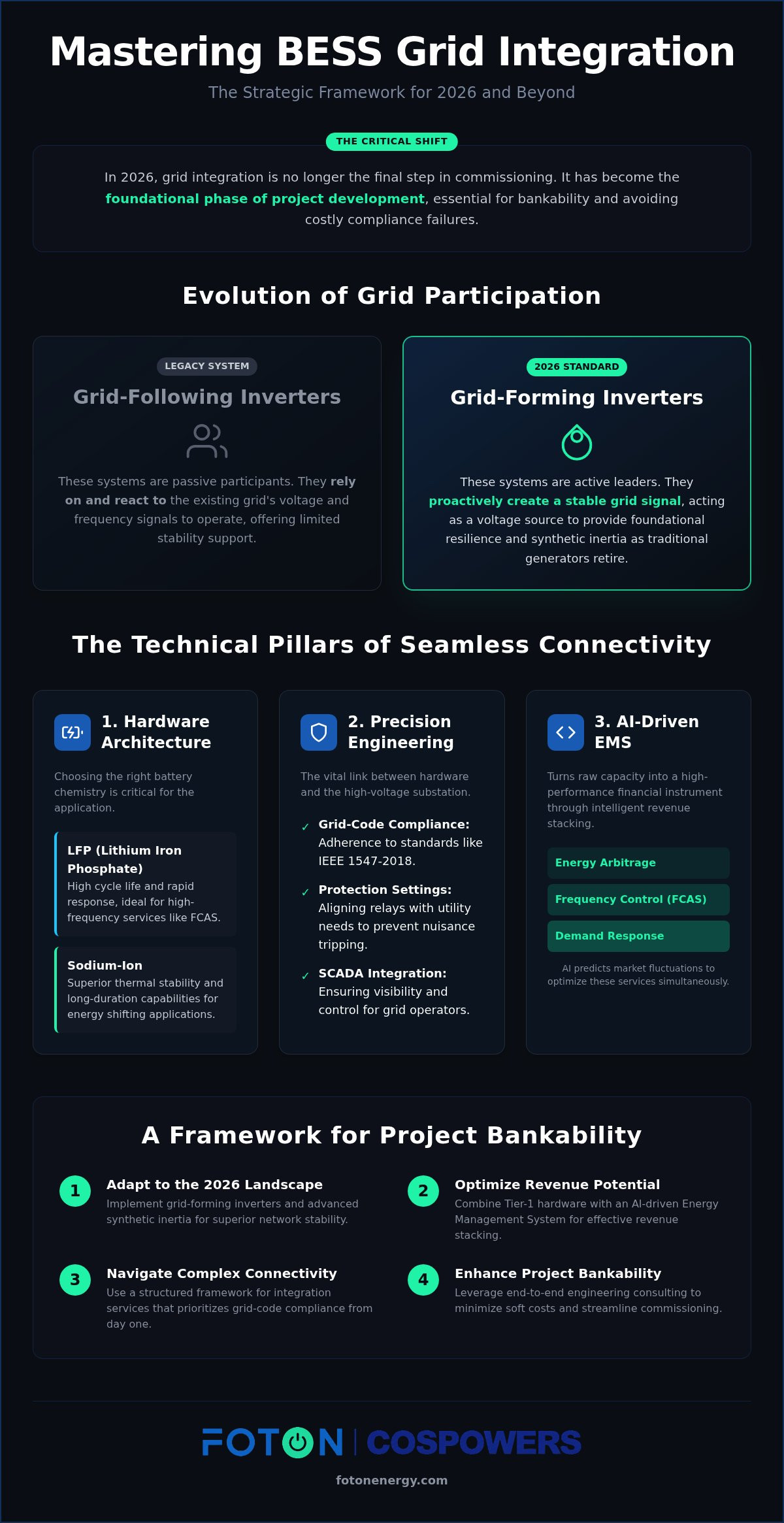
Successful grid synchronization is the cornerstone of utility-scale storage bankability. In 2026, BESS grid integration services have evolved from a final commissioning step into the foundational phase of project development. This process involves the rigorous technical and regulatory synchronization of a battery energy storage system (BESS) with the high-voltage network. It requires a sophisticated alignment of hardware architecture, grid-code engineering, and real-time control logic. Without this strategic integration, even the most advanced hardware remains a stranded asset.
The primary drivers for this evolution are clear. Aggressive decarbonization mandates and the increasing volatility of renewable-heavy grids have transformed the role of storage. Operators no longer just store energy; they provide critical stability through frequency control ancillary services (FCAS) and synthetic inertia. Consequently, bankability now starts with integration engineering. Investors prioritize projects that demonstrate seamless interoperability and compliance with the latest standards, such as IEEE 1547-2018 and the emerging European mandates for grid-forming capabilities.
As renewable-heavy grids continue to evolve, learn more about Greenvolt Next and their role in developing the large-scale solar infrastructure that supports these storage systems.
The Shift from Passive to Active Grid Participation
Modern energy landscapes demand more than passive energy shifting. Historically, systems utilized grid-following technology, which relied on the existing grid signal to operate. By 2026, the standard has shifted toward grid-forming inverters. These systems act as voltage sources, providing the grid with the stability it lacks as traditional synchronous generators retire. This transition requires BESS grid integration services to manage complex bidirectional communication and high-speed response protocols. These active systems ensure the storage asset functions as a foundational pillar of grid resilience rather than a mere participant.
Revenue Stacking and Grid Service Capabilities
Profitability in the current market depends on your ability to execute multiple operational strategies simultaneously. Revenue stacking is the simultaneous utilization of BESS for multiple market services, such as energy arbitrage, FCAS, and demand response. To achieve this, your system requires ultra-low latency response times and AI driven energy management systems that can predict market fluctuations in real time. Whether you're leveraging established LFP chemistry or exploring sodium-ion battery commercial availability for long-duration needs, the integration layer is what turns raw capacity into a high-performance financial instrument.
The Technical Pillars of Seamless BESS Connectivity
Connectivity is not a single point of failure; it is a vertical stack of interdependent layers. Hardware selection represents the first pillar of this architecture. Tier-1 LFP modules provide the high cycle life required for the ancillary services market for BESS, while sodium-ion modules offer superior thermal stability for long-duration storage applications. These physical assets must be supported by a rigorous engineering layer that handles protection settings, transformer sizing, and SCADA integration to ensure the system behaves predictably under grid stress.
Precise engineering consulting ensures that protection relay settings align with utility-specific requirements. This technical alignment prevents nuisance tripping during rapid frequency swings or voltage dips. High-quality BESS grid integration services act as the vital link between factory-gate hardware and the high-voltage substation. Without precise SCADA mapping and protocol translation, your asset remains invisible to the grid operator, effectively stalling all revenue potential before the project even begins.
AI-Driven EMS and Grid Intelligence
Machine learning is no longer optional for utility-scale assets. AI driven energy management systems predict demand spikes and optimize dispatch to protect battery health while maximizing profit. Successful integration requires protocol bridging between Modbus for local components, CANbus for internal battery communication, and DNP3 for utility telemetry. Balancing edge control for millisecond response times with cloud-based analytics allows for both immediate grid support and long-term asset optimization.
Thermal Management and Safety Architecture
Grid-connection approval in 2026 hinges on a deeply integrated safety architecture. Utility operators require verifiable proof that high-discharge events won't compromise thermal stability. Modern integration strategies involve linking advanced liquid cooling systems directly to the primary grid control logic. If internal sensors detect a thermal anomaly, the system must possess the intelligence to autonomously throttle power output before the primary protection relays trip. Integrating certified fire suppression alerts directly into the operator's SCADA system provides the "bankable" security and operational transparency required for large-scale infrastructure investments.
If you're planning a project, engaging with expert engineering consulting early can prevent costly commissioning delays.
Hardware Selection for Grid Stability: LFP vs. Sodium-Ion Architectures
Hardware selection is the first strategic decision in the project lifecycle. It determines whether your asset will thrive in the high-frequency market or excel in energy shifting. For developers utilizing BESS grid integration services, the choice between Lithium Iron Phosphate (LFP) and Sodium-ion isn't just about chemistry; it's about matching the physical capabilities of the cell to the specific demands of the local transmission network. Your choice dictates the limits of your dispatch strategy and the long-term reliability of your connection.
Comparing the two chemistries reveals a clear divide in application. LFP offers higher energy density and a mature ecosystem, while sodium-ion provides wider operating temperatures and reduced fire risk. Discharge rates also differ. LFP typically excels in high-power, short-duration bursts required for FCAS, whereas sodium-ion is gaining ground in the four-to-eight-hour storage window. Ultimately, hardware bankability dictates the feasibility of your connection agreement. Lenders and grid operators favor hardware backed by rigorous testing and international certifications. This assurance is what allows BESS grid integration services to move from the engineering phase to live operation without regulatory pushback.
LFP: The Workhorse of Utility-Scale Integration
Lithium Iron Phosphate remains the dominant chemistry for grid-connected infrastructure due to its proven track record and high cycle life. In 2026, LFP continues to lead the market, accounting for the vast majority of new utility-scale awards globally. It's the ideal choice for assets participating in daily market arbitrage and frequency control, where the battery may cycle several times a day. Meeting Tier-1 certification standards is a prerequisite for project financing. This ensures the hardware can withstand the rigors of rapid discharge without premature degradation, protecting your investment for its entire operational life.
Sodium-Ion: Future-Proofing Grid Infrastructure
The landscape is shifting with the 2026 emergence of sodium-ion battery commercial availability. While LFP is the current standard, sodium-ion offers distinct advantages in safety-critical zones and extreme temperatures. It serves as a vital hedge against lithium supply chain volatility and is increasingly integrated into modern utility scale BESS procurement workflows. Sodium-ion’s superior thermal stability makes it a compelling option for long-duration storage where energy density is less critical than operational safety. Its ability to operate across a wider temperature range reduces the parasitic load from HVAC systems, improving round-trip efficiency in harsh environments.
A Framework for BESS Project Feasibility and Grid-Code Compliance
Precision in the planning phase dictates the success of the entire project lifecycle. High-quality BESS grid integration services begin long before hardware arrives on site, starting instead with a rigorous analysis of grid capacity and local connection requirements. In an era where interconnection queues can represent hundreds of gigawatts of stalled capacity, identifying a viable point of connection is your first strategic victory. This stage requires a deep dive into substation thermal limits, fault level contributions, and the specific voltage control requirements of the local network.
Once feasibility is established, system design must bridge the gap between theoretical capacity and operational reality. This involves sizing the BESS and selecting an inverter and transformer topology that aligns with the specific grid conditions. Engineering teams then utilize high-fidelity modeling tools like PSS/E or PSCAD to simulate system performance under various contingencies. These simulations are critical for predicting how the asset will react to grid disturbances, ensuring that the final build is robust enough to handle the volatile dynamics of a modern high-voltage network.
Navigating Grid-Code Compliance
Meeting the stringent requirements of operators like AEMO in Australia or ENTSO-E in Europe is a complex undertaking that demands specialized expertise. These bodies require verifiable proof that your system can provide reactive power support and frequency response during transient events. Accurate simulation models are the primary tool for securing fast-track approval from utility regulators. Grid-code compliance is a legal prerequisite for energization in utility-scale markets. Without this certification, your asset cannot legally export power, regardless of its physical readiness or hardware quality.
The Role of Technical Consulting
Managing the interface between Engineering, Procurement, and Construction (EPC) is where many large-scale projects face significant delays. This is why BESS engineering consulting services are critical for de-risking the connection process. Expert consultants provide the technical oversight needed to ensure that the physical installation matches the approved simulation models. This support is particularly vital during the 'Hold Point' testing phase of commissioning. During this final verification, the system is tested in incremental stages of power output to confirm it behaves exactly as predicted before reaching its full commercial operation date (COD).
Eliminate technical bottlenecks and accelerate your timeline by engaging with Foton Energy for end-to-end BESS grid integration services.
Ensuring Bankability: The Foton Energy Approach to Grid Integration
Bankability is the ultimate metric of a project's success. It represents the intersection of technical excellence, manufacturing heritage, and regulatory foresight. Foton Energy provides this assurance through an exclusive global partnership with Cospowers, a Tier-1 manufacturer with over 30 years of industrial experience. By merging this manufacturing depth with local engineering expertise, we deliver BESS grid integration services that transform technical complexity into commercial stability. This synergy ensures that every component, from the cell to the inverter, is optimized for the specific demands of the high-voltage network.
Our end-to-end approach is designed specifically to reduce the soft costs that often plague utility-scale deployments. Industry data suggests that permitting, compliance, and interconnection studies can represent 25% to 35% of a total project budget. We mitigate these expenses by providing a unified engineering and procurement workflow. By managing the integration process from the feasibility stage through to final commissioning, we eliminate the friction between disparate vendors and contractors. This streamlined methodology prevents the long commissioning delays that erode investor confidence and delay revenue generation.
Long-term asset performance is secured through our AI-driven predictive maintenance protocols. Our intelligent EMS does more than just optimize market dispatch; it monitors the granular health of every string and module in real time. By identifying potential thermal anomalies or degradation patterns before they trigger a system trip, we maintain the high availability rates required by grid operators. This proactive oversight ensures that your infrastructure remains a reliable pillar of the energy ecosystem for its entire operational lifecycle, providing the "bankable" security that institutional financiers demand.
Strategic Sourcing and Procurement
Direct wholesale access to Tier-1 hardware provides a significant competitive advantage in a volatile market. Our partnership with Cospowers allows for complete supply chain transparency, which is a critical trust-builder for institutional investors and global developers. We don't offer off-the-shelf solutions. Instead, we customize BESS containers to thrive in specific environmental conditions, whether that involves specialized HVAC systems for desert heat or corrosion-resistant enclosures for coastal deployments. This level of customization ensures that the physical hardware remains as resilient as the grid-code modeling that supports it.
Global Network and Collaborative Support
Scale and reach are fundamental to our identity as a foundational pillar of the energy transition. We leverage a robust marketing and engineering network that spans over 70 countries, providing local support backed by global manufacturing power. We invite you to participate in a shared vision of a cleaner, more resilient future through strategic alignment and operational excellence. Our team acts as a steady, guiding hand for large-scale investors, ensuring that every project is rooted in proven experience and rigorous testing. Partner with Foton Energy for your next utility-scale grid integration project.
Securing Your Position in the 2026 Energy Market
The transition from passive energy storage to active grid participation requires more than just high-capacity cells. It demands a strategic alignment of grid-forming inverters, advanced modeling, and AI-driven management. You've seen how precise engineering de-risks the connection process and how the right choice between LFP and sodium-ion architectures can future-proof your investment against supply chain volatility. Professional BESS grid integration services act as the essential bridge between these technical pillars and a live, revenue-generating connection.
Foton Energy brings the stability of a 30-year manufacturing heritage through our exclusive partnership with Tier-1 manufacturer Cospowers. We combine this legacy with safety-first architecture and an intelligent EMS to ensure your project meets the highest global standards. Our global footprint across 70 countries provides the localized expertise needed to navigate complex grid codes while maintaining the bankable assurance of a world-class manufacturing partner. Let's build a resilient energy future together.
Design your bankable grid-scale BESS with Foton Energy's engineering experts.
Frequently Asked Questions
What are BESS grid integration services?
BESS grid integration services are the comprehensive technical and regulatory processes required to synchronize a battery system with the high-voltage transmission network. These services encompass everything from initial feasibility studies and grid-code modeling to the final commissioning phase. By aligning Tier-1 hardware with sophisticated control logic, these services ensure that the storage asset operates safely and profitably within the grid's operational constraints.
Why is grid-code compliance critical for battery energy storage?
Grid-code compliance is a legal prerequisite for energizing any utility-scale storage project. It ensures that the BESS can provide essential services like reactive power support and frequency regulation without compromising network stability. Without verifiable compliance with standards like IEEE 1547-2018 or local AEMO requirements, grid operators won't allow the system to export power, regardless of its physical readiness.
How does an Energy Management System (EMS) improve grid integration?
An Energy Management System (EMS) acts as the central intelligence that optimizes battery dispatch based on real-time grid signals and market data. By utilizing AI-driven algorithms, the EMS predicts demand spikes and manages revenue stacking across multiple services like arbitrage and FCAS. It also manages protocol bridging between local hardware and utility SCADA systems, which is a core component of effective BESS grid integration services.
Can sodium-ion batteries be used for utility-scale grid services?
Yes, sodium-ion batteries have reached commercial availability in 2026 and are increasingly utilized for utility-scale applications. They offer a cost-effective alternative for long-duration storage where energy density is less critical than safety and thermal stability. Their ability to operate across a wide temperature range makes them particularly valuable for grid services in harsh environmental conditions where LFP might require more intensive HVAC support.
What is the difference between grid-forming and grid-following inverters?
Grid-following inverters rely on the existing grid voltage and frequency to operate, effectively following the network signal. In contrast, grid-forming inverters act as a voltage source, capable of creating their own frequency and voltage reference. This capability is becoming a regulatory mandate in many regions as it allows BESS to provide synthetic inertia and stabilize grids with high renewable penetration.
How long does the BESS grid connection process typically take in 2026?
In 2026, the grid connection process typically spans 12 to 24 months, depending on the complexity of the local interconnection queue. This timeline includes feasibility studies, system modeling, and the final Hold Point testing required for commercial operation. Engaging expert BESS grid integration services early in the development cycle can help mitigate delays by ensuring all technical documentation meets utility standards from the outset.
What role does thermal management play in grid stability?
Thermal management ensures that battery cells remain within safe operating limits during high-discharge events, which are common during frequency regulation services. If a system lacks robust cooling, it may autonomously throttle output or trip entirely to prevent damage, causing a loss of grid support. Integrating thermal monitoring directly into the grid control logic maintains stability and protects the long-term health of the asset.
How do I ensure my BESS project is bankable for financiers?
Bankability is achieved by utilizing Tier-1 certified hardware and demonstrating a clear path to grid-code compliance. Financiers prioritize projects that feature proven manufacturing heritage and sophisticated AI-driven energy management. Ensuring your project has a comprehensive engineering and maintenance strategy provides the long-term security and performance guarantees that institutional investors require for large-scale infrastructure.


