
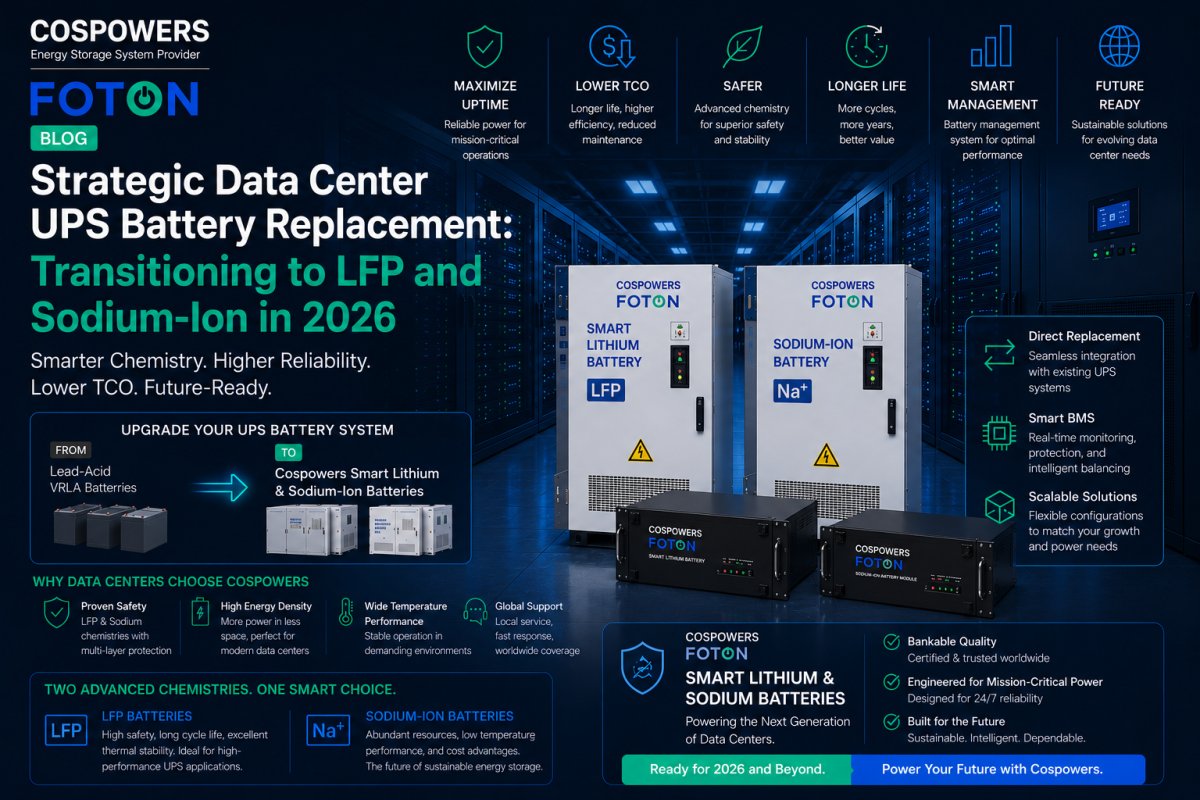
The traditional approach to a data center ups battery replacement has shifted from a simple maintenance task to a critical strategic pivot. With AI workloads projected to account for 44% of data center power demand by 2030, legacy VRLA systems can no longer keep pace with rack densities hitting 120kW. You've likely managed the frustrations of short lifespans and the high operational costs associated with lead-acid hardware. It's time to demand more from your energy storage infrastructure.
We recognize that safety and long-term stability are your primary concerns when evaluating high-density lithium or sodium-ion alternatives. This article serves as a comprehensive technical guide to help you navigate the transition to LFP and sodium-ion replacements in 2026. We'll examine how to secure a lifecycle exceeding 10 years and reduce your physical footprint while adhering to the latest OBBBA sourcing regulations. You'll gain a clear framework for deploying bankable, Tier-1 hardware that ensures your infrastructure remains resilient, optimized, and future-ready.
Key Takeaways
- Align your infrastructure with the power requirements of modern AI workloads by identifying the critical limitations of legacy VRLA systems in high-density environments.
- Evaluate the technical trade-offs between LFP and Sodium-Ion chemistries to optimize your facility's energy density, cycle life, and thermal safety profile.
- Navigate the complexities of a data center ups battery replacement by mastering voltage window matching and ensuring seamless communication between new BMS hardware and existing DCIM systems.
- Secure your infrastructure investment by leveraging Tier-1 manufacturing heritage and multi-level safety architectures designed to prevent thermal runaway at the cell and container levels.
- Streamline your procurement strategy through global partnerships that offer direct access to high-capacity battery modules while ensuring compliance with 2026 regulatory and sourcing standards.
The 2026 Data Center Power Shift: Why Legacy UPS Batteries Are Failing
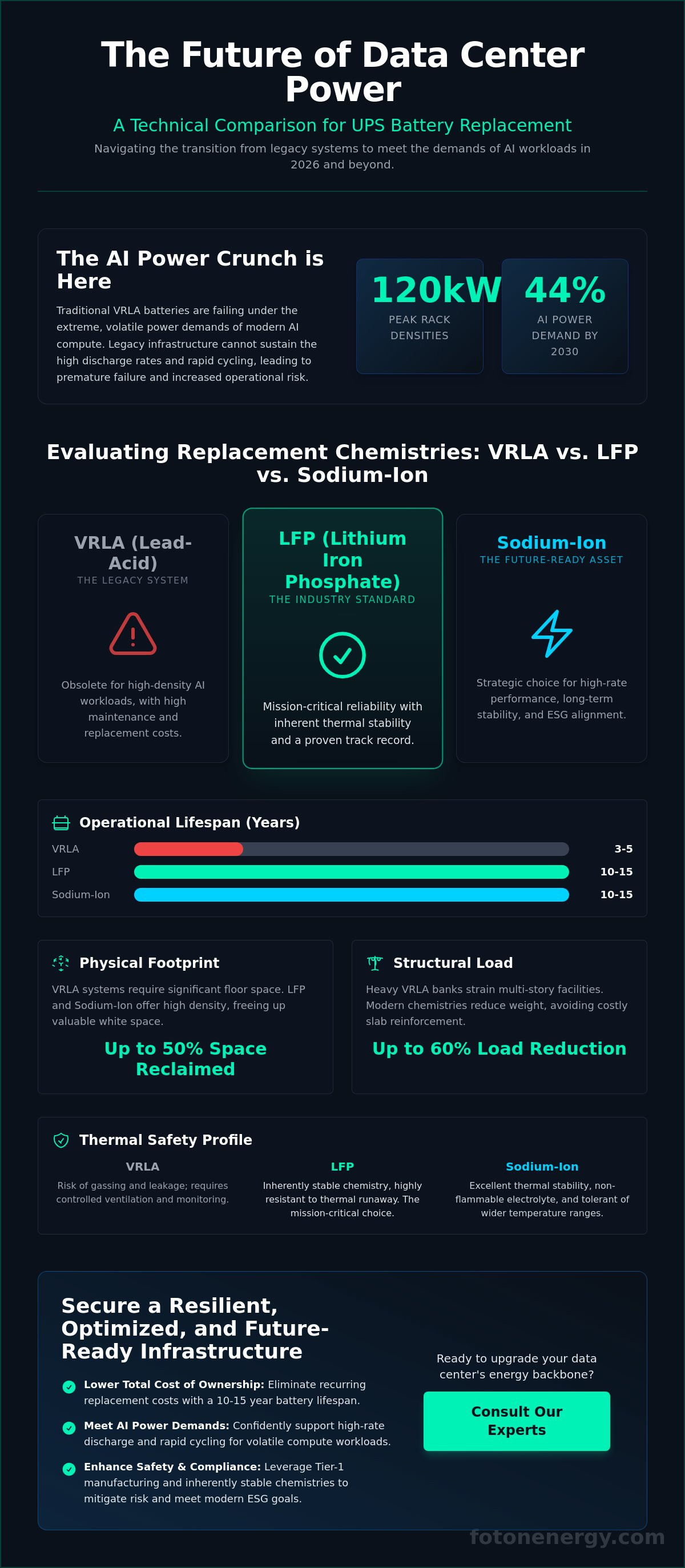
Data center infrastructure faces an unprecedented evolution. The rapid ascent of AI workloads has pushed rack power densities from a manageable 15kW to staggering peaks of 120kW. This shift renders traditional battery configurations obsolete. As you plan your next data center ups battery replacement, it's vital to recognize that the uninterruptible power supply (UPS) is only as resilient as the chemistry driving it. Legacy lead-acid systems simply cannot sustain the discharge rates required by modern, high-density compute clusters.
To better understand the practical steps of maintaining these critical systems, watch this helpful video on battery replacement:
The AI Power Crunch and Discharge Requirements
AI training workloads aren't steady; they're volatile. These systems demand sub-second bursts of massive power that create extreme stress on energy storage. While "pure lead" VRLA technologies were once the industry standard, they struggle under the rapid cycling and high-rate discharge profiles of 2026. Frequent micro-discharges lead to accelerated sulfation and premature failure. We're seeing operators move toward chemistries that handle these fluctuations without degrading. This is where a sodium-ion battery for data centers becomes a strategic asset. It offers the high-rate performance needed to solve the AI power crunch while ensuring long-term stability.
Total Cost of Ownership (TCO) in 2026
Evaluating a data center ups battery replacement requires looking beyond the initial purchase price. VRLA batteries typically require replacement every 3 to 5 years, creating a cycle of recurring capital expenditure and logistical headaches. In contrast, LFP and sodium-ion systems offer a 10 to 15 year operational life. This longevity eliminates the "hidden" costs of frequent disposal, labor, and procurement. Beyond the cell life, space optimization is a major driver. High-density lithium and sodium modules allow you to reclaim up to 50% of your floor space compared to lead-acid racks. This reclaimed square footage can be redirected toward revenue-generating server capacity, directly improving your facility's profitability.
Environmental and sustainability mandates are also tightening as we move through 2026. Lead-acid disposal is becoming more regulated and expensive globally. Transitioning to LFP or sodium-ion aligns your facility with modern ESG goals while providing a bankable, Tier-1 solution that is both technologically advanced and commercially stable.
Evaluating Replacement Chemistries: VRLA vs. LFP vs. Sodium-Ion
Selecting the optimal chemistry for a data center ups battery replacement is a complex decision that balances performance metrics with structural constraints. While the 2026 Data Center Power Shift emphasizes the urgent need for higher energy density, operators must also account for floor loading limits. Multi-story facilities often face weight restrictions that make heavy VRLA banks impractical. Transitioning to LFP or sodium-ion can reduce the structural load by up to 60%, allowing you to deploy more compute capacity without the need for expensive slab reinforcement.
LFP: The Reliable Workhorse
Lithium Iron Phosphate (LFP) has solidified its position as the industry standard for mission-critical reliability. Unlike NMC chemistries used in consumer electronics, LFP is inherently stable and resistant to thermal runaway. Tier-1 modules, such as those from Cospowers, offer a cycle life that often exceeds 6,000 cycles at 80% depth of discharge. This durability ensures that your battery replacement cycle aligns with the 10-15 year lifespan of the UPS electronics. Standardized LFP form factors now allow these modules to slide directly into existing rack architectures, which simplifies the physical integration process.
Sodium-Ion: The Next Frontier
Sodium-ion technology is emerging as a compelling alternative for a data center ups battery replacement, especially for operators prioritizing safety and supply chain resilience. It performs exceptionally well across a wide temperature range, which can significantly reduce the cooling overhead required for battery rooms. Because it doesn't rely on cobalt or lithium, sodium-ion offers a more stable price point and a more sustainable procurement path. Its fire risk is lower than even LFP, making it an ideal candidate for facilities in dense urban areas with stringent fire suppression requirements.
Choosing between these advanced chemistries requires a deep understanding of your specific site architecture and future load projections. It's not just about the cells; it's about the intelligent integration of the system into your broader power strategy. If you're currently evaluating your transition options, our engineering consulting team can help you map out a roadmap that maximizes both density and safety. Balancing these technical trade-offs today ensures that your infrastructure remains bankable and resilient well into the next decade.
Technical Integration: Retrofitting Legacy UPS Systems
Success in a data center ups battery replacement hinges on precise electrical synchronization between new chemistries and existing infrastructure. Most legacy inverters were engineered for the specific discharge curves of lead-acid batteries. When you transition to LFP or sodium-ion, you must evaluate the voltage window compatibility of your current UPS. If the inverter's cutoff voltage doesn't align with the flatter discharge profile of these modern cells, you risk underutilizing the available capacity or triggering premature low-battery alarms. Correcting these setpoints is a foundational step in any strategic retrofit.
The charge and discharge profiles of sodium-ion and LFP differ significantly from the VRLA systems they replace. Lithium-based systems require sophisticated constant current and constant voltage (CC/CV) charging regimes. Sodium-ion is often more forgiving in wide temperature ranges, yet it still demands a precise charging curve to maximize its 10 to 15 year lifespan. Aligning these profiles ensures your UPS electronics and your energy storage work as a single, cohesive unit rather than two competing technologies.
BMS and DCIM Integration
Visibility is the bedrock of modern infrastructure management. Unlike passive lead-acid strings, modern lithium and sodium systems include an integrated Battery Management System (BMS). This hardware provides real-time data on State of Charge (SOC) and State of Health (SOH) that VRLA simply cannot offer. To achieve a seamless data center ups battery replacement, ensure your BMS supports standard protocols like Modbus or CANbus for integration with your existing DCIM. Our Intelligent EMS further optimizes performance across mixed battery fleets, providing a unified view of your entire energy ecosystem and allowing for proactive maintenance before a cell failure occurs.
Physical Installation and Safety
Moving from heavy lead-acid cabinets to high-density racks changes the physical dynamics of your battery room. While you'll reclaim significant floor space, you must address new mechanical requirements. Seismic bracing remains a critical necessity for high-density modules, especially in multi-story facilities where vibration is amplified. Additionally, while sodium-ion offers superior thermal stability, high-density LFP installations may require specific environmental cooling adjustments to maintain optimal operating temperatures. Every replacement project must conclude with rigorous commissioning to verify grid-code compliance and ensure that your multi-level safety architecture is fully operational from day one.
Implementing these technical changes requires a partner who understands the interconnectedness of power electronics and chemical storage. If your team is navigating these integration challenges, our engineering consulting services provide the technical proof points needed to ensure a stable, bankable transition.
Risk Mitigation: Safety Architecture and Bankability
De-risking a large-scale infrastructure investment requires more than just high-performance specifications. When you execute a data center ups battery replacement, you're making a decade-long commitment to the stability of your facility. Financiers and insurers now demand "bankability," a standard that ensures the hardware is backed by rigorous testing and a stable supply chain. This assurance is built on the foundation of Tier-1 manufacturing heritage. Working with partners like Cospowers, who bring over 30 years of manufacturing experience, provides the grounded reliability necessary for such critical deployments.
Tier-1 Certification and Heritage
Bankability in the context of commercial and industrial BESS solutions is defined by the verifiable track record of the hardware. For a project to be considered bankable in 2026, it must meet international safety standards such as UL1973 for battery systems and IEC 62619 for industrial applications. These certifications, combined with DNV verification, provide the technical proof points that financiers require to approve capital expenditure. Foton serves as the exclusive global strategic partner for Cospowers, ensuring that your procurement process is streamlined and your hardware is sourced from an entity with proven commercial stability.
Thermal Management and Fire Safety
High-density environments demand a multi-level safety architecture that begins at the cell level and extends to the entire container. While previous sections detailed the thermal stability of LFP and sodium-ion, the physical safety layers are equally vital. Modern data center ups battery replacement projects utilize active cooling systems to maintain optimal cell temperatures, but they also incorporate passive barriers to prevent cell-to-cell propagation. This hierarchical approach ensures that even in the unlikely event of a single cell failure, the system remains contained.
Fire suppression for high-density racks has evolved beyond building-level sprinklers. We now integrate aerosol and clean-agent suppression systems directly into the battery cabinets. These systems are coupled with advanced gas detection and early warning sensors that identify the off-gassing associated with the initial stages of thermal runaway. By detecting these precursors before a fire even begins, operators can initiate automated safety protocols to isolate the affected string. This level of granular protection is what distinguishes a Tier-1 installation from generic alternatives.
Securing your infrastructure against future volatility requires a partner who balances technical innovation with rigorous safety standards. If you're ready to modernize your power storage with a certified, bankable solution, explore our Data Centre & Telco Backup offerings to see how we prioritize your operational security.
Strategic Procurement: Why Foton and Cospowers for UPS Replacement
Executing a successful data center ups battery replacement requires a partner that understands the intersection of global logistics and local compliance. Foton serves as the exclusive global strategic partner for Cospowers, providing a direct link to Tier-1 manufacturing excellence. This partnership ensures that your facility has immediate access to high-capacity LFP and sodium-ion modules without the delays often found in fragmented distribution networks. We manage a robust supply chain across 70 countries, providing the rapid deployment capabilities necessary to keep pace with the 2026 data center expansion. Our heritage in large-scale infrastructure allows us to offer a bankable assurance that protects your capital investment.
Compliance with the latest regulatory frameworks is a cornerstone of our procurement strategy. We navigate the complexities of the One Big Beautiful Bill Act (OBBBA) and the Foreign Entity of Concern (FEOC) rules to ensure your project remains eligible for critical tax credits. By utilizing the framework established in IRS Notice 2026-15, we help you evaluate the Material Assistance Cost Ratio of your equipment. This meticulous attention to detail ensures that your energy storage project meets the 55% direct equipment cost threshold required for the Investment Tax Credit. We don't just deliver batteries; we provide a strategically aligned path to financial and operational success.
Wholesale Hardware and Engineering Support
We streamline the procurement journey for EPCs and system integrators by acting as a comprehensive technical partner. Our engineering consulting services cover the entire project lifecycle, from initial feasibility studies to final grid-code compliance and commissioning. Every data center possesses a unique power footprint, and we work collaboratively to design systems that match your specific discharge profiles. This tailored approach ensures that your new battery modules integrate flawlessly with your legacy UPS inverters. Our relationship with clients is a long-term cooperation, extending into asset management and technical support to ensure your system performs reliably for its entire 10 to 15 year lifecycle. For sourcing the broader IT and networking hardware needed during these upgrades, Computech-Solutions offers a specialized range of equipment to complement your infrastructure projects.
Leveraging AI-Driven EMS
Intelligence is the key to resilience in modern power infrastructure. Our Intelligent EMS uses advanced AI to monitor your entire battery fleet in real-time, providing a level of visibility that legacy systems cannot match. This platform goes beyond simple data collection; it uses predictive algorithms to identify performance anomalies before they escalate into failures. By optimizing charging cycles through intelligent algorithms, we help you extend the life of your data center ups battery replacement and reduce your total cost of ownership. For operators with global portfolios, the system provides a centralized dashboard to monitor health and efficiency across every site. This level of optimization ensures that your facility is not just powered, but intelligently managed for maximum durability and performance.
Securing the Future of Data Center Power
The transition to high-density power storage is no longer optional. As AI workloads continue to redefine rack requirements, your infrastructure must adapt to survive. Successful operators are moving beyond the limitations of VRLA to embrace the durability of LFP and the emerging safety advantages of sodium-ion. This strategic shift ensures that your data center ups battery replacement isn't just a maintenance event; it's a foundational upgrade that secures your facility's operational future for the next decade.
Reliability is built on proven manufacturing heritage and intelligent oversight. We invite you to consult with Foton Energy for a Tier-1 UPS Battery Replacement Strategy. As the exclusive global partner of Tier-1 manufacturer Cospowers, we provide the bankable hardware and AI-driven EMS necessary for real-time performance monitoring. With a strategic presence in over 70 countries, we're prepared to support your global data center portfolio with precision and expertise. Let's build a more resilient, optimized, and future-ready power infrastructure together.
Frequently Asked Questions
How long does a typical data center UPS battery replacement take?
A standard data center ups battery replacement typically requires four to eight hours per battery string for physical installation and electrical commissioning. The total project duration depends on the scale of the facility and the complexity of the integration with existing DCIM systems. We recommend a phased approach to ensure continuous uptime during the transition.
Can I mix LFP and VRLA batteries in the same UPS system?
You cannot mix LFP and VRLA batteries within the same UPS string due to fundamentally different charging profiles and voltage windows. Attempting to combine these chemistries would lead to improper charging, reduced lifespan, and potential safety risks. Operators should replace entire strings to maintain system stability and ensure accurate monitoring through the BMS.
What are the main safety advantages of Sodium-ion over Lithium-ion for data centers?
Sodium-ion batteries offer superior thermal stability and a significantly lower risk of thermal runaway compared to traditional lithium-ion chemistries. They remain stable across a wider temperature range and utilize abundant, non-toxic materials. This inherent safety makes them an excellent choice for high-density urban data centers where fire suppression requirements are exceptionally stringent.
Does Foton provide onsite installation for UPS battery replacements?
Foton focuses on the strategic supply of Tier-1 hardware and comprehensive engineering consulting rather than direct onsite labor for installation. We work collaboratively with your preferred EPC partners and system integrators to ensure our battery modules are deployed according to global standards. This approach ensures you receive elite technical guidance while maintaining your existing service relationships.
What is the expected cycle life of a Cospowers LFP battery module?
A Cospowers LFP battery module typically delivers an expected cycle life of approximately 6,000 cycles at an 80% depth of discharge. This durability ensures the system remains operational for 10 to 15 years, effectively matching the lifespan of the UPS electronics. This longevity significantly reduces the total cost of ownership compared to legacy lead-acid alternatives.
Are Sodium-ion batteries compatible with standard UPS charging systems?
Sodium-ion batteries are compatible with most modern UPS charging systems, though they require specific firmware adjustments to match their flatter discharge curves. Most legacy inverters can be retrofitted to accommodate these new setpoints during a data center ups battery replacement. Our engineering team provides the technical proof points needed to verify compatibility with your specific inverter hardware.
How does Foton ensure the bankability of its battery solutions?
We ensure bankability by exclusively partnering with Tier-1 manufacturers like Cospowers and maintaining rigorous international certifications. Every solution undergoes extensive testing to meet UL and IEC standards, backed by third-party DNV verification. This level of grounded assurance inspires trust in large-scale infrastructure investments and satisfies the requirements of global financiers and insurers.
What certifications should I look for in a UPS battery replacement?
You should prioritize hardware that carries UL1973 for battery systems and IEC 62619 for industrial applications. Additionally, UL9540A testing is critical for evaluating thermal runaway propagation and ensuring fire safety compliance. These certifications verify that your replacement modules meet the highest global standards for durability, safety, and operational excellence.


