

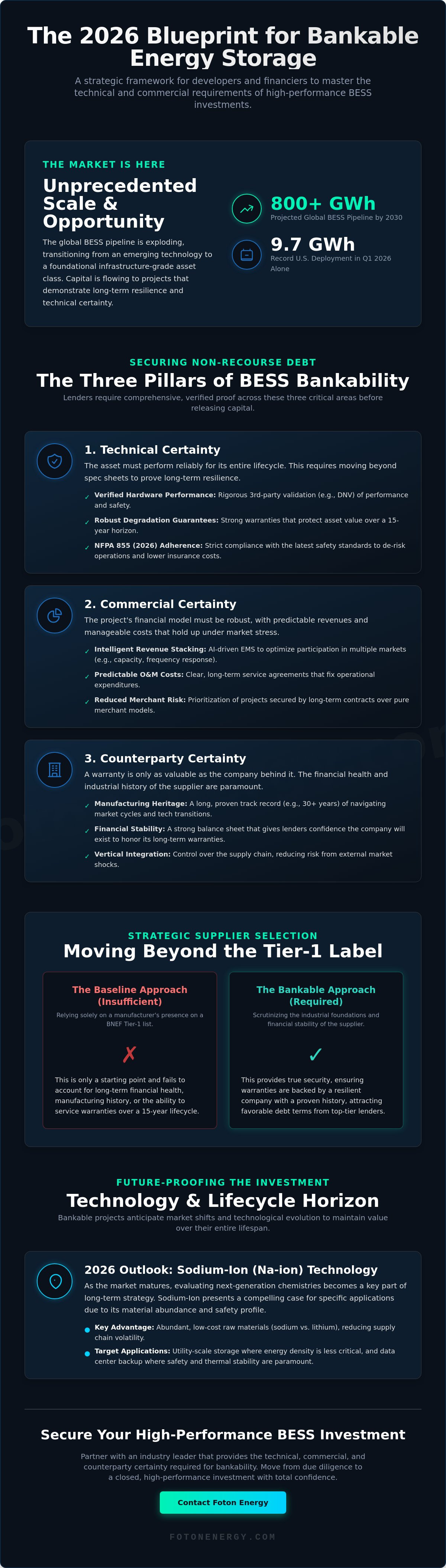
The global BESS pipeline is projected to exceed 800 GWh by 2030, yet capital remains discerning. In the first quarter of 2026 alone, the U.S. market deployed a record 9.7 GWh of capacity, proving that the scale for massive deployment is here. Securing bankable energy storage for financiers is no longer just about sourcing hardware; it's about validating a long-term industrial ecosystem that can withstand a decade of market shifts. You understand that the difference between a high-performing asset and a stranded one often rests on the manufacturer's balance sheet and the system's technical resilience.
The criteria for project financing have evolved. Lenders now demand rigorous proof of operational performance and strict adherence to the 2026 edition of NFPA 855 safety standards. This guide provides the strategic framework you need to master these technical and regulatory requirements. You'll gain a clear checklist for due diligence, learn how AI-driven Energy Management Systems stabilize merchant revenue, and discover why Tier-1 hardware selection is your strongest defense against technical degradation. We provide the clarity required to move from initial due diligence to a closed, high-performance investment with total confidence.
Key Takeaways
- Establish the 2026 standard for non-recourse debt and the transition of BESS into a mature, infrastructure-grade asset class.
- Move beyond the basic Tier-1 label by prioritizing manufacturing heritage and financial stability to secure bankable energy storage for financiers.
- De-risk your investment by implementing safety-first architectures that directly optimize insurance premiums and senior debt terms.
- Leverage AI-driven Energy Management Systems to unlock revenue stacking and ensure long-term commercial viability across multiple market streams.
- Evaluate the 2026 outlook for Sodium-Ion technology to future-proof utility-scale and data center backup applications.
Defining Bankability in the 2026 Energy Storage Market
Bankability isn't a vague marketing term; it's a specific financial threshold. It represents the willingness of top-tier lenders to provide non-recourse debt based solely on the project's projected cash flows and technical merit. By 2026, the global market has transitioned from treating storage as an experimental add-on to viewing it as foundational infrastructure. This shift means that securing bankable energy storage for financiers now requires a comprehensive audit of every component in the value chain, ensuring the asset can perform for decades without insolvency risks.
Financiers have moved their focus away from the lowest initial CAPEX. Instead, they prioritize long-term asset resilience and the ability of the system to maintain performance over a 15-year horizon. This evolution is supported by rigorous third-party verifications from organizations like DNV and BloombergNEF. These entities provide the necessary validation of the technical and economic aspects of BESS, ensuring that the hardware meets international standards for safety and reliability.
To better understand how bankability is defined in the current market, watch this industry analysis:
The Evolution of BESS Risk Profiles
The risk landscape for energy storage has changed dramatically. Bloomberg NEF reported a 31% reduction in BESS costs throughout 2025, which significantly improved debt-to-equity ratios for developers. Lower hardware costs allow for more conservative financial modeling while still meeting internal rate of return (IRR) targets. We're also seeing a move away from pure merchant risk. Projects are increasingly secured by capacity market contracts and frequency response services that provide predictable revenue streams. For a deeper look at these market dynamics, explore our Strategic Guide to Commercial and Industrial BESS Solutions.
The Three Pillars of Project Financing
Securing capital for large-scale storage requires demonstrating certainty across three distinct areas. Lenders won't release funds without verified proof of these pillars:
- Technical Certainty: This includes verified hardware performance data and robust degradation guarantees that protect the asset's value over time.
- Commercial Certainty: Lenders require clear strategies for revenue stacking and predictable operation and maintenance (O&M) costs.
- Counterparty Certainty: The financial health of the hardware supplier is paramount. A warranty is only as good as the company standing behind it, making manufacturer heritage a critical due diligence point.
By focusing on these pillars, developers can present a low-risk profile that attracts senior debt at favorable rates. In 2026, the most successful projects are those that treat bankability as a core engineering requirement from day one.
Manufacturer Due Diligence: Beyond the Tier-1 Label
The Tier-1 label is a baseline, not a conclusion. In the competitive landscape of 2026, relying solely on a manufacturer's presence on a list is insufficient for securing bankable energy storage for financiers. Lenders now scrutinize the industrial foundations of the supplier to ensure that warranties remain valid throughout the entire 15-year asset lifecycle. While many firms claim Tier-1 status, few possess the manufacturing heritage required to withstand long-term economic shifts or technical stress tests. True bankability is found where financial stability meets a proven track record of industrial excellence.
Heritage provides a level of security that new entrants cannot replicate. Cospowers' 30-year history in battery manufacturing offers lenders a tangible record of resilience, proving they can navigate market cycles and technological transitions. This longevity is often a deciding factor during the due diligence process. Financiers also prioritize vertical integration; they prefer manufacturers who control the entire process from cell production to final assembly. This control minimizes supply chain risks and ensures that every component meets rigorous quality standards, as highlighted in this analysis by DNV on Building Bankable Battery Projects. If you are preparing a project for debt financing, you can consult with our engineering team to evaluate your hardware selection against current lender expectations.
The Cospowers & Foton Strategic Advantage
Our exclusive strategic global partnership bridges the gap between sophisticated Australian engineering and world-class Tier-1 manufacturing. This alignment ensures total supply chain transparency, allowing financiers to trace the quality and origin of every cell. By combining local technical oversight with a massive manufacturing footprint, we provide a de-risked path to project execution. Understanding these nuances is essential for any developer, and you can find more detail in our guide on Navigating Bankability with Tier 1 BESS Suppliers.
Certifications That Unlock Capital
Technical certifications act as the keys to institutional capital. To satisfy the requirements for non-recourse debt, systems must adhere to a strict hierarchy of international standards:
- UL 1973 and UL 9540A: These are non-negotiable for fire safety and thermal runaway prevention.
- IEC 62619: This ensures the secondary lithium cells and batteries are safe for industrial applications.
- Independent Bankability Reports: Validations from firms like Black & Veatch or DNV provide the third-party assurance lenders require.
A manufacturer's consistent allocation of high-percentage revenue toward R&D serves as a primary indicator of their ability to adapt to shifting grid requirements and maintain long-term bankability. This commitment to innovation ensures the hardware remains relevant even as grid standards evolve.
Technical Resilience: Safety Architecture as a De-risking Tool
Safety architecture is the most powerful lever for reducing the cost of debt in modern BESS projects. When a project demonstrates superior safety protocols, it directly influences the risk assessment performed by insurance underwriters and senior lenders. High-performance safety systems don't just prevent accidents; they lower insurance premiums and secure more favorable interest rates. This direct financial impact makes technical resilience a cornerstone of bankable energy storage for financiers. Without a robust safety framework, a project may face prohibitive operational costs or struggle to find a lead arranger for the debt facility.
Integrating a "Safety-by-Design" philosophy is essential for infrastructure-grade assets. This approach moves beyond basic container-level fire suppression to include cell-level monitoring and intervention. Lithium Iron Phosphate (LFP) has emerged as the global bankable standard because of its inherent thermal stability. Unlike other chemistries, LFP offers a significantly lower risk of thermal runaway, providing the security that institutional investors demand. As explored in the Thomson Reuters' Guide to Structuring Bankable Energy Storage, technical de-risking through robust safety architecture is a critical component of a project's overall bankability profile.
Thermal Management and Cycle Life
Degradation is the silent killer of BESS returns. Consistent operating temperatures are vital for maintaining the health of battery cells over a 10 to 20-year horizon. Advanced thermal management has evolved from passive cooling to active, AI-driven systems. These platforms use predictive algorithms to adjust cooling loads in real-time, preventing hot spots before they escalate into technical failures. Financiers now demand performance guarantees that are strictly tied to these thermal profiles. By ensuring the battery stays within its optimal temperature range, developers can protect the cycle life promised in the financial model.
Safety Standards and Grid Code Compliance
Compliance is a non-negotiable prerequisite for utility-scale connection. In the Australian market, meeting NER and AEMO grid codes requires a sophisticated understanding of how hardware interacts with the network. Large-scale containerized BESS must undergo "Type Testing" to prove performance under extreme conditions. We've seen instances where AI-driven safety architecture didn't just improve the model; it saved the project's insurance feasibility. When traditional insurers hesitated due to site-specific risks, the presence of active, cell-level monitoring provided the data-backed assurance needed to secure coverage. This level of technical detail transforms a risky asset into a stable, bankable investment.
Revenue Certainty: The Role of Intelligent EMS
Hardware is essentially inert without the intelligence to drive it. While high-quality cells and robust containers provide the physical foundation, an AI-driven Energy Management System (EMS) is the brain that converts technical potential into financial performance. For a project to qualify as bankable energy storage for financiers, it must demonstrate a sophisticated ability to navigate volatile energy markets. The EMS acts as a digital safeguard, translating complex grid signals into profitable dispatch actions while ensuring the system operates within its optimal safety parameters.
Financiers view the EMS as the primary tool for mitigating merchant risk. Relying on unpredictable price spreads requires more than just capacity; it requires algorithmic precision. By automating bidding and response strategies, an intelligent EMS can capture revenue during millisecond price spikes that manual systems simply cannot track. This software-driven optimization transforms a potentially volatile merchant asset into a stable, infrastructure-grade investment. If you're looking to optimize your project's financial performance, explore our Intelligent EMS solutions to see how we protect your long-term ROI.
AI-Driven Optimization Strategies
In Commercial and Industrial (C&I) applications, the focus often lands on peak shaving and demand charge reduction. The EMS analyzes historical load patterns to ensure the battery discharges precisely when utility costs are at their highest, shielding the business from expensive tariff peaks. Predictive analytics take this a step further by forecasting grid demand based on weather patterns and regional market trends. Revenue stacking refers to the strategic orchestration of a single BESS asset to simultaneously participate in multiple market opportunities, such as frequency control, wholesale arbitrage, and capacity reserve, to maximize the total return on investment.
Real-Time Monitoring and Asset Transparency
Transparency is the most effective antidote to perceived financial risk. Providing financiers with read-only access to real-time performance dashboards allows them to verify technical health and revenue performance without intermediary reporting. This level of data visibility ensures that lenders aren't left in the dark regarding asset underperformance or degradation issues. Foton's Intelligent EMS plays a critical role here, serving as a foundational tool for our long-term technical consulting services. It ensures the system remains adaptable to changing grid codes and evolving market structures, maintaining its bankable status throughout its entire operational life. When data is transparent and accessible, the path to non-recourse debt becomes significantly clearer.
Future-Proofing the Investment: Sodium-Ion and Asset Lifecycle
Diversifying technology is the next frontier of risk management. By 2026, Sodium-Ion batteries have transitioned from lab-scale prototypes to a commercial reality, offering a strategic alternative for specific industrial applications. While LFP remains the dominant choice for high-density utility projects, Sodium-Ion is quickly becoming a preferred bankable energy storage for financiers focusing on data centers and telecommunications. This shift is driven by the technology's inherent safety and its ability to operate in extreme temperatures without the heavy parasitic loads of active cooling. Lenders view this as a significant reduction in operational risk for assets located in harsh environments.
Financiers evaluating these chemistries look at different risk profiles. LFP offers proven cycle life and high energy density, but Sodium-Ion presents a lower CAPEX floor, with 2026 costs reaching approximately $70/kWh. Sodium-Ion's supply chain is also more stable, as it doesn't rely on the same lithium and cobalt constraints that have historically caused price volatility. However, bankability for these newer systems depends heavily on modular design. Lenders need to know that as cells degrade, they can be easily augmented or replaced without redesigning the entire balance of plant. A modular architecture ensures the project doesn't become a stranded asset in its second decade of operation.
Sodium-Ion: The New Frontier for Data Centers
The AI power crunch is driving a massive wave of investment into sodium-ion storage. Data centers require high-discharge capabilities and extreme safety, making the non-flammable nature of sodium-ion particularly attractive to insurance underwriters. You can explore Sodium-Ion Battery for Data Centers to understand how this chemistry is solving the specific power demands of modern AI infrastructure. Evaluating the supply chain stability of these non-lithium chemistries is now a standard part of technical due diligence for 2026 projects.
Asset Management and Consulting
Engineering consulting is no longer an optional add-on; it's a critical bankability expense. Lenders want to see that a project has been vetted by experts from feasibility through to long-term O&M. Foton's end-to-end approach ensures that every technical decision is aligned with the commercial requirements of the debt facility. To ensure your project meets these high standards, consider this final checklist of five questions every financier must ask their developer:
- Does the hardware manufacturer have a 10-year solvency track record and proven manufacturing heritage?
- Is the EMS capable of revenue stacking across at least three different market streams simultaneously?
- Does the safety architecture meet the 2026 edition of NFPA 855 standards for fire prevention?
- Is there a modular augmentation plan in the project budget for year 7 and year 14?
- What is the verified recycling cost or residual value of the cells at the end of the 15-year lifecycle?
Addressing these questions early ensures that the project moves through the credit committee without delays. Managing the end-of-life liability is just as important as securing the initial capital. A project with a clear path for decommissioning is a project that protects its long-term financial integrity.
Securing Your Position in the 2026 Energy Infrastructure Market
The transition from experimental storage assets to infrastructure-grade investments is now complete. Success in this landscape requires looking beyond simple hardware specifications to the industrial foundations that underpin long-term value. Securing bankable energy storage for financiers requires a strategic synergy between proven manufacturing heritage and intelligent operational software. By prioritizing safety-first architecture and AI-driven revenue stacking, you can effectively protect a project's ROI against both market volatility and technical degradation.
As the exclusive strategic partner of Cospowers, we bring over 30 years of manufacturing excellence to your project. Our global network, spanning 70+ countries, combined with our proprietary AI-driven EMS, ensures your assets are optimized for peak performance throughout their lifecycle. We invite you to partner with Foton for your next bankable BESS deployment and leverage our engineering expertise to de-risk your investment. The future of energy is built on stability and innovation, and we're ready to help you lead the way with confidence.
Frequently Asked Questions
What makes an energy storage system 'bankable' for major lenders?
Bankability is defined by a lender's confidence in providing non-recourse debt based on the asset's ability to generate stable cash flows. It requires a combination of high-quality hardware, a solvent manufacturer, and a robust revenue strategy. For those seeking bankable energy storage for financiers, this means passing rigorous technical and commercial due diligence that proves the system can operate safely and profitably for its entire 15-year life.
How do Tier-1 certifications differ from bankability reports?
Tier-1 status is primarily a measure of a manufacturer's scale and financial health over the past two years. In contrast, bankability reports from firms like DNV or Black & Veatch are exhaustive technical audits of specific product architectures. While Tier-1 is a necessary entry requirement, lenders rely on these independent reports to verify that the engineering and performance claims of the BESS are accurate and reliable in real-world conditions.
Why is LFP preferred over NMC for project financing in 2026?
Lithium Iron Phosphate (LFP) is the preferred chemistry in 2026 because it offers superior thermal stability compared to Nickel Manganese Cobalt (NMC). LFP's higher threshold for thermal runaway significantly reduces the risk of catastrophic fire incidents. This inherent safety profile, combined with a longer cycle life, makes it easier for developers to secure insurance and lower-interest debt, as the long-term technical risk is considerably lower.
Can AI-driven EMS software actually improve a project's debt terms?
AI-driven EMS software improves debt terms by directly addressing merchant risk and operational uncertainty. By providing algorithmic proof of revenue stacking and real-time performance data, the EMS gives lenders the confidence that the project can navigate volatile market conditions. This transparency often leads to higher leverage and lower debt service coverage ratios, as the brain of the system minimizes the probability of revenue shortfalls.
What is the expected ROI for a bankable C&I BESS project?
The ROI for a C&I BESS project depends on the specific tariff structure and the asset's ability to reduce demand charges. While returns are site-specific, bankable projects typically achieve their targets by combining peak shaving with participation in local grid services. Lenders focus on the stability of these returns, preferring projects that use an intelligent EMS to automate savings and capture multiple revenue streams without increasing degradation.
How does sodium-ion technology impact the bankability of data center storage?
Sodium-ion technology is enhancing bankability for data centers by providing a non-flammable, cost-effective alternative to lithium. Its ability to operate in wide temperature ranges without intensive cooling reduces the parasitic load, which stabilizes the project's operational expenses. For financiers, this creates a more predictable cost model in an industry where safety and uptime are the highest priorities, making sodium-ion a strategic choice for backup power.
What role does thermal management play in securing project insurance?
Thermal management is a primary factor in risk assessment for insurance underwriters. Active, AI-driven cooling systems prevent the localized hot spots that lead to cell failure and thermal runaway. Projects that utilize advanced thermal management often see lower insurance premiums because the technology provides a verifiable layer of protection against the most common causes of BESS accidents, directly improving the project's overall financial feasibility.
How does Foton Energy support the bankability of Cospowers hardware?
Foton Energy provides the essential technical and commercial bridge that makes Cospowers hardware a premier choice for bankable energy storage for financiers. We provide the engineering consulting and local technical oversight that lenders require for project execution. By integrating our Intelligent EMS with Cospowers' 30 years of manufacturing heritage, we deliver a de-risked solution that meets the highest global standards for safety, performance, and financial reliability.


