
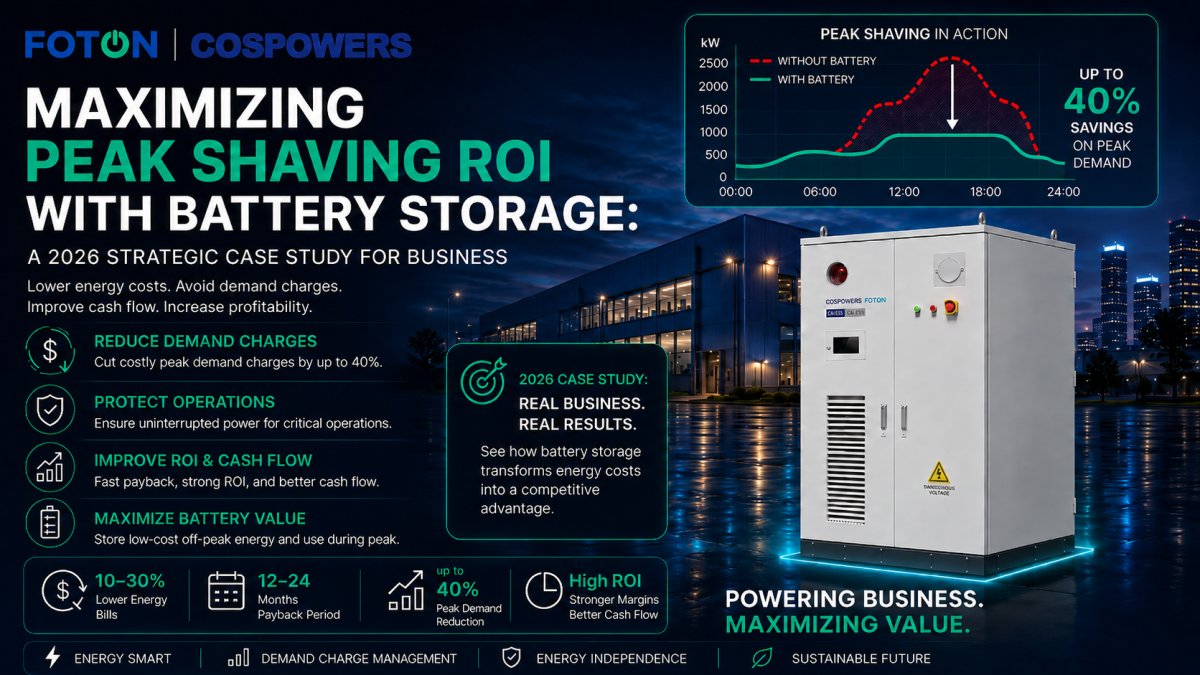
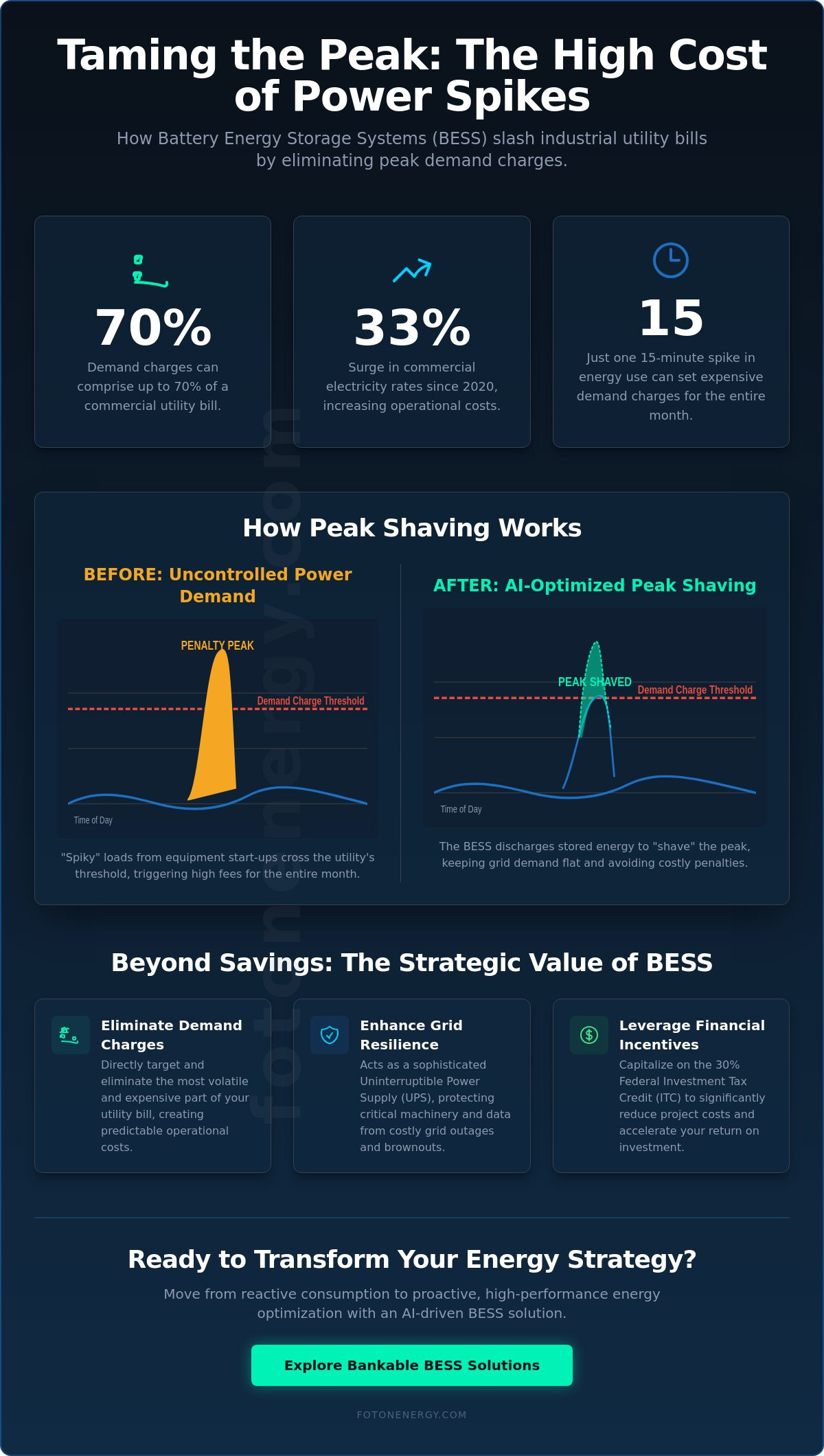
Demand charges account for up to 70% of the total utility bill for modern industrial facilities. This volatility transforms energy procurement into a significant liability rather than a manageable operational cost. You're likely facing the reality of commercial electricity rates that have surged 33% since 2020, making the implementation of peak shaving battery storage for business a strategic necessity for maintaining industrial uptime. It's a challenging environment where calculating the true payback of energy assets often feels obscured by technical variables like cell degradation and shifting regulatory frameworks.
Discover how AI-driven BESS architecture transforms these volatile charges into predictable operational savings through detailed 2026 commercial case studies. This strategic framework provides a verified, bankable path to secure financing and maximize your return on investment. Explore how these systems leverage the 30% federal Investment Tax Credit and advanced LFP chemistry to deliver long-term operational resilience. By integrating intelligent EMS with Tier-1 hardware, your organization can transition from reactive energy consumption to proactive, high-performance optimization.
Key Takeaways
- Understand the mechanics of peak shaving battery storage for business to mitigate demand charges that often comprise 70% of utility expenses.
- Learn why AI-driven Energy Management Systems (EMS) are critical for predictive forecasting and real-time load monitoring to prevent manual intervention failure.
- Compare how diverse load profiles, from high-torque manufacturing spikes to constant data center demands, dictate the ideal battery architecture for maximum ROI.
- Identify the criteria for bankable energy storage, focusing on Tier-1 manufacturing standards that satisfy institutional investors and ensure long-term performance.
- Discover a comprehensive deployment framework that integrates global manufacturing excellence with local engineering expertise for scalable energy infrastructure.
The Economic Reality of Industrial Demand Charges in 2026
The 2026 energy market presents a stark reality for high-consumption enterprises. While average commercial electricity rates have climbed to 14.12¢/kWh in the USA, a 5.3% increase year-over-year, the true financial burden lies in demand charges. These fees, which can constitute between 30% and 70% of a total utility bill, penalize businesses for brief periods of high energy intensity. Implementing peak shaving battery storage for business provides a strategic buffer against these costs. By utilizing a Battery Energy Storage System (BESS), companies can discharge stored power during these expensive intervals, effectively lowering the peak demand recorded by the utility.
To better understand this concept, watch this helpful video:
Unlike simple energy arbitrage, which focuses on buying low and selling high based on time-of-use rates, peak shaving targets the specific demand spikes that trigger high-tariff penalties. In manufacturing and cold storage environments, "spiky" load profiles are common due to high-torque motor start-ups or refrigeration cycles. These momentary surges dictate the pricing for the entire month, creating a hidden cost that erodes operational margins. Effective peak shaving requires precision, as even a single missed peak can negate the savings for an entire billing cycle.
Calculating the Real Impact of Peak Demand
Utilities typically measure demand in 15-minute intervals, capturing the highest average load during those short windows to set the monthly rate. Demand charges are fees levied by utilities based on the highest volume of power drawn during a specific measurement window within a billing cycle. This pricing structure means that even a single 15-minute surge can inflate energy costs for weeks. Modern commercial and industrial BESS solutions play a critical role in flattening this load curve, ensuring that the facility never crosses the threshold into the most expensive billing tiers.
Beyond Savings: Grid Resilience and Reliability
The value of energy storage extends beyond immediate cost reduction. A robust BESS serves as a sophisticated Uninterruptible Power Supply (UPS), providing emergency backup that protects critical machinery and data. This secondary function reduces the risk of production downtime during grid brownouts or instability, which are becoming more frequent as global infrastructure ages. By combining peak shaving battery storage for business with onsite renewables, companies achieve a synergistic effect. They gain the ability to store clean energy and deploy it precisely when it offers the highest financial and operational value, securing long-term resilience in an increasingly volatile grid environment.
Engineering the Perfect Shave: AI-Driven EMS and Battery Architecture
Static thresholds are no longer sufficient for modern industrial energy management. While basic systems trigger discharge at a set kilowatt level, true optimization requires a dynamic approach that anticipates demand before it occurs. Manual peak shaving fails because it's reactive. It can't account for the subtle interplay between production schedules, ambient temperature, and grid volatility. This is why peak shaving battery storage for business now relies on sophisticated Energy Management Systems (EMS) that function as the brain of the installation, orchestrating real-time responses to fluctuating loads.
A high-performance EMS monitors facility consumption with millisecond precision, ensuring that the battery discharges only when necessary to stay below a specific demand cap. This level of control is vital for thermal management. Rapid discharge cycles generate heat, and without intelligent oversight, aggressive peak shaving can accelerate cell degradation. By balancing discharge rates with real-time cooling data, the system preserves the long-term health of the asset while meeting the immediate needs of the facility. Explore our Intelligent EMS solutions to see how predictive modeling can secure your facility’s energy future.
Predictive Analytics and Load Forecasting
AI algorithms have revolutionized how businesses approach energy intensity. By analyzing years of historical usage data alongside real-time weather patterns, these systems anticipate peak events with remarkable accuracy. This foresight prevents the common pitfall of "shaving too early," where a BESS depletes its capacity on a minor surge only to be empty when the true peak occurs later in the day. Machine learning models continuously adapt to changing facility operations, such as the addition of new production lines or shifts in shift timing, ensuring the peak shaving strategy remains optimized as the business scales. Precision in forecasting isn't just about efficiency; it's about the financial integrity of the entire energy strategy.
Hardware Reliability: LFP vs. Sodium-Ion for Peak Shaving
Selecting the right chemistry is a foundational decision for any 15-year infrastructure investment. Lithium Iron Phosphate (LFP) remains the industry standard in 2026, offering a long cycle life of 6,000 to over 10,000 cycles. It's the dependable choice for high-frequency peak shaving where the battery must perform daily without significant capacity loss. However, the mass production of the sodium-ion battery for data centers and industrial sites provides a compelling alternative for high-drain environments. Sodium-ion excels in temperature-volatile settings and offers superior safety profiles. Regardless of chemistry, bankable hardware must include multi-tier fire suppression and cell-level monitoring to meet the rigorous safety standards required for large-scale commercial deployment.
Comparative Case Study: Manufacturing vs. Data Center Load Profiles
Return on investment for energy storage is not a static calculation. It is a precise reflection of a facility’s unique consumption habits. While one business may struggle with erratic power surges, another might face a relentless, high-intensity baseload. Understanding these nuances is the first step toward deploying peak shaving battery storage for business that actually delivers on its financial promises. By examining two distinct industrial profiles, we can see how the same technology solves fundamentally different economic problems.
Before intervention, both manufacturing plants and data centers often display load curves that utilities penalize heavily. After integrating a BESS, these curves are "shaved," effectively capping the demand and smoothing out the volatility. The financial impact of this smoothing varies based on local tariff structures and the intensity of the peaks being mitigated. In many jurisdictions, the savings from avoiding a single monthly peak can justify the year's operational costs for the storage asset.
Manufacturing: Taming the Startup Spike
Industrial facilities are defined by high-torque motor start-ups and heavy machinery cycles. These actions create massive, short-lived spikes in power draw that set the demand charge for the entire billing period. In a typical manufacturing environment, these 15-minute interval peaks can be several times higher than the average operational load. Reducing these spikes directly lowers the utility bill without requiring any changes to the production schedule or throughput speeds.
- ROI Metrics: The primary driver is demand charge reduction. However, the system must balance aggressive shaving with battery cycle life to ensure the hardware lasts the intended 15 years.
- Hardware Durability: For these high-stress environments, procurement through a trusted Cospowers BESS distributor ensures access to industrial-grade cells designed for rapid, frequent discharge.
Data Centers: Balancing PUE and Peak Costs
Data centers operate with a high, constant baseload where Power Usage Effectiveness (PUE) is the critical metric. Here, peak shaving battery storage for business provides a dual-purpose benefit. It manages the occasional peaks caused by cooling system surges while simultaneously serving as a high-speed UPS. This integration reduces the facility's reliance on diesel generators for short-term frequency regulation and momentary outages, which simplifies the overall power architecture. For facility managers who still maintain backup power systems and require specialized support with fuel and engine health, visit Fleetmaxx Solutions for their bulk and lubricant services.
Calculating the total cost of ownership (TCO) for a data center BESS reveals value beyond simple bill savings. By replacing traditional lead-acid UPS systems with modern LFP or sodium-ion storage, operators gain better energy density and longer service intervals. The 10-year horizon for these projects often shows that the operational resilience and grid service participation fees outweigh the initial capital expenditure. This is especially true in markets where grid instability poses a constant threat to uptime and data integrity.
Evaluating Bankability: Tier-1 Hardware and Long-Term Performance
Investment in large-scale energy infrastructure requires more than just technical feasibility. For institutional investors in 2026, bankability is the primary metric for project approval. It signifies that a BESS project is backed by hardware with a proven manufacturing heritage and rigorous third-party verification. When deploying peak shaving battery storage for business, the stability of the manufacturer is as critical as the efficiency of the cells. Investors look for a bankable assurance that the asset will perform throughout its 15-year lifecycle, ensuring that projected savings aren't derailed by premature failure or lack of warranty support.
Securing project finance depends on navigating DNV verification and meeting international safety certifications like UL 9540A. These benchmarks provide the security needed to inspire trust in large-scale infrastructure investments. Adhering to bankable energy storage for financiers guidelines ensures that every component, from the inverter to the fire suppression system, meets global standards. This comprehensive approach transforms a complex technical asset into a stable, high-yield financial instrument.
The Tier-1 Advantage in Procurement
Partnering with a tier 1 BESS supplier significantly reduces technical and financial risk. These manufacturers, such as Cospowers, bring decades of heritage and extensive certifications to the table. This pedigree is essential for securing competitive financing, as lenders require an image of stability and long-term reliability. Hardware quality correlates directly with predictable ROI. If a system experiences unexpected downtime, the loss of peak shaving benefits can jeopardize the entire project’s financial model. To ensure your investment meets these rigorous standards, contact Foton Energy for expert guidance on Tier-1 hardware selection.
Degradation Modeling and OPEX
Capacity fade is an inevitable physical reality that must be factored into every long-term financial model. Battery degradation reduces the usable energy available for peak shaving over time, which can lead to missed savings if the system wasn't sized with adequate margin or an augmentation strategy. To maintain peak shaving battery storage for business performance, operators often plan for augmentation cycles. This involves adding fresh battery modules in year five or seven to compensate for natural capacity loss.
Intelligent cooling plays a vital role in preserving cell health. By maintaining optimal temperatures during high-drain events, an advanced EMS extends the interval between augmentation cycles. This proactive maintenance reduces long-term OPEX and ensures that the shave remains as effective in year ten as it was on day one. High-performance thermal management is not just a safety feature; it's a critical component of the asset’s financial durability.
Strategic Deployment with Foton: Scaling Your Energy Infrastructure
Execution is the final bridge between strategic vision and operational reality. While the technical and financial arguments for peak shaving battery storage for business are compelling, the success of any installation depends on the precision of its deployment. Foton provides an end-to-end framework that manages every phase of the project, from initial feasibility modeling to the integration of AI-driven control systems. This comprehensive approach ensures that the theoretical ROI identified in the planning stages translates into tangible, long-term operational savings.
Our partnership with Cospowers represents a unique synergy in the energy market. It combines global manufacturing excellence with local engineering expertise, providing clients with access to a robust, high-capacity supply chain. This collaboration ensures that Tier-1 hardware is always paired with site-specific optimization, creating a "trusted partner" relationship that extends far beyond the initial commissioning. By choosing a partner with a deep manufacturing heritage, you secure the stability required for large-scale infrastructure investments.
Consultative Engineering and Feasibility
A successful BESS project begins with rigorous data analysis. Foton’s engineering team conducts exhaustive feasibility studies, analyzing your facility’s historical utility data to model real-world savings. We don't rely on generic benchmarks. Instead, we customize the safety architecture and system sizing to meet specific site constraints and local grid-code requirements. This consultative process ensures that the proposed solution is both technically sound and commercially viable, providing a clear roadmap for your energy transition.
- Site Analysis: Evaluating physical space, thermal requirements, and existing electrical infrastructure to ensure seamless integration.
- Compliance: Ensuring full alignment with international safety certifications and specific local utility regulations for large-scale C&I deployments.
- Modeling: Simulating 10-year performance curves based on actual load profiles and shifting tariff structures to verify bankability.
Partnering for Long-Term Energy Independence
Scalability is a core component of our architectural philosophy. As your business grows and your energy demands evolve, our modular BESS designs allow for seamless capacity expansion. This future-proof approach protects your initial capital expenditure by ensuring the system can adapt to new production lines or increased operational intensity. Through our extensive network of channel partners and resellers, we provide localized support backed by a global ecosystem of technical expertise. Take the first step toward a resilient, cost-effective energy future and consult with Foton Energy for your C&I BESS deployment today. Our team is ready to transform your volatile demand charges into a predictable strategic advantage.
Transforming Energy Volatility into Operational Certainty
Navigating the 2026 utility landscape requires a shift from reactive consumption to proactive optimization. As demand charges continue to consume up to 70% of industrial energy budgets, the implementation of peak shaving battery storage for business has evolved from a sustainability goal into a fundamental financial necessity. By integrating predictive AI-driven Energy Management Systems with high-performance hardware, your facility can effectively cap expensive power surges while building long-term grid resilience.
Success in large-scale energy infrastructure is built on bankability and proven heritage. Foton Energy leverages over 30 years of manufacturing experience and an exclusive global partnership with Cospowers to deliver Tier-1 solutions that satisfy institutional investors and operational requirements alike. It's time to transition your energy strategy from an unpredictable liability to a stable, high-performance asset. Design your bankable BESS solution with Foton Energy and secure the intelligence your infrastructure needs to thrive in an increasingly complex grid environment. Your path to energy independence starts with a strategic, data-backed foundation.
Frequently Asked Questions
How does peak shaving battery storage reduce my business electricity bill?
Peak shaving reduces your bill by discharging stored energy during high-demand intervals to stay below a set threshold. This strategy directly targets demand charges, which can account for up to 70% of a commercial utility bill. By using peak shaving battery storage for business, you effectively lower the highest 15-minute average load recorded by the utility, preventing expensive tariff penalties without altering your production schedule or operational output.
What is the typical payback period for a commercial BESS used for peak shaving?
Payback periods vary significantly based on local utility rates and available incentives, but many businesses see a return on investment within three to seven years. In markets with high demand charges or robust state-level rebates, the accelerated savings on monthly bills can shorten this window. Factoring in the 30% federal Investment Tax Credit (ITC) and potential grants like USDA REAP can further improve the financial modeling for industrial-scale projects.
Can I use the same battery for peak shaving and emergency backup?
You can utilize a single BESS for both peak shaving and emergency backup through a strategy known as value stacking. The system's Energy Management System (EMS) maintains a reserve capacity for critical UPS functions while using the remaining capacity for daily peak mitigation. This dual-purpose architecture ensures that your facility maintains operational uptime during grid outages while simultaneously delivering predictable monthly savings through demand charge reduction.
What is the difference between peak shaving and energy arbitrage?
Peak shaving focuses on lowering the maximum power draw to reduce demand charges, while energy arbitrage involves buying electricity when prices are low and using it when rates are high. While both strategies utilize peak shaving battery storage for business, peak shaving often delivers a higher ROI in industrial contexts. This is because demand charges are typically more punitive than the spread between off-peak and on-peak energy rates.
Do I need to upgrade my existing electrical infrastructure to install a BESS?
Infrastructure requirements depend on the size of the BESS and the capacity of your current switchgear and transformer. While many installations integrate seamlessly with existing systems, larger utility-scale storage projects might require upgrades to handle high-rate discharge and charging. A comprehensive feasibility study conducted by engineering consultants is essential to determine if your facility's electrical distribution network can support the new energy asset without significant modification.
How long do industrial-scale batteries last under daily peak shaving cycles?
Modern industrial batteries typically last between 10 and 15 years when managed by an intelligent EMS. Lithium Iron Phosphate (LFP) cells are rated for 6,000 to 10,000 cycles, allowing for daily discharge over a decade while maintaining roughly 80% of their original capacity. Implementing advanced thermal management and proper degradation modeling ensures that the system remains an effective peak shaving tool throughout its projected operational lifespan.
Is sodium-ion battery storage better than LFP for peak shaving?
LFP remains the industry standard for peak shaving due to its proven cycle life and bankability, but sodium-ion is a superior choice for temperature-volatile environments. Sodium-ion cells offer excellent high-drain performance and safety profiles without the need for lithium or cobalt. While LFP is currently more established for institutional financing, sodium-ion mass production in 2026 makes it an increasingly viable, lower-cost alternative for specific high-performance industrial applications.
How much space is required for a containerized BESS solution?
Space requirements depend on the system's energy density, with most large-scale solutions housed in standard 20-foot or 40-foot shipping containers. A 1MWh system typically fits within a 20-foot container, including the batteries, inverters, and cooling systems. These modular units are designed for outdoor installation on a concrete pad, allowing businesses to scale their energy infrastructure without consuming valuable indoor floor space or requiring extensive building modifications.


