
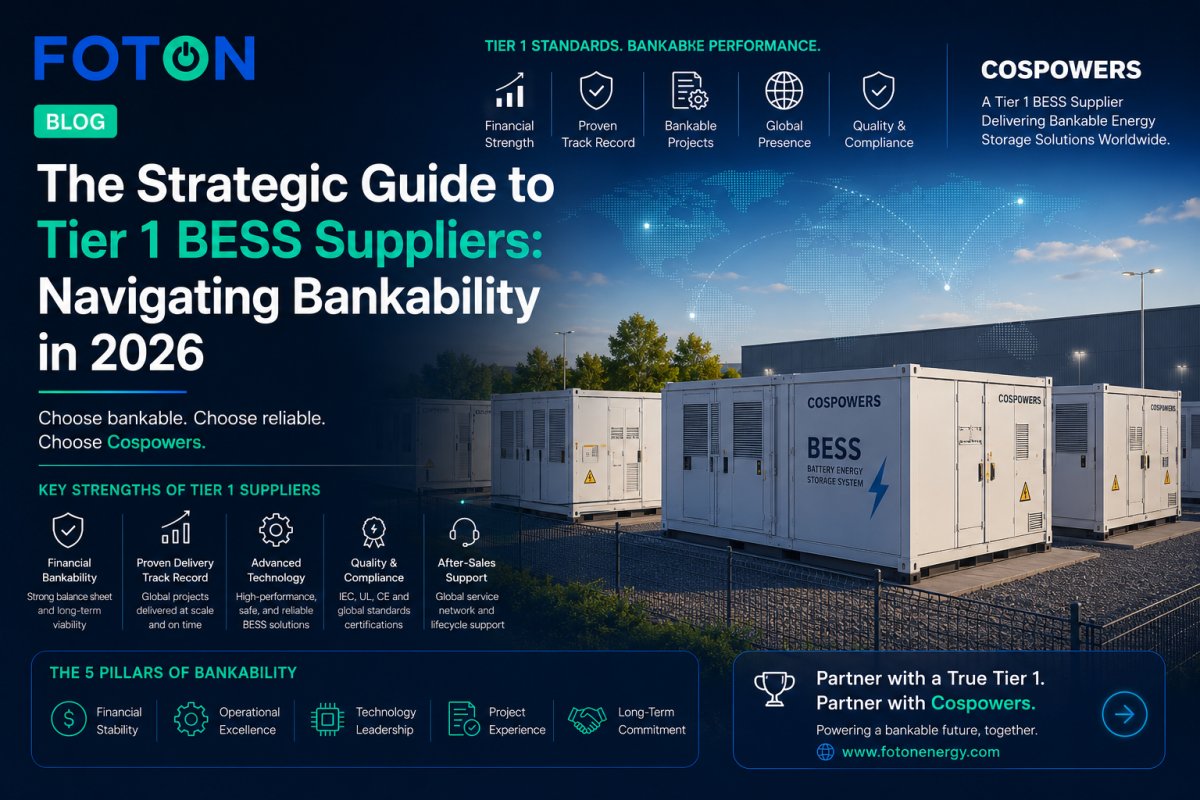
A tier 1 BESS supplier designation is a measure of financial transparency, not a guarantee of technical excellence or operational longevity. While the industry often treats these lists as a gold standard for quality, they primarily track a manufacturer's ability to secure non-recourse debt for large-scale projects. You understand that securing financing for a utility-scale project or a complex C&I deployment depends on hardware that lenders trust. However, relying solely on a quarterly list without evaluating technical architecture can lead to long-term operational risks.
This guide empowers you to master the 2026 criteria for Tier 1 status and leverage high-performance manufacturing for sustained project success. You'll learn how to navigate the latest BloombergNEF requirements and maximize IRA incentives like the 10% domestic content bonus available for projects starting this year. We'll explore a strategic framework that aligns financial bankability with intelligent EMS and localized engineering to ensure your energy storage assets deliver reliable value throughout their entire lifecycle.
Key Takeaways
- Distinguish between BNEF financial benchmarks and actual technical reliability to ensure project longevity and operational safety.
- Identify the essential criteria of a tier 1 BESS supplier, including proprietary cell production and the financial solvency required to back 15-year warranties.
- Master a strategic procurement framework that combines quarterly bankability verification with rigorous engineering due diligence.
- Explore how AI-driven EMS and localized integration services transform raw hardware into a bankable, high-performance energy asset.
- Learn to leverage decades of manufacturing heritage and engineering consulting to mitigate supply chain volatility in utility-scale deployments.
What Defines a Tier 1 BESS Supplier in 2026?
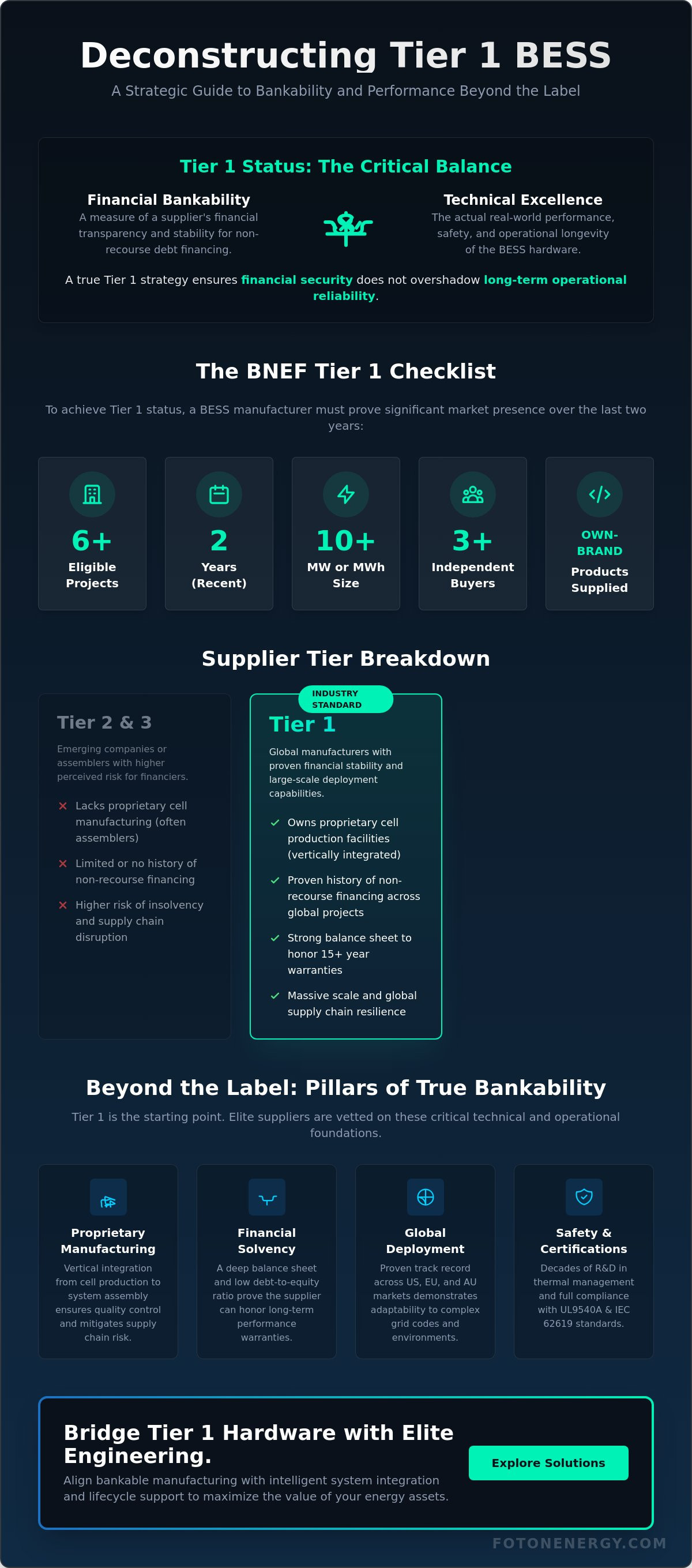
Tier 1 status is a financial filter, not a technical certificate. In 2026, the BloombergNEF (BNEF) benchmark remains the industry's gold standard for identifying manufacturers with the transparency required for non-recourse project financing. Choosing a tier 1 BESS supplier ensures that your hardware is recognized by global lenders. This is a critical step for utility-scale success. This classification doesn't rank the specific energy density or cycle life of a battery. Instead, it measures the brand's ability to supply large-scale projects consistently and maintain a transparent financial profile.
The '6 Projects' Rule defines the threshold for credibility. To achieve Tier 1 status as of the March 18, 2026 update, a manufacturer must have supplied own-brand products to at least six different eligible projects in the last two years. These projects must be at least 10MW or 10MWh and involve at least three different independent buyers. This rigorous standard protects investors from manufacturer insolvency during a battery energy storage system (BESS) lifecycle that often spans 20 years. When a supplier holds this status, it proves they have the balance sheet depth to honor long-term warranties and support operational continuity.
The Difference Between Tier 1, Tier 2, and Tier 3
Tier 1 entities possess massive scale and proprietary cell manufacturing. They have a proven history of non-recourse financing across multiple global regions. Tier 2 and Tier 3 players are often emerging companies or assemblers who lack their own cell production facilities. Financiers rarely approve hardware from these lower tiers for utility-scale Power Purchase Agreements (PPAs). The risk of company failure or supply chain disruptions is simply too high for most institutional lenders to accept.
Beyond the Label: Why 'Tier 1' is Only the Starting Point
Tier 1 status is your entry ticket, but it's not the end of your due diligence. Independent engineering reports from firms like DNV or Black & Veatch are essential to vet specific technical claims. You must also distinguish between a cell manufacturer and a system integrator. A tier 1 BESS supplier might produce the cells, but the integration of intelligent EMS and thermal management determines the project's actual safety. True bankability requires aligning this financial status with rigorous technical testing and operational excellence.
Evaluating the Criteria: How Tier 1 Status is Earned
Strategic alignment with a tier 1 BESS supplier requires a deep dive into the manufacturer's balance sheet and production capabilities. While financial benchmarks provide a snapshot of market presence, true bankability is built on the foundation of proprietary manufacturing. A supplier that owns its cell production facilities minimizes third-party dependencies, offering a level of quality control that simple assemblers can't match. This vertical integration extends from raw material sourcing to the delivery of fully integrated containers, ensuring that every component meets rigorous performance standards.
Financial solvency remains the ultimate safeguard for your investment. Lenders scrutinize debt-to-equity ratios to confirm that a manufacturer can honor 10 to 15 year warranties. A proven global deployment history across the US, EU, and Australian markets demonstrates that the supplier can adapt to complex grid-code requirements and varying environmental conditions. This track record serves as a stress test for their operational reliability, proving they can maintain stability through various market cycles and regulatory shifts.
Manufacturing Heritage and R&D Investment
Legacy matters in an industry where assets are expected to perform for decades. A significant manufacturing heritage, often spanning decades, provides a bankable assurance that the company has evolved through multiple technology cycles. This experience fuels continuous R&D investment in safety architecture and advanced thermal management. By prioritizing these technical proof points, developers can mitigate the risk of thermal runaway and ensure high-performance reliability. For those seeking to align their projects with this level of expertise, engaging with engineering consulting services can help bridge the gap between raw hardware and optimized system design.
Certifications and Grid-Code Compliance
Tier 1 suppliers simplify the commissioning process by securing comprehensive international certifications. Compliance with UL9540A and IEC 62619 is non-negotiable for modern utility-scale and C&I deployments. These certifications verify that the hardware meets stringent fire safety and electrical standards. When a tier 1 BESS supplier provides pre-certified, grid-compliant systems, it reduces the burden on EPC partners and accelerates the timeline to commercial operation. This readiness is a hallmark of a partner who is not just a participant in the market but a foundational pillar of it.
The Bankability Trap: Why Technical Performance Matters More Than Ever
Financial health provides the floor for project security, but it doesn't dictate the ceiling of technical performance. While partnering with a tier 1 BESS supplier ensures your project remains attractive to institutional lenders, bankability isn't a shield against thermal runaway or premature cell degradation. A manufacturer's presence on a quarterly list confirms their capital depth, yet it doesn't always reflect the precision of their system-level engineering. Investors often fall into the trap of assuming that a strong balance sheet translates directly to operational excellence. Real-world performance requires a synergy between financial stability and rigorous technical due diligence.
The industry's shift toward Lithium Iron Phosphate (LFP) has driven cell prices down to between $60 and $80 per kWh in 2026, making utility-scale storage more accessible than ever. However, raw hardware is only as effective as the software managing it. An Intelligent EMS acts as the critical link, optimizing discharge cycles and monitoring the state of health (SoH) to prevent the "bankability trap" where hardware fails despite its Tier 1 pedigree. Without sophisticated thermal management and AI-driven monitoring, even the most expensive DC blocks can suffer from accelerated capacity loss, undermining the long-term ROI of a 20-year asset.
Safety Architecture and Fire Suppression
True resilience starts at the cell level and extends to the entire containerized solution. We prioritize a "Safety-First" architecture that integrates multi-level safety protocols to mitigate risks before they escalate. By leveraging Cospowers' 30-year manufacturing heritage, Foton's utility-scale storage solutions employ advanced fire suppression and localized thermal controls. This approach ensures that technical safety matches the financial security expected from a tier 1 BESS supplier, protecting both the physical infrastructure and the project's bottom line.
Sodium-Ion: The Next Frontier for Tier 1 Manufacturers
Sodium-ion battery technology is emerging as a vital alternative for mission-critical applications, particularly in data centre and telco backup sectors. With cell prices currently ranging from $80 to $120 per kWh, sodium-ion offers superior safety profiles and exceptional cold-climate performance compared to traditional chemistries. Tier 1 manufacturers are increasingly investing in these production lines to serve global markets where LFP might struggle. This diversification allows developers to source resilient hardware for specialized environments, ensuring interconnectedness and reliability across diverse global deployments.
Procurement Strategy: Sourcing Tier 1 BESS for Global Projects
Successful procurement begins with a rigorous, five-step audit that extends far beyond a simple price-per-kWh comparison. First, you must verify the current-quarter BNEF status of your manufacturer. The Q1 2026 list was published on January 30, and the criteria were refined as recently as March 18, 2026. This ensures your tier 1 BESS supplier is recognized by modern financial institutions. Second, assess the engineering capabilities of your distribution partner to bridge the gap between factory output and site-specific integration. Third, conduct a deep audit of ESG and supply chain transparency to meet increasing regulatory demands for ethical sourcing. Fourth, evaluate the local support network for commissioning and predictive maintenance. Finally, review the software stack to ensure the EMS supports grid-optimization and peak shaving.
It's a mistake to overlook the operational nuances of deployment. While global BESS shipments reached approximately 315 GWh in 2025, the ability to successfully commission these systems depends on local expertise. A strategic procurement strategy moves beyond the hardware purchase. It focuses on a long-term operational partnership of 10 to 15 years. You must ensure that your supplier doesn't just deliver a container, but provides a foundational pillar for your energy infrastructure.
For organizations looking to showcase their energy storage systems or sustainable infrastructure at global industry events, you can discover Coker Exhibition Systems Ltd (CokerExpo) for high-impact display and lightbox solutions.
Wholesale Procurement vs. Strategic Partnership
Factory-direct sourcing often presents a lower upfront cost but carries significant risks without local engineering oversight. A strategic partner adds value by managing project feasibility and ensuring grid-code compliance before the hardware arrives on site. This collaborative approach is detailed in our Strategic Guide to Commercial and Industrial BESS Solutions. Strategic partners act as a steady, guiding hand for large-scale investors. They move beyond raw hardware to deliver a complete industrial ecosystem. Selecting a tier 1 BESS supplier through a strategic lens ensures that your project is not just financed, but optimized for decades of operation.
Navigating the Global Supply Chain
Managing lead times for containerized BESS deployments requires a partner with established logistics networks and a deep understanding of international certifications. In 2026, the complexity of global shipping and the need for local technical consulting make a "set and forget" mentality impossible. Long-term asset management depends on having technical experts available for immediate support and predictive maintenance. To secure your project's future and ensure high-performance reliability, consult with our engineering team to align your procurement strategy with global standards and operational excellence.
Foton Energy: Bridging Tier 1 Manufacturing with Elite Engineering
Foton Energy operates as the critical link between elite manufacturing capabilities and the complex requirements of global energy developers. Through an exclusive partnership with Cospowers, we bring 30 years of heritage to every project, ensuring that our clients benefit from a tier 1 BESS supplier with proven stability. We provide end-to-end solutions that move beyond simple hardware delivery. Our team manages everything from initial procurement to the integration of AI-driven Intelligent EMS, creating a seamless path from investment to operation. It's about turning high-performance components into a cohesive, income-generating asset.
Our global reach supports EPCs and developers in more than 70 countries, combining international standards with deep local expertise. We lead the industry's transition into future-ready infrastructure by offering both high-capacity LFP and emerging Sodium-ion systems. This diversification allows our partners to deploy the most effective chemistry for their specific application, whether it's a utility-scale storage plant or a critical data centre and telco backup system. We provide the technical certainty required to secure large-scale infrastructure investments in a rapidly evolving market.
The Foton Advantage for EPCs and Developers
We empower our partners through specialized engineering consulting that addresses project feasibility and grid-scale complexities from the earliest stages. Our integration process prioritizes proprietary thermal management and multi-level safety architecture. By aligning with a tier 1 BESS supplier through Foton, you gain access to a collaborative partner dedicated to bankable energy storage infrastructure. We don't just sell systems; we design resilient ecosystems that maximize efficiency and safety for the entire 20-year asset lifecycle.
Securing Your 2026 Energy Infrastructure
Foton stands as the preferred Cospowers BESS distributor for utility-scale projects, offering a steady hand in a volatile supply chain. We understand that your project's success depends on more than just a list; it requires operational excellence and technical proof points that satisfy the most rigorous lenders. Secure your project's future by leveraging our manufacturing heritage and engineering precision. Contact our technical team today for a comprehensive project audit and discover how we can optimize your 2026 energy infrastructure for maximum reliability and performance.
Mastering the Future of Energy Infrastructure
Success in the 2026 energy landscape requires moving beyond surface-level metrics to embrace a deeper understanding of bankability. True project security emerges when you align the financial stability of a tier 1 BESS supplier with a technical architecture designed for long-term resilience. Financial lists provide the starting point. However, the real value lies in proprietary manufacturing, advanced safety protocols, and the intelligence of an AI-driven EMS. As global shipments continue to rise, the distinction between a simple hardware purchase and a strategic partnership will define the winners in utility-scale and C&I deployments.
Foton Energy stands ready to guide your transition toward high-performance infrastructure. We leverage an exclusive partnership with Cospowers, backed by 30 years of manufacturing heritage and a global network spanning over 70 countries. Our focus on safety-first architecture and grid-optimized software ensures your assets deliver reliable value for decades. Don't leave your project's financing or performance to chance. Partner with Foton for Bankable Tier 1 BESS Solutions and build your next deployment on a foundation of proven excellence. Let's shape a cleaner, more stable future together.
Frequently Asked Questions
What is the difference between a Tier 1 and a bankable BESS supplier?
Tier 1 status is a specific benchmark of financial transparency provided by organizations like BloombergNEF. Bankability is a broader concept reflecting a lender's willingness to finance a project using specific hardware. While a tier 1 BESS supplier has the high-level financial data required for non-recourse debt, true bankability also involves technical due diligence, independent engineering reports, and the manufacturer's long-term ability to honor warranties.
How often does the BNEF Tier 1 energy storage list change?
The BloombergNEF Tier 1 energy storage list is updated quarterly. This frequent revision ensures the industry has access to the most current financial and project data. For instance, the Q1 2026 list was published on January 30, while the criteria themselves were refined on March 18, 2026. Developers should always verify a manufacturer's status against the latest quarterly report to ensure project financing remains secure.
Can a Sodium-ion battery manufacturer be considered Tier 1?
A Sodium-ion battery manufacturer can achieve Tier 1 status provided they meet the standard BNEF criteria for project volume and financial transparency. The classification is chemistry-agnostic. It focuses on the brand's ability to supply at least six eligible projects over 10MWh within a two-year period. As companies like Cospowers expand production, alternative chemistries are increasingly appearing on these bankability lists.
Why do financiers insist on Tier 1 hardware for energy storage projects?
Financiers insist on hardware from a tier 1 BESS supplier to mitigate long-term investment risks. Non-recourse debt providers require assurance that the manufacturer will remain solvent throughout the 10 to 15 year warranty period. Tier 1 status serves as a standardized proxy for financial stability, suggesting the company has the balance sheet depth to support the asset's operational life and honor performance guarantees.
Is a Tier 1 manufacturer always the best choice for small-scale C&I projects?
Tier 1 manufacturers are often the preferred choice for C&I projects because they offer a higher degree of reliability and standardized support. While smaller, specialized integrators might offer niche customization, they often lack the manufacturing heritage and financial backing of a top-tier entity. For commercial and industrial deployments, the long-term stability of the hardware partner is usually more critical than minor upfront cost savings.
What certifications should I look for in a Tier 1 energy storage manufacturer?
Essential certifications include UL 9540A for fire safety and thermal runaway testing, alongside IEC 62619 for industrial battery safety. You should also verify compliance with regional grid codes, such as IEEE 1547 in North America or G99 in the UK. These certifications ensure the hardware meets international safety and performance standards, simplifying the permitting and commissioning process for EPC partners and developers.
How does Foton Energy support the commissioning of Tier 1 BESS hardware?
Foton Energy provides comprehensive engineering consulting and technical oversight to bridge the gap between factory delivery and site operation. We oversee the integration of Intelligent EMS and ensure all safety protocols are correctly implemented during the commissioning phase. Our collaborative approach helps EPCs navigate complex grid-code requirements, ensuring the hardware performs to its maximum potential from day one of commercial operation.
Does Tier 1 status guarantee a 20-year battery lifespan?
Tier 1 status does not guarantee a 20-year lifespan because it is primarily a measure of financial transparency. The actual longevity of a system depends on technical factors like thermal management, depth of discharge, and the quality of the Energy Management System. While a Tier 1 brand has the resources to build durable hardware, long-term asset health requires proactive O&M and intelligent operational strategies.


