
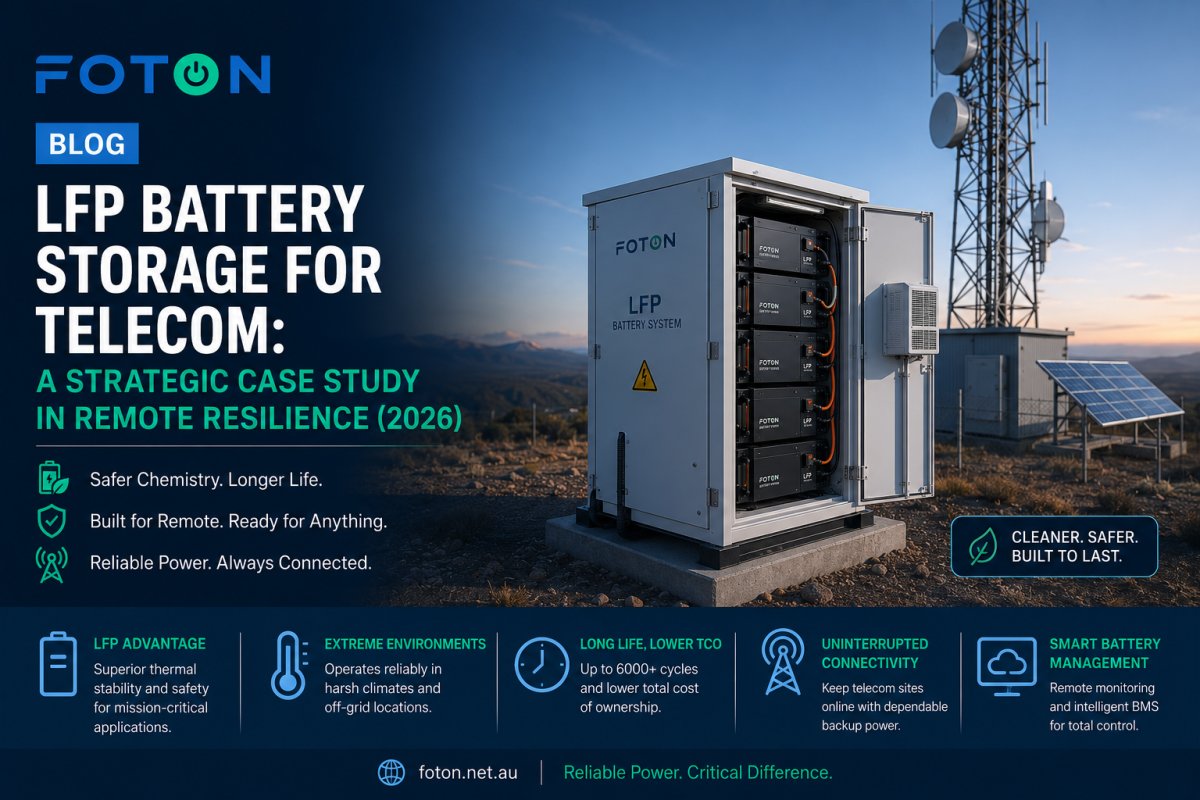
By the end of 2025, 90% of new global battery storage deployments had shifted to lithium iron phosphate, signaling a definitive end to the era of lead-acid dominance. It's a clear mandate for an industry facing the dual pressures of 5G power demands and extreme environmental conditions. You've likely experienced the relentless cycle of lead-acid failures at high-temperature remote sites, where maintenance visits become a significant drain on both capital and operational resources. LFP battery storage for telecom is no longer just a premium alternative; it's the foundational layer for resilient, zero-touch infrastructure.
This case study demonstrates how Tier-1 LFP technology delivers a 10 to 15 year service life and the compact footprint necessary for modern 5G rack space. We'll analyze the strategic shift toward high-voltage architectures and intelligent remote monitoring that ensures site bankability in the most demanding environments. You will discover how these systems provide the stability required for large-scale infrastructure investments while significantly reducing long-term costs through optimized engineering. We are moving toward a future where power is a silent, reliable partner in global connectivity.
Key Takeaways
- Learn why 5G power demands require a shift from legacy VRLA to high-density rack-integrated modules to maintain site uptime.
- Discover the technical advantages of LFP battery storage for telecom, including a 6,000+ cycle life and superior safety in high-temperature environments.
- Calculate the long-term value of your investment by analyzing how 15-year lifecycles and remote monitoring significantly reduce total cost of ownership.
- Master the deployment of modular architectures and AI-driven energy management to achieve N+1 redundancy at remote, mission-critical sites.
- Understand how a 30-year manufacturing heritage and the evolution toward sodium-ion technology provide a bankable path for future-proofing your network.
The 5G Energy Challenge: Why Telecom Infrastructure Requires LFP Storage
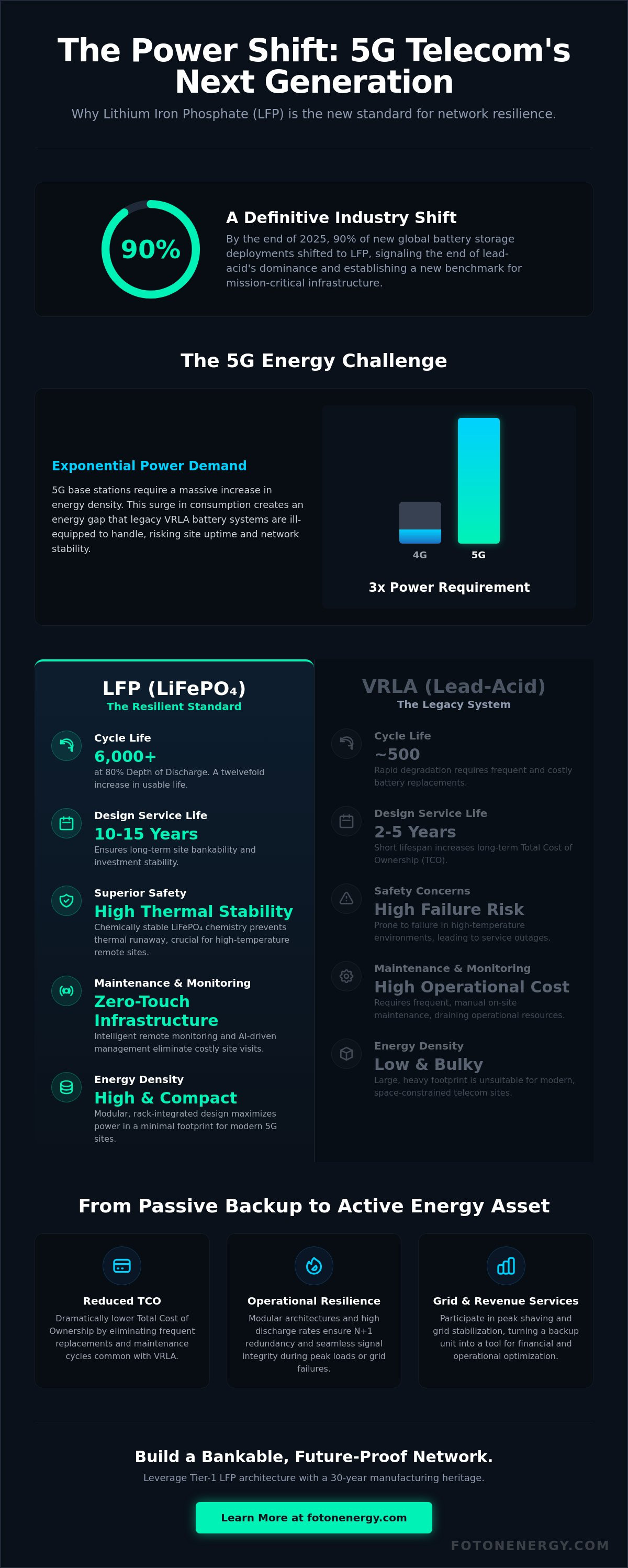
5G deployment represents a fundamental shift in how we power connectivity. It isn't just a faster signal; it's a massive increase in energy density requirements. Traditional sites built on Valve-Regulated Lead-Acid (VRLA) technology are hitting a wall. 5G base stations often require three times the power of 4G equipment, creating an energy gap that legacy systems simply cannot bridge. This is where LFP battery storage for telecom enters the strategic conversation. These systems leverage the unique properties of a Lithium iron phosphate (LFP) battery to provide high-cycle, high-density power in 48V and 51.2V modules. They're built specifically for standard telecom rack integration, ensuring that capacity grows alongside network demands.
To better understand the chemistry behind these systems, watch this helpful video:
We don't just see a battery; we see a strategic asset. At Foton, we view these installations as critical nodes within a wider ecosystem of commercial and industrial BESS solutions. In urban environments, these batteries do more than wait for a grid failure. They participate in peak shaving and provide grid stability, helping operators manage high electricity costs during peak hours. This transformation turns a simple backup unit into a tool for financial and operational optimization.
From Passive Backup to Active Energy Management
In the past, batteries were passive observers. Today's LFP battery storage for telecom allows for active energy management. By creating hybrid sites that combine the grid, solar arrays, and LFP storage, operators can significantly reduce their carbon footprint and energy spend. The high discharge rates inherent to LFP technology are vital for maintaining signal integrity during peak traffic loads. It ensures that even when the grid is strained, the 5G experience remains seamless for the end user.
The Shift to Tier-1 Manufacturing Standards
Reliability in the field is born in the factory. A 30-year manufacturing heritage provides the stability that large-scale infrastructure requires. There's a massive difference between consumer-grade lithium and Tier-1 industrial LFP. Industrial-grade modules undergo rigorous testing to meet international standards and DNV verification. These certifications are critical for securing site insurance and ensuring that the equipment survives the full 15-year lifecycle expected by investors. It's about building a foundation that's as resilient as the networks it supports.
Cycle Life and Thermal Stability: The Technical Superiority of LFP
Technical resilience is the bedrock of modern connectivity. For safety-critical telecom sites, the choice of battery chemistry isn't merely a procurement decision; it's a strategic commitment to network longevity. Lithium Iron Phosphate (LiFePO4) has emerged as the industry standard, outperforming Nickel Manganese Cobalt (NMC) in the specific areas that matter most for infrastructure. While NMC offers high energy density for mobile applications, its lower thermal runaway threshold makes it a liability in stationary telecom racks. LFP battery storage for telecom provides a more stable alternative, ensuring that power remains consistent even under significant electrical stress.
The performance gap between legacy systems and modern LFP is staggering. Traditional VRLA batteries typically offer around 500 cycles before significant degradation occurs. In contrast, Tier-1 LFP modules deliver 6,000+ cycles at 80% Depth of Discharge (DoD). This represents a twelvefold increase in usable life, effectively decoupling site uptime from frequent battery replacement schedules. When you consider that 5G hardware demands 3x the energy density of previous generations, the ability to fit three times the capacity into a standard 19-inch rack footprint becomes a operational necessity rather than a luxury. If you're looking to optimize your existing rack space, you can consult with our engineering team to explore high-density integration strategies.
Safety Architecture: Preventing Thermal Runaway
Security starts at the molecular level. The primary advantage of LFP chemistry lies in the inherent stability of the phosphorus-oxygen (P-O) bond. This strong covalent bond is significantly more resistant to oxygen release during overcharge or internal shorts than the metal-oxide bonds found in other lithium chemistries. Beyond the chemistry, industrial-grade modules incorporate cell-level safety mechanisms, including precision venting and pressure relief valves. These features are indispensable for containerized deployments where thermal management is a critical safety concern. We focus on these multi-layered safety architectures to provide a bankable assurance that your infrastructure is protected against catastrophic failure.
Performance in Extreme Environments
Remote towers often operate in the world's most unforgiving climates. Maintenance-free operation is essential when a site visit requires a helicopter or a multi-day trek. LFP systems thrive in these environments, maintaining operational integrity in ambient temperatures up to 60°C without the need for active HVAC cooling. Degradation curves show that LFP maintains its capacity far better than lead-acid over a 10-year period, even in desert or tropical conditions. Superior cycle life is the primary driver of telecom site bankability and long-term operational success. By eliminating the rapid capacity loss associated with heat-stressed VRLA, operators can secure a stable, predictable power profile for the entire life of the 5G equipment.
From VRLA to LFP: A Comparative Case Study in Total Cost of Ownership (TCO)
The financial argument for LFP battery storage for telecom is often misunderstood as a simple hardware purchase; it's actually a strategic shift in capital allocation. While the initial CAPEX for lithium is higher than lead-acid, the long-term OPEX savings create a compelling case for large-scale infrastructure. Lead-acid systems typically require replacement every three to five years, especially in high-temperature environments. In contrast, Tier-1 LFP systems are engineered for a 15-year service life, effectively eliminating the recurring procurement and labor costs associated with legacy technology. This longevity allows operators to amortize their investment over a much longer period, significantly improving the project's net present value.
Operational efficiency is further enhanced by the elimination of "truck rolls." Sending technicians to remote sites for routine battery inspections or emergency replacements is a massive logistical burden. Modern LFP modules feature integrated remote monitoring that provides real-time data on state of charge, health, and temperature. This intelligence allows maintenance teams to transition from reactive to predictive service models, resolving issues before they lead to site downtime. For operators managing hybrid infrastructure with significant compute needs, our strategic data center UPS battery replacement framework offers a blueprint for scaling these transitions across diverse asset classes.
The "Hidden" Costs of Lead-Acid Batteries
VRLA batteries are notoriously sensitive to heat, often requiring constant air conditioning to maintain a 25°C environment. This auxiliary power consumption is a hidden drain on site profitability. LFP systems operate efficiently at 60°C, allowing operators to downsize or entirely remove cooling equipment. Additionally, the environmental compliance costs for lead-acid disposal are rising. LFP is a cleaner chemistry that's easier to recycle, reducing the long-term liability for the operator. We also must consider the revenue loss during "sudden death" failure modes common in lead-acid strings, which can bring down a 5G site without warning.
Financial Bankability for EPCs
Engineering, Procurement, and Construction (EPC) firms must demonstrate clear financial outcomes to their clients. Tier-1 LFP improves the internal rate of return (IRR) by reducing both replacement cycles and maintenance overhead. Global lenders and financiers prefer hardware backed by a 30-year manufacturing heritage, such as our Cospowers-backed solutions, because it represents a lower risk profile. Transitioning to Tier-1 LFP reduces site TCO by up to 40% over 10 years. This level of bankability is essential for developers who need to secure funding for massive 5G network expansions in challenging remote markets.
Operational Resilience: Deploying Modular LFP Systems for Remote Sites
Resilience isn't a passive state; it's an engineered outcome. Deploying LFP battery storage for telecom requires a fundamental move toward modular architecture. This design philosophy ensures N+1 redundancy, where the failure of a single module doesn't compromise the entire site's power supply. It's a critical requirement for mission-critical networks where downtime is unacceptable. By utilizing independent power modules, operators can scale capacity as 5G traffic grows without overhauling the initial infrastructure.
Intelligence is the second pillar of this resilience. We integrate AI-driven Energy Management Systems (EMS) that provide real-time health monitoring and predictive alerts. These systems don't just report failures; they anticipate them. High-density telecom cabinets generate significant heat, and managing this is vital for longevity. While air cooling remains effective for standard sites, liquid cooling is increasingly necessary for high-capacity urban hubs to prevent thermal degradation and maintain peak performance. One recent deployment in a remote region demonstrated the power of this approach when a site maintained 99.999% uptime during a 48-hour grid failure, managed entirely through automated remote protocols.
If you're ready to upgrade your network's dependability, you can explore our telecom backup solutions today.
Intelligent Monitoring and Predictive Maintenance
AI plays a decisive role in balancing cell voltages and extending the overall pack life. It manages the internal chemistry to ensure every cell operates within its optimal window. Remote firmware updates allow us to keep telecom hardware current with the latest efficiency protocols without requiring a physical site visit. This level of sophisticated oversight mirrors the rigorous standards found in industrial battery backup for hospitals, where reliability is a matter of public safety. It's about bringing that same level of "always-on" assurance to the telecommunications sector.
Engineering for Grid Code Compliance
Modern LFP battery storage for telecom does more than sit idle. These systems are now engineered to participate in Frequency Control Ancillary Services (FCAS), allowing operators to stabilize the local grid while generating ancillary revenue. Our engineering consulting services provide the technical system design needed for both grid-connected and off-grid towers. We focus on commissioning best practices to ensure high-capacity LFP modules meet all local grid codes and safety regulations from day one. This proactive design ensures your network is a supportive part of the energy transition rather than a burden on the grid.
Future-Proofing Telecom Networks with Foton’s Tier-1 LFP Architecture
Resilience is built on a foundation of proven experience. Our exclusive global partnership with Cospowers brings a 30-year manufacturing legacy to every deployment, ensuring that your infrastructure is supported by decades of technical refinement. This isn't just a supplier relationship; it's a strategic alliance that provides a bankable assurance to global investors and network operators. With a presence in over 70 countries, we understand the logistical and technical nuances of diverse markets, from high-density urban hubs to the most isolated remote towers. LFP battery storage for telecom has become the standard for these environments, but its success depends on the stability of the partner behind the hardware.
As technology evolves, our architecture remains adaptable. While lithium iron phosphate is the current gold standard for reliability and safety, we are already engineering the transition toward next-generation chemistries. For sites with massive power requirements, scaling into a sodium-ion battery for data centers and telecom nodes will become increasingly viable as the technology matures. Our end-to-end support model covers everything from initial engineering consulting to wholesale hardware procurement, ensuring that your network is ready for the 5G era and whatever follows it. We provide the steady, guiding hand needed to navigate these complex industrial transitions.
The Foton Advantage: Engineering Excellence
Success in large-scale infrastructure requires more than just high-quality cells. It requires an intelligent layer of oversight. Our partners gain access to proprietary AI-driven EMS and thermal management software, designed to optimize performance across massive portfolios. We maintain a strict strategic alignment with EPCs and financiers, providing the technical proof points required to secure funding for major deployments. This collaborative approach ensures that every site is optimized for its specific grid conditions and environmental stressors, reinforcing our position as a foundational pillar of the global energy storage market.
Next Steps for Infrastructure Managers
Transitioning to a more resilient power profile is a methodical process. We invite infrastructure managers and technical directors to participate in a shared vision for a more reliable network. To begin this transition, we recommend the following steps:
- Conduct a project feasibility study: Analyze your current site performance and quantify the potential gains from an LFP migration.
- Engage for technical design: Work with our engineering consultants to ensure system design meets all local grid-code compliance requirements.
- Leverage the channel partner programme: Explore how our global scalability can support your long-term expansion goals across multiple regions.
The momentum toward a cleaner, more resilient future is accelerating. By choosing a partner with deep manufacturing roots and a visionary pragmatism, you ensure that your network remains a critical, stable link in the global industrial ecosystem. Let's build the foundation for 2026 and beyond together.
Securing the Next Decade of Global Connectivity
The transition from legacy lead-acid to high-performance lithium is no longer a choice for forward-thinking operators; it's a strategic necessity. By adopting LFP battery storage for telecom, networks gain the thermal stability and cycle life required to sustain 5G expansion in the world's most demanding environments. We've seen how modular architecture and AI-driven monitoring eliminate the logistical burden of reactive maintenance, turning energy storage into a bankable asset that enhances long-term internal rates of return. This shift ensures that remote towers remain operational through grid instability while significantly reducing the total cost of ownership.
Reliability is the hallmark of a foundational infrastructure partner. As the exclusive strategic partner of Cospowers, we provide access to Tier-1 manufactured LFP and sodium-ion systems backed by a 30-year legacy of engineering excellence. Our AI-driven EMS ensures remote resilience and predictive oversight for portfolios spanning the globe. You can partner with Foton for bankable telecom storage solutions to secure your network's future and optimize your operational performance. We look forward to building a more resilient and connected world alongside you.
Frequently Asked Questions
Why is LFP preferred over NMC for telecom battery storage?
LFP is preferred over NMC primarily due to its superior thermal stability and safety profile in stationary applications. While NMC offers higher energy density for mobile devices, its lower thermal runaway threshold presents a risk in densely packed telecom racks. LFP chemistry remains stable at higher temperatures, ensuring that infrastructure remains secure even without intensive cooling systems. This makes it the ideal choice for safety-critical remote sites.
Can LFP batteries be mixed with existing lead-acid batteries in a telecom site?
Direct mixing of LFP and lead-acid batteries within the same string is generally not recommended due to their vastly different voltage curves and charging requirements. Attempting to parallel these chemistries without specialized power electronics can lead to uneven load distribution and premature failure. We advise a full string replacement or the use of intelligent DC-to-DC converters to manage hybrid configurations effectively while maintaining system integrity.
What is the typical lifespan of an LFP battery in a high-temperature remote tower?
An LFP battery in a high-temperature remote tower typically delivers a service life of 10 to 15 years. Unlike lead-acid batteries that degrade rapidly above 25°C, LFP chemistry maintains its structural integrity in ambient temperatures up to 60°C. This durability ensures that operators don't have to face the frequent replacement cycles common with legacy technologies, providing a stable foundation for long-term network planning.
How does an AI-driven EMS improve telecom battery performance?
AI-driven EMS improves performance by executing real-time cell balancing and predictive maintenance protocols that extend the pack's operational life. By analyzing historical data, the system identifies subtle degradation patterns before they manifest as site failures. This intelligence allows for remote optimization of charging cycles based on grid conditions, ensuring that LFP battery storage for telecom operates at peak efficiency throughout its entire lifecycle.
Is LFP battery storage for telecom bankable for large-scale infrastructure projects?
Yes, LFP battery storage for telecom is highly bankable, especially when sourced from Tier-1 manufacturers with established track records. Financiers and global lenders value the predictable 15-year lifecycle and low maintenance requirements, which significantly improve the project's internal rate of return. Choosing hardware with international certifications and manufacturing heritage provides the security necessary to attract large-scale infrastructure investment and ensure long-term site viability.
What certifications should I look for in a Tier-1 telecom battery manufacturer?
You should prioritize manufacturers that hold UL 1973 and IEC 62619 certifications, which are the global standards for safety in stationary energy storage. Additionally, UN38.3 certification is essential for ensuring the batteries can be safely transported to remote regions. These rigorous third-party verifications confirm that the hardware has undergone extensive testing for thermal runaway, electrical abuse, and mechanical integrity, providing a reliable baseline for infrastructure security.
How does LFP energy density compare to VRLA in 19-inch rack applications?
LFP technology offers approximately three times the energy density of traditional VRLA batteries within a standard 19-inch rack footprint. This allows operators to significantly increase their backup capacity without expanding the physical site or adding new cabinets. It's a critical advantage for 5G sites that require higher power draws but are constrained by existing rack space, enabling a seamless upgrade path for legacy infrastructure.
What are the fire safety requirements for LFP batteries in telecom cabinets?
Fire safety requirements for LFP in telecom cabinets focus on non-combustible enclosures, precision gas venting, and integrated Battery Management Systems (BMS). The BMS acts as the primary safety layer by monitoring cell temperatures and disconnecting the circuit if parameters exceed safe limits. While LFP is inherently more stable than other lithium chemistries, following local fire codes and ensuring proper cabinet ventilation remains essential for maintaining a secure operational environment.


