
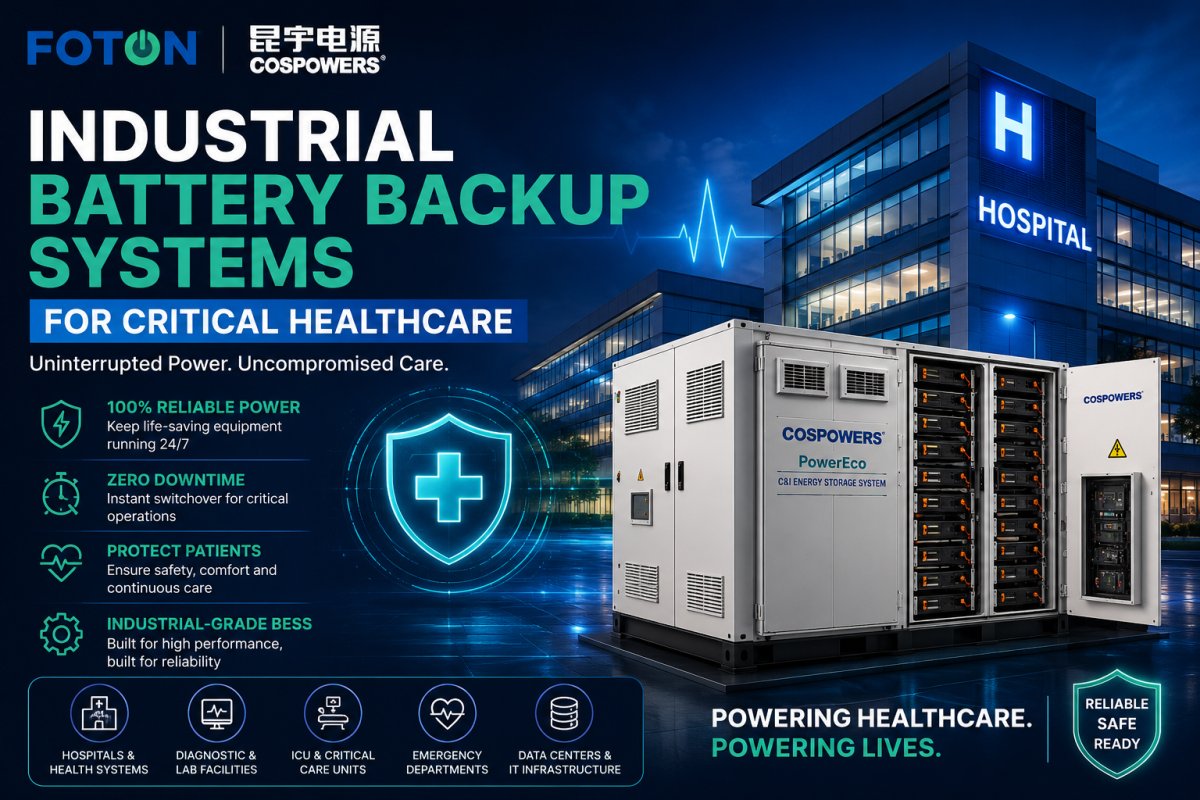
In 2026, the traditional reliance on diesel generators is no longer just an environmental liability; it's a strategic risk for modern hospital infrastructure. You understand that even a millisecond of power instability can compromise life-critical medical equipment and patient safety. As grid volatility increases and regulatory pressure to decarbonize intensifies, effective BESS design for critical healthcare facilities has evolved from an optional redundancy into a mission-critical necessity. This transition requires a sophisticated integration of safety, reliability, and long-term economic optimization.
This article provides the engineering blueprint to master these requirements, ensuring your facility maintains uninterrupted power while transforming energy storage into a bankable asset with 20 plus years of heritage. We'll examine the technical shift toward active explosion control under the 2026 NFPA 855 standards and the performance advantages of liquid-cooled LFP chemistry. You'll learn how AI-powered energy management systems enable strategic peak shaving to slash operational costs, creating a resilient, microgrid-ready environment that protects both your patients and your bottom line.
Key Takeaways
- Understand why modern hospitals are transitioning from passive backup to integrated energy infrastructure to protect high-density medical imaging and life-critical systems.
- Master the core technical requirements for BESS design for critical healthcare facilities, focusing on Tier-1 hardware and modular architectures that ensure long-term scalability.
- Evaluate the performance differences between N+1 and 2N redundancy configurations to maintain seamless power for high-stakes environments like surgical suites and trauma centers.
- Learn how to conduct high-resolution load profile analyses to define precise autonomy requirements that align with your facility's specific local risk profile.
- Discover the strategic importance of bankable engineering consulting for navigating complex grid-code compliance and securing your 20-year energy asset.
The Shift in Healthcare Power: Why BESS is Replacing Traditional Backup
Legacy hospital power systems were designed for a different era. Today, a Battery Energy Storage System (BESS) represents far more than a simple emergency reserve; it's a sophisticated, integrated energy infrastructure. Modern medical facilities operate with an unprecedented power density. Advanced imaging suites, robotic surgery units, and digitized patient records demand a level of stability that aging municipal grids often fail to provide. When the grid fluctuates, the impact isn't just a flickering light. It's a potential recalibration of a million dollar MRI or a life support interruption.
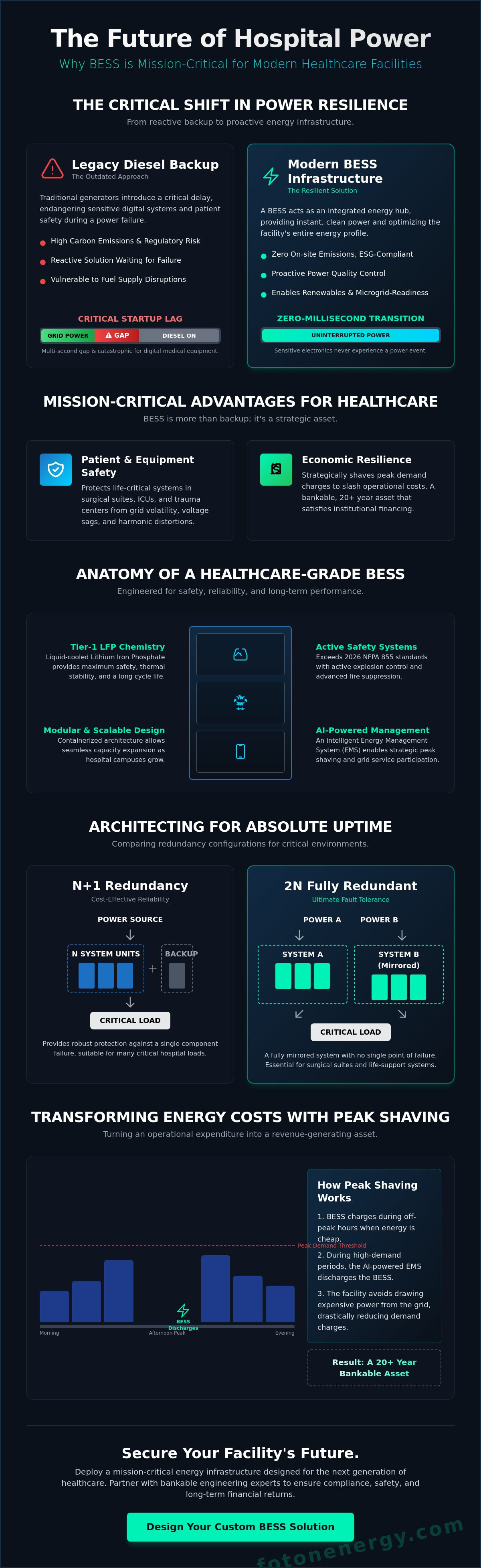
Traditional diesel generators, while reliable for long term outages, possess a critical flaw: the start up lag. Even the fastest automated transfer switches usually leave a multi second gap that can be catastrophic for sensitive digital systems. Strategic BESS design for critical healthcare facilities eliminates this vulnerability. It acts as the primary bridge, providing a seamless, zero millisecond transition that ensures sensitive electronics never "see" a power event. This reliability is essential as hospitals face increasing pressure to move away from carbon heavy backup solutions to meet new environmental mandates.
To better understand the engineering scale of these infrastructure projects, watch this overview of a high capacity energy storage installation:
From Backup to Energy Resilience
Passive backup is a reactive strategy that waits for a failure to occur. In contrast, active resilience utilizes BESS to continuously optimize power quality. Healthcare environments are particularly susceptible to voltage sags and harmonic distortions. These invisible power quality issues can degrade ICU equipment over time. By implementing a BESS, facility managers can stabilize these fluctuations in real time. This architecture also serves as the foundational link for integrating onsite renewables. It allows hospital grade solar arrays to contribute to the facility's power mix without compromising the stability of the local microgrid.
Economic Drivers in the 2026 Energy Market
Financial sustainability is now inseparable from clinical excellence. High performance commercial and industrial BESS solutions are becoming standard because they effectively mitigate rising peak demand charges. For hospital boards, the bankability of an energy asset is paramount. This means investing in systems with proven manufacturing heritage and long term warranties that satisfy rigorous institutional financing requirements. As ESG mandates tighten, BESS design for critical healthcare facilities has become a requirement for securing future capital and maintaining operational compliance in an evolving regulatory climate.
Core Components of BESS Design for Critical Healthcare Infrastructure
Engineering a resilient power ecosystem begins with selecting Tier-1 hardware capable of withstanding the rigorous demands of a 24/7 medical environment. A successful BESS design for critical healthcare facilities relies on modular, containerized architectures that allow for seamless scalability as hospital campuses expand. These systems aren't merely static boxes. They are dynamic units equipped with sophisticated thermal management systems specifically engineered for high-density indoor deployments where space is at a premium and safety is non-negotiable. If you're looking to optimize your facility's energy profile, you can explore customized C&I BESS configurations tailored to your specific clinical needs.
Modular designs ensure that a single component failure doesn't compromise the entire system. In a hospital, where every watt counts, this redundancy is paramount. High-density thermal management, often utilizing liquid cooling, ensures that battery cells operate within their optimal temperature window, even during rapid discharge events required by heavy medical machinery. This precision engineering reduces the risk of thermal runaway and extends the operational life of the asset. When evaluating local infrastructure, understanding community readiness for BESS is a vital step in ensuring your project aligns with broader utility and safety standards.
Chemistry Selection: LFP and Sodium-Ion for Safety
Lithium Iron Phosphate (LFP) remains the industry standard due to its impressive cycle life and thermal stability. However, for facilities prioritizing absolute fire safety in confined spaces like hospital basements, the emerging sodium-ion battery for data centers and healthcare offers a compelling alternative. Sodium-ion chemistry's inherently non-flammable characteristics make it ideal for sub-surface installations where traditional fire suppression access might be limited.
The Intelligent Layer: AI-Driven EMS
The intelligent layer of the system is where true resilience is forged. AI-driven Energy Management Systems (EMS) provide the predictive foresight necessary to maintain mission-critical operations. By managing the state-of-charge (SoC) in real-time, these systems prevent accelerated battery degradation and identify potential cell failures before they can impact hospital workflows. This software layer integrates directly with existing Hospital Building Management Systems (BMS) for holistic energy control.
Navigating Redundancy: Comparing BESS, UPS, and Hybrid Architectures
The boundary between emergency backup and grid management has blurred. In the past, hospitals maintained separate systems for short term power conditioning and long term emergency generation. Today, sophisticated BESS design for critical healthcare facilities integrates these functions into a single, high performance asset. Modern BESS units don't just wait for a blackout. They actively manage power quality, perform frequency regulation, and provide the instantaneous response traditionally reserved for Uninterruptible Power Supplies (UPS). This multi functional capability transforms what was once a cost center into a strategic energy tool.
Achieving mission critical reliability requires rigorous redundancy configurations. For surgical suites and trauma centers, engineers typically deploy N+1 or 2N architectures. An N+1 system ensures that if one module fails, the remaining units can carry the full critical load. A 2N configuration goes further, providing two completely independent power paths from the battery to the medical equipment. This level of security is vital when navigating BESS fire safety and public health regulations, as it ensures that maintenance or localized incidents don't compromise patient care.
The Death of the Traditional UPS?
Hospitals are rapidly pivoting away from legacy lead acid UPS systems. These older units are notoriously heavy, require significant climate controlled floor space, and offer no utility besides passive backup. By adopting proven data center ups battery replacement strategies, healthcare facilities can transition to LFP or Sodium ion chemistries. These modern alternatives offer a significant reduction in physical footprint and higher thermal thresholds. Crucially, BESS provides revenue generating potential through demand response programs that a traditional UPS simply cannot match.
Redundancy Engineering for Zero Downtime
Zero downtime is the only acceptable metric in a Tier IV healthcare environment. Decentralized storage modules are critical here. By distributing energy across multiple independent containers, you eliminate the single point of failure inherent in centralized systems. This architecture has been proven effective in real world scenarios where modular BESS maintained ICU operations during a four hour regional grid collapse, transitioning seamlessly without a single equipment reset. For extended outages, hybrid systems combine the immediate response of BESS with the long duration capacity of existing diesel generators, creating a comprehensive safety net that meets 2026 resilience standards.
Strategic Design Principles for Mission-Critical Energy Resilience
Engineering a resilient power network requires a methodical framework that prioritizes clinical uptime and commercial stability. Successful BESS design for critical healthcare facilities begins with a high-resolution load profile analysis. You must distinguish between life-critical circuits, such as ventilators and neonatal monitors, and essential but non-critical systems like administrative HVAC. This granularity allows for precise sizing that avoids over-capitalization while ensuring absolute protection for high-stakes zones. Once loads are defined, you must establish autonomy requirements. While a four-hour backup is standard for peak shaving, facilities in regions with high weather risks may require 24-hour autonomy to bridge the gap during extended grid collapses.
The technical architecture must also support seamless microgrid islanding. This capability allows the hospital to disconnect from a failing grid and operate as an autonomous energy island without a single millisecond of interruption. To achieve this, grid-code compliance is non-negotiable. Your system must meet stringent local utility requirements for interconnection while maintaining the frequency and voltage references necessary for sensitive medical electronics. Finally, design for bankability. Selecting Tier-1 components with DNV-verified performance ensures that your investment is protected by a 20-plus-year heritage of manufacturing excellence. Partner with experts who understand these engineering complexities by consulting on your next BESS project.
Safety Architecture and Fire Suppression
Safety is the foundational pillar of any healthcare installation. Choosing between aerosol and gas-based fire suppression depends on the specific room volume and proximity to clinical areas. While aerosol systems are highly effective for localized containment, gas-based solutions like Novec 1230 are often preferred for their ability to protect sensitive electronics without leaving residue. Cell-level thermal monitoring is essential to detect early signs of thermal runaway before they escalate. "NFPA 855 represents the definitive global benchmark for healthcare BESS safety, providing the rigorous fire protection standards necessary to safeguard both patients and infrastructure."
Sizing and Scalability for Future Growth
Modern medical technology is evolving rapidly, often increasing the power density of hospital departments. To prevent obsolescence, utilize a "LEGO" approach with modular, containerized units. This architecture allows you to size the BESS for current loads while leaving the physical and electrical footprint for easy capacity expansion as 2026-era medical imaging and AI-driven diagnostics are integrated. Balancing power (kW) for instantaneous surges with energy (kWh) for long-duration backup ensures your facility can handle both peak shaving and emergency resilience simultaneously.
Foton’s Engineering Approach: Deploying Bankable Healthcare Storage
Deploying mission-critical infrastructure requires more than just high-performance hardware; it demands a partner with the strategic depth to navigate complex regulatory and technical landscapes. Foton Energy (Foton Pty Ltd) brings a unique synergy to the global healthcare sector, combining cutting-edge battery technology with expert engineering consulting to ensure that every BESS design for critical healthcare facilities meets the most stringent international standards. Our technical teams provide the steady, guiding hand needed to ensure full grid-code compliance for large-scale hospital projects, bridging the gap between innovative energy storage and existing utility frameworks.
Success in this sector is built on a foundation of visionary pragmatism. We don't just sell equipment; we deliver a bankable energy asset backed by a 30-plus-year heritage of manufacturing excellence. This long-term stability is essential for hospital boards and stakeholders who require absolute assurance that their energy infrastructure will perform reliably for decades. By focusing on rigorous testing and international certifications, Foton Energy (Foton Pty Ltd) ensures that your transition to advanced energy storage is both technologically advanced and commercially stable.
Global Reach, Local Engineering Expertise
We understand that while our vision is global, execution must be local. Foton Energy (Foton Pty Ltd) operates a robust channel partner program that empowers local EPCs and installers with the technical resources and end-to-end support required for complex healthcare deployments. From the initial feasibility study to final commissioning, we provide a seamless integration process that minimizes operational disruption. Our global engineering network spans over 70 countries, allowing us to offer deep insights into diverse regulatory environments. This ensures that your facility's energy strategy remains compliant and high-performing regardless of local jurisdictional demands.
The Tier-1 Reliability Standard
For healthcare financiers and insurers, Tier-1 status is a non-negotiable requirement for risk mitigation. This designation is a testament to operational excellence and a proven track record in the global energy market. Foton Energy (Foton Pty Ltd) integrates proprietary safety architectures into all high-performance hardware, creating a specialized layer of protection tailored for the unique sensitivities of hospital environments. This elite level of engineering inspires trust in large-scale infrastructure investments, ensuring your facility is powered by a foundational pillar of the industrial ecosystem. It's time to secure your facility's future. Partner with Foton Energy (Foton Pty Ltd) for your next healthcare BESS deployment to transform your power resilience today.
Ready to move beyond traditional backup? Engage Foton Energy (Foton Pty Ltd) today for a comprehensive BESS project feasibility study. Our team will analyze your load profiles, local grid conditions, and long-term growth objectives to deliver a tailored, bankable solution that guarantees mission-critical resilience for your patients and your staff.
Securing the Future of Healthcare Infrastructure
The transition toward intelligent energy storage is no longer just a technical upgrade; it's a foundational shift in how medical facilities protect patient outcomes. By mastering BESS design for critical healthcare facilities, you move beyond the limitations of aging generators and passive backup systems. You've seen how integrating Tier-1 hardware with AI-driven energy management creates a resilient microgrid capable of stabilizing sensitive equipment while slashing peak demand costs. Adhering to rigorous safety standards like NFPA 855 ensures your infrastructure remains a secure, bankable asset for decades to come.
Foton Energy (Foton Pty Ltd) stands as your trusted partner in this journey. As a Tier-1 provider of mission-critical storage, we offer DNV-verified safety architecture and comprehensive engineering support across 70 plus countries. Our team is ready to help you navigate the complexities of grid-code compliance and mission-critical redundancy. Request a Technical Consultation for Your Healthcare BESS Project today to build a future-ready energy ecosystem. Let's work together to empower your facility with the stability and performance it deserves.
Frequently Asked Questions
How does BESS differ from a traditional hospital UPS?
A BESS provides both instantaneous power conditioning and long-duration energy storage, whereas a traditional UPS is typically limited to five or fifteen minutes of backup. While a UPS bridges the gap until a generator starts, a BESS can sustain critical loads for several hours. It also functions as an active energy asset that performs peak shaving to reduce utility costs, a capability that legacy UPS systems don't possess.
Can BESS completely replace diesel generators in critical healthcare settings?
BESS can replace diesel generators for most short to mid-duration outages, though a hybrid approach remains the standard for multi-day resilience. A BESS design for critical healthcare facilities usually targets a four to twenty-four hour autonomy window. This duration covers the vast majority of grid instability events. For catastrophic, week-long outages, the BESS works in tandem with onsite renewables or smaller diesel reserves to maintain long-term operations.
What are the fire safety requirements for installing large batteries in hospitals?
Fire safety for healthcare installations is governed by the 2026 edition of NFPA 855, which mandates active explosion control and flammable gas monitoring. Systems must be UL 9540 certified and provide UL 9540A test data to determine safe separation distances from patient care areas. These rigorous protocols ensure that any thermal event is contained and neutralized automatically, protecting both the facility's clinical infrastructure and its occupants.
How long can a BESS realistically power a critical care unit?
Realistic power duration depends on the total kWh capacity and the specific load density of the unit. Most mission-critical designs provide between four and twenty-four hours of full-load autonomy for a critical care environment. By utilizing an intelligent EMS to isolate non-essential circuits during an outage, facility managers can prioritize life-support systems. This strategy allows the BESS to sustain vital medical equipment for extended periods during grid failures.
Is Sodium-ion or LFP better for hospital energy storage?
Lithium Iron Phosphate (LFP) is the current industry standard due to its high energy density and established performance history. However, Sodium-ion is an emerging choice for indoor hospital applications because of its superior safety profile and non-flammable characteristics. If your project requires storage in a basement or near patient wards, the safety benefits of Sodium-ion may be preferable. Both chemistries offer significant advantages over legacy lead-acid systems.
What is the typical ROI for a healthcare BESS system through peak shaving?
The ROI for healthcare energy storage typically ranges from five to eight years, depending on local utility tariffs and peak demand charges. By discharging stored energy during high-cost periods, hospitals can significantly slash their monthly operational expenses. This financial return is often enhanced through revenue stacking. This involves participating in demand response programs and frequency regulation, which provides additional payments from the utility provider.
Does a BESS require significant maintenance compared to lead-acid batteries?
BESS requires far less physical maintenance than traditional lead-acid batteries because there's no need for water topping or manual terminal cleaning. The system relies on an intelligent Energy Management System (EMS) to monitor cell health and balance state-of-charge automatically. This digital-first approach reduces on-site labor requirements and provides predictive alerts. These alerts identify potential issues long before they can impact the reliability of the hospital's power supply.
How does BESS improve the bankability of a healthcare infrastructure project?
A sophisticated BESS design for critical healthcare facilities improves bankability by utilizing Tier-1 components with 20-plus-year life cycles. Financial institutions and insurers view these systems as stable, long-term assets rather than depreciating expenses. When a project features DNV-verified safety architectures and a clear path to operational savings, it attracts lower-cost capital. This makes large-scale infrastructure upgrades more financially feasible for hospital boards and private investors alike.


