

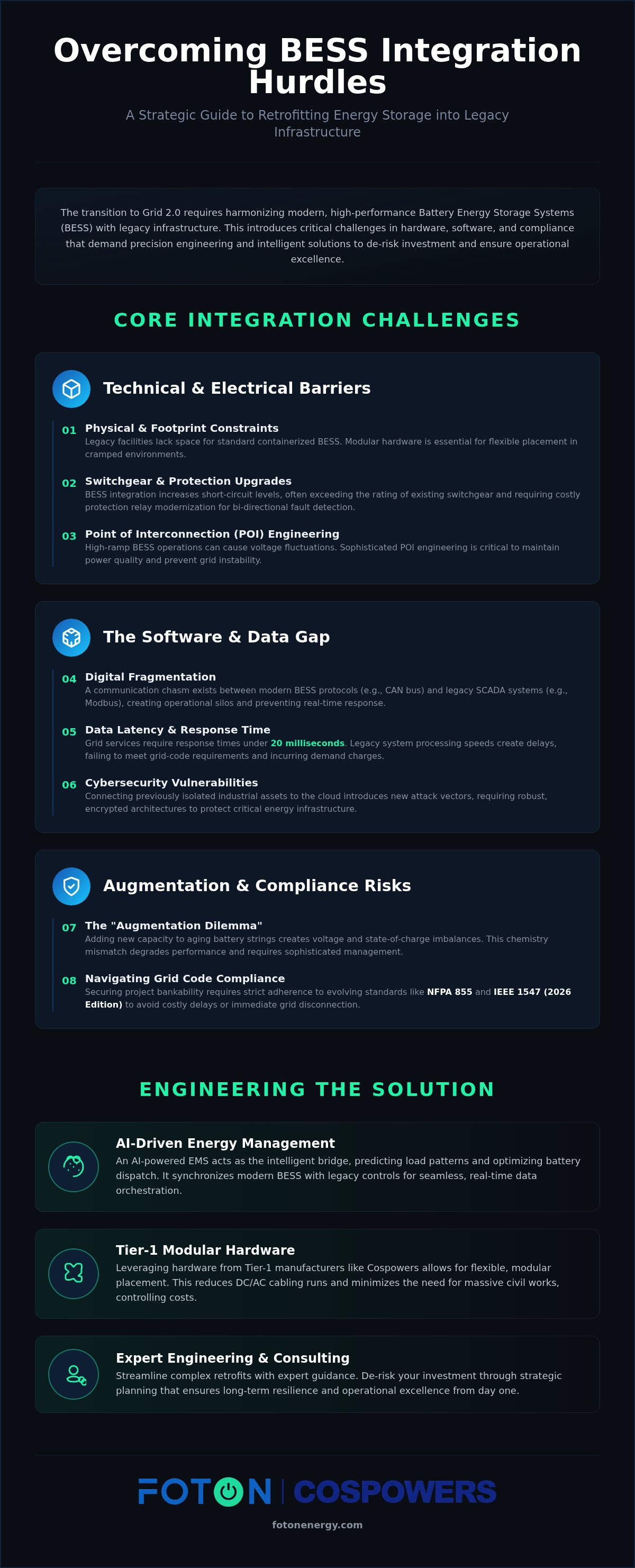
The successful transition to a Grid 2.0 architecture is not merely a hardware race; it's a complex orchestration of intelligent software and precision engineering. For utility and C&I leaders, the primary challenges of integrating BESS with existing infrastructure often emerge from the friction between legacy electrical components and modern, high-performance storage. While the promise of 20-millisecond response times and value stacking is compelling, the reality of retrofitting often involves unforeseen switchgear costs and the technical debt of outdated energy management systems.
We understand that maintaining project bankability while ensuring compliance with the 2026 edition of NFPA 855 and IEEE 1547 is a daunting task. You shouldn't have to risk project delays due to grid-code failures or EMS incompatibility. This strategic guide offers a clear roadmap for retrofitting, leveraging Tier-1 manufacturing heritage and expert engineering insights to de-risk your investment. We'll explore how to optimize existing assets using AI-driven software and navigate the nuances of battery augmentation to ensure long-term resilience and operational excellence.
Key Takeaways
- Identify the critical physical and electrical barriers, such as switchgear upgrades and footprint constraints, that define the challenges of integrating BESS with existing infrastructure.
- Bridge the communication gap between modern BESS protocols and legacy SCADA systems using AI-driven Energy Management Systems for seamless data orchestration.
- Resolve the "Augmentation Dilemma" by learning how to manage voltage and state-of-charge imbalances when adding new storage capacity to aging battery strings.
- Secure project bankability by navigating 2026 compliance standards, including NFPA 855 and IEEE 1547, to avoid the risk of immediate grid disconnection.
- Leverage modular hardware from Tier-1 manufacturer Cospowers and expert engineering consulting to streamline complex retrofits and ensure long-term operational excellence.
Technical and Electrical Barriers to BESS Interconnection
Successful BESS integration requires more than a simple hardware installation; it's the precise harmonization of energy storage with existing load profiles and grid connections. One of the primary challenges of integrating BESS with existing infrastructure is the physical reality of legacy industrial facilities. These sites were rarely designed with the footprint of a multi-megawatt battery system in mind. Navigating space constraints often requires a departure from standard containerized solutions. We address these limitations through the modularity of Cospowers hardware, which allows for flexible placement in cramped environments where traditional 20-foot or 40-foot enclosures simply won't fit.
The electrical impact of adding a BESS is equally profound. Integrating an inverter-based resource significantly alters the short-circuit levels of the existing network. This change forces a complete re-evaluation of protection coordination. If the existing switchgear isn't rated for the increased fault current, the system faces catastrophic failure risks during an electrical event. Ensuring that breakers and protection relays can still clear faults safely is a non-negotiable step in maintaining operational integrity.
Assessing Transformer and Switchgear Capacity
Thermal limits are the silent killers of poorly planned retrofits. Most legacy transformers were sized for one-way consumption, not the continuous, high-intensity discharge cycles required by modern BESS applications. Running a battery at peak power for four hours can push aging transformers beyond their cooling capacity, leading to accelerated insulation degradation. We've seen that the "hidden" costs of integration often lie in mandatory protection relay upgrades. These components must be modernized to detect bi-directional faults, a feature absent in many older installations. To mitigate these costs, we prioritize strategic modular placement, which reduces the length of expensive DC and AC cabling runs and minimizes the need for massive civil works.
Point of Interconnection (POI) Engineering
Designing for bi-directional power flow is a fundamental shift for systems originally built for simple consumption. During high-ramp operations, such as frequency response or peak shaving, the BESS can cause significant voltage fluctuations at the POI. Without sophisticated voltage regulation and reactive power support, these swings can trigger "nuisance tripping" or damage sensitive downstream equipment. Implementing advanced power quality solutions from Energy Control Systems can safeguard these critical components from transient surges and electrical noise. POI engineering is the critical link between storage and the broader distribution network. It ensures that the transition between charging and discharging occurs without violating the strict power-quality standards set by the utility, preserving both grid stability and project bankability.
Digital fragmentation remains one of the most persistent challenges of integrating BESS with existing infrastructure. While modern storage hardware is built on high-speed digital foundations, many industrial sites operate on legacy SCADA systems that utilize aging communication protocols. A project can stall indefinitely when a modern battery's CAN bus interface attempts to "talk" to a proprietary 1990s-era controller or a standard Modbus network without a sophisticated translator. This misalignment isn't just a technical nuisance; it creates operational silos that prevent the BESS from responding to grid signals in real-time.
Data latency is the invisible enemy of grid stability. In 2026, grid-tied systems must often respond to frequency deviations in less than 20 milliseconds. If the software handshake between the storage unit and the facility's main breaker is delayed by legacy processing speeds, the BESS cannot perform peak-shaving with the accuracy required to avoid high demand charges. Beyond these delays, connecting these previously isolated industrial assets to the cloud introduces cybersecurity vulnerabilities that require robust, encrypted architectures to protect critical energy infrastructure.
AI-Driven Orchestration of Disparate Assets
An AI driven energy management system acts as the intelligent bridge between old and new. By utilizing machine learning, these systems predict facility load patterns with high precision, optimizing battery dispatch to ensure storage is available exactly when demand peaks. This AI orchestration is particularly vital for managing "behind the meter" demand charges alongside existing solar arrays, ensuring every kilowatt is utilized for maximum ROI. Beyond simple dispatch, AI enables predictive maintenance in legacy environments, identifying thermal or electrical anomalies in aging hardware before they lead to system-wide failures.
Protocol Conversion and Data Harmonization
Standardizing data across a facility is essential for unified asset management. We implement high-speed gateway solutions that act as universal translators, converting disparate legacy signals into a harmonized data set for the central EMS. This ensures the BESS, backup generators, and industrial loads operate as a single, resilient ecosystem. Seamless failover protocols are a critical component of this design; if the primary grid connection fails, the EMS must instantaneously synchronize the BESS with onsite generation to maintain power quality. For facilities struggling with these digital hurdles, our engineering consulting services provide the technical roadmap needed to unify fragmented controls.
Chemistry Mismatch and Augmentation Challenges
Battery degradation is an inescapable reality of long-term asset management. One of the most complex challenges of integrating BESS with existing infrastructure involves the physical and chemical evolution of the storage medium itself. The "Augmentation Dilemma" arises when operators attempt to integrate fresh battery racks into a string that has already completed several thousand cycles. Because Lithium Iron Phosphate (LFP) cells typically offer up to 8,000 cycles, a system installed five years ago will possess significantly different internal resistance and voltage profiles than a new 2026-spec module. This mismatch leads to chronic state-of-charge (SoC) imbalances, where the newer cells are underutilized while the degraded legacy cells are pushed beyond their safe thermal limits.
Managing these hybrid arrays requires sophisticated power electronics that can isolate different battery generations. Without independent string inverters or DC/DC converters, the entire system often reverts to the performance level of its weakest, most degraded link. This results in a loss of rated capacity and a decline in the round-trip efficiency that was originally promised to investors. We solve these imbalances through rigorous engineering consulting, ensuring that augmentation strategies preserve project bankability over a 15 to 20-year lifecycle.
Integrating Sodium-Ion with LFP Infrastructure
By 2026, the landscape has shifted with the rise of sodium-ion battery commercial availability as a viable alternative for specific industrial applications. Integrating sodium-ion modules into an existing LFP-based infrastructure presents unique hurdles because their discharge curves don't align. Sodium-ion performs exceptionally well in sub-zero temperatures, whereas LFP requires intensive heating in cold climates. Mixing these chemistries in a single containerized solution necessitates independent DC/DC converters to prevent circulating currents. When managed correctly, this hybrid approach allows for a more resilient system that maintains high performance across diverse environmental conditions without the high cost of oversizing a single chemistry.
Thermal Management and Cooling Architecture
Retrofitting liquid-cooling units into facilities originally designed for passive or air-cooled ventilation creates significant engineering friction. Modern high-density LFP modules generate a concentrated heat signature that legacy HVAC systems simply can't dissipate. If the cooling architecture isn't upgraded alongside the battery cells, the risk of thermal runaway increases, potentially violating the strict 2026 NFPA 855 safety standards. Utility scale battery cooling systems must adapt to multi-chemistry heat loads by utilizing independent thermal loops that prevent localized hotspots in hybrid arrays. This precision ensures that both legacy and augmented assets operate within their ideal temperature windows, maximizing the lifespan of the entire investment.
Navigating Grid-Code Compliance and Bankability Risks
Compliance is not a final project checkbox; it's the foundation of operational permission. One of the most significant challenges of integrating BESS with existing infrastructure in 2026 is the rapid evolution of grid codes. Utilities and Distribution Network Service Providers (DNSPs) now enforce immediate disconnection protocols for systems that fail to meet stringent frequency response or voltage ride-through mandates. In the Australian market, adherence to updated local standards is mandatory for any asset seeking to participate in lucrative ancillary service markets. If your integration design doesn't account for these shifting requirements from day one, you risk owning a stranded asset that the grid simply won't accept.
The financial implications of these regulatory hurdles are profound. Integration complexity directly correlates with insurance premiums and project financing terms. Lenders view retrofits with high skepticism unless the technical architecture is backed by rigorous proof points. Achieving a bankable status requires a transparent roadmap that addresses every potential point of failure, from protection coordination to software failovers. By prioritizing Tier-1 manufacturing heritage and international safety certifications, developers can secure the confidence of institutional investors and reduce the cost of capital for large-scale storage deployments.
Achieving Grid-Scale Bankability
Financiers prioritize certainty. They look for DNV verification and ironclad long-term performance guarantees that protect against battery degradation and operational downtime. Successful utility scale BESS procurement involves selecting Tier-1 manufacturers like Cospowers, whose hardware is already certified under UL 9540 and international safety benchmarks. We believe that comprehensive project feasibility studies are the most effective risk mitigation tool available. These studies ensure that every electrical and regulatory variable is quantified before the first container arrives on site.
Automated Compliance Monitoring
Real-time adherence is the new standard. Modern Energy Management Systems (EMS) now feature automated compliance modules that ensure the BESS stays within the tight bounds of frequency and voltage regulation mandates. These systems don't just manage power; they generate detailed compliance reports for DNSPs, proving that the asset is a stabilizer rather than a liability. This automated oversight future-proofs your facility against evolving environmental and safety regulations, such as the 2026 updates to NFPA 855. To ensure your project meets these elite standards, partner with Foton Energy for expert engineering consulting.
Foton Energy: Engineering the Future of BESS Integration
Foton Energy stands at the intersection of manufacturing heritage and digital innovation. As the exclusive global partner of Tier-1 manufacturer Cospowers, we deliver hardware engineered specifically to overcome the physical and electrical challenges of integrating BESS with existing infrastructure. Since 1993, Cospowers has refined a manufacturing legacy that ensures every module meets the highest international safety and performance standards. Our collaborative approach transforms complex retrofits from high-risk gambles into stable, bankable assets through a combination of modular hardware and AI-driven intelligence.
We provide more than just hardware. Our BESS engineering consulting services guide partners through every phase of the integration lifecycle. From initial feasibility studies to final grid-code certification, we manage the technical hurdles that often stall industrial projects. This includes a proprietary safety architecture designed to protect legacy assets from thermal runaway, ensuring that new storage capacity doesn't compromise the integrity of your existing facility. Whether you're managing a utility-scale site or a critical data center, our solutions scale to meet your specific thermal and electrical requirements.
Case Study: Retrofitting for Resilience
In a recent industrial application, a client faced significant space constraints and outdated switchgear that lacked the capacity for high-ramp storage cycles. We deployed a modular Cospowers LFP system, utilizing our Intelligent EMS to synchronize the battery with the site's legacy SCADA controls. By bridging this software gap, the facility achieved immediate results. The client realized a substantial ROI through automated peak shaving and a significant reduction in monthly demand charges, all while maintaining full compliance with local utility mandates. This project proves that legacy infrastructure isn't a barrier to modernization when backed by the right engineering partner.
Partnering for Global Deployment
Our reach is truly global. Through Foton's channel partner programme, EPCs and energy developers in 70+ countries gain access to Tier-1 LFP and sodium-ion inventory. This scale allows us to support utility, C&I, and data center applications regardless of geographic or technical complexity. We offer the stability and technical expertise needed to secure your energy future in an evolving market. Our commitment to reliability ensures that your investment remains high-performing for decades. Contact Foton Energy for a Project Feasibility Study to begin your transition to a resilient, optimized infrastructure.
Orchestrating a Resilient Energy Future
Navigating the modern energy landscape requires a shift from simple hardware procurement to comprehensive system orchestration. We've explored how successful retrofits depend on bridging the software gap between legacy SCADA and modern AI-driven EMS, while managing the physical and chemical nuances of battery augmentation. The challenges of integrating BESS with existing infrastructure demand a partner who combines deep manufacturing heritage with forward-looking engineering expertise. By prioritizing Tier-1 standards and rigorous grid-code compliance, you don't just add storage; you build a bankable asset capable of delivering long-term value in a volatile market.
Foton Energy stands as your exclusive global strategic distributor for Cospowers, offering a Tier-1 manufacturing partnership rooted in decades of experience. Our commitment to AI-driven energy management excellence ensures that your legacy systems are optimized for the demands of 2026 and beyond. It's time to transform your infrastructure into a high-performance energy hub. Partner with Foton Energy for Strategic BESS Engineering and take the first step toward a more secure and profitable operation. We're ready to help you lead the transition.
Frequently Asked Questions
What are the most common electrical challenges when adding BESS to an existing factory?
The primary electrical challenges of integrating BESS with existing infrastructure include managing increased short-circuit levels and evaluating transformer thermal capacity. Legacy switchgear often isn't rated for the bi-directional fault currents introduced by modern inverters. You'll likely need protection relay upgrades to ensure the system clears faults safely without damaging sensitive facility loads. We solve these bottlenecks through engineering consulting, identifying exactly where your current protection coordination needs modernization to support high-intensity storage cycles.
Can I mix different battery chemistries like LFP and Sodium-ion in the same system?
You can integrate both chemistries, but they require independent power electronics to manage their distinct discharge curves. Sodium-ion performs well in cold climates, while LFP offers high energy density for standard operations. Because these chemistries have different voltage profiles, they shouldn't be wired in parallel on the same DC bus. Our AI-driven EMS orchestrates these disparate assets, ensuring each chemistry operates within its ideal thermal and electrical window to maximize overall system resilience.
How much does it cost to upgrade existing switchgear for BESS integration?
Upgrade costs vary significantly based on the existing equipment's age, fault current rating, and the complexity of the required protection coordination. A simple relay replacement is less intensive than a full switchgear lineup overhaul; learn more about sourcing reliable medium-voltage components for these critical upgrades. Factors like labor, regional compliance standards, and the physical footprint of the new components also influence the final investment. We recommend a project feasibility study to identify these specific infrastructure requirements early, preventing unforeseen expenses during the commissioning phase.
The choice depends on your long-term energy strategy and initial capital availability. Oversizing provides immediate capacity but carries higher upfront costs and potential underutilization. Augmentation, the process of adding racks later in the lifecycle, preserves capital but introduces technical challenges like voltage mismatch between old and new cells. We help partners navigate this "Augmentation Dilemma" by designing modular systems from Tier-1 manufacturer Cospowers that are ready for seamless future expansion without compromising current bankability.
What software is needed to control a BESS alongside a legacy energy system?
You need an AI-driven Energy Management System (EMS) capable of high-speed protocol translation. This software acts as a universal bridge, allowing modern storage hardware to communicate with legacy SCADA systems using Modbus, CAN bus, or proprietary signals. Beyond simple communication, the EMS must provide real-time optimization for peak shaving and demand response. Our Intelligent EMS ensures that your BESS and legacy assets operate as a unified, high-performance ecosystem, maximizing ROI through predictive load forecasting.
How do grid-code changes in 2026 affect my existing energy storage project?
The 2026 updates to standards like IEEE 1547 and NFPA 855 introduce stricter requirements for frequency regulation and thermal safety testing. Existing projects may need software updates or hardware retrofits to remain compliant with new utility disconnection protocols. Failure to meet these evolving mandates can lead to immediate grid disconnection or increased insurance premiums. We prioritize future-readiness by utilizing hardware and software that exceed international safety benchmarks, ensuring your asset remains compliant as regulations shift.
What is 'bankability' and why does it matter for BESS integration?
Bankability refers to the project's ability to secure favorable financing terms based on its technical and commercial reliability. Financiers look for proof points like DNV verification, long-term performance guarantees, and the use of Tier-1 manufactured components. For complex retrofits, bankability is a primary challenge of integrating BESS with existing infrastructure. Using proven hardware from partners like Cospowers ensures that your project meets the rigorous due diligence requirements of institutional investors, reducing your overall cost of capital.
Can an AI-driven EMS really improve the ROI of a legacy energy asset?
An AI-driven EMS significantly enhances ROI by optimizing asset dispatch based on predictive load patterns. By executing trades across multiple energy markets and accurately performing peak shaving, the software reduces demand charges that legacy systems often miss. It also extends hardware life through predictive maintenance, identifying electrical anomalies before they cause downtime. This level of intelligence transforms a passive storage unit into a proactive revenue generator, extracting maximum value from both new and existing infrastructure.


