

More batteries don’t automatically make a grid more stable. Improving grid stability with distributed storage depends on placing systems where the network needs support and controlling them to meet specific operating needs. As wind and solar output shifts, grid operators must balance supply and demand while managing local constraints. A battery in the wrong location or operating to the wrong objective may not address either challenge.
Storage can provide services such as frequency regulation, voltage support and congestion relief, but its value depends on grid conditions, system design and controls. Assess batteries alongside network upgrades, demand-side flexibility and other interventions rather than treating them as a universal fix.
This guide explains how distributed storage can support grid stability, where its capabilities are most relevant and how it compares with complementary measures. It also covers the technical and operational questions that shape a viable deployment, including siting, control strategy and grid integration. For decision-makers assessing a battery energy storage system, the goal is a practical framework for matching the technology to local needs, with energy management and engineering considered as part of the wider solution.
Key Takeaways
- Understand how distributed storage at local network points can help manage voltage and frequency conditions.
- See why battery charge and discharge controls can support renewable integration, and why voltage support and frequency response are distinct services.
- Compare distributed storage with network reinforcement, demand response and centralized resources by location, response and integration needs.
- Use a four-step assessment to define the grid constraint, select services, evaluate connection and controls, and measure outcomes.
- Learn why improving grid stability with distributed storage depends on aligning location, operating objectives, energy management and engineering integration.
Why Improving Grid Stability with Distributed Storage Starts at the Local Network
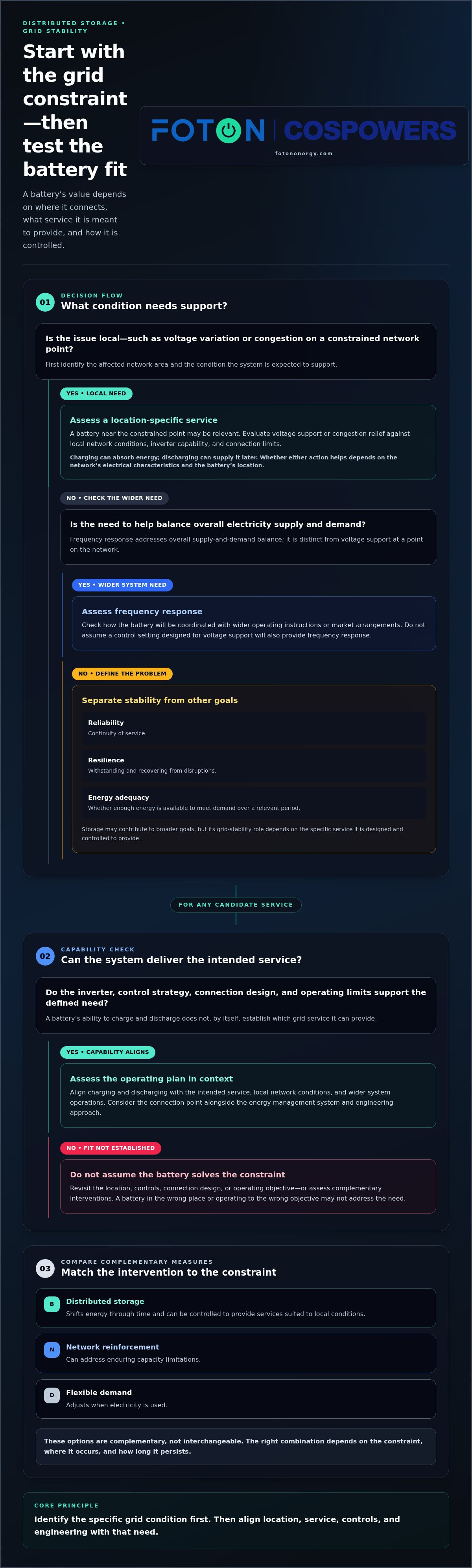
Grid stability is experienced locally. A feeder serving a group of businesses may face a different constraint from the transmission network or a distant generation site. Distributed storage means energy storage connected at multiple points across the electricity network, rather than only alongside central generation. Placing storage near a source of generation, a major load or a constrained network point can make it a controllable resource where it may be useful.
In practical terms, stability means keeping grid operation within acceptable voltage and frequency conditions as supply and demand change. It differs from reliability, which concerns continuity of service, and resilience, which concerns withstanding and recovering from disruptions. Energy adequacy is different again: it asks whether enough energy is available to meet demand over a relevant period. Storage may contribute to each broader goal, but its grid-stability role depends on the specific service it is designed and controlled to provide. For wider context, see Distributed Generation and Grid Stability.
Definition: Distributed storage is energy storage connected at network locations where it can be controlled to provide grid services suited to local conditions.
Which grid pressures can distributed storage help address?
Renewable generation can vary with weather and time of day, while demand changes across hours and locations. On a constrained network, these shifts may contribute to congestion or local voltage challenges. A battery can absorb energy when it is available or when network conditions make charging useful, then discharge later. This flexibility can help align energy flows with local needs, but it won’t resolve every constraint. First identify the cause of the problem and whether storage can address it.
Location matters. A system connected near a constrained feeder may be more relevant to a local network need than one elsewhere, while a project intended to support wider system operation may be assessed differently. Controls matter too: charging and discharging schedules must align with the intended service and network conditions. Improving grid stability with distributed storage therefore begins with identifying the specific constraint, not simply selecting a battery.
Distributed storage is a grid resource, not a standalone fix
Storage works alongside generation, network assets and flexible demand. It can shift energy through time, while network reinforcement can address enduring capacity limitations and flexible demand can adjust when electricity is used. The right combination depends on the constraint, where it occurs and how long it persists. These options are complementary, not interchangeable.
Some services are local, such as responding to a voltage issue at a particular part of the network. Others can be coordinated across a wider system, where operating instructions or market arrangements determine when a resource responds. A grid-aware project accounts for both the connection point and how its controls interact with wider operations.
- Local need: Identify the affected network area and the condition storage is expected to support.
- Wider system need: Define how the battery will be coordinated with other resources and operating requirements.
- Integrated design: Align the battery, energy management system and engineering approach with the project objective.
For commercial and industrial projects, this network-led approach connects grid objectives with site requirements. Foton Energy’s commercial and industrial BESS strategic guide explores how project feasibility, system design and energy management fit into a bankable storage strategy.
How Distributed Battery Storage Supports Voltage, Frequency, and Renewable Integration
A battery can change how it exchanges power with the grid: it charges to absorb energy and discharges to supply it later. That flexibility alone doesn’t define the service it can provide. The inverter, control strategy, connection design and operating limits determine whether a system can respond to a particular network need. Improving grid stability with distributed storage means matching a battery’s capabilities to a defined service, rather than assuming every system can provide every form of support.
Voltage and frequency are related aspects of grid operation, but they respond to different conditions. Voltage support concerns electrical conditions at a point on the network. Frequency response helps balance overall supply and demand. The distinction matters: a control setting designed for one objective shouldn’t be assumed to deliver the other.
Voltage support and local network constraints
Voltage can vary across a distribution network as local generation and demand change. A suitably configured battery may help manage these conditions by adjusting when it draws power or supplies it, subject to its inverter capability and connection limits. For example, charging during a period of high local generation may absorb some energy near its source. Discharging at a different time may support local demand. Whether either action improves voltage depends on the network’s electrical characteristics and where the battery connects.
Project assessment should use network studies to identify the location and nature of the voltage issue, then evaluate how charging and discharging would affect it. Control settings and applicable grid requirements also shape the available response. Research on batteries for distribution grid stability discusses distribution challenges such as limited transmission capacity and poor voltage quality, reinforcing why local conditions matter.
Frequency response and renewable flexibility
Frequency response addresses imbalances between electricity supply and demand over relevant operating timescales. A battery may respond by charging or discharging as directed, but its response depends on system design, controls, available stored energy and grid-connection requirements. The service must be specified and coordinated. The presence of a battery alone doesn’t establish that it can provide a particular response.
Storage can also shift renewable energy availability through time. If renewable generation is strong when demand is lower, a battery may charge and later discharge when demand rises or generation falls. This helps align energy supply with demand, but it doesn’t create additional renewable generation. The energy available to discharge is limited by what was stored and by system operating constraints.
Inverter controls define how a battery responds, while its grid connection determines which responses can be delivered at that location. An energy management system helps coordinate operating objectives with site and network conditions. For a closer look at this control layer, Foton Energy’s AI-driven energy management systems guide explores how EMS supports BESS operation. Foton Energy brings storage, intelligent energy management and engineering together for grid-aware project development. Explore its energy storage and engineering capabilities.
Distributed Storage Compared with Grid Upgrades and Other Flexibility Options
No single intervention addresses every grid constraint. Distributed storage can respond flexibly at selected network locations, while reinforcement, demand response and centralized resources solve different parts of the system challenge. Compare them by the service required, where it must be delivered, how quickly it is needed and how long the need is expected to persist.
| Option | Response characteristics | Location dependence | Flexibility | Integration needs |
|---|---|---|---|---|
| Distributed storage | Can charge or discharge according to configured controls and operating limits. | Connection location is important for local services. | Can shift energy and may be assigned different operating objectives. | Requires suitable connection, controls, energy management and coordination. |
| Network reinforcement | Addresses physical network capacity or asset constraints. | Must be applied to the relevant network assets or route. | Provides infrastructure capability rather than dispatchable energy shifting. | Requires network planning, design and integration with existing assets. |
| Demand response | Changes or shifts electricity use in response to a signal or operating need. | Depends on participating loads and their network locations. | Depends on load flexibility and operational requirements. | Needs coordination with customers, control arrangements and load processes. |
| Centralized resources | Can be dispatched to support broader system needs, subject to their design and operating constraints. | Typically connected at selected larger-scale network points. | Depends on resource capability and system coordination. | Requires connection and coordination with wider grid operations. |
Decision principle: Select interventions against the constraint, the required service and the planning horizon.
When distributed storage may be a strong fit
Storage deserves closer assessment when a need is tied to a particular location and a controllable resource could respond there. For example, a site with renewable generation and demand at different times may benefit from shifting stored energy to a more useful operating period. A local network constraint may also make the connection point central to the project’s potential value.
Projects can have more than one operating objective, such as supporting a site’s energy use while responding to a network signal. Don’t assume these objectives can be met simultaneously: they may compete for available power, stored energy or operating headroom. Assess technical feasibility and commercial value against the project’s actual dispatch priorities and constraints.
When storage should complement another intervention
A battery can provide a flexible response, but it may not resolve a sustained physical capacity limitation. Where a constraint persists or reflects an enduring shortfall in network capability, reinforcement may still be needed. Demand flexibility can complement either option by shifting or reducing load, potentially changing the timing or scale of the network need.
In practice, a portfolio of measures may be more effective than selecting a single intervention: reinforcement can address a lasting infrastructure constraint, while storage and flexible demand respond to changing operating conditions. Improving grid stability with distributed storage requires assessing how these resources work together over the relevant planning horizon. For project-level considerations such as system requirements and procurement decisions, Foton Energy’s utility-scale BESS procurement guide provides related context.
How to Assess a Distributed Storage Project for Grid Stability
A credible assessment starts with the grid need, not a preferred battery size. Define the operational issue, identify where it occurs and establish what a storage system would need to do. Project studies can then determine whether the proposed system, connection and controls are suited to the task. There’s no universal capacity or duration that guarantees a stability benefit.
Use a structured sequence to connect the problem to measurable outcomes:
- Define the constraint. Pinpoint the network location, operating conditions and affected users or assets. Establish whether the issue concerns voltage, frequency, congestion or another defined need.
- Select the service. Specify the response expected from storage, including when it should operate and which project objectives take priority.
- Assess connection and controls. Evaluate connection capacity, network operating conditions, inverter and EMS controls, and applicable grid-code requirements.
- Measure outcomes. Set a baseline and compare observed performance with the project’s stated objective over defined reporting periods.
Start with the grid need and connection context
Build the baseline from relevant network conditions, demand patterns and renewable generation profiles. For example, a site with daytime renewable output and a later demand peak may need an assessment of how its proposed charging and discharging schedule interacts with local network limits. This is not a sizing rule: studies must establish the feasible operating strategy and capacity for the project’s actual conditions.
Document the intended beneficiaries and connection context before specifying equipment. Foton Energy’s BESS engineering consulting for project design addresses how feasibility, system design and grid-code considerations fit into project development.
Define controls, coordination, and performance measures
An EMS coordinates battery operation with project objectives and available system inputs. Define how it should prioritize the selected service, respond to operating signals and manage competing objectives. Include control interfaces and coordination arrangements in the design, so performance can be assessed against intended operation rather than assumed from equipment capability alone.
Choose measures that match the service. A voltage-support objective may call for tracking voltage conditions at the relevant network point. An energy-shifting objective may require comparing charge and discharge periods with demand and generation patterns. Set baselines, reporting periods and data responsibilities in advance, then review results against the project’s defined targets. Don’t rely on a single headline metric.
Planning also needs to address safety architecture, thermal management, commissioning and lifecycle support. These are integral to a dependable deployment, alongside engineering integration and operational controls. Improving grid stability with distributed storage is an evidence-led process: specify the need, design around the connection, then verify performance in operation. Explore Foton Energy’s engineering consulting for storage projects.
Integrating Distributed Storage into a More Resilient Grid
Distributed storage contributes to grid stability when four elements align: the system’s location, the service it is intended to provide, its controls and the network’s needs. The battery is one part of the solution. Its value depends on how it is integrated with renewable generation, network operations and other flexible resources, and on whether its operating role is clear.
Improving grid stability with distributed storage is therefore a project-specific exercise, not a matter of deploying the same configuration everywhere. A system intended to respond to a local network condition may need different operating priorities from one designed to shift energy at a commercial or industrial site. Define those priorities early and make sure the equipment, controls and connection design support them.
Coordinate storage with the wider energy system
Battery assets operate within a larger system. Their charging and discharging schedules may need to account for renewable generation, site demand, network operating requirements and signals from other flexibility resources. Coordination clarifies when the battery is expected to operate, which objectives take priority and how its actions fit alongside other grid measures.
Operational visibility matters too. Project teams need a practical way to understand relevant system inputs and assess whether controls are responding as intended. An energy management system can coordinate battery operation with defined objectives, while engineering integration connects the storage system to the project’s operating and network context. These design elements support an informed assessment, but don’t by themselves prove a particular grid outcome. Evaluate performance against project objectives using operating data.
Move from grid need to project discussion
A disciplined project pathway starts by identifying the constraint and its location. Next, match the intended grid services to the operating objective, assess connection and control requirements, and define how outcomes will be measured. This sequence keeps decisions about system configuration and operating strategy anchored to the need rather than assumptions about what a battery can deliver.
Foton Energy (Foton Pty Ltd) brings together LFP and sodium-ion storage systems, AI-driven energy management, safety and thermal-management architecture, and engineering consulting for commercial, industrial and utility applications. Backed by extensive manufacturing heritage, Foton Energy connects project development with advanced manufacturing capabilities. The right combination of hardware, EMS and engineering depends on the project’s requirements and integration context.
Have a grid-storage project in development? Discuss the network need, BESS options and engineering considerations with Foton Energy (Foton Pty Ltd) to shape a project-specific path from initial assessment to system design.
Turn Grid Priorities into a Practical Storage Plan
The next step is to bring grid planning and project development into the same conversation. Treat storage not as a fixed equipment choice, but as an adaptable part of the energy system whose role can be shaped around changing operational priorities. This helps decision-makers keep future options open while grounding investment choices in network needs.
For teams considering improving grid stability with distributed storage, start with a focused project discussion: what is changing on the network, which outcomes matter most, and what evidence will guide the next decision? A clear brief can align technical studies, commercial priorities and operational planning before design choices become fixed.
Foton Energy supports energy-storage deployments with BESS solutions and engineering expertise. Explore Foton’s BESS and engineering solutions to discuss how your project can progress from grid priorities to a practical development pathway.
With a well-defined need and a coordinated plan, storage can become a purposeful part of a more adaptable energy system.
Frequently Asked Questions
How does distributed battery storage improve grid stability?
Distributed battery storage can help by changing its power exchange with the grid in response to defined operating needs. For example, a system connected near a constrained area could be scheduled to absorb or supply power at relevant times, subject to its controls and connection limits. Improving grid stability with distributed storage starts by specifying the local service and operating conditions, rather than assuming that installing a battery will automatically improve grid performance.
Can distributed storage help manage voltage fluctuations?
Yes, a suitably configured system may help manage voltage conditions near its connection point by adjusting charging or discharging. Its effect depends on the network’s electrical characteristics, so a battery that supports conditions on one feeder may have little influence elsewhere. Assessment should consider voltage measurements at relevant points, local demand and generation, and how the proposed operating schedule interacts with other equipment on the network.
What is the difference between grid stability and grid resilience?
Grid stability concerns maintaining orderly electrical operation, including voltage and frequency, as conditions change. Grid resilience focuses on a system’s ability to withstand disruption and recover afterward. For example, a network may remain stable during normal daily variations but still be vulnerable to a severe event that damages infrastructure. Resilience planning can include recovery measures that matter after disruption, not just control of routine operating conditions.
Is distributed storage better than upgrading the electricity network?
Not in every situation. Storage may suit a need for flexible operation at a specific location, while a network upgrade may be more appropriate for a persistent physical capacity constraint. Demand response can also help by shifting or reducing electricity use. Compare the options by the problem to solve, where the response is needed, how long the need is expected to last, and how each option fits with other planned measures.
How does battery storage support renewable energy integration?
Battery storage can shift some renewable energy from its generation period to a later time, helping align availability with demand. For instance, a site may store surplus solar generation for use after output declines. The battery doesn’t generate additional renewable energy, and its contribution depends on available generation, storage capacity, operating limits and the project’s dispatch plan. Coordinating storage with renewable forecasts can help inform that plan.
What data is needed to assess a grid-connected storage project?
Start with data that describes the issue and the connection point: relevant voltage or network loading records, demand patterns, renewable generation profiles, connection capacity and operating constraints. Include the intended service and the periods when it is needed. The data interval should suit the service being assessed, and the baseline should cover conditions that could affect operation. This gives project teams a basis for setting measures and comparing actual performance.
Can one battery system provide multiple grid services?
Potentially, if its hardware, connection, controls and operating plan support the services being considered. However, providing one service can limit the system’s ability to provide another at the same time. For example, stored energy reserved for a scheduled discharge may not be available for a separate response. Project planning should define service priorities, operating limits and how performance will be assessed for each objective.


