

What if a battery has the right power rating but still can’t deliver the renewable output a project needs? Battery storage for renewable energy firming is about more than choosing a system specification. Wind and solar variability can complicate delivery commitments, and firming depends on how generation, storage, controls and grid requirements work together.
Comparing battery power and energy duration in isolation can therefore give an incomplete picture. Renewable energy firming is a system outcome shaped by the generation profile, the project’s operating needs and how the battery is controlled.
This guide explains what firming means in practice, compares batteries with other approaches to managing variable generation, and outlines the technical and commercial questions that shape a BESS design. It covers how chemistry, system controls and project engineering fit together, and why a configuration should reflect the site and its requirements rather than follow a one-size-fits-all template.
Key Takeaways
- Battery storage for renewable energy firming helps shape variable generation into a more predictable delivery profile against a defined output target.
- Forecasting, charging, dispatch and monitoring work together. Power capacity and energy duration describe different system needs.
- Batteries, flexible generation, grid interconnection and a diversified renewable portfolio have different operating roles, dependencies and project fit.
- Use generation data, delivery targets, site conditions and grid requirements to define system power, energy and dispatch strategy before committing to a design.
- Battery chemistry, intelligent energy management, thermal management, safety architecture and engineering support should align with project requirements.
What battery storage for renewable energy firming actually does
Firming shapes variable generation into a more predictable delivery profile. Instead of expecting wind or solar to produce at a constant level, a project defines an output requirement and uses available resources to help meet it. That target might be a scheduled export profile or a defined level of supply during particular operating periods. It does not necessarily mean delivering the renewable plant’s maximum possible output at every moment.
Firming is not a synonym for every battery application. Energy shifting stores electricity for later use, such as moving daytime solar generation into evening hours. Peak shaving reduces a site’s highest demand from the grid. Backup power supplies designated loads when the usual source is unavailable. A battery may support more than one use, but each use brings different operating priorities that should be reflected in the system design.
Firming is one role within the broader set of grid storage applications described in this Grid energy storage overview. In practice, outcomes depend on the renewable generation pattern, the target delivery profile, battery system design, controls and operating requirements. The battery is part of an interconnected project, not a standalone guarantee of a particular output.
How renewable variability creates a firming requirement
Solar output changes with daylight, cloud cover and the sun’s position. Wind output varies with the available wind resource. As a result, generation may not line up with when a project is expected to deliver power. The appropriate target depends on the project and grid context, including its delivery schedule and the periods when support is needed.
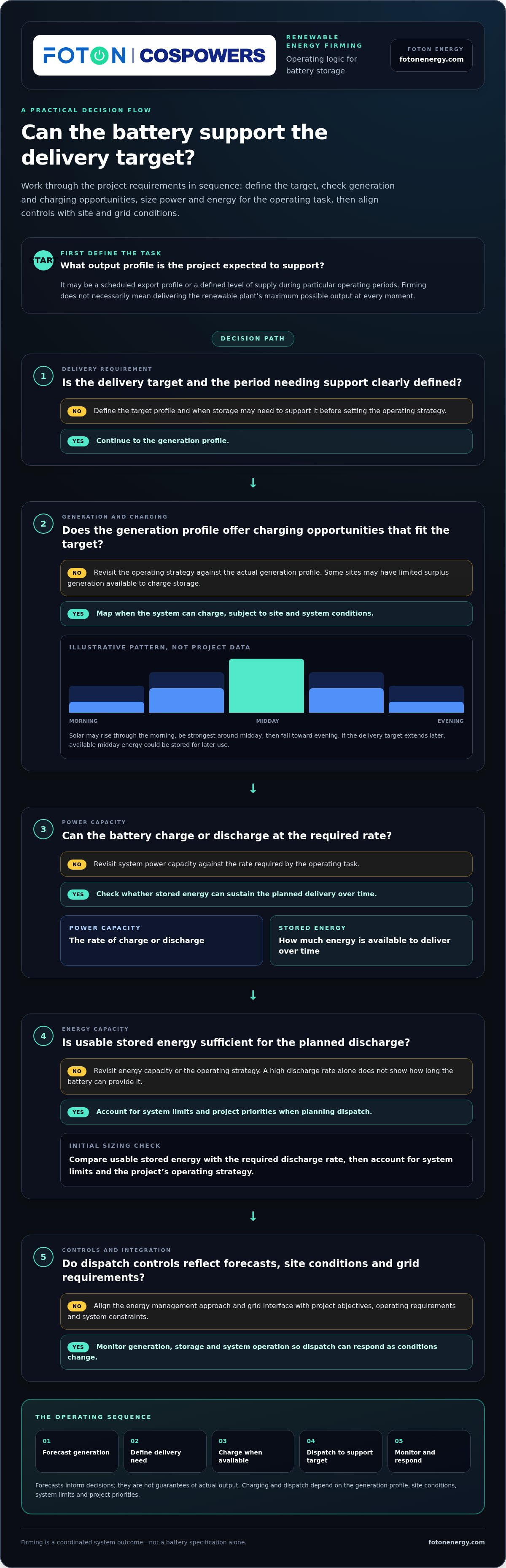
Illustrative profile, not project data: solar generation rises through the morning, is strongest around midday, then falls toward evening. If the delivery target extends into the evening, the system could store some available midday energy and discharge it later. This illustrates the basic relationship, not a standard operating schedule.
What a battery contributes, and what it cannot do alone
A battery can charge when renewable generation is available and discharge when generation needs support against the target profile. Two measures answer different design questions: power capacity describes the rate at which the system can charge or discharge, while stored energy describes how much energy is available to deliver over time. The project needs both measures to describe the operating task.
Storage does not remove the need for sound forecasting or operating controls. Project teams need to understand when generation may be available, what delivery profile the battery is intended to support, and how it should respond as conditions change. Those requirements help determine the system’s operating strategy and whether its design matches its intended role.
How battery storage firms renewable generation across time
Firming depends on coordinating decisions over time, not simply placing a battery beside a renewable generator. The operating sequence starts with forecasting available generation and defining the delivery profile the project aims to support. The system can then plan when to charge, when to dispatch stored energy and what to monitor as conditions change. Actual dispatch depends on site conditions, system limits and project priorities.
Power capacity sets the rate of charge or discharge; energy capacity sets how much energy can be stored and delivered over time. Power rating helps answer whether the system can respond at the required rate. Energy capacity helps answer how long it can sustain a planned discharge, given the energy available. A high discharge rate alone does not show how long the battery can provide it. As an initial check, teams can compare usable stored energy with the required discharge rate, then account for system limits and the project’s operating strategy.
Map the operating logic in sequence:
- Forecast renewable generation, treating forecasts as inputs to decisions rather than guarantees of actual output.
- Define the delivery requirement and the periods when storage may need to support it.
- Charge when generation is available and site and system conditions allow.
- Dispatch stored energy when renewable output falls short of the target, in line with the project’s priorities.
- Monitor generation, storage and system operation so dispatch can respond to changing conditions.
Charging and discharging around renewable output
When generation exceeds immediate delivery needs and the system can accept a charge, storage may absorb some of that energy for later use. If output then falls below the target profile, the battery may discharge to help bridge the gap. The strategy depends on the project: some sites may have limited surplus generation, while others may prioritise a different operating objective. Base charging and dispatch decisions on the actual generation profile and project requirements.
Why energy management and grid integration matter
An energy management system coordinates generation, storage and operating objectives, using forecasts and monitoring to inform dispatch decisions. The grid interface also matters: project requirements and system constraints shape how storage can operate alongside generation and deliver energy. The IRENA overview of battery storage for renewables discusses storage’s role in integrating variable renewable energy and supporting grid flexibility.
Forecasts inform decisions, but they do not guarantee what generation will be. Monitoring helps the control system respond to actual operating conditions, while the delivery objective guides how available battery capacity is used. For more on the control layer, see this guide to AI-driven energy management systems.
For battery storage for renewable energy firming, align the storage design, control strategy and grid interface with the project’s intended operation. Foton Energy’s energy storage and engineering capabilities bring these considerations into project planning.
Battery firming compared with other renewable integration approaches
No single approach is right for every project. Batteries can help manage differences between renewable output and a target delivery profile, but flexible generation, grid interconnection and a diversified renewable portfolio can also contribute. These approaches may work together. The right combination depends on the required response, project configuration, site conditions and operating objectives.
| Approach | Response and operating role | Dependencies and project-fit questions |
|---|---|---|
| Battery storage | Can charge when energy is available and discharge to support a target profile, subject to system capability and operating settings. | What response and discharge period are required? Is there suitable space and a workable grid interface? |
| Flexible generation | Can adjust generation to help meet demand or a delivery requirement, depending on the plant and its operating limits. | What resource, operating constraints and fuel or supply dependencies apply? |
| Grid interconnection | Provides a connection to the wider electricity system, enabling power exchange subject to network capacity and arrangements. | What connection capability and network conditions shape the project’s options? |
| Diversified renewable portfolio | Combines generation sources or sites with differing output patterns to shape aggregate supply. | How do resource profiles align, and what transmission and coordination are needed? |
The EIA’s overview of battery storage grid services describes batteries’ roles in storing and smoothing renewable electricity, providing dispatchable power and supporting grid services. This context helps explain why storage may complement generation and network solutions rather than replace them.
When battery storage may fit the project requirement
Battery storage can be a useful firming component when the required response, discharge period and operating profile match the system design. For co-located generation, the design must account for how the renewable plant and battery share a site and connect to the grid. A grid-connected storage project has its own interface and operating requirements. Technical fit is only part of the decision; project economics need separate, site-specific analysis.
How LFP and sodium-ion fit into a technology comparison
Foton’s storage offering includes LFP and sodium-ion systems. Assess chemistry against the project’s operating requirements and the technical information for the proposed system, rather than assuming one option is universally preferable. Compare relevant system characteristics for the intended application, then consider how controls, integration and engineering shape the overall solution. The sodium-ion commercial availability analysis adds market context.
Battery storage for renewable energy firming is most useful when its response and duration match a clearly defined project need. Foton’s energy storage and engineering capabilities connect system choices with project requirements.
How to evaluate a battery firming system before project commitment
Start with the operating requirement, then design the system around it. A bankable assessment connects generation data, the delivery target, site constraints and grid requirements before fixing the battery configuration. For battery storage for renewable energy firming, define both the outcome the project needs and the conditions under which the system is expected to operate.
Use this checklist to establish the project basis:
- Generation data: Map renewable output across representative operating periods, including relevant seasonal or weather-driven variation where data is available.
- Delivery profile: Specify the output target, when it applies and how shortfalls or changes in delivery priorities should be handled.
- System requirements: Define required power, energy, operating windows and dispatch strategy as separate but connected design inputs.
- Site conditions: Account for available space, environmental conditions and practical constraints that may affect equipment layout and system integration.
- Grid interface: Document the connection point, export or import objectives, and interfaces between generation, the BESS, controls and the grid.
- Project obligations: Identify applicable grid-code, market and compliance requirements for the project’s jurisdiction, then incorporate them into the design basis.
Build the operating and technical requirements
Map renewable output against load or delivery needs over representative periods. Then identify when charging could occur and which dispatch priorities take precedence. Record constraints such as limited charging opportunities or competing operating objectives before specifying capacity. This makes the connection between the intended operation and technical design explicit, rather than relying on a generic battery size.
Document how each asset connects and exchanges operating information: generation equipment, the BESS, the energy management system and the grid connection. Clear interface definitions help align controls and engineering responsibilities across the project. They also make it easier to assess whether a proposed configuration supports the required operating profile.
Assess integration, safety and project readiness
Review engineering, thermal management, safety architecture and commissioning as connected workstreams. Define how the design will be validated during commissioning and what system information will be monitored in operation. Grid-code, market and compliance requirements vary by jurisdiction, so the project needs a location-specific review rather than assumptions based on another project or market.
Foton’s engineering consulting brings system design and project requirements into the same planning process. The BESS engineering consulting guide explores development considerations that can inform this work. Together, the generation profile, operating strategy, interfaces and delivery obligations provide a practical basis for project decisions.
Bring firming requirements into a coordinated design discussion through Foton Energy’s BESS engineering team.
How Foton supports renewable energy firming projects
Firming design works best when battery hardware, controls and project engineering are considered together. Foton Energy (Foton Pty Ltd) supports commercial, industrial and utility-scale storage projects with LFP and sodium-ion systems, AI-driven energy management, thermal management, safety architecture and engineering consulting. These capabilities can be aligned with a project’s generation profile, delivery objectives and integration requirements, rather than assuming one chemistry or configuration suits every site.
Foton Energy (Foton Pty Ltd) leverages Tier-1 manufacturing capabilities and decades of industry heritage to deliver robust energy storage solutions. This strong manufacturing foundation provides a reliable basis for project discussions, while system design remains specific to the application. No battery configuration alone guarantees a particular firming outcome: performance depends on the complete system and how it is operated.
Connect battery hardware, controls and engineering
Battery hardware establishes the storage system’s capabilities; the energy management system coordinates operation against project objectives. Thermal management and safety architecture are integral design considerations, not afterthoughts. Foton Energy (Foton Pty Ltd)’s engineering support can address feasibility, system design and project-specific grid-code compliance, with applicable requirements assessed for the relevant jurisdiction.
For commercial and industrial projects, the same integrated thinking applies across the generation asset, storage system, controls and grid interface. Explore Foton Energy (Foton Pty Ltd)’s commercial and industrial BESS solutions to see how project requirements inform system planning.
Define practical next steps for a firming project
A productive project discussion starts with a clear evidence base. Bring together generation profiles, delivery objectives, site constraints and grid-interface information. Then identify expected operating windows, dispatch priorities and integration interfaces. This frames the next step around project requirements and engineering priorities, rather than a standard package or assumed system size.
Use that information to focus technical discussions on the questions that shape system architecture:
- Operating need: What delivery objective should storage support, and during which periods?
- System integration: How must battery hardware and controls coordinate with generation and the grid connection?
- Project design: Which chemistry, thermal management and safety considerations align with the site and application?
- Delivery readiness: How will engineering, commissioning and ongoing monitoring fit into the project plan?
Turn the project brief into a coordinated storage design. For teams assessing battery storage for renewable energy firming, Foton Energy (Foton Pty Ltd)’s engineering consulting and energy management capabilities support a requirements-led approach to integration and system planning. Explore Foton Energy (Foton Pty Ltd)’s energy storage solutions and begin planning around your project’s operating objectives.
Turn your firming strategy into a project brief
Make the project’s priorities explicit before committing to a configuration. Align stakeholders on the delivery profile the project needs to support, the operating trade-offs they are prepared to make, and the conditions that could change how the system is used. A clear brief gives technical and commercial teams a shared basis for assessing battery storage for renewable energy firming.
The brief can also guide a focused design conversation: which system requirements are fixed, where flexibility matters, and how storage should integrate with the wider project. Foton combines storage systems with energy management and engineering consulting, backed by its strategic partnership with Cospowers and the manufacturer’s more than 30 years of manufacturing heritage.
Build the next stage around your project’s requirements. Explore Foton’s energy storage solutions and take the next step toward a firming design shaped for your objectives.
Frequently Asked Questions
Can battery storage firm renewable energy on its own?
Yes, within defined operating limits, but a battery cannot independently guarantee renewable supply. It stores energy generated earlier and returns it later; it cannot replenish itself during a prolonged generation shortfall. Battery storage for renewable energy firming is therefore one part of a system that includes generation and dispatch controls, and may also depend on other supply or network resources. Set the delivery target with available energy and operating conditions in mind.
How long can a battery support renewable energy output?
There is no universal duration. It depends on the energy available in the battery, the rate at which the project draws on it, the intended operating reserve and opportunities to recharge. For example, a project aiming to support a defined evening delivery window needs to model how much energy the target requires across that window. Usable capacity and system operating limits inform the assessment.
What happens when renewable generation stays low for an extended period?
A battery can continue discharging only while it has energy available, so an extended period of low generation can reduce its ability to support the delivery target. The project’s operating plan should account for this possibility. Depending on the grid connection and project arrangements, responses could include drawing on other supply resources, adjusting dispatch priorities or revising delivery expectations. Storage shifts energy across time; it does not create a new energy source.
Is battery storage the same as renewable energy backup power?
No. Firming generally supports a planned renewable delivery profile, while backup power supplies designated loads when the normal source is unavailable. A battery system may serve both purposes, but its design and control strategy need to account for each role. For backup, the system must be configured for the required loads and operating conditions; firming alone does not establish outage protection or islanded operation.
Can a battery firm both solar and wind generation?
Yes. A battery can be integrated with solar, wind or a combination of renewable sources, provided the system architecture and controls are designed around the generation assets and project objectives. For a mixed portfolio, the operating strategy can consider combined output rather than treating each source in isolation. The project still needs to assess how the assets connect, how their data is coordinated and what delivery requirement storage is intended to support.
Does renewable energy firming always require co-located battery storage?
No. A battery can be located alongside a renewable generator or connected elsewhere in the electricity network, depending on the project design and grid arrangements. Firming can also draw on approaches such as flexible generation or a mix of renewable sources. Location affects the connection, controls and project requirements, so assess the network context and intended operating role rather than assuming co-location is essential.
How does an energy management system support battery firming?
An energy management system coordinates operating decisions using inputs such as generation and system monitoring, forecasts, battery status and project priorities. It helps align charging and dispatch with the intended use of storage, while actual decisions remain subject to system limits and operating conditions. The EMS does not guarantee forecast accuracy or replace sound system design. Its role is to connect information, controls and operating objectives.


