

A battery project can be technically sound and still lose momentum at the interfaces between hardware, EMS and engineering. That’s why smart energy storage for epc partners is about more than sourcing equipment. EPCs need an integrated delivery relationship that helps manage technical and supply-chain risk while keeping project leadership and responsibilities clear.
Storage partners can support that goal without displacing the EPC. This guide offers a practical framework for assessing partnership fit and aligning project needs with battery chemistry, intelligent EMS, thermal management, safety architecture and engineering support. It follows the project lifecycle from feasibility and system design through grid-code compliance, commissioning and long-term asset management. Foton Energy (Foton Pty Ltd) brings these capabilities together as a complementary partner, supported by decades of advanced manufacturing heritage. The result is a practical way to assess how an integrated storage layer can strengthen project delivery while the EPC remains at the centre of its work.
Key Takeaways
- See how a coordinated storage partnership can connect battery hardware, controls and technical support while keeping EPC project leadership clear.
- Understand how LFP or sodium-ion systems, intelligent EMS and engineering fit together to support project-specific requirements.
- Use a practical framework to compare hardware-only, hardware-plus-controls and engineering-supported partnership scopes.
- Map EPC decisions, partner inputs and project interfaces across feasibility, design, commissioning and asset management.
- Learn how smart energy storage for epc partners can strengthen delivery with Foton as a complementary storage and engineering partner, not a replacement EPC.
Why smart energy storage partnerships matter to EPC project delivery
For an EPC, adding storage means coordinating more than a battery order. Equipment, controls, engineering inputs and project interfaces must align across design, procurement, construction and commissioning. If each workstream develops in isolation, the EPC may have to resolve mismatches late, when a design change can affect other parts of the project. An integration-focused partnership gives the EPC access to connected storage capabilities while keeping overall project delivery under its leadership.
A smart energy storage partnership coordinates battery hardware, control systems and technical support around the project’s requirements. A Battery Energy Storage System (BESS) is not simply a battery enclosure: its operation depends on the wider system and how its components interact. For an EPC, the practical questions are how those components fit the project scope, how they connect to other systems, and how they support the intended operating strategy.
An EPC-aligned storage partnership connects hardware, controls and engineering support to the project while leaving project leadership and agreed delivery responsibilities with the EPC. The EPC coordinates the broader scope and stakeholder interfaces; the storage partner contributes defined equipment and technical expertise. Record responsibilities in the project structure so that design inputs, reviews and commissioning support have clear owners.
What EPC partners need beyond battery hardware
Equipment supply alone may not address the engineering decisions needed to integrate storage into a site. Battery selection needs to be considered alongside the EMS, which manages charging and discharging according to the system’s operating strategy. Thermal management and safety architecture also belong in the design conversation, not as isolated details added after equipment has been selected. Treat these as connected parts of the storage package and identify their interfaces with the wider project.
Consider a commercial site planning a battery system to manage its energy use. The EPC leads site design and coordinates electrical and construction interfaces. Storage engineering inputs can bring the battery system, EMS, thermal management and safety architecture into the design as a coherent package. The EPC can then define how that package connects with the rest of the works and which parties own each interface. The benefit is clearer coordination, not a guaranteed operating result.
How a complementary partner can preserve EPC accountability
The EPC remains responsible for coordinating the wider project scope, including schedules, design interfaces and engagement across project stakeholders, as set out in its contract. A storage partner contributes within its agreed scope, such as battery supply, controls and engineering support. This is a collaborative model, not a transfer of EPC accountability.
Make the division of work visible early. Identify who provides system design inputs, who leads grid-code compliance work, how EMS interfaces are documented, and who participates in commissioning. Then record the handoffs and required information for each interface. The allocation depends on the project structure and agreed scope. Clear boundaries help the EPC retain control of delivery while drawing on specialist storage capabilities. That is the practical foundation of smart energy storage for epc partners: complementary expertise, connected workstreams and accountable project leadership.
How smart storage connects batteries, EMS and engineering
Storage performance depends on how the system’s layers work together, not on battery hardware in isolation. The battery provides the storage medium; the energy management system (EMS) directs how the system is operated; and engineering translates project requirements into a coordinated design. If these elements are considered separately, key interfaces may be left unresolved until later design or commissioning work. For EPC teams, connecting them early creates a clearer basis for technical decisions and scope coordination.
Battery technology and project application
Foton offers lithium iron phosphate (LFP) and sodium-ion battery systems. Neither chemistry is a universal answer for every project. Selection should follow the application and its requirements, considered alongside the system design and intended operating strategy. Start by defining what the project needs from storage, then compare each system against that brief, including its integration requirements and operating context.
For a commercial or industrial site, for example, the EPC may be coordinating storage with existing electrical infrastructure and an operating plan shaped by the site’s energy needs. Battery selection is one input to that design, not a substitute for it. The commercial and industrial BESS solutions guide provides further context for evaluating project requirements and system fit.
EMS, thermal management and safety architecture
The EMS connects operating objectives with system controls. An AI-driven EMS can support real-time monitoring and grid optimisation by using system information to inform charging and discharging decisions. Its role should be assessed against the project’s operating strategy and the interfaces it must support, rather than treated as an add-on to the battery package. For an EPC, defining control requirements early helps bring system expectations into design coordination.
Thermal management and safety architecture also need to be considered as part of the integrated system. Their design context is tied to the battery system and project configuration, so coordinate them alongside engineering work rather than treating them as a late-stage checklist. Review how hardware, controls, thermal management and safety provisions fit together, and document the interfaces that need to be addressed during commissioning. This keeps technical discussions connected to the project scope without assuming identical solutions across sites.
Battery hardware stores energy, the EMS governs how the system responds, and engineering connects both layers to the project’s requirements and interfaces. That is the core of smart energy storage for epc partners: treating components as a coordinated architecture. EPC teams developing this approach can explore Foton’s AI-driven energy management systems guide and its integrated storage and engineering capabilities as they shape a project-specific technical scope.
How EPC partners can align storage capabilities with project requirements
The right partnership scope depends on what the project needs and where the EPC needs additional capability. Start with three questions: what must the storage system do, which technical workstreams need support, and where do interfaces with the wider project sit? Then compare potential scopes against the project stage, the EPC’s in-house capabilities and the decisions that need specialist input. This keeps the assessment grounded in project requirements rather than assuming one package fits every commercial, industrial or utility-scale application.
Use the table as a starting point for defining scope. These are partnership models, not fixed packages; project requirements and agreed responsibilities determine what belongs in each.
| Partnership scope | Useful when | Key interface to define |
|---|---|---|
| Hardware-only | The EPC has the engineering and controls capability to integrate the selected battery system. | Equipment requirements, design inputs and the boundary between supply and EPC-led integration. |
| Hardware plus controls | The project needs battery equipment and an EMS considered together, with control requirements coordinated early. | How the EMS interfaces with the storage system and the project’s wider controls. |
| Engineering-supported | Technical input is needed across feasibility, system design, grid-code compliance, commissioning or asset management. | Which party provides each engineering input, reviews interfaces and contributes at each project stage. |
Match the partnership scope to the project stage
At feasibility, define project needs and assess how storage fits the intended application. System design turns those needs into a technical configuration and identifies interfaces with the site or grid. Address grid-code compliance within the project’s design and responsibility plan, rather than treating it as an isolated task. During procurement, clarify equipment and documentation boundaries. During commissioning, establish how the EPC and storage partner coordinate technical inputs. If the EPC’s delivery model extends beyond handover, long-term asset management support may also be relevant.
Defining support by stage helps avoid both gaps and overlap. An EPC with established design and commissioning resources may need a narrower scope than one seeking engineering input across several phases. The BESS engineering consulting guide can help frame the kinds of technical support that may be considered across a project lifecycle.
Align technology and interfaces with the application
Next, map application needs to system capabilities. A commercial or industrial project may have a different operating context and different site interfaces from a utility-scale installation. For either application, consider the operating strategy, battery technology, control requirements, thermal management, safety architecture and connection to project systems. LFP and sodium-ion are available technology options, but the application and design requirements should guide selection rather than a blanket preference.
An added partner doesn’t have to blur accountability. Put responsibilities in the project scope: identify who leads overall coordination, who supplies design information, who owns each technical interface and how commissioning inputs are managed. This makes smart energy storage for epc partners a practical extension of EPC capability, with a defined contribution from the storage partner and project leadership retained by the EPC.
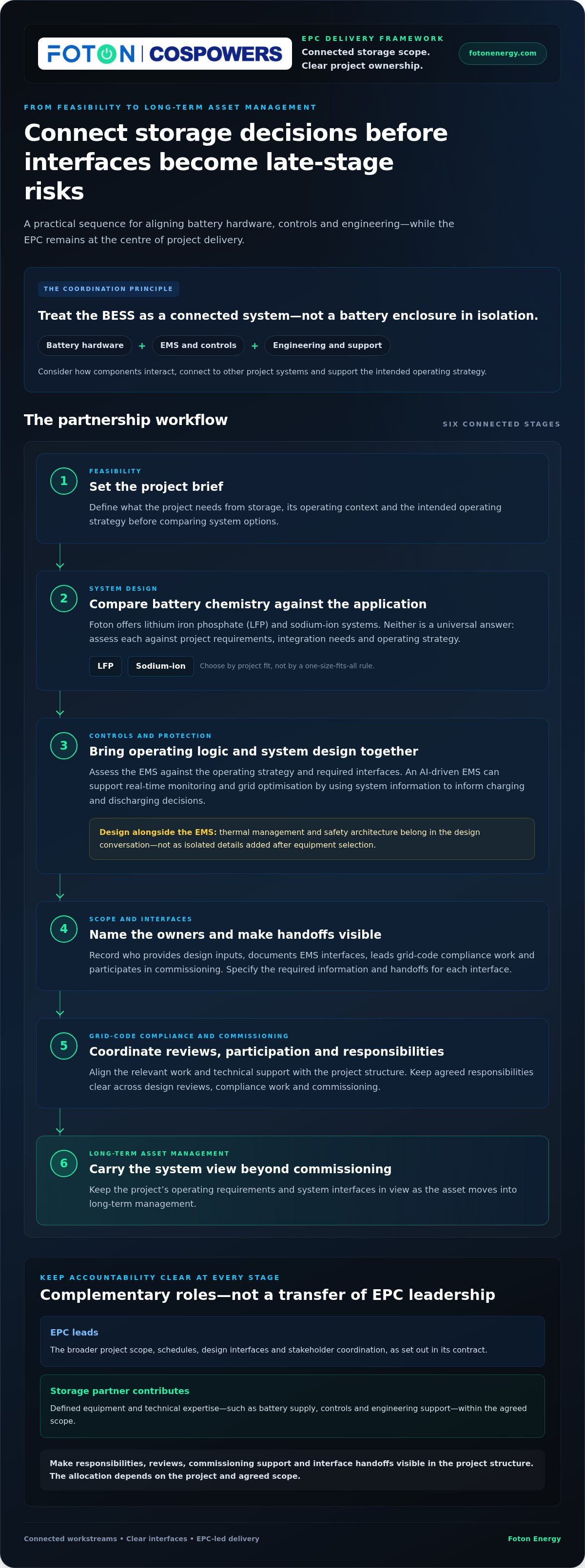
An EPC partnership workflow from feasibility to commissioning
A clear workflow turns a storage partnership into defined contributions at each project stage. The EPC retains project leadership and makes the decisions required to coordinate the wider scope. The storage partner provides agreed supply and engineering inputs, with interfaces documented so both teams know what information, reviews and participation are expected.
Early feasibility work gives the EPC and storage partner a clearer basis for defining system requirements, responsibilities and project interfaces. Use the workflow below to bring those decisions forward, then tailor each stage to the project and agreed scope.
- Feasibility and application definition. The EPC establishes the project objectives, site context and constraints that shape the storage scope. The storage partner can contribute feasibility input on system requirements and potential configurations. Together, the teams identify the information needed from the project and where storage connects to the wider design. The EPC remains responsible for aligning this work with the overall project plan and stakeholders.
- System design and technical requirements. The EPC decides how the storage system must fit into the project design and coordinates relevant disciplines. The storage partner can provide system design input, including battery, EMS, thermal management and safety architecture considerations. Grid-code compliance is an engineering consideration to address in the project context, not an automatic outcome of selecting a particular system. Define which party prepares, reviews and incorporates each technical input.
- Procurement planning. The EPC leads procurement planning against the approved project design, schedule and scope. The storage partner provides equipment information and technical documentation associated with its agreed contribution. Before procurement progresses, align equipment requirements with design assumptions, identify dependencies and record the boundaries between supply and EPC-led integration. This keeps purchasing decisions connected to project interfaces rather than treating the storage package as a standalone order.
- Commissioning and handover. The EPC coordinates commissioning within the overall project sequence and leads stakeholder communication. The storage partner can provide commissioning support as defined in the project scope, contributing relevant technical input for its system. Agree how issues are documented, who reviews them and how handover information moves between parties. These arrangements connect commissioning activities to the project’s acceptance and handover process without shifting EPC accountability.
- Long-term asset management. The EPC determines whether its delivery model includes a continuing role after handover and how that role relates to the asset owner’s needs. Engineering support for long-term asset management can be included where agreed. Define the intended scope, information flows and responsibilities so ongoing support aligns with the project’s operating context, rather than leaving expectations implicit once commissioning is complete.
This stage-by-stage approach gives smart energy storage for epc partners a workable structure: EPC decisions stay with the EPC, specialist inputs have a defined place, and shared interfaces are addressed as the project develops. To shape a project-specific workflow, explore Foton’s storage engineering support across feasibility, system design, grid-code compliance, commissioning and asset management.
Build an EPC delivery model with Foton’s smart energy storage partnership
With the partnership framework established, EPCs can consider how a storage specialist fits their delivery model. Foton Energy is an Australian energy storage infrastructure company and Cospowers’ exclusive global strategic partner. Foton brings storage systems and engineering capabilities to the relationship, while the EPC retains leadership of the wider project and its agreed responsibilities.
What Foton brings to an EPC partnership
Foton supplies LFP and sodium-ion battery systems, AI-driven EMS and engineering consulting. Its technical support spans feasibility, system design, grid-code compliance, commissioning and long-term asset management. Thermal management and safety architecture can also be considered alongside the hardware and controls, helping EPC teams define an integrated storage scope rather than coordinate each element in isolation.
Cospowers brings more than 30 years of manufacturing heritage. Foton also operates a global marketing network spanning more than 70 countries. For EPCs assessing a strategic relationship, these facts provide context alongside the project’s application, technical requirements and agreed responsibilities.
In practice, an EPC might bring Foton into feasibility to discuss system requirements, then draw on engineering inputs during design and procurement planning. The EPC continues coordinating the broader project, stakeholders and interfaces. Foton’s contribution is shaped around the storage-related scope, whether that involves battery systems, EMS or engineering support at defined stages. This lets the EPC extend its storage capability without positioning the partner as the project’s EPC contractor.
Reflect that distinction in the working model. Define who supplies technical information, who coordinates design reviews, which party contributes to commissioning and how ongoing asset-management support fits after handover. Clear scope boundaries give both organisations a practical basis for collaboration and help keep project accountability with the EPC.
Start a project conversation with clear priorities
A focused partnership conversation can begin with three essentials: the application, the project stage and the technical objectives. An EPC exploring commercial and industrial storage may be at an early feasibility stage, while a utility-scale project may need support with system design or commissioning. Stating the current need helps frame which capabilities are relevant and where interfaces with the EPC’s scope sit.
Bring the operating context, current design questions and known project interfaces into the discussion. Then define the potential partnership scope, from storage hardware and EMS to engineering support across the project lifecycle. The purpose is not to replace the EPC’s delivery model, but to identify where coordinated storage expertise can complement it.
To discuss a project-specific scope, explore an EPC partnership with Foton.
Turn storage collaboration into a stronger delivery capability
The next step is to make partnership thinking part of how your EPC approaches future storage opportunities. Consider where your team wants greater technical depth, which project stages would benefit from specialist input, and how a partner’s contribution should fit your delivery model. Those priorities can shape a repeatable approach without forcing every project into the same structure.
For smart energy storage for epc partners, lasting value starts with a working relationship that adapts to project needs while keeping EPC leadership clear. Begin with a live opportunity or a defined capability gap. Share the application, current project stage and technical objectives, then use that context to frame a relevant partnership scope.
Foton’s storage and engineering capabilities are designed to complement EPC delivery. Explore an EPC partnership with Foton to discuss your project priorities and develop a practical starting point for collaboration.
Frequently Asked Questions
What does EPC mean in energy storage?
EPC means engineering, procurement and construction. In an energy storage project, the EPC typically coordinates design, equipment sourcing and construction interfaces as defined by the project contract. For example, an EPC may align battery equipment requirements with site electrical works and the construction sequence. A manufacturer or storage partner can contribute equipment, controls or engineering support, but that contribution doesn’t automatically transfer overall project leadership from the EPC.
Can smart energy storage support projects beyond solar?
Yes. Battery storage can serve different energy infrastructure applications, with the design shaped by project operating requirements rather than an assumption that solar is present. Foton offers systems for commercial and industrial, utility-scale, residential, data centre and telecommunications applications. For example, a project may evaluate storage for site energy management or backup needs. The intended use and site configuration guide how storage is integrated into the wider system.
Can LFP and sodium-ion batteries be used for the same EPC project?
Foton offers both LFP and sodium-ion systems, but both chemistries shouldn’t be combined by default. Whether one or multiple battery technologies belong in a project depends on the application, design and technical requirements. An EPC can treat chemistry selection as part of system engineering, alongside controls and project interfaces. This keeps the decision tied to the project specification without assuming either chemistry is universally better or making unsupported comparisons.
What does an energy management system do in a BESS project?
An energy management system helps monitor and optimise how a battery energy storage system operates. Foton’s AI-driven EMS supports real-time monitoring and grid optimisation, making it a control layer within the broader system architecture. For an EPC, the practical step is to define how the EMS relates to the battery system and project controls, and what operational requirements it needs to address. Avoid assuming specific savings or compatibility with unspecified platforms.
When should EPC partners involve storage engineering support?
Involve storage engineering support when project questions could shape the design or procurement scope. During feasibility, input can help frame requirements; during system design, it can clarify technical interfaces before equipment decisions are fixed. Foton’s engineering consulting covers feasibility, system design and grid-code compliance, as well as commissioning and long-term asset management. The best engagement point depends on the EPC’s scope, project stage and the decisions that need technical input.
Does Foton support EPC partners internationally?
Foton is an Australian energy storage infrastructure company and Cospowers’ exclusive global strategic partner, with a global marketing network spanning more than 70 countries. EPC partners can define the relevant project scope around the application, technical requirements and agreed responsibilities.


