

Fire suppression is only one part of a BESS safety chain. A robust bess fire safety architecture must also address how thermal runaway is prevented, detected, contained, and managed by site teams and emergency responders. If a safeguard fails or a hazard develops faster than expected, the interfaces between protection layers matter.
It’s reasonable to ask what a complete design needs beyond suppression, especially when test results, site constraints, and local requirements don’t point to an obvious choice. This article explains how prevention, detection, mitigation, and emergency response work together, and how to assess evidence without relying on broad safety claims.
You’ll learn which questions to raise with manufacturers, engineers, and authorities, and how battery chemistry, system configuration, and operating plans shape design decisions. We’ll also consider UL 9540A test evidence and the 2026 edition of NFPA 855, while recognizing that applicable standards and requirements depend on the project jurisdiction. The aim is to give you a clearer basis for evaluating risk and building safety into system design from the start.
Key Takeaways
- Assess bess fire safety architecture as a coordinated system of equipment, site design, controls, and emergency response, not as a standalone suppression choice.
- Map how prevention, detection, and mitigation interact, then identify gaps between battery controls, thermal management, alarms, and fire protection.
- Check what each test result covers. Confirm that the tested configuration and scenario match the proposed system before using evidence to guide design decisions.
- Build a project review around defined hazards, design assumptions, site constraints, operating limits, evidence, and clear responsibility boundaries.
- Align equipment selection and operational planning with the project’s scale, application, chemistry, location, and authority requirements.
What BESS Fire Safety Architecture Must Protect Against
BESS fire safety architecture is the coordinated design of equipment, site measures, controls, and response procedures that reduces fire-related hazards across a battery energy storage system. It is not a single suppression device. A complete safety case considers how a hazard could begin, how it might be detected, whether it could spread, and how people and responders should act.
The risks are connected, but they are not interchangeable. Thermal runaway can produce intense heat and gases; heat transfer can expose nearby cells or equipment; smoke can affect visibility and create additional exposure concerns; and electrical hazards may remain relevant during isolation and response. Each calls for controls suited to its purpose. An overview of Battery energy storage system (BESS) technology, including fire safety and battery chemistry, provides useful context. Project decisions, however, need evidence for the actual system and site.
How thermal runaway can affect a battery energy storage system
Thermal runaway occurs when a battery cell’s internal condition becomes unstable and heat generation accelerates. A cell-level failure is not the same as a system-wide event. Consequences depend on whether heat or released gases affect neighboring cells, modules, or other equipment. Propagation is a risk to assess, not an inevitable outcome.
Behavior can vary with chemistry, system configuration, operating conditions, and the initiating scenario. Cell spacing, enclosure design, thermal management, and protective controls may influence how an event develops. Test evidence is most useful when it represents the proposed configuration and relevant conditions, rather than being treated as a universal prediction. Chemistry can shape hazard characteristics, but no chemistry makes a system inherently risk-free.
Why a BESS fire safety case is a layered design
A practical design links five layers: prevention, detection, mitigation, containment, and emergency response. Prevention aims to reduce the likelihood of unsafe conditions; detection identifies warning signs; mitigation addresses an event; containment limits its consequences; and response planning helps coordinate action at the site.
Pay close attention to the interfaces. A sensor may detect a condition, but its value depends on whether the alarm reaches the right people and prompts a defined action. Likewise, a protective component may not perform its intended role if system controls, site layout, or response assumptions do not align. Review these dependencies alongside individual equipment claims.
The objective is hazard reduction and consequence management, not a promise that risk can be eliminated. Foton Energy’s engineering consulting can help put equipment selection, thermal management, monitoring, and operational planning into project context. Verify the functions and supporting evidence for the specific system.
How Prevention, Detection, and Mitigation Work Together in BESS
A battery’s safety chain runs from cell and module design through the enclosure, control systems, and site layout. Each stage has a different role: design choices influence how faults may develop, controls monitor operating conditions, detection identifies warning signs, and mitigation measures respond to an event. For a dependable bess fire safety architecture, these elements need to work as a coordinated system, with interfaces tested and responsibilities clearly defined.
The NFPA 855 standard is one reference project teams use when evaluating installation safety. Confirm the applicable requirements and edition for the project’s jurisdiction, alongside guidance from authorities and fire services.
Prevention and monitoring before an incident
Prevention starts with operating the battery system within its approved limits. Battery management systems (BMS) monitor battery conditions and may trigger control actions when values move outside defined parameters. Thermal management supports operation within intended conditions, while maintenance helps teams identify deterioration or faults that warrant investigation.
Monitoring is effective only if information leads to an appropriate response. Review how abnormal conditions become alarms, where those alarms are sent, who receives them, and what actions follow. Check communications between the BMS, energy management system (EMS), site controls, and operator interfaces. An EMS can support system monitoring and operational coordination, but it should not be treated as a substitute for dedicated fire detection or protection.
Detection, suppression, and propagation control
Detection methods identify different indicators. Gas sensors may detect signs of off-gassing; smoke detection responds to smoke; heat detection identifies temperature changes; and other approaches may be considered where appropriate. Don’t assume that one method will detect every hazard at every stage. Match sensor selection, placement, alarm logic, and escalation paths to the system design and project risk assessment.
Detection is not mitigation. After an alarm, the documented response may involve operator notification, equipment control actions, emergency communication, or protective systems. Suppression and cooling strategies depend on the hazard analysis, enclosure design, tested system configuration, and authority requirements. Separation distances and containment measures also need engineering review. Their suitability depends on the site and the evidence supporting the proposed layout.
Safeguards reduce risk most effectively when detection, control, and response interfaces are designed and validated together, not assessed as isolated components. Project teams can review equipment selection, thermal management, monitoring, and operating assumptions alongside Foton Energy’s BESS engineering expertise, then verify the functions and evidence for the specific configuration.
How to Evaluate BESS Fire Safety Evidence and Design Trade-Offs
Evidence is useful only when it answers the project’s actual question. A certification, component test, system-level fire test, hazard analysis, and site approval each serve a different purpose. None should be treated as a substitute for the others. For a defensible bess fire safety architecture, connect each design decision to the evidence that supports it, and record any assumptions or limitations.
Compare safeguards by their intended purpose. Prevention evidence may address operating controls or thermal management; detection evidence concerns whether a particular method identifies defined warning conditions; mitigation and containment evidence examines performance in specified test scenarios. Emergency response plans need to be assessed against site conditions, available information, and local fire-service guidance. A strong claim in one category does not prove performance in another.
What test reports and standards can, and cannot, show
UL 9540A provides a test method for evaluating thermal runaway fire propagation, while NFPA 855 addresses installation of stationary energy storage systems. The sixth edition of UL 9540A was published in March 2026, and NFPA 855 has a 2026 edition. Confirm the applicable edition, jurisdictional requirements, and authority guidance for each project. A test report records observed performance under stated conditions; it does not guarantee identical outcomes at another site.
Before relying on a report, ask which product configuration was tested, what installation assumptions applied, which scenario was assessed, and what the report excludes. Check whether cell, module, unit, or large-scale results support the specific design decision. Don’t extend conclusions to a different enclosure, layout, control strategy, or operating condition without a documented technical basis.
Keep evidence categories distinct. Equipment certification addresses defined requirements for the equipment; component and system tests provide results for their tested scope; hazard analysis evaluates project-specific risks; and site approvals reflect the applicable review process. One does not automatically confer the others.
LFP and sodium-ion: compare evidence, not assumptions
Chemistry is one input, not a complete safety conclusion. Compare LFP and sodium-ion systems using evidence relevant to the proposed cells, form factor, controls, thermal management, enclosure, and installation. Avoid categorical claims that either chemistry is inherently safe or unsafe. Foton Energy supplies large-scale LFP and sodium-ion storage systems, so project teams can frame questions around configuration-specific evidence and design conditions. For further context, see this sodium-ion battery safety standards guide.
Document design trade-offs rather than resolving them with headline claims. For broader project considerations, including commercial and industrial storage, consult the commercial and industrial BESS strategic guide.
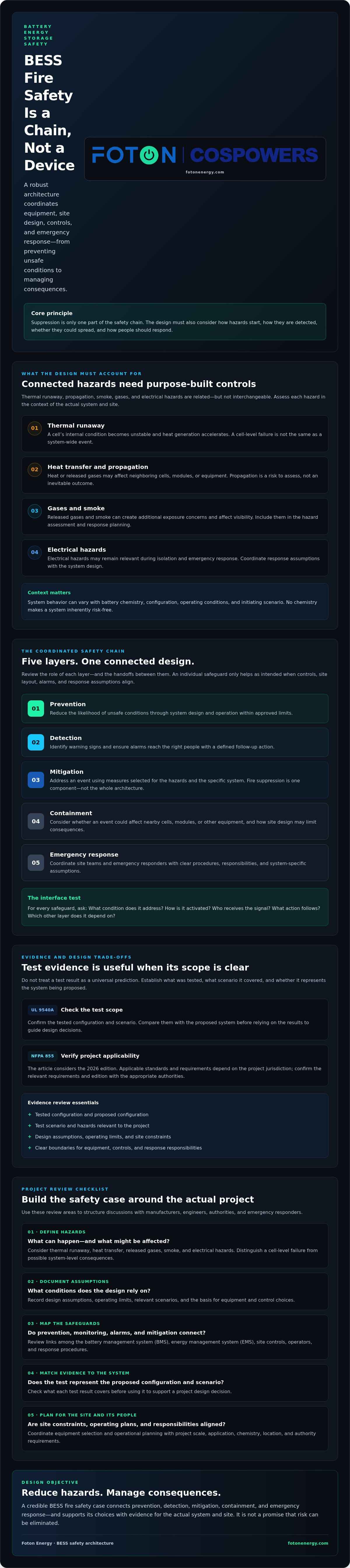
A Project Checklist for BESS Fire Safety Architecture
Turn the safety concept into a reviewable project record. A clear sequence helps teams identify gaps before procurement decisions and site constraints become difficult to change. For each step, document the evidence, assumptions, decisions, and responsible party.
- Define hazards: Identify credible scenarios for the battery chemistry, equipment configuration, operating conditions, and site. Record what is in scope and the assumptions behind the assessment.
- Establish the design basis: Document the operating envelope, system boundaries, site layout, access routes, neighboring exposures, and relevant environmental conditions. Have the project engineers confirm applicable codes, standards, editions, and authority interpretations for the jurisdiction.
- Verify evidence: Request relevant equipment certifications, test reports, and hazard analyses. Check the tested configuration, scenario, installation assumptions, limitations, and how each item supports a design decision.
- Assess interfaces: Map how alarms, communications, control actions, shutdown logic, and operator notifications connect. Assign responsibility for each interface and identify who verifies its function.
- Plan response: Review emergency access, site information, isolation procedures, responder coordination, and the responsibilities of operators and emergency personnel.
Questions to ask during design and procurement
Ask manufacturers and engineers which hazards and credible scenarios informed the proposed bess fire safety architecture. Request documentation defining system boundaries, operating assumptions, test scope, and known limitations. Then confirm how alarms are routed, what shutdown actions are initiated, who receives notifications, what maintenance is required, and which party owns each response task. Involve local authorities, fire services, and insurers at appropriate design stages rather than assuming their requirements will align automatically.
Commissioning, operations, and emergency readiness
Safety planning continues after equipment selection. Commissioning should verify relevant alarm pathways, control logic, communications, and operating procedures against the approved design. Define staff training, inspection schedules, recordkeeping, and a change-management process for modifications to equipment, settings, or site layout. Emergency plans should reflect actual access routes, isolation procedures, site drawings, and responder coordination. Review them with relevant parties and update them when the system or site changes.
For engineering-stage context, see the BESS engineering consulting guide. The Foton Energy BESS engineering consulting page provides further information on connecting project assumptions, equipment choices, and review responsibilities.
Integrating BESS Fire Safety into a Bankable System Design
Safety decisions shape the system, not just the fire-protection package. Equipment selection affects thermal management, control requirements, site layout, operating procedures, and the evidence project stakeholders need to assess. Integrating these decisions early helps teams identify design dependencies, clarify responsibilities, and avoid treating safety as a late-stage addition.
There’s no universal architecture. The right design depends on project scale and application, battery chemistry and configuration, location, site constraints, and authority requirements. A utility-scale installation, a commercial and industrial system, and a backup application may have different operating needs and site conditions. Each needs a project-specific review, with applicable rules and authority interpretations confirmed for its jurisdiction.
Aligning equipment, controls, and site engineering
Coordination should bring the battery supplier, system integrator, EPC, engineering team, owner, and relevant site stakeholders around a shared design basis. They need to align equipment boundaries, thermal management, monitoring and control interfaces, site engineering, and operating responsibilities. Gaps can emerge when one party assumes another is handling an alarm pathway, control action, or maintenance task.
Foton Energy supplies large-scale LFP and sodium-ion storage systems and offers engineering consulting, thermal management, safety architecture, and AI-driven energy management. These capabilities can inform a project discussion, but the functions and evidence for a specific system must be checked against its proposed configuration. An intelligent EMS and thermal management are integration considerations, not substitutes for dedicated detection, mitigation, or other safeguards.
Moving from safety requirements to a project review
Prepare a concise design brief before technical review. Identify the application, project stage, jurisdiction, proposed chemistry and system configuration, key site constraints, and available engineering and test evidence. Note open questions about interfaces, authority requirements, and operations. This gives project partners a concrete basis for discussing system design and safety architecture instead of relying on general claims.
For a storage project, Foton’s engineering consulting can support discussion of system design, feasibility, and grid-code compliance, with safety requirements considered in the project context. Early coordination can help connect equipment choices with site engineering and operational planning, while keeping assumptions and responsibilities visible to the project team.
Ready to review your project requirements? Discuss a BESS project with Foton to explore system design, safety architecture, and engineering consulting needs.
Build Safety Into the Project From the Start
A resilient bess fire safety architecture connects prevention, detection, mitigation, site design, and emergency readiness. Its value depends not on a single device or broad claim, but on whether the safeguards fit the project and the evidence supports the proposed configuration. Confirm assumptions, operating limits, interfaces, and local requirements before they become fixed design constraints.
Safety decisions also need to align with equipment selection and ongoing operations. Foton Energy (Foton Pty Ltd) supports LFP and sodium-ion storage systems across multiple applications and provides engineering consulting for feasibility, system design, and grid-code compliance. Backed by decades of advanced manufacturing expertise, the engineering framework integrates rigorous production standards with comprehensive quality controls. For any proposed system, confirm the specific safety functions and evidence that apply to its configuration and project location.
Bring your application, jurisdiction, project stage, and available technical evidence into the discussion. Discuss your BESS safety architecture with Foton and take the next step toward a well-integrated, project-specific design. Strong preparation supports clearer decisions as your project moves forward.
Frequently Asked Questions
What is BESS fire safety architecture?
BESS fire safety architecture is the coordinated set of equipment, controls, site measures, and response procedures designed to manage fire-related hazards in a battery energy storage system. It considers how hazards may be prevented, detected, mitigated, contained, and handled by site teams and emergency responders. A suppression device is one possible element, not a complete architecture. The design should reflect the system configuration, operating conditions, site, and applicable local requirements.
Can a battery energy storage system be made completely fireproof?
No design should be described as completely fireproof or risk-free. A project can use layered safeguards to reduce the likelihood of certain events and limit their potential consequences, but performance depends on the equipment, installation, operating conditions, and scenario. Evaluate evidence for the proposed system and site, and clarify what each safeguard can and cannot do. Avoid relying on absolute claims that aren’t supported by configuration-specific evidence.
How does thermal runaway affect BESS fire safety design?
Thermal runaway is an accelerating heat-generating failure within a battery cell. Depending on chemistry, configuration, operating conditions, and the event scenario, heat and gases may affect neighboring cells or equipment and create propagation concerns. Design teams should consider how the system detects abnormal conditions, manages heat, and limits consequences. Test reports can inform these decisions, but their findings apply to the configurations and scenarios they evaluated.
Does LFP chemistry remove the need for BESS fire protection?
No. LFP chemistry is one factor in a hazard assessment, not a reason to assume fire protection or other safeguards are unnecessary. Risk controls should also reflect the cell and system configuration, operating limits, thermal management, detection, site layout, and response plan. Compare evidence relevant to the proposed installation rather than relying on broad chemistry claims. The selected architecture should also meet applicable authority requirements for the project location.
What does UL 9540A testing tell you about a BESS?
UL 9540A is a test method for evaluating thermal runaway fire propagation in battery energy storage systems. Its results can help teams understand observed behavior under the report’s stated test conditions and assess design questions. Check which product configuration and test level were covered, what assumptions applied, and what the report excludes. A result doesn’t guarantee identical performance in a different system configuration or site scenario.
Who should review a BESS fire safety plan?
A BESS fire safety plan should be reviewed by the project’s qualified engineering team and relevant equipment or system suppliers, with input from the site owner or operator. Coordinate with the authority having jurisdiction and local fire services, and include insurer review where appropriate. Roles vary by project and location, so confirm applicable review processes early. Make sure reviewers can see the design basis, evidence, site conditions, alarm interfaces, and emergency procedures.
What should a BESS fire safety review checklist include?
A useful checklist records the project scope, battery chemistry, credible hazards, operating envelope, site constraints, applicable codes and standards, and the assumptions behind the design. It should also track relevant test evidence and its limitations, system boundaries, alarm and control interfaces, maintenance requirements, and assigned responsibilities. Include commissioning checks, staff training, emergency access, isolation procedures, and responder coordination. Review the checklist as the system, site, or operating plan changes.


