
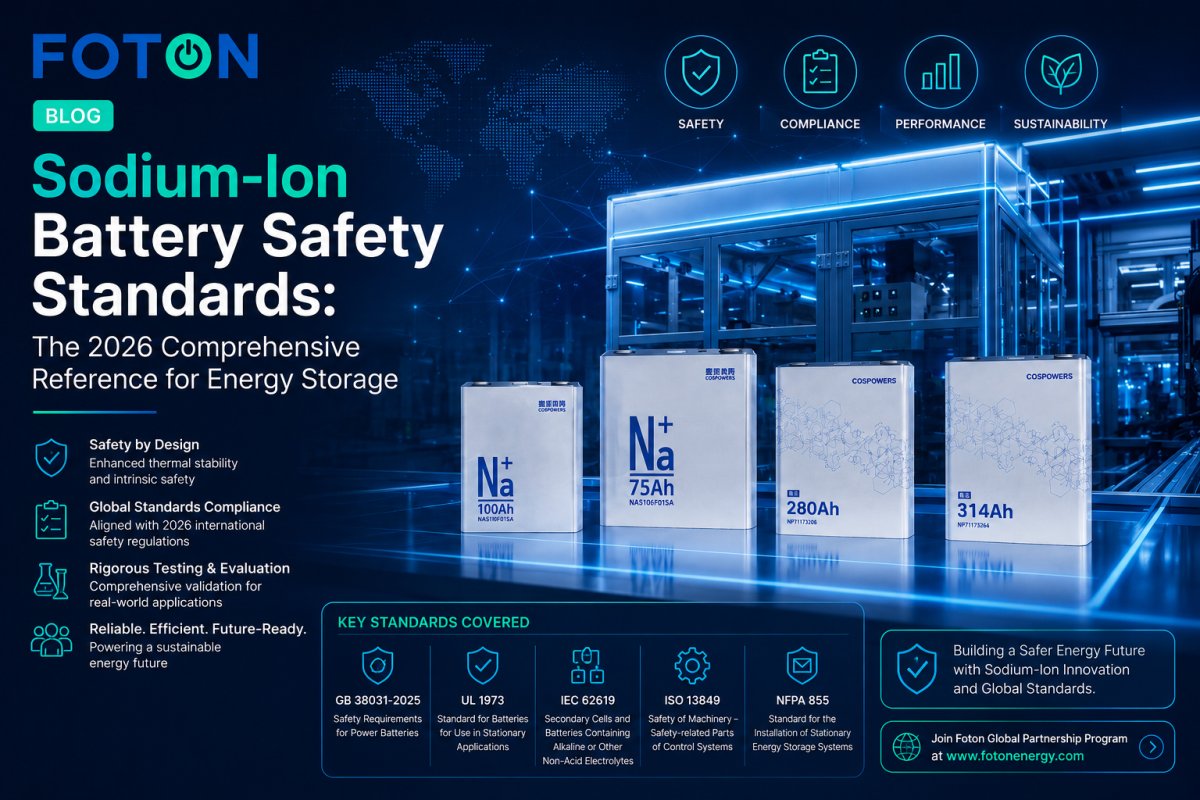
Safety isn't just a byproduct of sodium chemistry; it's a rigorous framework of certified manufacturing and integrated system architecture. While lithium-ion has long dominated the energy storage market, the rapid commercialization of sodium-ion technology in 2026 has introduced a new paradigm of operational security. You might feel uncertain about the maturity of current sodium-ion battery safety standards when planning high-density data centre applications or utility-scale projects. It's a valid concern, as managing the shift from R&D to 370 GWh of global production capacity requires more than just performance data.
You're likely looking for a way to mitigate thermal runaway risks while simplifying the logistical complexity of international transport codes. We understand that bankable energy storage relies on absolute regulatory clarity. This guide provides a clear roadmap of the required certifications, from the updated ANSI/CAN/UL 9540A fifth edition to the 67th Edition of the IATA Dangerous Goods Regulations. We'll verify the technical claims behind zero-volt shipping safety and examine how the February 2026 PHMSA rulemaking aligns domestic requirements with global benchmarks. You'll gain the technical proof points needed to invest in sodium-ion infrastructure with absolute confidence.
Key Takeaways
- Define the electrochemical stability of sodium-ion cells and explore why 2026 represents a strategic transition toward inherently safer energy storage chemistries.
- Navigate the mandatory sodium-ion battery safety standards required for project certification, including the specific requirements of UL 1973 and IEC 62619.
- Capitalize on the unique Zero-Volt shipping advantage to streamline global logistics and eliminate the thermal runaway risks typically associated with battery transport.
- Build resilient infrastructure for data centres and utility-scale projects using a Defence in Depth model that combines hardware safety with intelligent EMS monitoring.
- Strengthen project bankability by aligning your storage strategy with Tier-1 manufacturing benchmarks and rigorous international safety certifications.
The Fundamental Safety Profile of Sodium-Ion Technology
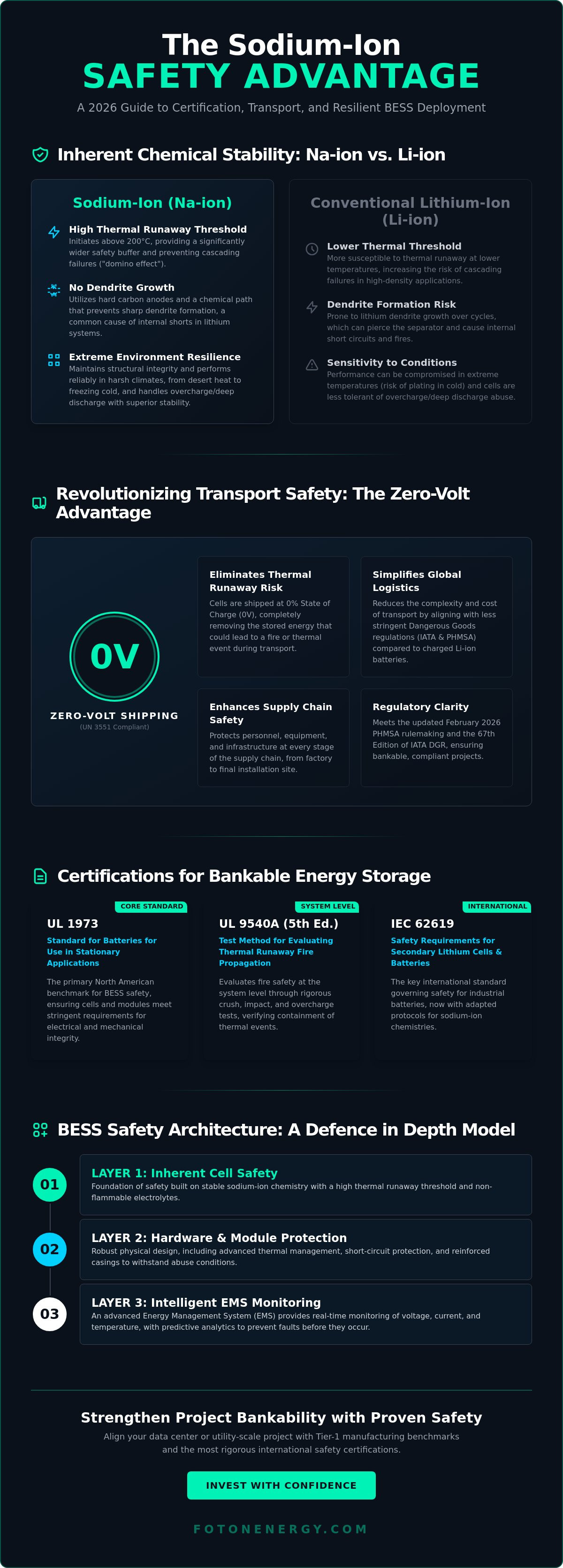
Sodium-ion safety is fundamentally defined by the electrochemical stability and thermal resilience of Na-ion cells. As we move through 2026, the energy industry is witnessing a strategic pivot toward these chemistries as the preferred non-flammable alternative for large-scale storage. This transition isn't accidental; it's the result of material innovations like hard carbon anodes and refined non-flammable electrolytes that inherently reduce fire risks. While early critics raised concerns about internal short circuits, Sodium-ion battery technology utilizes a specific chemical path that prevents the sharp dendrite growth common in lithium systems. This inherent stability is the cornerstone upon which modern sodium-ion battery safety standards are built, ensuring that your infrastructure remains secure. The global market now recognizes that achieving net-zero goals requires more than just energy density; it demands the reliability of a chemistry that won't compromise site safety.
Thermal Runaway Mechanisms: Sodium vs. Lithium
Preventing cascading failures is critical for protecting high-value assets like data centres and telecommunications hubs. Sodium-ion cells offer a distinct advantage here because their exothermic reaction temperatures are significantly higher than those of traditional lithium-ion. This means the cells are far more resistant to the 'domino effect' where one failing cell triggers its neighbors. In Na-ion chemistry, thermal runaway typically only initiates when internal temperatures surpass 200°C, providing a much wider safety buffer during unexpected electrical or physical stress. By choosing sodium, you're investing in a system that resists self-sustaining fire cycles, even under extreme abuse conditions. This thermal headroom is a primary reason why 2026 has become the 'Year of Sodium' for utility-scale providers.
Chemical Stability in Extreme Environments
Performance reliability in harsh climates is a non-negotiable requirement for utility-scale energy projects. Sodium-ion technology maintains its structural integrity through rapid temperature fluctuations, proving resilient in high-ambient regions like Australia and the Middle East. These cells handle overcharge and deep discharge scenarios with a level of stability that lithium-ion simply can't match. They don't experience the same volatile breakdowns when pushed to their limits, which is vital for long-term operational excellence.
Beyond environmental resilience, the ability to operate safely in cold climates without the risk of plating or internal damage makes sodium a versatile choice for global deployment. This chemical robustness ensures that whether your system is in a freezing northern latitude or a desert environment, the core architecture remains stable and dependable. By adhering to rigorous sodium-ion battery safety standards, we ensure that these environmental advantages translate into bankable, long-term value for every installation. Choosing sodium means choosing a future where safety and scale exist in perfect alignment.
Global Regulatory Frameworks and Certification Standards
Regulatory compliance is the bridge between chemical potential and commercial deployment. While the inherent stability of sodium is a significant advantage, institutional trust is built on a foundation of rigorous, standardized testing. The landscape of sodium-ion battery safety standards has matured rapidly, moving away from repurposed lithium-ion protocols toward chemistry-specific annexes that reflect the unique profile of sodium. This evolution ensures that utility-scale and C&I installations meet the same bankability requirements as traditional technologies. To secure your investment, you must understand how these frameworks govern every stage of the system lifecycle, from cell manufacturing to grid interconnection.
UL 1973: The Gold Standard for BESS Safety
UL 1973 serves as the primary benchmark for stationary battery systems, providing the technical assurance required for North American deployments. In 2026, the standard has evolved to include specific testing pathways for sodium-ion chemistry, moving beyond the "lithium-only" focus of previous iterations. EPCs must demand proof of compliance with the latest 5th edition of ANSI/CAN/UL 9540A, which evaluates thermal runaway risk through intensive crush, impact, and thermal abuse tests. An In-depth safety analysis of sodium-ion batteries confirms that while sodium is less reactive, standardized unit-level fire testing remains critical for large-scale commercial success. These protocols don't just measure failure; they define the parameters of safe operation within high-density environments like data centres. If you're planning a large-scale project, our engineering consulting services can help you navigate these complex certification timelines to ensure your hardware meets every local mandate.
IEC Standards for Global Market Access
International benchmarks like IEC 62619 and IEC 63056 provide a unified language for safety across the global industrial and utility-scale landscape. IEC 62619 focuses specifically on the safety of secondary cells and batteries, ensuring they can withstand severe mechanical and electrical stress without compromising the surrounding infrastructure. Navigating the nuances between European CE marks and Australian safety mandates requires a partner who understands the role of third-party verification. Entities like TÜV SÜD and DNV now offer specific certification tracks for Na-ion systems, providing the technical verification needed to satisfy insurance providers and government regulators alike. These standards ensure that your sodium-ion battery safety standards are recognized globally, facilitating smoother project financing and international expansion.
Beyond the battery rack, integration safety is governed by NFPA 855 and IEEE 1547. NFPA 855 dictates the fire protection requirements for BESS installations, specifying spatial separation and suppression systems that are essential for urban C&I projects. Simultaneously, IEEE 1547 compliance ensures that your sodium-ion system interacts safely with the utility grid, managing voltage and frequency fluctuations without causing downstream disturbances. By aligning your project with these comprehensive frameworks, you're not just following rules; you're building a resilient, high-performance asset that stands the test of time and scrutiny.
Transport Safety: The UN 3551 and Zero-Volt Advantage
Logistical security is the unsung hero of energy infrastructure. While chemical stability at the cell level is vital, the ability to move high-capacity hardware across borders without incident is what truly defines a project's viability. In 2026, the regulatory landscape has crystallized around specific identifiers for sodium-ion technology. UN 3551 now governs the transport of sodium-ion batteries, while UN 3552 applies to those contained in or packed with equipment. These classifications aren't just bureaucratic markers; they represent a global consensus on the unique safety profile of sodium. By adhering to these sodium-ion battery safety standards, manufacturers and developers can eliminate the ambiguity that previously slowed down international sea and air freight.
Shipping at 0% State of Charge (SoC)
Sodium-ion chemistry's most disruptive safety feature is its ability to be transported at a zero-volt state. Unlike lithium-ion batteries, which must maintain a roughly 30% state of charge to prevent copper current collector dissolution, sodium cells utilize aluminum collectors on both the cathode and anode. This allows the battery to be fully discharged to 0% SoC without suffering any permanent capacity loss or structural degradation. According to the U.S. DOT Sodium-Ion Battery Safety Report, this inert state essentially removes the stored energy that fuels thermal events during transit. By allowing for a completely inert state during transit, zero-volt shipping bolsters global supply chain resilience by ensuring that critical energy assets arrive at their destination without the volatility risks that plague traditional chemistries. This breakthrough doesn't just improve safety; it simplifies handling and significantly reduces insurance premiums for large-scale Utility-Scale Storage deployments.
Compliance with IATA and IMDG Codes
Navigating the 67th Edition of the IATA Dangerous Goods Regulations, effective as of January 1, 2026, requires a methodical approach to documentation and packaging. These international codes mandate rigorous physical protection and specific labeling to ensure multi-modal transport safety. It's no longer enough to simply ship hardware; you must provide a comprehensive audit trail of compliance. At Foton, our strategic approach involves integrating these sodium-ion battery safety standards into our end-to-end delivery process for C&I BESS and Data Centre & Telco Backup systems. We ensure that every unit meets the packaging standards required for both air and sea transit, providing our partners with the peace of mind that their hardware won't be delayed by regulatory bottlenecks. This commitment to logistical excellence is a key pillar of our engineering consulting, helping you move from procurement to installation with maximum efficiency.
Eliminating the risk of thermal events during freight isn't just a technical win; it's a commercial necessity. When you remove the threat of fire during shipping, you simplify the entire project timeline. Simplified handling requirements mean fewer specialized logistics partners are needed, which directly lowers the total cost of ownership. As the industry moves toward 370 GWh of global production capacity, those who master these transport protocols will be the ones who lead the market in reliability and cost-effectiveness. Let's work together to ensure your next energy storage project is built on a foundation of logistical certainty.
BESS Safety Architecture: Beyond the Cell Level
Safety within a Battery Energy Storage System (BESS) isn't a single feature; it's a multi-layered architecture known as the 'Defence in Depth' model. While we've established the inherent chemical stability of sodium, scaling this technology to utility-scale or data centre applications requires a robust system-level strategy. This framework integrates hardware containment with intelligent software to ensure that sodium-ion battery safety standards are maintained even during unforeseen operational stresses. We don't just rely on the cell's resilience. Instead, we surround it with active and passive layers of protection designed to isolate, detect, and mitigate risks before they escalate. This approach ensures that a minor cell-level event never translates into a system-wide failure.
Intelligent BMS and Safety Monitoring
Modern energy management systems now leverage AI-driven diagnostics to provide real-time safety monitoring. By analyzing high-frequency data from across the sensor network, these systems identify voltage anomalies or impedance changes that might indicate a developing fault long before it becomes critical. We've developed a proprietary safety architecture for commercial and industrial BESS solutions that prioritizes this predictive maintenance. This setup utilizes a redundant sensor network that tracks temperature, gas, and smoke detection to provide a comprehensive view of system health. It's a shift from reactive cooling to proactive optimization, ensuring your backup systems remain ready for critical loads in any environment.
Fire Suppression and Containment Strategies
Thermal management for sodium-ion systems involves a strategic choice between air and liquid cooling. While liquid cooling offers superior precision for high-power applications, air cooling remains a highly reliable and cost-effective option for many C&I projects due to sodium's high thermal runaway threshold of approximately 200°C. Effective containment also requires structural integrity that meets international explosion venting standards for BESS enclosures. For fire suppression, the industry has moved toward aerosol-based systems that effectively neutralize chemical fires without the collateral damage caused by traditional water-mist solutions. Site operators must follow specific emergency response protocols tailored to Na-ion chemistry to maintain a secure facility. If you're ready to integrate these advanced protections into your infrastructure, our team provides expert engineering consulting to help you design a secure, high-performance storage solution.
Designing for resilience means looking at the entire ecosystem of the battery container. We prioritize modular designs that allow for easy isolation of battery racks, preventing any potential thermal event from cascading. This structural compartmentalization, combined with the sodium-ion battery safety standards we adhere to, makes Na-ion a superior choice for urban environments where space is limited and safety requirements are stringent. By combining these physical barriers with real-time AI monitoring, we provide a level of operational security that makes sodium-ion the most bankable choice for the next generation of energy storage.
Evaluating Bankability: Tier-1 Manufacturing and Safety
Bankability is the ultimate litmus test for any energy technology entering the global market. While chemical advantages are compelling, institutional investors and insurance providers prioritize the mitigation of technical risk above all else. This is where sodium-ion battery safety standards intersect with project finance. A system's ability to secure favorable terms depends on the manufacturer's ability to prove long-term reliability through rigorous third-party verification and a documented history of production excellence. By choosing hardware backed by a Tier-1 manufacturing heritage, developers transform a technical asset into a bankable financial instrument that stands up to the scrutiny of major lenders.
The Role of Manufacturing Heritage
A 30-year legacy in battery production isn't just a milestone; it's a critical safety indicator. Cospowers' extensive experience informs modern sodium-ion safety protocols, ensuring that every cell produced on their lines benefits from decades of refined quality control. Our exclusive partnership with Cospowers allows us to deliver systems that meet the most stringent ISO 9001 and ISO 14001 standards, providing end-to-end supply chain visibility. This transparency is vital for safety assurance, as it allows for the precise tracking of materials and components throughout the production lifecycle. When you invest in our Utility-Scale Storage or C&I systems, you're leveraging a manufacturing foundation that's been battle-tested across global industrial sectors for over three decades.
Securing Project Finance through Safety
Financiers view safety certifications as a direct proxy for risk management. Adhering to the 2026 sodium-ion battery safety standards drastically reduces the technical risk that often hampers the adoption of emerging technologies. Verification from entities like DNV provides the external validation needed for grid-scale bankability, making it easier to secure project financing and insurance coverage. These certifications prove the system can handle extreme operational stresses without compromising the surrounding infrastructure. You're not just buying a battery; you're securing a stable, low-risk asset designed for long-term performance. If you're looking to scale your energy transition, you can partner with Foton for certified, high-performance energy storage infrastructure that meets the highest global benchmarks.
Checklist for EPCs: 5 Safety Questions to Ask Your Supplier
Before committing to a sodium-ion supplier, ensure they can provide concrete data to back their claims. We recommend asking these five critical questions during the procurement process:
- Can you provide the full test report for the latest 5th edition of ANSI/CAN/UL 9540A at the unit level?
- What is your documented protocol for zero-volt shipping, and how does it impact cell longevity?
- Does your manufacturing partner have at least 20 years of verifiable electrochemical production heritage?
- How does your EMS architecture handle sensor redundancy and predictive fault detection?
- Is your supply chain fully transparent and compliant with ISO 9001 and 14001 quality management standards?
By demanding these proof points, you ensure that your project isn't just safe on paper, but resilient in practice. Safety is the foundation of bankability, and in 2026, it's the primary driver of successful energy storage deployment.
The Path to Bankable Sodium-Ion Deployment
The transition to sodium-ion technology represents a strategic leap forward in operational security and logistical efficiency. By leveraging inherently stable cell chemistry and the unique zero-volt shipping advantage, you can eliminate the volatility risks that have historically challenged large-scale storage projects. Adhering to rigorous sodium-ion battery safety standards isn't just about regulatory compliance; it's the foundation of project bankability and long-term asset protection. We've seen how integrating these standards with Tier-1 manufacturing heritage creates a stable, high-performance environment for utility-scale and C&I applications alike.
As the exclusive global partner of Cospowers, Foton brings over 30 years of manufacturing heritage to your infrastructure investments. Our specialized engineering consulting ensures your systems meet strict grid-code compliance while optimizing performance across diverse environments. We invite you to participate in this shared vision for a cleaner, more resilient energy future. Design your next bankable energy storage project with Foton and experience the technical assurance of a trusted industry pillar. Together, we can build an energy landscape that's both elite in performance and dependable in safety.
Frequently Asked Questions
Are sodium-ion batteries safer than lithium-ion batteries?
Sodium-ion batteries offer superior inherent safety compared to traditional lithium-ion chemistries. Their non-flammable electrolytes and significantly higher thermal runaway thresholds, typically around 200°C, provide a wider margin for operational security. Unlike lithium, they don't suffer from the sharp dendrite growth that can cause internal short circuits. Adhering to modern sodium-ion battery safety standards ensures these chemical advantages translate into reliable, long-term performance for high-density applications like data centres.
What are the specific UN numbers for sodium-ion battery transport?
Specific identifiers govern the transport of these systems. Sodium-ion batteries are classified under UN 3551, while those packed with or contained in equipment use UN 3552. These designations became effective under the 67th Edition of the IATA Dangerous Goods Regulations on January 1, 2026. This classification provides a clear regulatory framework for air and sea freight, ensuring that global logistics remain streamlined and compliant with international shipping protocols.
Can sodium-ion batteries catch fire or experience thermal runaway?
Thermal runaway is possible but far less likely than in lithium-ion systems. Sodium chemistry is less reactive, meaning it requires higher internal temperatures to trigger an exothermic reaction. Even if a cell fails, the chemistry's inherent stability helps prevent the cascading 'domino effect' often seen in other battery types. When integrated with a Defence in Depth architecture, the risk of a major fire event in a BESS is effectively minimized.
Do sodium-ion batteries require special fire suppression systems?
Standard BESS fire suppression technologies are effective, though aerosol-based systems are often preferred. Sodium-ion fires don't release the same volume of oxygen as certain lithium-ion chemistries, making them easier to neutralize without specialized agents. We design our containerized systems with integrated aerosol or water-mist suppression to ensure rapid containment. Site operators should still follow chemistry-specific emergency response protocols to maintain a secure environment for all utility-scale installations.
Is UL 1973 certification available for sodium-ion batteries?
Yes, UL 1973 certification is available and essential for commercial deployments. The standard's fifth edition has been specifically updated to address new battery chemistries, including sodium-ion. This certification involves rigorous testing for thermal abuse, impact, and crushing to ensure the system can withstand industrial stress. For developers in North America, meeting this standard is a critical step in achieving project bankability and satisfying insurance requirements for large-scale energy storage.
Can sodium-ion batteries be stored at zero volts safely?
You can safely store and transport sodium-ion batteries at a zero-volt state. This is a unique advantage over lithium-ion, which requires a partial charge to prevent permanent damage to the copper current collectors. Sodium-ion cells use aluminum collectors on both sides, allowing for a 0% state of charge during transit. This inert state removes the stored energy that could fuel a fire, making them the safest chemistry for global distribution.
How do sodium-ion batteries perform in high-temperature environments?
Sodium-ion batteries perform exceptionally well in high-temperature environments. They maintain structural integrity and electrochemical stability even when ambient temperatures fluctuate rapidly. This resilience makes them an ideal choice for stationary storage in desert climates or regions with high solar irradiance. Because their thermal runaway threshold is higher than lithium's, they offer a more robust safety buffer in extreme heat, reducing the cooling load on the energy management system.
What safety standards are required for utility-scale BESS in Australia?
Utility-scale projects in Australia must comply with IEC 62619 and AS/NZS 5139. These frameworks ensure that sodium-ion battery safety standards align with local grid-code requirements and industrial safety mandates. Third-party verification from bodies like DNV or TÜV SÜD is often required to satisfy Australian financiers and insurers. Aligning with these benchmarks ensures your project is both technically sound and commercially bankable within the Australian National Electricity Market.


