

Sodium-ion isn’t a universal replacement for LFP. Its strongest case is fit: the benefits of sodium-ion batteries for stationary storage may matter most where material availability, cold-weather operation, or future cost potential align with a project’s needs. But an advantage at cell level doesn’t automatically translate into better system performance or project value.
Weigh those potential benefits against LFP’s maturity and established deployment history, as well as questions about supply chains, long-term operation, and project risk. The right comparison starts with what the storage system must deliver, not with a headline claim about chemistry.
This 2026 guide explains where sodium-ion may suit stationary applications, which trade-offs deserve close attention, and what evidence supports a sound evaluation. It looks beyond cell-level claims to system design, controls, thermal management, safety architecture, and operating requirements, so you can assess whether sodium-ion fits your project on practical and commercial grounds.
Key Takeaways
- The benefits of sodium-ion batteries for stationary storage depend on project conditions, including operating profile, site constraints, and supply priorities.
- Assess potential chemistry advantages as attributes to verify, not guaranteed system-level outcomes.
- Compare sodium-ion with LFP against your project’s energy needs, footprint, integration requirements, and available evidence.
- Use a structured screening process to examine performance, operating limits, safety, lifecycle, and project economics.
- Connect chemistry selection to system engineering, controls, thermal design, and operational requirements for a complete project assessment.
Why sodium-ion battery benefits can matter differently in stationary storage
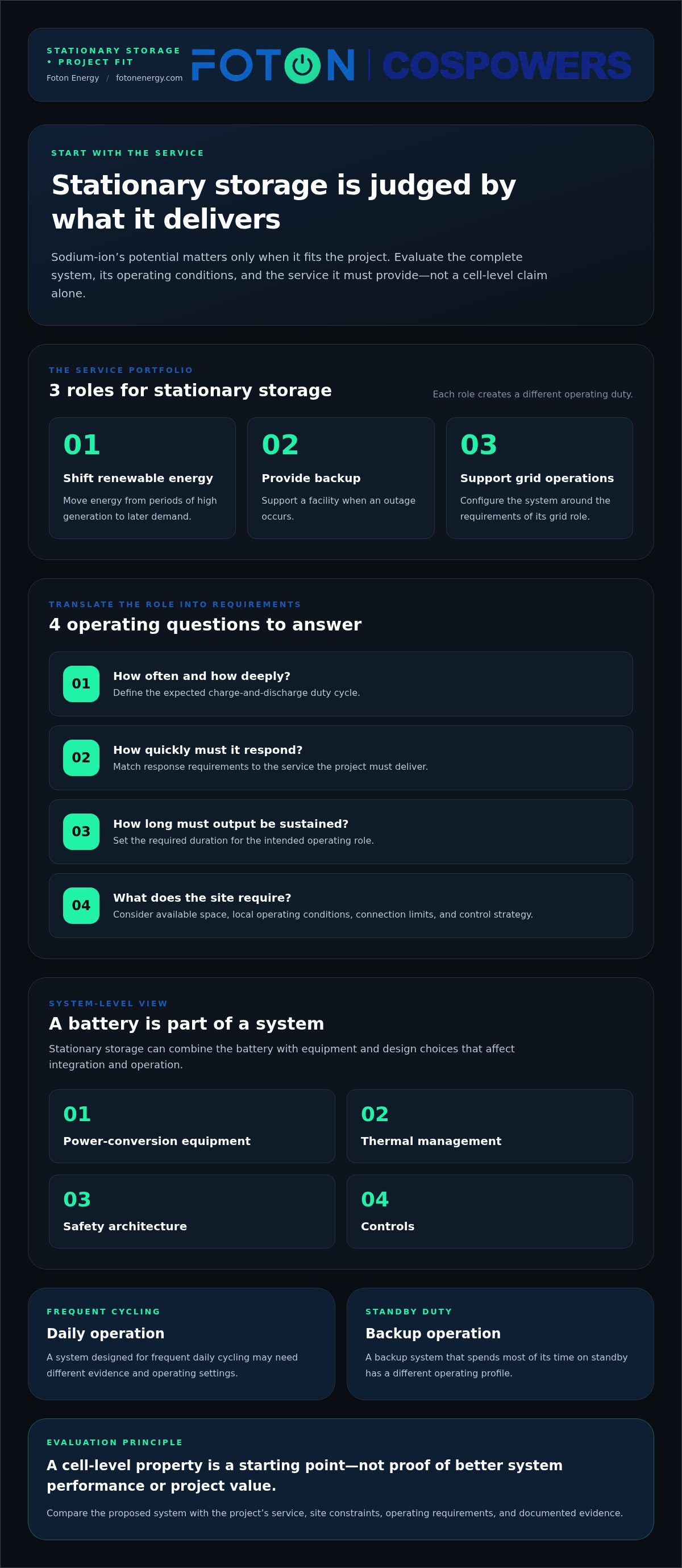
Stationary storage is judged by the service it delivers, not by how far a battery can travel. Sodium-ion batteries store and release electricity by moving sodium ions between electrodes. In a stationary installation, the battery is part of a system that can include power-conversion equipment, thermal management, safety architecture, and controls. The Sodium-ion battery technology overview explains the chemistry and its applications.
That fixed setting changes the evaluation. Vehicle batteries must balance range, weight, charging, and space. A stationary project may put more emphasis on dependable delivery, site footprint, integration, operating conditions, and supply resilience. These priorities don’t make one chemistry the automatic winner: requirements differ between a facility seeking backup power and a grid-connected system balancing renewable generation.
A cell-level property is only a starting point; system design and operating conditions determine the project outcome. That distinction is central when considering the benefits of sodium-ion batteries for stationary storage. Test chemistry claims against the complete system and its intended duty.
What stationary storage asks of a battery system
Stationary systems can shift renewable energy from periods of high generation to later demand, provide backup during an outage, or support grid operations. Each role creates a different duty cycle: how often and how deeply the battery charges and discharges, how quickly it must respond, and how long it needs to sustain output.
Requirements also depend on the site. Available space, local operating conditions, connection limits, and the project’s control strategy influence system configuration. A design for frequent daily cycling may need different evidence and operating settings from a backup system that spends most of its time on standby.
Why sodium-ion is gaining attention
Sodium-ion is another chemistry being considered for stationary applications alongside established options such as LFP. Sodium is widely available as a resource, which may support supply-chain diversification. That potential does not guarantee lower costs, stable component supply, or a stronger project case. Manufacturing scale, cell design, and system integration also affect what a project can achieve.
Stationary applications can place less emphasis on vehicle-specific priorities such as minimizing battery weight. That can make alternative chemistries worth evaluating, but it doesn’t remove constraints such as site footprint, performance requirements, or long-term operating needs. Chemistry alone also doesn’t establish a system’s safety profile. The cells, system architecture, thermal design, controls, and project conditions all matter.
Use an evidence-led comparison. Start with the service the project must provide, then assess whether the proposed system can meet its operating requirements with documented performance, safety, and lifecycle evidence. The sections that follow examine potential advantages and limitations in that project-level context, rather than treating a material attribute as a guaranteed outcome.
Five potential sodium-ion advantages: what drives each one
Potential advantages only create value when a project can verify them. Sodium-ion benefits vary by cell design, system configuration, manufacturing maturity, and operating conditions. Treat the five considerations below as project questions, not guarantees shared by every product. IRENA's perspective on sodium-ion batteries for energy storage provides context on material availability and the technology’s possible role in stationary applications.
Resource availability, supply resilience, and sustainability
Sodium is broadly available in nature, which may offer a route to diversify battery-material supply. But resource abundance is not the same as available cell capacity, mature supply chains, or lower delivered system cost. Component processing, manufacturing scale, logistics, and system integration also shape project value.
Environmental comparisons need equally careful boundaries. A credible lifecycle assessment should account for raw-material sourcing and processing, cell and system manufacturing, operating life and efficiency, replacement needs, and end-of-life handling. Without comparable assumptions across those stages, a claim of greater sustainability may reflect the assessment method as much as the technology.
Safety, thermal behaviour, and system architecture
Safety performance is product-specific. Cell chemistry can influence thermal behaviour, but it cannot establish the safety of a complete installation by itself. Protection systems, thermal management, controls, enclosure design, and operating conditions all contribute to system-level outcomes.
Validate claims of lower cooling demand or simpler thermal design against the proposed system’s operating limits and site conditions. The practical opportunity is not to assume fewer safeguards, but to design thermal management and protection around evidence for the specific cells and system.
For stationary projects, simplicity matters when it reduces integration burden without compromising protection or performance. Apply that principle to the benefits of sodium-ion batteries for stationary storage by asking questions the project team can test:
- Material availability: Broader sodium resources may support supply diversification, but assess actual sourcing and manufacturing capacity.
- Potential cost development: Costs may change as production scales, but compare project-specific system economics rather than assuming cell-level savings become installed savings.
- Thermal characteristics: Potential differences in thermal behaviour may affect design, but require evidence at the cell and system levels.
- Cold-weather operation: Sodium-ion is associated with potential low-temperature advantages. Examine operating data for the specific product and climate.
- Stationary design flexibility: Fixed installations may place less emphasis on vehicle weight, yet footprint, energy needs, and integration still constrain the design.
Use these attributes to guide due diligence: request comparable evidence, identify the conditions under which it applies, and connect it to the project’s operating strategy. Foton Energy provides engineering consulting and integrated storage solutions to support system-level assessment. Learn more about integrated storage project support.
Sodium-ion versus LFP: assess stationary storage by project fit
Neither chemistry wins every project. Compare sodium-ion and lithium iron phosphate (LFP) against the service, site, and operating strategy the system must support. LFP is a more established option, while sodium-ion is attracting interest for potential material-supply and low-temperature attributes. Those broad expectations are not a substitute for verified specifications from the cells and complete systems under consideration.
Match chemistry to duty cycle and site constraints
Start with the required power and discharge duration, then map how often the system will cycle and under what conditions. A space-constrained site may place a premium on footprint; a system in a cold climate may need closer review of operating limits and thermal design. Chemistry can inform these questions, but the specific system configuration determines whether it meets the project’s requirements.
Use the comparison below to structure the assessment. Treat chemistry-level expectations as screening prompts, not project specifications. Confirm system-level values against documentation for the proposed configuration and intended conditions.
| Project factor | Sodium-ion | LFP | Evidence to assess |
|---|---|---|---|
| Energy needs | Assess available energy and power for the required discharge profile. | Compare the same duty using the proposed LFP system. | Usable energy, power, operating limits, and discharge duration. |
| Footprint | Don’t assume a smaller installation from chemistry alone. | Compare the system’s actual space requirements. | Layout drawings and complete-system dimensions. |
| Operating profile | Check product-specific performance under planned cycling and temperatures. | Evaluate against the identical operating profile. | Relevant operating data and lifecycle assumptions. |
| Integration | Review compatibility with controls, thermal design, and site interfaces. | Apply the same integration review. | System architecture, control strategy, and interface requirements. |
| Evidence | Separate general chemistry claims from validated system specifications. | Review the equivalent system-level documentation. | Test evidence and specifications applicable to the proposed system. |
For example, a project with limited space should compare complete system layouts, not rely on a cell-level energy-density claim. A cold-weather use case needs evidence for operating performance at relevant temperatures, alongside the thermal design and controls that support it.
When complementary technology portfolios help
A portfolio that includes both sodium-ion and LFP can help align chemistry with different project roles, rather than force one option across every application. Procurement conditions, supply maturity, integration requirements, operating needs, and available evidence all influence the decision. The commercial and industrial BESS strategic guide outlines broader project considerations, while this 2026 sodium-ion commercial availability analysis adds context on market readiness.
The benefits of sodium-ion batteries for stationary storage matter when verified system performance, site fit, and operating requirements align. Compare both chemistries using the same project assumptions, then carry the strongest candidates into system validation.
A practical evaluation framework for sodium-ion stationary storage
Choose a chemistry only after the project requirements and system evidence align. A structured review helps teams distinguish promising attributes from performance they can rely on in design and financial planning. Keep sodium-ion and LFP comparisons on the same assumptions, and evaluate the complete system rather than the cell in isolation.
Define the use case and measurable requirements
Begin with the service the system must provide, then document its operating conditions. A renewable-shifting project, for example, may have a different schedule and energy requirement from a backup system designed to support critical loads. Define power, usable energy, discharge duration, cycling pattern, resilience objectives, and the system’s role in site operations.
Record site conditions before comparing options: operating temperatures, available footprint, grid or facility connection limits, and applicable project requirements. State assumptions clearly, including the operating schedule and analysis period. This gives each chemistry a consistent basis for assessment.
Screen in sequence, then validate the complete system
- Set measurable requirements. Define the service, power and energy needs, duty cycle, response expectations, and resilience targets.
- Document site constraints. Capture temperature conditions, footprint, connection interfaces, and project requirements that influence system design.
- Compare applicable performance evidence. Review product-specific data for the proposed configuration and operating conditions. Separate cell-level results from complete-system specifications.
- Review operating limits and lifecycle assumptions. Assess the evidence behind expected performance, degradation, maintenance, and replacement assumptions over the project analysis period.
- Assess safety and certification evidence. Examine test results and certification documentation for applicability to the specific cells and system. Consider protection architecture, thermal management, controls, and site integration together.
- Validate delivery and project economics. Include integration, commissioning, monitoring, and operating assumptions in the comparison. Check whether the system can meet project requirements as configured, not just under idealized cell-level conditions.
Sound chemistry selection requires product-specific evidence that connects cell performance to system operation, safety, lifecycle, and project economics. A certification or test result is useful only when its scope matches the proposed equipment and intended application. Projected economics should also use consistent assumptions for usable energy, operating strategy, system integration, and expected service life.
Controls are part of the assessment, not an afterthought. The energy management system (EMS) influences how the battery responds to site demand, grid signals, and operating constraints. Review the control strategy alongside thermal management and safety architecture, and consider how performance will be monitored after commissioning. Foton Energy’s AI-driven BESS energy management guide explores the role of controls in system operation.
Use this framework to test whether the benefits of sodium-ion batteries for stationary storage apply to your specific operating case. Foton Energy provides project-level engineering consulting and integrated storage solutions that connect chemistry, engineering, and system integration. Explore Foton Energy’s storage and engineering capabilities.
How Foton supports sodium-ion decisions for integrated storage projects
Chemistry selection is one part of a larger project decision. A stationary storage system must align equipment, controls, thermal design, safety architecture, and site requirements. Foton Energy supplies sodium-ion and LFP energy storage systems for commercial, industrial, utility-scale, residential, data-centre, and telecom applications, supporting project teams as they assess technology within an integrated system.
From battery selection to integrated BESS design
Engineering begins with the application and operating profile. A commercial facility managing demand, a utility project supporting the grid, and a data centre planning backup have different priorities. Those use cases inform system design, including thermal management, safety architecture, controls, and the interfaces between storage equipment and the site.
Foton Energy supports projects with engineering consulting, thermal management, safety architecture, and AI-driven energy management systems (EMS). The EMS is part of the broader approach to monitoring and managing energy. Consider its role and configuration alongside the project’s operating strategy, not as a substitute for appropriate equipment design.
Equipment selection also connects to delivery and long-term operation. Project teams can account for system integration and commissioning during planning, then include operating limits, monitoring needs, and lifecycle assumptions in their evaluation. These considerations help assess a chemistry’s potential attributes in the context of the full asset, rather than as isolated cell claims.
Foton Energy leverages decades of Tier-1 manufacturing heritage and robust supply chain partnerships. This foundation supports Foton Energy's role in supplying and assessing sodium-ion storage systems, while project decisions remain grounded in the application, system configuration, and relevant evidence.
Build a project-specific next step
For commercial, utility, and distribution project teams, a useful first discussion defines the intended service and the constraints that shape system architecture. Bring the expected operating profile, site conditions, connection requirements, footprint considerations, and project objectives into the evaluation. This creates a practical basis for comparing storage options and identifying the technical evidence needed.
The benefits of sodium-ion batteries for stationary storage depend on how well the chemistry and complete system match those requirements. Foton Energy connects storage supply with project-specific engineering and integration considerations, rather than relying on a one-size-fits-all recommendation. The aim is to assess how storage architecture, controls, thermal management, and safety design fit the project’s needs.
Start a project-specific discussion about suitable storage architecture and operating requirements. Explore Foton Energy’s integrated storage solutions.
Turn your storage priorities into a project brief
Translate your project objectives into a decision-ready set of requirements. Identify the service the system must deliver, the conditions it will operate in, and the evidence your team needs before selecting a chemistry. This creates a stronger foundation for technical review, procurement planning, and system design.
The benefits of sodium-ion batteries for stationary storage are most relevant when they align with defined needs and are supported by evidence for the proposed system. A focused project discussion can connect application requirements with storage architecture, engineering, controls, and long-term operating considerations.
Foton Energy brings storage supply and project engineering capabilities together to support that evaluation. Explore Foton Energy’s integrated storage solutions and take the next step toward an architecture shaped around your project’s priorities.
With clear requirements and a disciplined assessment, your team can move forward with a storage decision built for the work it needs to do.
Frequently Asked Questions
Are sodium-ion batteries suitable for stationary energy storage?
Yes, sodium-ion batteries can be suitable for stationary storage when the proposed system meets the project’s operating and site requirements. They may be considered for applications such as facility storage, backup, or grid support. Evaluate the system’s usable energy, output, operating limits, safety evidence, and lifecycle assumptions for the intended duty. The benefits of sodium-ion batteries for stationary storage depend on this fit, not the chemistry label alone.
What are the main benefits of sodium-ion batteries for grid storage?
Potential benefits include a battery chemistry based on broadly available sodium resources, possible supply-chain diversification, and attributes that may suit some operating conditions. Stationary grid projects can also place less emphasis on low battery weight than vehicles do. These points are reasons to assess sodium-ion, not proof of lower project costs or superior performance. Grid operators still need to validate response, duration, dispatch strategy, and system-level safety for the specific installation.
Can sodium-ion batteries reduce the cooling needs of a BESS?
Possibly, but don’t assume sodium-ion automatically needs less cooling. Thermal requirements depend on the specific cells, system design, operating conditions, and site environment. For a proposed BESS, examine thermal data across its planned charge and discharge profile, ambient temperatures, and enclosure design. Then assess how the thermal-management approach supports operating limits and protection. A chemistry-level statement alone can’t establish cooling equipment needs for the complete system.
How do sodium-ion and LFP batteries differ for stationary storage?
LFP is a more established stationary-storage chemistry, while sodium-ion is being evaluated for potential material-supply and operating-condition advantages. Sodium-ion and LFP systems can differ in usable energy, footprint, operating limits, lifecycle, and integration needs, depending on the product. For a fair comparison, use the same duty cycle and site assumptions, then compare system-level specifications and supporting evidence. Neither chemistry is automatically the best choice for every application.
Do sodium-ion batteries use more abundant materials than lithium-ion batteries?
Sodium is more broadly available in nature than lithium, which may create opportunities to diversify battery-material supply. However, a cell uses more than its headline element: cathode materials, hard carbon, processing, and manufacturing capacity also affect supply resilience. Greater resource availability doesn’t guarantee that all components are readily sourced or that a complete battery system will cost less. Assess the supply chain for the particular chemistry and product.
What should developers verify before choosing a sodium-ion BESS?
Developers should verify product-specific performance for the intended duty, operating limits, safety and test documentation, lifecycle assumptions, and project economics. Check that the evidence applies to the actual cells and complete system under consideration, rather than relying on generic chemistry claims. Also review grid or site interfaces, thermal design, controls, commissioning needs, and plans for ongoing monitoring. These checks help reveal whether the system can meet the project’s requirements in practice.
Can sodium-ion batteries support renewable energy integration?
Yes. A sodium-ion BESS can store surplus renewable electricity and discharge it later, subject to the system’s capabilities and project design. For example, a site might charge during periods of strong solar generation and use stored energy when generation falls. The project must be sized and controlled for its generation and demand patterns, connection limits, and required discharge duration. Assess those factors alongside system performance evidence before selecting a chemistry.


