

A brief power spike can set the demand peak that shapes your bill for the entire billing period. If you’re asking how to reduce commercial electricity demand charges, start by finding out what created that peak, not by assuming a battery is the answer. Review the tariff and your site’s load profile together to identify which demand readings affect the bill and what caused them.
Demand charges and energy-use charges measure different things. Energy charges reflect electricity consumed over time, measured in kilowatt-hours (kWh). Demand charges are typically based on the highest power draw, measured in kilowatts (kW), during a set interval. The tariff determines how that interval is measured and which periods count. A short spike from overlapping equipment may therefore affect the bill differently from steady consumption.
This guide explains how to read the relevant parts of your bill, identify when and why peaks occur, and prioritise operational changes such as staggering equipment starts. You’ll also learn how interval data, intelligent energy management, and battery storage can help address recurring peaks, and what to assess before making a capital investment. The practical sequence is to understand the measured peak first, then evaluate solutions against the remaining load.
Key Takeaways
- Learn which tariff details determine your billed peak, and how that differs from total electricity consumption.
- Use bills and interval data to trace demand peaks to recurring patterns, equipment, or one-off events.
- Compare scheduling, load sequencing, control upgrades, and battery storage against your site’s operating conditions before investing.
- Build a practical baseline and measure results under comparable operating conditions to see whether changes are working.
- Discover how to reduce commercial electricity demand charges by matching operational strategies, energy management, and potential BESS to your tariff and load profile.
How commercial electricity demand charges work, and what determines the billed peak
Demand charges measure how much power a site draws at a particular time, not just how much electricity it uses. They’re tariff charges tied to measured power demand, usually expressed in kilowatts (kW). Energy charges, by contrast, are based on electricity consumed over time, measured in kilowatt-hours (kWh). Understanding this distinction is essential before deciding how to reduce commercial electricity demand charges.
Billing demand is the level of power demand used to calculate a demand charge under a specific tariff. The tariff sets how that figure is measured and whether additional rules, such as peak windows or demand ratchets, affect it.
Demand charges versus energy charges on a commercial bill
Consider equipment drawing 10 kW for two hours: it uses 20 kWh of energy. A separate, brief period when several machines run together could create a much higher measured kW demand, even if the site’s total monthly kWh remains similar. Depending on the tariff, that peak may affect a demand charge independently of the energy charge.
On a bill, look for labels such as “demand,” “peak demand,” or “capacity.” Retailers may use different terms, and some bills show several demand-related components. Use the bill definitions and tariff documents to establish what each line measures. This example explains the difference between power and energy, not a universal billing calculation.
Which tariff rules shape the demand charge?
The exact calculation depends on the applicable tariff and contract. A tariff may define demand using an interval average, specify particular peak windows, or apply different rules by season. For example, demand might be measured over a 15- or 30-minute interval, but these periods aren’t universal. The method determines how a short burst of load is reflected in the billed figure.
Some tariffs also include demand ratchets, which can link billed demand to a prior peak, or contracted-demand provisions that set a specified capacity level. These rules apply only where the tariff includes them, and their details vary. Review the tariff schedule alongside the bill definitions. Don’t assume the highest reading shown by a meter is automatically the number used for billing.
For a useful first review, identify the billing period, demand unit, measurement interval, and any stated peak or seasonal window. Then establish whether the tariff refers to actual, billed, or contracted demand, and look for provisions that carry past peaks into a later bill. Record the relevant rules before analysing interval data. This helps distinguish a one-time operational spike from a peak that may affect billing again.
How to find the load peaks driving your commercial electricity demand charges
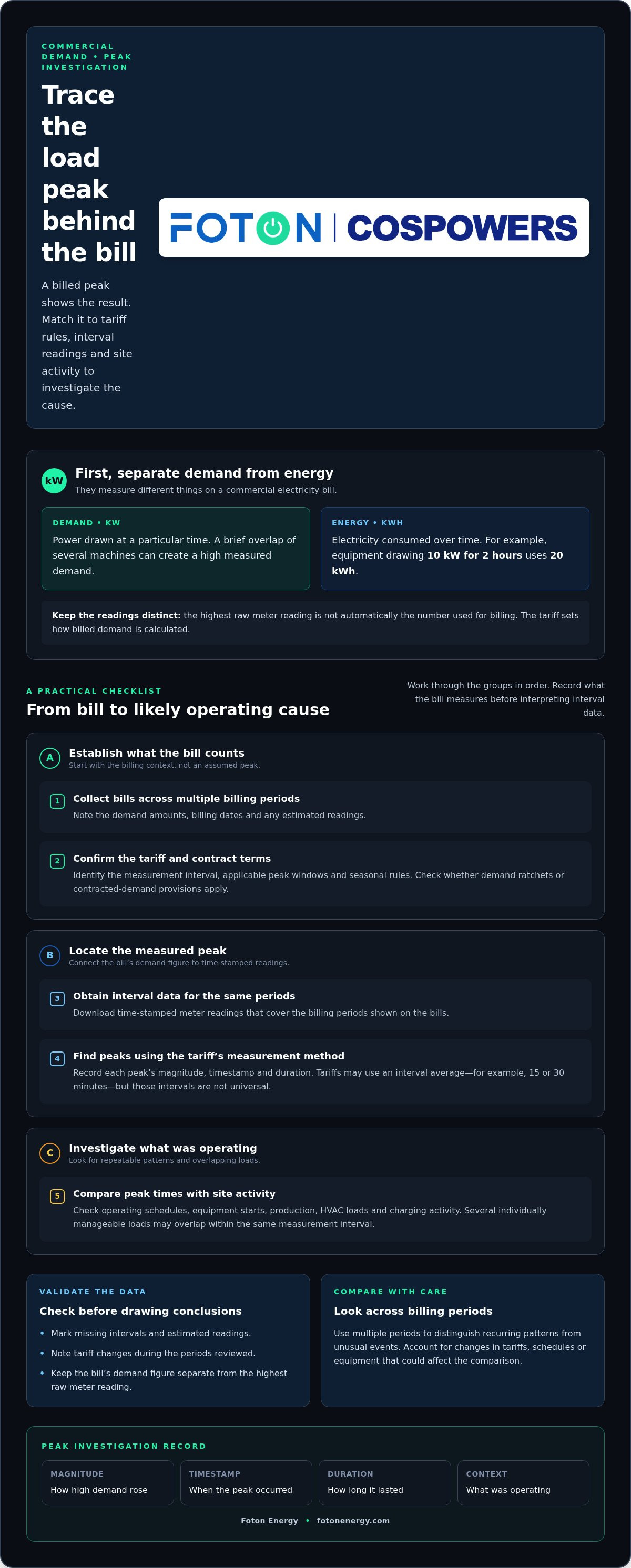
A billed peak tells you the result, not the cause. To identify what drove it, connect the bill’s demand figure to interval readings and the site’s operating records. Review multiple billing periods to distinguish recurring patterns from unusual events, while accounting for changes in tariffs, schedules, or equipment that could affect comparisons.
Use this workflow to move from the bill to a likely operational cause:
- Step 1: Collect bills. Gather bills for multiple billing periods and note the demand amounts, billing dates, and any estimated readings.
- Step 2: Confirm the tariff. Identify the applicable tariff and contract terms, including the measurement interval and any relevant peak windows or seasonal rules.
- Step 3: Obtain interval data. Download time-stamped meter readings that cover the same billing periods as the bills.
- Step 4: Locate the peaks. Align the data with the tariff’s measurement method, then record each peak’s magnitude, timestamp, and duration.
- Step 5: Investigate causes. Compare peak times with operating schedules and equipment activity before deciding which loads may be controllable.
Read bills and interval data together
Match the billed demand to the relevant billing period and the interval specified in the tariff. Then chart interval-meter readings across operating hours, paying particular attention to any applicable peak windows. This helps distinguish a high reading outside a chargeable window from one that may have contributed to billed demand.
Check data quality before drawing conclusions. Mark missing intervals, estimated readings, and tariff changes during the periods under review. Keep the demand figure shown on the bill separate from the highest raw reading in the data. The tariff’s calculation rules determine how those values relate.
Trace peaks back to site operations
For each peak timestamp, compare meter data with equipment starts, production schedules, HVAC loads, and charging activity. Look for combinations: several individually manageable loads may overlap during the same measurement interval. Record the peak’s magnitude, timing, duration, and operating context so recurring causes are easier to distinguish from one-off events.
Interval data helps identify the events behind a billed peak: the bill shows the chargeable result, while time-stamped readings show when demand rose and what was operating. If a suspected cause appears repeatedly, note which loads can be rescheduled and which are constrained by safety, process requirements, or output commitments. A demand-management change should not compromise safe operations or production.
This diagnosis is the practical starting point for how to reduce commercial electricity demand charges: act on measured causes rather than assumptions. Where the analysis points to a complex load profile, site-specific engineering consulting can help connect interval data, operating needs, and a potential demand-management approach.
Compare demand-charge reduction strategies before investing in storage
Start with the least complex measure that can address the peak you’ve identified. If loads overlap because equipment starts at the same time, test scheduling or sequencing before adding storage. If the peak is frequent, difficult to shift, or tied to operational needs, controls or a battery may warrant closer assessment. The right choice depends on the tariff, load profile, and site constraints.
| Strategy | Mechanism | Suitable conditions | Data required | Key limitations |
|---|---|---|---|---|
| Operational scheduling | Shifts flexible processes outside relevant peak periods. | Production, charging, or other tasks have scheduling flexibility. | Peak timestamps, operating schedules, and tariff windows. | May be constrained by deadlines, staffing, or process requirements. |
| Load sequencing | Staggers equipment starts to reduce coincident demand. | Several large loads start together and can be started in sequence. | Equipment start profiles, interval readings, and operating constraints. | Requires safe sequencing and may not address unrelated peaks. |
| Control upgrades | Adjusts or coordinates controllable loads, such as HVAC or pumping. | Existing controls can respond to measured demand without disrupting operations. | Load behavior, control settings, operating limits, and tariff rules. | Results depend on the site and how controls interact with processes. |
| Battery storage | Dispatches stored energy to limit grid demand during selected intervals. | Peaks recur and their timing and duration can be addressed within system capabilities. | Interval data, tariff, peak duration, required power and usable energy, and reserve needs. | Tariff structure, operating needs, and system efficiency affect outcomes. |
Operational changes that may reduce coincident peaks
Check whether equipment starts, flexible production steps, or EV charging can be staggered or shifted beyond measured peak periods. HVAC, refrigeration, and pumping may also offer scheduling or control opportunities, but only where site conditions and operating requirements permit. Test changes against demand data and document their effects. These measures depend on the site and don’t guarantee savings.
When battery storage may fit the load profile
Peak shaving uses stored energy to limit grid demand during selected intervals. An assessment should match recurring peak timing and duration with the battery’s required power, usable energy, and reserve requirements. A short, sharp peak presents a different operating need from a longer period of elevated demand. Tariff rules, operational constraints, and system efficiency all influence whether storage is practical.
Solar generation alone doesn’t guarantee a lower billed peak. Its output must coincide with the relevant demand interval, and tariff rules determine how the measured peak is calculated. Compare actual or modelled site demand with solar production timing rather than assuming daytime generation will reduce the charge.
For broader system-planning context, the commercial and industrial BESS strategic guide explains how to evaluate storage as part of a wider energy strategy. For businesses weighing how to reduce commercial electricity demand charges, a measured sequence is often clearest: test operational changes, assess control options, then size storage to the remaining peak profile.
How to build and validate a demand-charge reduction plan
A demand-management plan needs a clear baseline, a defined intervention, and a way to verify the result. Without those steps, a lower bill may reflect changes in production or weather rather than the measure you introduced. Use a consistent process to connect tariff rules and site operations to measurable outcomes.
- Review the tariff. Confirm which demand metric is billed, how it is measured, and whether time windows or other tariff provisions affect the calculation.
- Set a baseline. Select comparable billing periods and record billed demand, peak intervals, and relevant operating conditions. Note differences in production, weather, occupancy, and operating hours.
- Define success criteria. Choose the measures you’ll track, such as billed kW, the number or timing of peak intervals, and demand-charge line items.
- Choose and document one intervention. Record what changed, when it began, and which loads or operating practices it affects. Where practical, avoid combining several changes at once so their effects are easier to interpret.
- Measure and adjust. Compare post-change results with the baseline using comparable periods. Account for operating changes, then refine the approach if the peak shifts or the measure affects business requirements.
Cost objectives must sit alongside reliability, safety, and business continuity. A plan that lowers a measured peak but disrupts a critical process is not a sound operating outcome. Document constraints before implementation and include them in your success criteria.
Set success criteria before implementing a change
Choose a primary metric that matches the tariff and the intended intervention. A scheduling change may aim to reduce demand during specific intervals, while a broader plan may track billed demand and related charge line items. Record production levels, weather, occupancy, operating hours, and unusual events for each comparison period. These notes help distinguish an intervention’s effect from a change in site conditions.
Use monitoring and energy management to maintain control
An energy management system (EMS) can provide visibility into load behaviour and support operational decisions as conditions change. Its usefulness depends on the available data, the loads being monitored, and how teams apply the insights. AI-driven energy management can also inform how monitoring fits into a wider energy plan.
Engineering analysis can connect interval data with tariff rules and operating requirements when a proposed change involves coordinated controls or storage design. Savings estimates require tariff-specific modelling and verified site data; they shouldn’t be treated as universal projections. Record the assumptions and compare measured outcomes against the baseline before scaling a change.
Foton Energy’s engineering consulting and energy management solutions support demand analysis and system design.
How Foton Energy supports commercial demand management with BESS and EMS
Storage is a potential tool, not an automatic answer. A commercial and industrial battery energy storage system (BESS) should be considered after the site’s tariff, interval data, and operating priorities show that storage may address a recurring, measurable peak. Foton Energy (Foton Pty Ltd) brings together C&I storage, an AI-driven energy management system (EMS), and engineering consulting to support a site-specific assessment, from understanding the load profile to developing a system concept.
This measured approach matters because a battery’s contribution depends on how its operation relates to the tariff’s demand calculation. A peak outside a chargeable window, a billing rule that carries earlier demand forward, or operating needs that require the battery to retain energy can all affect the analysis. The objective is to understand the site first, then determine whether storage belongs in a broader strategy for how to reduce commercial electricity demand charges.
Connect site analysis to a right-sized storage concept
A feasibility assessment brings together interval data, demand intervals, tariff rules, and site operating priorities. It considers whether peaks recur, when they occur, how long they last, and whether they can be addressed without conflicting with business requirements. This informs whether storage merits further design work, rather than assuming every high reading calls for a battery.
Power and energy capacity describe different parts of the requirement. Power relates to how much demand the system can deliver at a given time; usable energy relates to how long it can sustain that delivery. A brief peak and a sustained period of high demand therefore present different design questions. Reserve requirements and other site needs also shape the concept. Any estimate of demand-charge reduction should follow modelling against verified site data and the applicable billing rules.
Integrate storage, monitoring, and engineering
An EMS can provide real-time visibility into energy use and support coordinated system operation. Monitoring helps teams understand how loads behave and assess whether a planned response aligns with site conditions. Foton’s AI-driven EMS supports real-time monitoring and grid optimisation; its role in a demand-management strategy depends on the system design and site needs.
Engineering consulting connects load analysis and tariff requirements with project feasibility, system design, and grid-code-compliance considerations. This coordination helps evaluate the technical concept alongside operational priorities, rather than treating battery capacity, monitoring, and tariff analysis as separate decisions.
Foton Energy (Foton Pty Ltd) provides advanced C&I storage offerings, including LFP and sodium-ion systems. These chemistries can be considered during project development, alongside site-specific suitability and long-term performance requirements.
If your interval data and tariff analysis point to a potential role for storage, explore Foton Energy’s storage solutions as part of a measured demand-management strategy.
Turn your demand data into a stronger energy strategy
Turn your analysis into a decision your operations team can stand behind. Use the tariff and site data to establish what needs to change, then compare practical interventions against reliability, safety, and business priorities. This gives your team a clear basis for deciding whether to adjust operations, improve monitoring, or assess storage as part of a longer-term plan.
Knowing how to reduce commercial electricity demand charges starts with measurement, not a one-size-fits-all solution. As your load profile and energy needs evolve, revisit the assumptions behind your plan and validate changes against actual site conditions.
Explore Foton Energy’s commercial storage solutions to assess how storage could fit within your wider energy strategy.
Frequently Asked Questions
What is a demand charge on a commercial electricity bill?
A demand charge is a tariff fee based on a business’s measured power demand, rather than the total electricity consumed. It may appear as a separate line item or be included among other delivery or capacity charges, depending on the retailer’s bill format. Review the bill glossary and tariff schedule together to identify it. The charge’s name alone may not reveal how it’s calculated or which demand reading applies.
How is peak demand measured for commercial electricity charges?
Peak demand is measured according to the method specified in the applicable tariff, often using meter readings over defined intervals. A utility may calculate average demand across an interval rather than use a momentary reading, and the tariff may distinguish between peak periods. For example, a meter’s highest instantaneous value may not match billed demand. Compare the bill with interval data and confirm the measurement method in the tariff.
Can a business reduce demand charges without installing a battery?
Yes. A business may lower its billed peak by changing when flexible equipment operates, staggering starts, or adjusting suitable control settings. For example, a facility might avoid starting a large process at the same time as scheduled vehicle charging, if operations allow. These steps can be a practical first test for how to reduce commercial electricity demand charges. Track the relevant readings and confirm that the tariff calculation reflects the change.
Will solar panels reduce commercial demand charges?
Not necessarily. Solar generation can reduce the power a site draws from the grid while the system is producing, but it won’t automatically lower the demand value used for billing. The outcome depends on whether generation coincides with the tariff’s demand measurement period and how the tariff defines billed demand. Compare site load with solar output across the relevant intervals. A timing mismatch can leave the chargeable peak largely unchanged.
How can a battery reduce commercial electricity demand charges?
A battery can discharge during a targeted high-demand period, supplying some of the site’s load and potentially limiting power drawn from the grid. Whether that changes the bill depends on the tariff’s rules, peak timing, and the system’s operating limits. A useful assessment examines how often peaks occur, how long they last, and what reserve the site needs. Model these conditions against verified data before estimating bill impacts.
What data does a business need to analyse demand charges?
Gather bills, the applicable tariff and contract, and time-stamped interval-meter data covering the same billing periods. Add operating calendars showing production schedules, equipment use, charging activity, and unusual shutdowns or events. Weather, occupancy, and production records can help explain differences between periods. Check for estimated readings or missing intervals before comparing peaks, since data gaps can obscure the timing or cause of a demand event.
Do all commercial electricity tariffs include demand charges?
No. Tariff structures vary by market, utility, customer type, and contract. Some include a charge tied to measured demand, while others use different billing components or have no separate demand-charge line. Certain tariffs may use subscribed capacity or other arrangements instead of a conventional peak-demand calculation. Review the current tariff documents and bill definitions, especially after a contract or rate-plan change, to understand which charges apply to your site.


