

Sodium’s abundance doesn’t guarantee a resilient battery supply chain. The real test is whether materials can be processed, cells manufactured, and suppliers qualified at the scale and reliability your project requires. That’s the distinction behind the sodium-ion battery supply chain advantages: material diversification has value only when dependable industrial capacity supports it.
If you’re concerned about concentrated sources of battery materials, sodium-ion may broaden your options, particularly for stationary storage. But abundance alone doesn’t resolve questions about manufacturing maturity, supplier bankability, or project fit. Sodium-ion is an option to evaluate, not a universal replacement for lithium-ion.
This guide explains how to assess where sodium-ion could strengthen supply-chain resilience and where constraints remain. You’ll learn what to examine in material sourcing, processing and manufacturing readiness, supplier qualification, and project fit. Use the practical checks throughout to weigh supply-chain evidence alongside your application’s technical and deployment requirements.
Key Takeaways
- Assess the full battery supply chain, from materials and processing to cell production and system integration, rather than judging resilience by chemistry alone.
- Understand how sodium’s broad availability may support the sodium-ion battery supply chain advantages, while distinguishing raw resources from qualified battery-grade materials.
- Evaluate manufacturing scale, quality control, and regional production evidence before treating sodium-ion as a dependable source of project supply.
- Use a structured diligence process to separate supply-chain resilience from cell performance, safety, and project economics.
- Match sodium-ion or LFP to your project’s requirements, then connect technology selection with system design and deployment planning.
What sodium-ion battery supply-chain advantages mean for energy storage buyers
A resilient battery supply chain depends on more than plentiful raw materials. It includes the feedstocks and refined materials used in cells, cell components and production, and the system integration that turns cells into an operating battery energy storage system (BESS). Each stage can affect availability, quality, traceability, and whether supply meets a project’s deployment schedule.
The potential sodium-ion battery supply chain advantages start with the possibility of using more widely available inputs than some lithium-ion chemistries require. But resource abundance isn’t the same as dependable access to battery-grade materials. Those materials still need suitable processing, consistent quality, qualified suppliers, and production capacity that meets project requirements. For a technology overview, see Sodium-ion battery technology overview.
Which stages shape a sodium-ion battery supply chain?
Follow the value chain from upstream resources through to deployment. Processing capability and qualified suppliers matter at every transition. A source of raw material alone can’t guarantee a consistent supply of cells or a system ready to operate.
- Upstream: Feedstocks, material extraction or recovery, refining, and production of battery-grade active materials.
- Midstream: Cell components, electrode preparation, cell manufacturing, testing, and quality control.
- Downstream: Cells assembled into modules or packs, then integrated with the BESS architecture, controls, and site requirements.
This breakdown helps pinpoint supply-chain exposure. A material may be widely available even when the processing capacity or qualified manufacturing needed to turn it into dependable cells is limited. Trace key inputs through cell production and system integration rather than treating the chemistry label as proof of sourcing diversity.
Why supply-chain resilience matters to BESS procurement
Sourcing diversity can give buyers alternatives if a supplier, processing route, or transport channel is disrupted. It can also make procurement dependencies and potential substitutions easier to plan for. The risks vary by project: a smaller installation with a flexible schedule may face different constraints from a large deployment with a fixed milestone and defined operating requirements.
Assess supply-chain claims against four procurement priorities:
- Resilience: Identify critical dependencies and whether qualified alternatives exist.
- Traceability: Understand how suppliers document material origins and processing stages.
- Scale: Establish whether manufacturing capacity can support the project’s required volume and schedule.
- Qualification: Confirm that cells and integrated systems meet the project’s technical and operational requirements.
These checks belong within system-level procurement, alongside design. A BESS must suit its duty cycle, site conditions, controls, and deployment objectives. The commercial and industrial BESS strategic guide provides related context for evaluating storage as an integrated project. Sodium-ion may offer more sourcing options, but resilience still depends on qualified materials, manufacturing, and integration being available when the project needs them.
Sodium-ion battery materials: where sourcing diversity may create an advantage
Sodium-ion can change which material dependencies buyers need to manage, but it doesn’t remove supply-chain risk. Sodium is broadly available in natural compounds, which may offer an alternative to lithium-based inputs. But raw-resource availability is only the starting point. Battery-grade materials must be processed to the required quality and supplied consistently. Manufacturing capacity and other cell components also affect dependable procurement.
How sodium-ion inputs differ from lithium-ion inputs
Neither chemistry has one universal recipe. Sodium-ion cathodes use different material families, and anodes often use hard carbon. Lithium-ion batteries also have varied cathode chemistries and commonly use graphite anodes. Electrolytes and other components depend on cell design. The comparison below summarizes common examples, not every cell formulation. Chemistry examples are discussed in Vaalma et al., Journal of Power Sources (2018); lithium-ion supply-chain context is covered in the International Energy Agency’s Global Supply Chains of EV Batteries (2022).
Input | Sodium-ion | Lithium-ion
Active materials: Sodium-bearing compounds are processed into cathode materials, which vary by design. Lithium-based cathodes also vary and require processed lithium inputs. Source: Vaalma et al. (2018); IEA (2022).
Anode: Hard carbon is used in many sodium-ion designs; graphite is common in lithium-ion cells. Source: Vaalma et al. (2018).
Electrolyte: Formulations vary across both chemistries. Assess the actual cell specification rather than assuming a universal input. Source: Vaalma et al. (2018).
Current collectors: Sodium-ion designs can use aluminum on both electrodes, while conventional lithium-ion designs commonly use copper for the anode. This may diversify demand for collector materials, but doesn’t establish supply security by itself. Source: Vaalma et al. (2018).
The practical takeaway is specific: sodium-ion may diversify dependence on lithium and, in some designs, copper anode collectors. It doesn’t eliminate reliance on processed cathode and anode materials, electrolytes, components, or qualified cell manufacturing. Because chemistry choices vary, request the material specifications for the actual cell under consideration rather than treating a broad chemistry category as a bill of materials.
When material abundance does not guarantee supply security
A resource can be abundant while battery-grade processing remains limited, concentrated, or unable to deliver consistent quality at the scale a project needs. A change in chemistry also doesn’t automatically create geographically diverse supply: refining, component production, and cell manufacturing may still depend on a narrow set of suppliers or regions. For buyers, the relevant evidence is traceable sourcing and qualified capacity, not resource abundance alone.
Evaluate material claims alongside manufacturing readiness and the project’s procurement timeline. When comparing options, check whether the stated sourcing and production evidence applies to the specific cell and system you’re considering. Foton Energy’s engineering consulting can connect chemistry selection with system requirements and deployment planning through its energy-storage project capabilities.
Manufacturing scale and regional diversification: the advantages still depend on execution
A factory announcement isn’t the same as dependable BESS supply. Sodium-ion manufacturing must demonstrate consistent cell quality, repeatable production, and the ability to deliver output qualified for the intended application. Regional production may broaden sourcing options, but a change in chemistry alone doesn’t establish that a supply chain is geographically diverse or ready to support a project.
What must scale beyond the cell chemistry?
Cell production depends on more than a viable chemistry. Manufacturers need process controls that maintain consistency, access to required components, quality systems that detect defects, and production yields that support reliable output. During ramp-up, a line’s planned nameplate capacity may differ from the volume of cells it can consistently produce and release to customers.
Distinguish four stages of manufacturing evidence:
- Announced: Capacity or a facility has been planned or publicized.
- Commissioned: Equipment is installed and the line has begun operations.
- Qualified: Output has passed testing and approval relevant to the intended use.
- Repeatable: Production and delivery can be sustained at the quality and volume required.
Pilot activity can demonstrate technical progress, but it doesn’t establish commercial-scale performance by itself. Cell output alone doesn’t equal usable BESS supply either. Modules, system architecture, controls, engineering, and site integration must work together. A manufacturer’s broader production heritage can provide useful context, but assess evidence for the specific chemistry, production line, and system being considered.
How to assess claims of geographic diversification
Map the chain by production location, not by a supplier’s headquarters or the country named in a product description. Trace where key materials are processed, where cells are manufactured, and where systems are assembled. Then identify which steps are operational, which depend on single sources, and what evidence supports claims of available, qualified capacity.
- Request a stage-by-stage map of material processing, cell production, and system assembly locations.
- Separate planned capacity from operational output, and establish whether the output is qualified for the project’s intended application.
- Compare supplier disclosures with credible independent sources, and record the date and scope of each claim.
- Label gaps clearly. If production volume, utilization, qualification status, or sourcing location isn’t disclosed, treat it as unknown rather than assuming capacity is available.
Capacity, production, and market-share figures can change quickly and may describe different measures. Verify each figure against a dated, credible source and confirm what it measures before relying on it for procurement. Sodium-ion battery supply chain advantages become meaningful when evidence shows that qualified production, components, and integration are available in the locations and volumes a project can use.
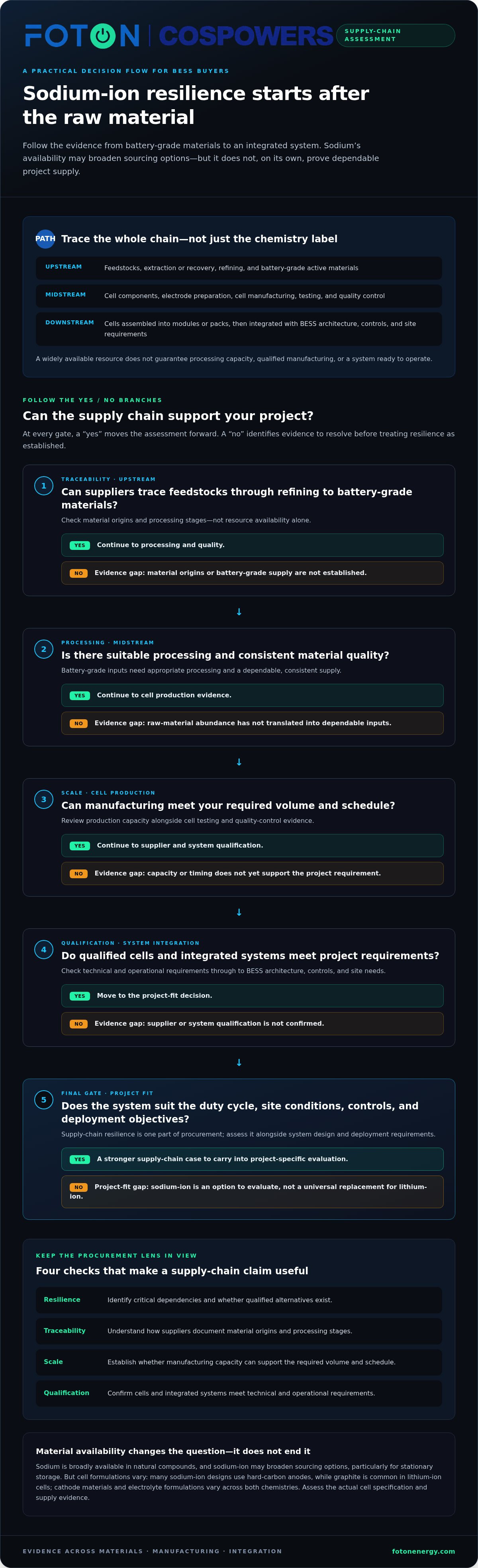
A practical framework for evaluating sodium-ion supply-chain claims
Turn broad claims into evidence tied to your project. A supplier may describe materials as abundant or production as scalable, but procurement decisions need to establish what is traceable, operational, qualified, and relevant to the required system. Keep supply-chain resilience distinct from cell performance, safety, and project economics. These factors inform the same decision, but evidence for one doesn’t prove the others.
Five checks for supplier and supply-chain readiness
Use this sequence to move from project needs to verifiable supply-chain evidence. Record what is documented, what remains unclear, and how each gap could affect procurement or qualification.
- Define the project requirement. Set the application, deployment scale, operating profile, required milestones, and system-level constraints first. This gives every later claim a practical reference point.
- Map key inputs and locations. Trace critical materials through processing, component production, cell manufacturing, and system assembly. Note disclosed sourcing dependencies and distinguish named locations from assumptions.
- Review manufacturing readiness. Examine the manufacturer’s relevant production heritage, quality processes, and evidence of repeatable output. Separate announced capacity or pilot activity from commissioned production and qualified cells.
- Check documentation and traceability. Review material-origin disclosures, production records, quality-control information, and qualification documents. Where certifications are relevant, confirm their scope, applicability, and status for the project rather than relying on a general reference.
- Assess system qualification. Establish whether the cells and integrated system have evidence appropriate to the intended application, operating conditions, and project requirements. Record unresolved gaps and the steps needed to close them.
Translate supply-chain evidence into project fit
A well-documented source map can improve visibility, but it doesn’t establish that a system will meet a project’s operating needs. Assess supply resilience separately from cell-level performance, safety characteristics, and economics. Then connect each assessment to system design, including thermal management, safety architecture, controls, energy management, and integration requirements.
For example, a project with a fixed deployment milestone may place greater weight on demonstrated production readiness and documented supply planning. A project with a distinct operating profile should also confirm that the proposed cell and system configuration suit its performance requirements. Compare technologies against project criteria, not a general claim that one chemistry is better. The sodium-ion versus lithium energy-storage comparison can help frame that technology-level evaluation.
The strongest case for sodium-ion battery supply chain advantages links sourcing and manufacturing evidence to a qualified system and a realistic deployment plan. Foton’s engineering consulting connects technology selection with system design and energy management integration. Explore Foton’s BESS and engineering capabilities for context on how these elements can be aligned with a project.
How Foton connects sodium-ion supply options with integrated BESS deployment
A battery’s supply chain creates value when it leads to a system suited to the project. Sodium-ion is one option in Foton Energy (Foton Pty Ltd)’s storage portfolio alongside LFP. The right choice depends on the application, operating profile, site conditions, and procurement requirements, not chemistry alone. Assessing sodium-ion battery supply chain advantages means looking beyond cell sourcing to feasibility, system design, controls, and deployment readiness.
From battery supply to an integrated storage system
Cells and modules are building blocks, not a complete BESS. Their performance and availability need to be considered within the system architecture, which includes power conversion, controls, thermal management, safety measures, and the site’s electrical and operating requirements. The configuration needs to suit the project, whether it serves commercial and industrial operations, utility-scale storage, or data-centre and telecom backup.
Engineering consulting connects technology selection with feasibility, system design, and grid-code considerations. These questions matter early: project requirements can shape which system architecture is viable, while commissioning planning helps align equipment, controls, and site integration. Include these steps in supply-chain planning. Cells that can’t be integrated and commissioned to meet project requirements don’t constitute a ready-to-deploy storage solution.
Foton Energy (Foton Pty Ltd)’s AI-driven Energy Management System is part of this system-level approach. It supports integration of storage with project operating objectives, while engineering work considers how the selected technology fits into the wider system. Thermal management and safety architecture also need to be addressed in system design, with requirements assessed for the actual equipment and application. No single chemistry or configuration suits every deployment.
Where Foton fits in the supply chain
Foton Energy (Foton Pty Ltd) brings extensive manufacturing heritage and supply chain expertise, providing useful context when evaluating the relationship and the manufacturer’s experience. Heritage isn’t a substitute for project-specific evidence: buyers still need to assess the relevant system, technical requirements, qualification documents, and deployment plan for their application.
Foton Energy (Foton Pty Ltd) connects sodium-ion and LFP options with engineering consulting and energy management integration for commercial, industrial, utility-scale, data-centre, and telecom applications. This project-led approach ties technology selection to the full operating system rather than treating cell chemistry as the whole decision. The aim is to align supply, design, controls, and long-term operation with the project’s requirements.
Bring your application, operating priorities, site context, and procurement milestones into the discussion to assess technology and system fit. Discuss a sodium-ion BESS project with Foton Energy (Foton Pty Ltd).
Turn supply-chain insight into a confident project decision
Turn your priorities into a decision brief: identify which supply dependencies matter most, what evidence your team needs, and how storage must perform over the project’s operating life. Use the brief to compare technology options against actual procurement milestones and system requirements. Sodium-ion battery supply chain advantages matter only when they support a solution that is feasible, qualified, and aligned with the intended deployment.
Foton brings sodium-ion and LFP options together with engineering consulting and AI-driven energy management integration, connecting technology evaluation with system planning. As Cospowers’ exclusive global strategic partner, Foton can also bring relevant manufacturing context into the discussion, including Cospowers’ more than 30 years of manufacturing heritage. The focus is your project’s requirements and the fit between supply, design, and operation.
For a project-focused discussion of technology selection and integrated storage, talk with Foton about your energy storage project.
Frequently Asked Questions
Is sodium-ion battery supply less dependent on critical minerals than lithium-ion supply?
It can reduce reliance on lithium, but it doesn’t eliminate dependence on processed battery materials. Sodium-ion formulations differ, and some may avoid metals used in certain lithium-ion cathodes, while others use different materials with their own sourcing requirements. For procurement, compare the bill of materials for the specific cells under consideration. “Less dependent on critical minerals” isn’t a blanket claim that every sodium-ion supply chain has lower material risk.
Can sodium-ion batteries reduce supply-chain concentration risk for BESS projects?
Potentially, but the chemistry alone doesn’t guarantee diversified sourcing. A project may still depend on a limited number of processors, component suppliers, or cell manufacturers. Test the claim by identifying whether key inputs and production stages come from genuinely independent sources, rather than different suppliers relying on the same upstream facility. This matters particularly when procurement rules, local-content objectives, or a fixed construction schedule make particular supply routes important.
How mature is sodium-ion battery manufacturing in 2026?
Manufacturing is progressing from development toward commercial applications, but readiness varies by producer, cell design, and intended use. An announced factory or product launch doesn’t establish sustained output for a BESS project. In 2026, assess the specific line’s operational status, repeatable production, quality records, and evidence that its cells are qualified for the intended system. Treat broad market forecasts as context, not proof of supply available for your procurement schedule.
What materials are used in sodium-ion batteries?
Materials depend on the cell chemistry. A typical design includes a sodium-based cathode, an anode often made with hard carbon, an electrolyte, and current collectors. Cathode formulations vary, so a broad description may not match the cell being offered. For technical review, request the cell’s material specification and safety documentation, then compare the declared inputs with the project’s sourcing, traceability, and operating requirements.
Does sodium-ion battery supply-chain diversification guarantee lower project costs?
No. Broader sourcing options don’t automatically lower the total cost of a BESS project. Cell pricing is only one consideration; system design, integration, qualification, logistics, operating requirements, and procurement timing can also affect project economics. Compare proposals on a consistent system basis, including usable energy, operating profile, and required supporting equipment. The value of diversification may instead be greater procurement flexibility or reduced exposure to a particular supply dependency.
Can sodium-ion batteries be sourced for utility-scale energy storage projects?
Yes, sodium-ion can be considered for utility-scale storage when the proposed system suits the project and has appropriate supply and qualification evidence. Foton’s portfolio includes sodium-ion systems for utility-scale applications alongside LFP options. Align cell and system documentation with the required operating profile, grid interface, safety design, and deployment milestones. Suitability depends on the system configuration and project requirements, not the chemistry label alone.
How can buyers verify a sodium-ion battery supplier’s manufacturing readiness?
Request evidence tied to the actual production line and cell model, not just corporate capability statements. Useful records include facility status, quality-control procedures, production-lot test results, traceability documents, and qualification reports relevant to the proposed system. Confirm whether stated capacity is planned, operating, or producing accepted output. Where an independent audit or project reference is offered, check its scope and relevance to your application before relying on it.


