

What if every battery rack passes its checks, but the plant still isn’t ready to operate? Battery energy storage system commissioning must prove more than component performance: it must show that controls, communications, power conversion, thermal management, and safety systems work together as an integrated asset. Under compressed schedules, late-stage integration issues can expose gaps in test ownership and records, while successful energisation alone doesn’t demonstrate operational readiness.
Commissioning is the bridge between installed equipment and a controlled handover. This article explains what the process must demonstrate, how teams can coordinate responsibilities and evidence against project requirements, and how to track findings through acceptance. We’ll follow the work from factory and site checks to integrated functional testing, with attention to the interfaces between the battery management system, power conversion system, and energy management system. You’ll also see how clear test records and documented outstanding actions support a more controlled transition to operations. Foton Energy’s engineering consulting and commissioning technical support form part of a broader project lifecycle focused on system integration and readiness.
Key Takeaways
- Battery energy storage system commissioning verifies that installed equipment and integrated functions meet project requirements before operation.
- Structure the work around project-specific readiness checks, pre-energisation activities, startup, and integrated tests, following approved procedures.
- Look beyond individual component checks to assess how controls, communications, and system interfaces perform together against acceptance criteria.
- Keep findings, owners, resolutions, and test evidence organised to support a clear, controlled handover.
- Foton Energy’s engineering consulting and commissioning technical support connect system integration, EMS, thermal management, and safety architecture across the project lifecycle.
What battery energy storage system commissioning proves before operation
Battery energy storage system commissioning verifies that installed equipment and integrated systems meet the project’s approved requirements and are ready for the next authorised operating stage. It is planned verification, supported by documented tests and findings, not simply the final step in construction. Equipment can be physically installed while important questions about its controls, interfaces, protection, or response remain unresolved.
That distinction matters. Construction completion confirms that installation work has reached a defined milestone; it doesn’t, by itself, establish that the system functions as intended. Commissioning evaluates the evidence. Routine operation begins after the asset is released for its operating purpose, while contractual acceptance and commercial operation are separate project decisions that depend on their own requirements and approvals. A successful startup alone isn’t proof that every acceptance condition has been met.
For context on system components, applications, and general operation, see Battery Energy Storage System (BESS). Commissioning builds on that system view by checking not only what each piece of equipment does, but how the parts work together within the project’s defined scope.
How commissioning connects equipment, controls, and grid interfaces
A BESS brings together battery equipment, the power conversion system (PCS), controls, protection, thermal management, and external interfaces. A component may pass its own checks yet fail to demonstrate that commands, status signals, and protective responses coordinate correctly across the plant. Commissioning therefore tests relevant interfaces as well as individual equipment, using project procedures and acceptance references to establish the required evidence.
The scope determines which functions and operating scenarios need validation. A project’s connection arrangement, control strategy, and operating purpose shape the test plan; there is no universal sequence or checklist that replaces approved project documents. Procurement decisions also shape system configuration and integration expectations, as discussed in this utility-scale BESS procurement guide.
Commissioning readiness, acceptance, and commercial operation
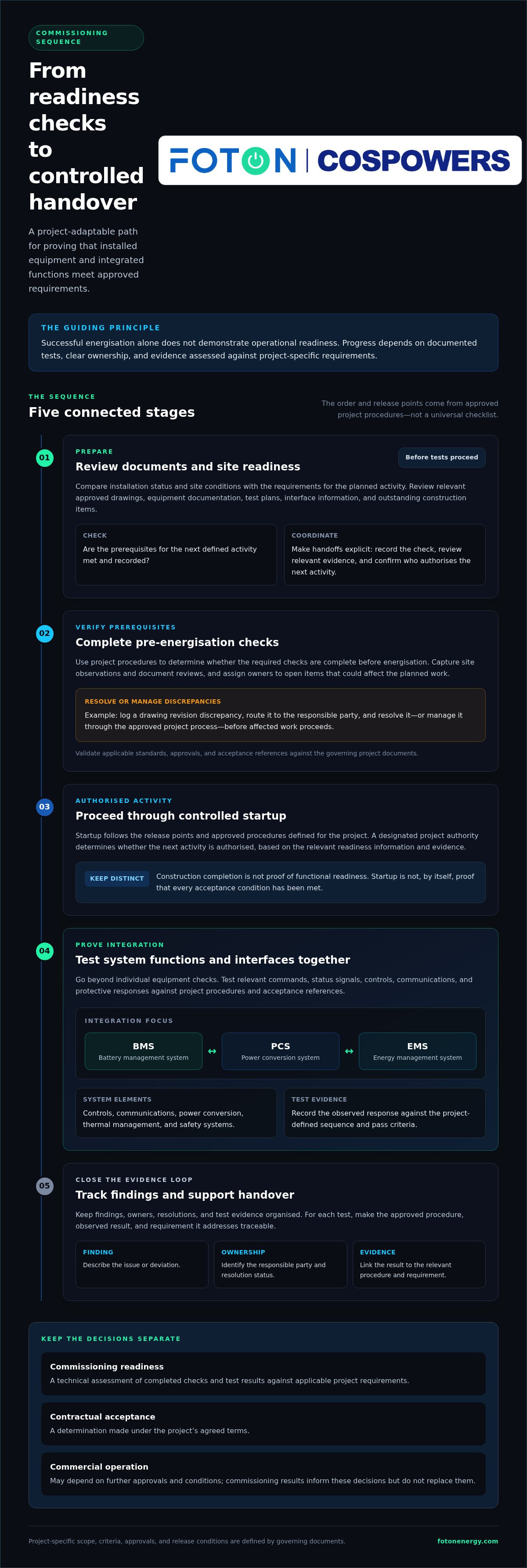
Readiness is an evidence-based technical assessment: teams compare completed checks and test results with applicable project requirements, record deviations, and identify unresolved items. Acceptance is a contractual determination made under the project’s agreed terms. Commercial-operation decisions may involve further approvals and conditions, so commissioning results should inform those decisions without being treated as a substitute for them.
Keep these records distinct and traceable. For each test, teams should be able to identify the approved procedure, the observed result, and the requirement it addresses. For example, an integrated control test should record the system’s response against the project-defined sequence, while the relevant acceptance reference establishes the pass criteria. Those criteria, required approvals, and release conditions are project-specific and must be checked against governing documents. Commissioning supports a controlled transition; it doesn’t guarantee future performance, revenue, or uninterrupted operation.
How BESS commissioning progresses from readiness checks to energisation
Commissioning typically moves from document and site readiness through pre-energisation checks, authorised startup, and integrated testing, with the order and release points set by approved project procedures. This is a project-adaptable framework, not a universal sequence. For battery energy storage system commissioning, use it to coordinate dependencies, evidence, and decision-making rather than treat it as a fixed checklist.
Preparation starts as construction work approaches completion. Installation status, equipment records, interface documents, and outstanding construction items all inform whether a test can proceed. Make handoffs explicit: the team completing an installation check records its result, the responsible discipline reviews relevant evidence, and the designated project authority determines whether the next activity is authorised. This helps surface missing information or unresolved work before it affects energisation readiness.
What teams review before energisation
Readiness reviews compare project records and site conditions with applicable requirements. Teams may review approved drawings, equipment documentation, test plans, interface information, and construction items that could affect the planned tests. The goal isn’t to complete a generic certification checklist; it’s to establish whether prerequisites for the next defined activity have been met and recorded.
Assign clear owners for document review, site observations, and open items. For example, log a drawing revision discrepancy, route it to the responsible party, and resolve it or manage it under the project’s approved process before affected work proceeds. Validate applicable standards, approvals, and acceptance references against project documents. The EPRI Energy Storage Commissioning Guide offers a relevant reference for teams developing their commissioning approach.
From cold checks to integrated functional testing
Non-energised checks can include inspections and electrical or communication checks performed under approved conditions. They establish prerequisites; they aren’t the same as startup or functional testing, which may involve energised equipment and therefore requires the authorisations and controls defined for the project. Exact activities and boundaries belong in approved procedures, not in an assumed industry-wide sequence.
As evidence accumulates, testing can progress from equipment-level results toward coordinated system behaviour. A test plan might first record checks for individual equipment and then verify interfaces between the battery system, power conversion, controls, and external connections. For each step, identify the procedure, evidence record, responsible reviewer, and prerequisite for moving forward. If a test exposes an issue, record the finding and follow the project’s process for resolution and retesting before relying on that function’s result.
Engineering consulting can help align commissioning preparation with system integration and project requirements. Information about Foton Energy’s engineering consulting provides context on this part of a coordinated storage project lifecycle.
How to verify BESS controls, interfaces, and acceptance criteria
Passing individual equipment checks doesn’t, on its own, prove that a BESS is ready as a whole. Component tests show whether equipment meets its own specified checks; integrated tests examine whether components exchange information and respond together as the project requires. Battery energy storage system commissioning should connect both forms of evidence to approved requirements, so teams can see what was tested, what result was observed, and which acceptance reference applies.
Define each test around a clear interface: the function under test, the expected response, the evidence to capture, and the parties responsible for review. The table below is a planning aid, not a universal test specification. Adapt its entries to the system architecture, project scope, and approved procedures.
| Test area | Evidence sought | Responsible interface | Project acceptance reference |
|---|---|---|---|
| Battery management system (BMS) | Recorded status, alarms, and responses relevant to the approved test | Battery equipment to BMS and supervisory controls | Applicable functional requirement or approved procedure |
| Power conversion | Observed response to defined control inputs and operating commands | BMS or supervisory controls to power conversion system | Project control and equipment requirements |
| Energy management system (EMS) | Command, monitoring, and feedback records for the tested function | EMS to plant controls and connected equipment | Approved operating strategy and test criteria |
| Communications | Message, status, and event records across specified paths | Relevant devices, networks, and control platforms | Interface documents and approved communications tests |
| Grid interface | Test observations for the defined connection and control functions | Plant controls and power conversion to the grid interface | Applicable project and connection requirements |
Testing controls and communications as an integrated system
Check that expected communication paths carry the required information and that control responses match approved project requirements. The BMS provides battery-system monitoring and relevant status to the wider control architecture; the EMS supports monitoring, coordination, and system operation according to the project’s design. Neither role substitutes for testing the interface between them. For broader context on EMS capabilities, see this AI-driven energy management systems guide.
Capture the command, resulting response, relevant status or event record, and any deviation. This makes a failed interface easier to isolate than a single pass/fail entry. For safety-related test planning, the PNNL Battery Energy Storage System Safety Report provides additional reference material.
Relating test results to grid and contractual requirements
Compare observed results with the approved grid-interface and contractual acceptance references that apply to the specific project. Don’t assume a standard or grid-code obligation without validating its applicability for the project jurisdiction and documents. Keep test evidence separate from interpretation: technical reviewers record what happened, while designated project parties determine whether the result satisfies contractual conditions and supports acceptance.
How to manage commissioning findings, records, and handover
A commissioning finding is useful only when the project can trace it from observation to disposition. During battery energy storage system commissioning, teams need a consistent way to capture what was observed, identify who owns the next action, and preserve evidence showing how the matter was addressed. A clear record helps prevent open items from disappearing between disciplines or being mistaken for completed work.
Agree on the project’s recording and review approach early. A shared register can be a practical coordination tool, whether maintained in a digital system or another approved format. The key is traceability: each entry should point to the relevant test or requirement and make its current status visible to the people responsible for review and resolution.
Keeping commissioning actions visible and accountable
For each finding, record a concise description, the affected equipment or interface, the evidence that prompted it, an assigned owner, and a current status. Add the resolution and supporting retest or review evidence when available. If an issue involves multiple disciplines, identify the handoff so responsibility remains clear.
- Link the observation to the relevant approved test, procedure, or acceptance reference.
- Record ownership, status, supporting documents, and any project-defined impact or dependency.
- Update the entry when evidence changes, an action is completed, or a decision is documented.
Regular coordination helps teams identify dependencies, such as an interface issue that affects more than one planned test. Report status and impact using categories defined by the project rather than imposing universal severity labels or closure rules. For broader project-engineering context, see Foton Energy’s BESS engineering consulting guide.
Preparing a project-specific handover package
Handover should give the receiving operations and maintenance teams a traceable view of what was tested, what documentation governs the asset, and what actions remain. The package and sign-off responsibilities depend on project agreements, so align its contents with applicable handover requirements rather than relying on a generic list.
- Approved test procedures, signed reports, and associated results or evidence.
- Updated project documents, including applicable as-built records and final settings information.
- A current register of open findings, owners, status, and documented dispositions.
- Operating and maintenance information required by the project for the transition to operations.
Keep outstanding actions visible in the handover record, with their status and next steps documented under the project’s process. Commissioning evidence can support long-term asset management by giving future teams a baseline for understanding system configuration and test history. It doesn’t guarantee future operating outcomes.
Foton Energy provides project-specific engineering and commissioning technical support. Further information is available in Foton Energy’s BESS engineering consulting.
How Foton Energy supports BESS commissioning readiness and integration
Commissioning readiness starts well before the first site test. Project requirements, equipment selection, controls, interfaces, and handover expectations all need to work as a coordinated plan. Foton Energy provides engineering consulting and technical support for commissioning as part of a broader project lifecycle that also includes long-term asset management. This helps project teams consider how design choices and system integration relate to the evidence they will need to assess readiness.
Foton Energy’s energy storage solutions include LFP and sodium-ion systems, an AI-driven EMS, thermal management, and safety architecture. These capabilities are relevant to readiness because they form parts of a connected system, not isolated checklist items. For example, the project’s control strategy informs how the EMS and battery system are expected to interact, while thermal management and safety architecture form part of the overall design context. Specific tests and acceptance criteria remain governed by project documents.
Connecting engineering support with project requirements
Feasibility, system design, integration, and grid-code compliance considerations shape project preparation. Engineering support can help align these workstreams with the project’s intended application and documented requirements, including the interfaces commissioning will need to assess. Validate applicable grid-code references and required approvals for the project jurisdiction and against its governing documents.
Technical support is project-specific. The system configuration, project scope, and agreed responsibilities determine the relevant preparation and evidence, so support should not be read as a promise of a particular commissioning result or commercial operation date. Foton Energy’s AI-driven EMS supports real-time monitoring, prediction, and optimisation, while integration planning considers how controls and equipment fit within the project architecture.
Foton Energy’s safety architecture includes “NFPA tested”, “Safety-tested thermal control”, and “Multi-layer protection with intelligent BMS, fault detection, and fire prevention.” These terms describe elements of the stated architecture; project teams should assess requirements and evidence in the context of their own design and approval documents.
Taking the next step with Foton Energy
As you shape a project, organise the context that will guide technical discussions: the application, the system configuration under consideration, key equipment and control interfaces, project-specific acceptance references, and commissioning questions that remain open. This connects procurement and engineering decisions with practical readiness planning without assuming one standard scope for every deployment.
Foton Energy supports energy storage deployments through engineering consulting, commissioning technical support, and long-term asset management. Review the project context and integration priorities alongside Foton Energy’s energy storage and engineering offerings.
Build readiness into the next stage of your energy project
Bring commissioning considerations into project planning early. Align the intended application, system design, control interfaces, project-specific acceptance requirements, and handover expectations so the teams involved can work from a shared view of readiness. A well-prepared approach connects technical decisions to the evidence needed as the project advances.
Foton Energy brings 30+ years of manufacturing heritage, with DNV Verified and BNEF Tier 1 credentials. Its technical support for commissioning and long-term asset management connects project preparation with the needs of an operating asset. For teams evaluating a deployment, this helps frame discussions around system integration, evidence, and ongoing asset responsibilities, without treating battery energy storage system commissioning as a guarantee of future performance.
Explore Foton Energy’s energy storage and engineering solutions to discuss the requirements and integration priorities for your project: Explore Foton Energy’s energy storage and engineering solutions.
Frequently Asked Questions
How long does battery energy storage system commissioning take?
Battery energy storage system commissioning has no fixed duration; the schedule depends on project scope, system complexity, site readiness, and test requirements. A site with unresolved construction work or incomplete equipment documentation may need more preparation before testing can proceed. Improve schedule visibility by mapping prerequisites and review points to the project programme, then updating plans as findings or dependencies emerge. Use the approved project schedule rather than a generic duration estimate.
Can BESS commissioning be performed remotely?
Some commissioning activities may use remote access, particularly reviews of system data or control and communications records, if project arrangements allow it. Remote work can’t replace physical inspections or any test that the approved procedure requires to be performed on site. Define which activities can be completed remotely, how results will be recorded, and who is authorised to witness or approve each activity.
Is BESS commissioning required before commercial operation?
Whether commissioning is a formal prerequisite to commercial operation depends on the project’s contracts, approvals, and connection requirements. Commissioning evidence may support readiness and acceptance decisions, but it doesn’t automatically satisfy every commercial-operation condition. For instance, a completed functional test may document a technical result while separate contractual or grid-interface approvals remain outstanding. Review the governing project documents to identify the required evidence, decision-makers, and release conditions.
What happens if BESS commissioning is delayed?
A commissioning delay can affect dependent activities, including planned tests, reviews, handover preparation, and the project’s intended transition to operation. Identify the cause, affected work, and decision needed, then update the schedule and coordinate with the responsible parties. For example, an equipment issue may require repair and repeat testing before a dependent integrated test can proceed. The effect on commercial milestones depends on project agreements.
Does commissioning guarantee a battery system’s performance over its lifetime?
No. Commissioning records results against defined requirements at the time of testing; it can’t guarantee future performance, revenue, or uninterrupted operation. Long-term outcomes also depend on factors such as operating conditions, maintenance, and the system’s ongoing management. Retaining accurate baseline test records can help asset teams compare later observations with documented commissioning results, while operating and maintenance plans guide their response to changes over the asset’s service life.
Can a BESS be recommissioned after a major equipment change?
Yes, a major equipment change may call for additional commissioning or targeted retesting, depending on what changed and which functions or interfaces could be affected. Replacing a control device, for example, may warrant review of connected communications and control responses, not just the replacement unit itself. The project’s technical authority should define the scope, procedures, approvals, and evidence required for the modification under the applicable project process.
How does commissioning affect battery system warranty coverage?
Commissioning may relate to warranty requirements, but its effect depends on the specific warranty terms and project agreements. Review the applicable documents for any stated requirements concerning installation, authorised procedures, records, operation, or notification of issues. Keep commissioning reports and change records organised, since they can help establish the system’s documented condition and history. Don’t assume that commissioning alone activates, extends, or preserves warranty coverage.


