
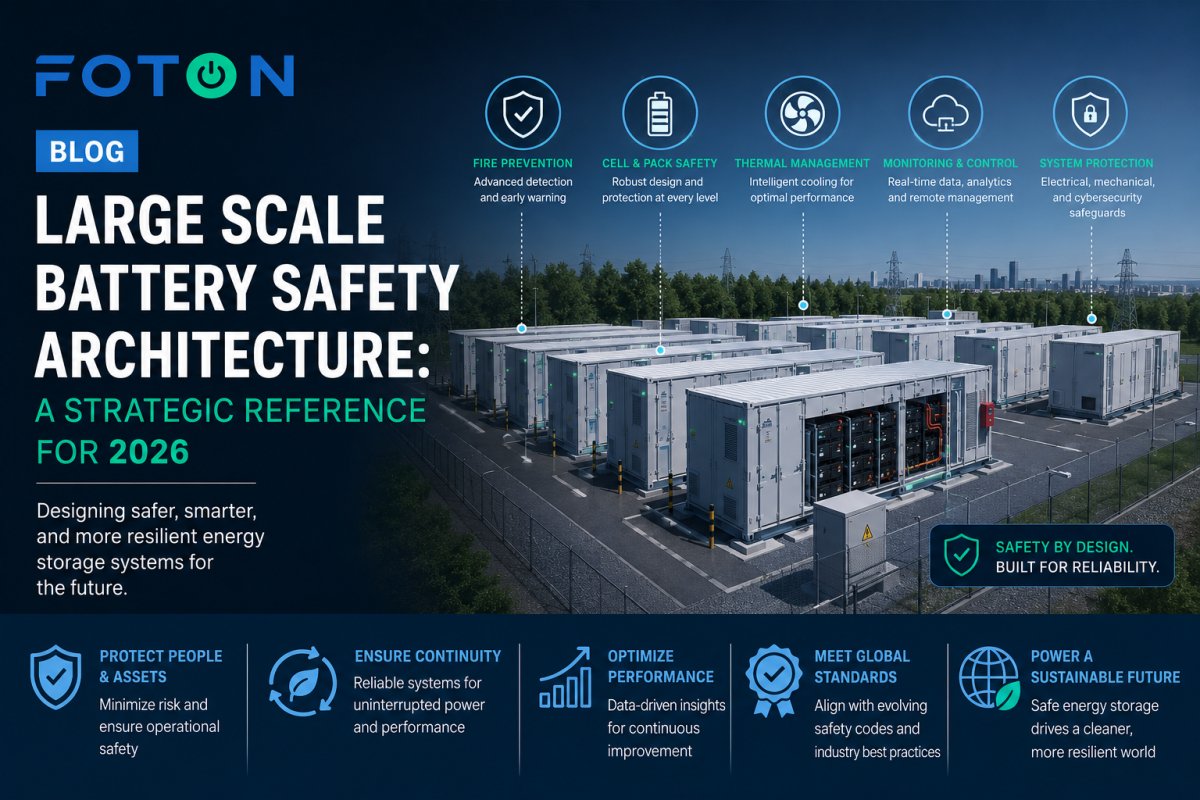
Bankability is no longer just about capacity. By 2026, the global battery energy storage market will reach $81.6 billion, yet project success now rests entirely on a rigorous large scale battery safety architecture that exceeds basic compliance. You've likely seen how the complexity of securing insurance for new chemistries and the pressure of the updated 2026 NFPA 855 standards can stall even the most ambitious utility-scale projects. It's a high-stakes environment where traditional safety measures are no longer sufficient to mitigate the risk of thermal runaway or explosion events.
Safety is the foundation of long-term value. We recognize that managing these regulatory shifts requires more than just hardware; it demands a strategic alignment of technology and intelligence. This article provides a comprehensive guide to the multi-layered safety frameworks and AI-driven monitoring systems that define modern, bankable storage. You'll gain a clear understanding of how to evaluate Tier-1 hardware safety and how predictive EMS analytics can transform your operational resilience. Let's examine the technical pillars that ensure your infrastructure remains secure, compliant, and commercially stable for the long term.
Key Takeaways
- Adopt an integrated approach to large scale battery safety architecture to shift your operational strategy from reactive mitigation to proactive, multi-layered prevention.
- Evaluate the safety profiles of LFP and Sodium-ion chemistries to select a cell foundation that balances industrial performance with long-term chemical stability.
- Implement advanced thermal management solutions that utilize liquid cooling to maintain optimal temperatures and prevent the degradation that leads to thermal runaway.
- Deploy AI-driven Energy Management Systems (EMS) as a predictive safety layer capable of identifying and isolating cell anomalies in real-time.
- Strengthen project bankability by utilizing Tier-1 hardware and DNV-verified safety data to secure more favorable financing and insurance terms.
Defining Large Scale Battery Safety Architecture
Safety is not a reactive measure. It's a fundamental design philosophy. A robust large scale battery safety architecture functions as an integrated hierarchy that aligns hardware, software, and chemistry into a single, resilient system. Historically, the industry focused on fire suppression after an event occurred. Today, we've transitioned to proactive architectural prevention. This shift ensures that every Battery energy storage system (BESS) is built to isolate risks at the source before they escalate into critical failures.
To achieve this, we employ the concept of "Defense in Depth." This methodology creates multiple, independent layers of protection. If one layer is compromised, subsequent layers are engineered to contain the issue. This structural integrity is heavily dependent on Tier-1 manufacturing heritage. A provider with a deep history in large-scale production brings a level of bankable assurance that newer, unproven manufacturers cannot match. Reliability isn't just a claim; it's a legacy of proven performance in the field.
To better understand this concept, watch this helpful video:
The Four Pillars of BESS Safety
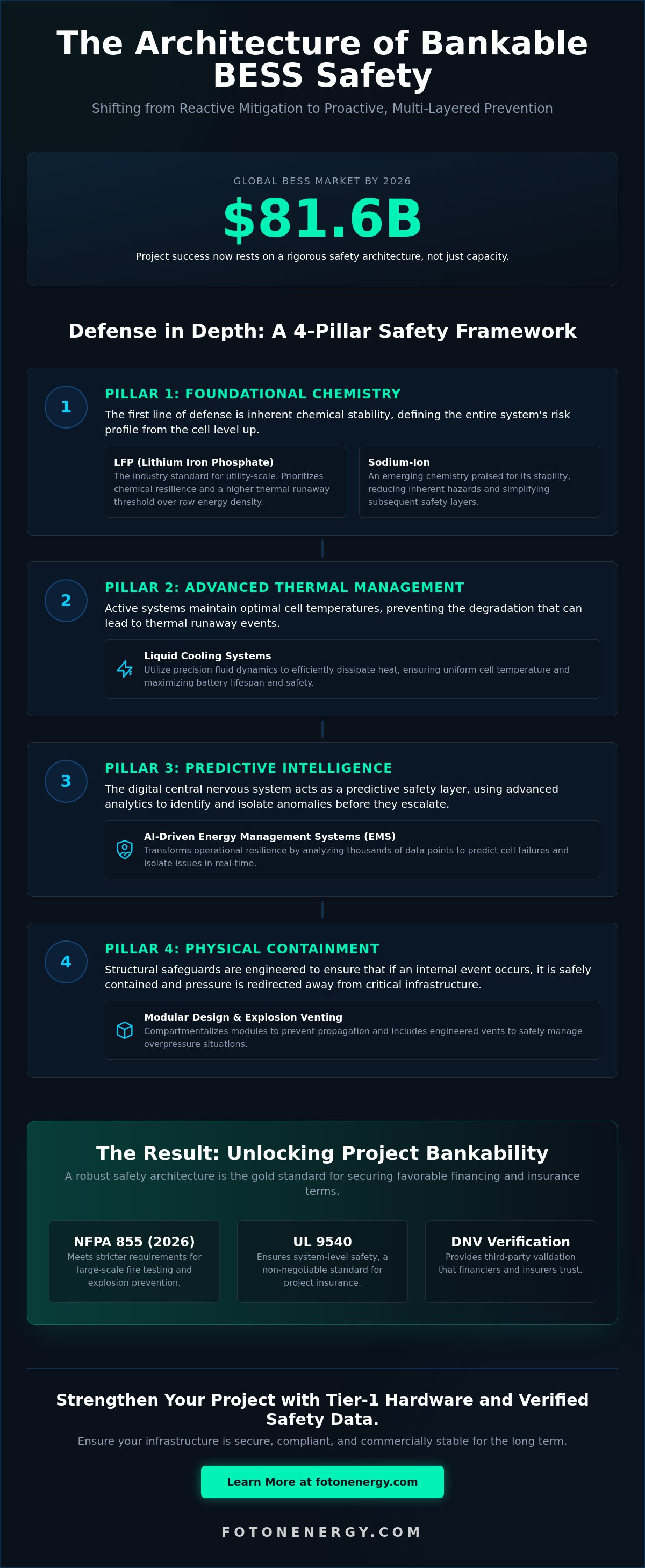
A comprehensive large scale battery safety architecture rests on four critical pillars. First, chemical stability dictates the foundational risk profile. Choosing stable chemistries like Lithium Iron Phosphate (LFP) reduces inherent hazards compared to traditional high-energy alternatives. Second, thermal management uses active liquid cooling or precision airflow to maintain optimal cell temperatures. Third, monitoring and control systems, specifically the BMS and EMS, act as the digital central nervous system. Finally, physical containment through modular design and explosion venting ensures that any internal pressure is safely redirected away from critical infrastructure.
Regulatory Frameworks and Standards in 2026
Compliance is the baseline for project viability. The 2026 edition of NFPA 855 introduces stricter requirements for large-scale fire testing, explosion prevention, and emergency ventilation. Meeting UL 9540 standards is no longer optional for those seeking project insurance. Beyond these, international grid-code compliance and DNV verification serve as the gold standard for technical bankability. These certifications prove that your safety architecture is a verified reality that financiers and insurers can trust. We recommend partnering with experts who prioritize these standards during the engineering consulting phase to ensure your project remains future-proof.
Cell-Level Safety: Comparing LFP and Sodium-Ion Chemistries
Chemistry is the first line of defense. Before software or physical containment systems are engaged, the inherent stability of the cell defines the risk profile of the entire large scale battery safety architecture. While traditional Nickel Manganese Cobalt (NMC) batteries offer high energy density, their lower thermal runaway threshold presents significant challenges for utility-scale projects. We've seen the industry pivot decisively toward chemistries that prioritize chemical resilience over raw density to ensure long-term site security.
Thermal runaway occurs when an internal short circuit or external heat source triggers an exothermic reaction that the system cannot dissipate. According to Energy storage safety research, selecting a chemistry with a higher decomposition temperature is the most effective way to mitigate this risk at the source. By choosing materials that are less prone to oxygen release during a failure, we create a foundation that simplifies every subsequent layer of the safety framework.
LFP: The Industry Standard for Utility-Scale
Lithium Iron Phosphate (LFP) has become the dominant choice for commercial and industrial BESS solutions due to its robust P-O bond. This chemical structure remains stable even under high-stress discharge and elevated temperatures. Beyond its inherent stability, Tier-1 LFP cells often include Current Interruption Devices (CID) that physically disconnect the cell in the event of internal pressure buildup. With LFP cell costs currently ranging between $52 and $55 per kWh, it remains the most bankable balance of safety and economic performance for 2026 projects.
Sodium-Ion: The New Frontier in Safety
Sodium-ion is emerging as a critical alternative for applications where safety is the absolute priority, such as a sodium-ion battery for data centers. These systems utilize a non-flammable electrolyte and can be shipped at a zero percent state of charge (SoC), significantly reducing transit risks. In testing, sodium-ion cells have shown remarkable resilience during overcharge and short-circuit scenarios without the violent venting associated with lithium-based chemistries.
- Cold-Climate Performance: Sodium-ion maintains safety and discharge efficiency at temperatures as low as -20°C, where lithium chemistries often require intensive heating.
- Cost-Effective Stability: With 2026 cell costs projected between $46 and $62 per kWh, sodium-ion provides a competitive safety-first option for industrial backup.
- Supply Chain Resilience: Using abundant sodium rather than scarce lithium enhances the long-term project stability that investors demand.
Selecting the right chemistry is a strategic decision that impacts insurance premiums and operational lifespan. If you're currently weighing these options for your next project, our engineering consulting team can help you model the safety and performance outcomes for your specific site conditions.
Thermal Management and Structural Fire Suppression
Cooling is the thermal backbone of a robust large scale battery safety architecture. While chemistry provides the foundation, active thermal management ensures that cells operate within their optimal window to prevent the degradation that leads to thermal runaway. As the global battery thermal management system market is projected to reach USD 4.5 billion in 2026, the industry is moving away from legacy air cooling toward more sophisticated liquid-cooled solutions. Active systems, including liquid cooling and high-efficiency fans, already accounted for 62% of the market revenue by 2024, reflecting a clear preference for precision thermal control in utility-scale deployments.
Structural fire suppression serves as the final physical barrier. Modern containerized BESS designs aren't just storage boxes; they're engineered blast shields. These systems integrate aerosol or clean-agent suppression technologies that can extinguish a fire without the collateral damage caused by water-based systems. By isolating modules within reinforced, fire-rated compartments, we ensure that a localized incident remains contained, protecting the rest of your infrastructure investment.
Advanced Cooling for High-Density Storage
Liquid cooling is the gold standard for high-density utility-scale projects. It maintains a uniform temperature delta, often less than 3°C across an entire module, which is nearly impossible to achieve with traditional air cooling. This thermal consistency is vital for extending battery cycle life and maximizing energy efficiency in harsh environments. When temperatures remain stable, internal resistance is minimized, and the risk of a single cell becoming a thermal weak point is virtually eliminated. This proactive management is a critical component for any project aiming for long-term bankability.
Physical Mitigation and Explosion Venting
Structure defines safety. The 2026 updates to NFPA 855 place a heavy emphasis on explosion prevention, specifically through the integration of NFPA 68 and 69 standards for deflagration venting. We utilize stainless steel and reinforced housings to maintain structural integrity under extreme pressure. Emergency ventilation systems and flammable gas monitoring are now mandatory requirements to prevent the buildup of hazardous gases. Proper zoning and clearance requirements ensure that even in a worst-case scenario, the safety of the surrounding facility and personnel is never compromised. Our engineering consulting services can help you design a site layout that meets these stringent 2026 regulatory demands while optimizing space and performance.
Layer 3: AI-Driven EMS and Predictive Safety Monitoring
Intelligence is the ultimate safeguard. While physical containment and chemical stability provide the foundation, the Energy Management System (EMS) acts as the cognitive layer within a large scale battery safety architecture. Traditional systems rely on passive sensors to detect heat or smoke after a failure has already begun. Modern AI-driven architectures, however, identify the digital signatures of cell degradation long before a thermal event occurs. This predictive capability is essential for grid-connected energy storage engineering, where operational reliability is the primary metric for project success and bankability.
Integrating proprietary software directly into Tier-1 hardware creates a closed-loop ecosystem. This synergy ensures that every data point, from micro-voltage fluctuations to internal resistance changes, is processed with millisecond precision. It's not just about monitoring; it's about active, autonomous intervention. By utilizing high-granularity data, the system can distinguish between normal operational stress and the early indicators of internal short circuits, providing a level of security that physical barriers alone cannot match.
Predictive Maintenance and State of Health (SoH)
Machine learning models now analyze historical performance to forecast the State of Health (SoH) of individual cells with remarkable accuracy. By tracking subtle trends in resistance and discharge efficiency, these algorithms flag "rogue" cells weeks before they pose a genuine safety risk. Automated shutdown protocols ensure the system self-protects by isolating compromised strings without requiring human intervention. Cloud integration further enhances this by allowing for fleet-wide safety updates. This ensures that every asset in your portfolio benefits from the latest security patches and optimization logic as soon as they're developed.
The Software-Hardware Synergy
The relationship between the Battery Management System (BMS) and the EMS is the cornerstone of system resilience. While the BMS handles cell-level balancing, the EMS optimizes the entire system's discharge rates to maintain generous safety margins during peak loads. In high-stakes environments like data center or telco backup, this AI-driven intervention prevents catastrophic downtime. For example, predictive monitoring can identify early-stage anode plating in backup systems, allowing operators to adjust charging profiles and extend the asset's functional life. This level of optimization ensures that safety and performance are never in conflict.
A sophisticated software layer is what transforms a collection of batteries into a secure, high-performance asset. If you're looking to integrate these intelligent layers into your infrastructure, explore our Intelligent EMS solutions to see how we prioritize safety through data.
Project Bankability: The Commercial Value of Safety Architecture
Safety is the ultimate currency in utility-scale energy. Financial institutions and insurance providers no longer view safety as a secondary technical detail; it's now a primary determinant of a project's weighted average cost of capital (WACC). By implementing a comprehensive large scale battery safety architecture, developers can significantly lower their risk profile, which directly translates into more favorable financing terms and reduced insurance premiums. In an era where thermal events can lead to total asset loss, bankability is inextricably linked to the physical and digital safeguards integrated into the system from day one.
Financiers prioritize projects that utilize Tier-1 hardware and provide DNV-verified safety data. This verification serves as an independent proof point that the system's "Defense in Depth" strategy is more than just a theoretical framework. To identify and mitigate these risks before capital is deployed, a rigorous BESS project feasibility study is essential. This study acts as the commercial blueprint, ensuring that the chosen hardware and software layers align with the stringent requirements of global lenders and local regulatory bodies.
Reducing Risk for EPCs and Developers
A robust safety architecture streamlines the entire project lifecycle. For EPCs and developers, a design that exceeds 2026 NFPA 855 standards shortens the permitting and approval cycle, as local authorities have greater confidence in the site's fire mitigation plan. Beyond initial deployment, safety is a key driver of residual value. Systems that utilize active thermal management and AI-driven predictive monitoring experience less degradation, ensuring the asset remains productive and sellable well into its second decade of operation. Our end-to-end engineering consulting ensures that these long-term value drivers are baked into your project's DNA.
The Future of Global Safety Standards
Looking toward 2030, we anticipate a global shift toward even more stringent safety and sustainability regulations. Future standards will likely mandate non-toxic, highly recyclable battery systems that minimize environmental impact while maintaining elite performance levels. The industry is moving toward a "total safety" model where the protection of the grid, the environment, and the investment are handled as a single, interconnected priority. This forward-thinking approach is what defines our partnership with Cospowers, as we continue to push the boundaries of what's possible in large-scale storage.
Securing the future of energy requires a partner who understands the deep interconnectedness of technology and finance. We invite you to collaborate with Foton for smarter, more resilient energy deployments that set the standard for safety and performance. Let's build a more stable grid together.
Securing the Future of Global Energy Infrastructure
Excellence in energy storage is defined by the seamless integration of intelligence and structural integrity. By 2026, a robust large scale battery safety architecture will be the non-negotiable standard for any project seeking long-term commercial viability. We've examined how the transition from reactive suppression to proactive architectural prevention ensures site security while maximizing discharge efficiency and asset lifespan. Success in this evolving market requires a strategic alignment of stable chemistries, precision thermal management, and AI-driven predictive monitoring.
As the exclusive global partner of Tier-1 manufacturer Cospowers, Foton delivers 30 years of manufacturing heritage and a proven global network spanning 70+ countries. Our AI-driven Energy Management Systems provide the real-time oversight necessary to protect both your physical infrastructure and your financial ROI. We invite you to Partner with Foton for Bankable Tier-1 Energy Storage Solutions that set the benchmark for safety and performance. Let's collaborate to build a more resilient and sustainable energy landscape together.
Frequently Asked Questions
What is the difference between active and passive safety in a BESS?
Active safety refers to dynamic systems that intervene during operation, such as liquid cooling, gas detection, and AI-driven monitoring. Passive safety includes structural elements like explosion venting, fire-rated compartments, and the inherent chemical stability of the cells. Both are essential components of a large scale battery safety architecture. By combining these layers, we ensure that if a passive barrier is breached, active systems can still mitigate the risk in real-time.
Is Sodium-ion safer than LFP for large-scale energy storage?
Sodium-ion and LFP are both significantly safer than traditional NMC chemistries due to their high thermal runaway thresholds. Sodium-ion offers specific advantages, including a non-flammable electrolyte and the ability to be transported at a zero percent state of charge. While LFP remains the industry standard for proven reliability, sodium-ion provides an elite alternative for industrial applications where extreme temperature resilience and supply chain stability are the primary concerns.
How does an Energy Management System (EMS) prevent battery fires?
The EMS prevents fires by acting as the system's digital central nervous system. It utilizes AI algorithms to detect micro-fluctuations in voltage and resistance that precede thermal events by days or weeks. By identifying these anomalies, the EMS triggers automated shutdown protocols to isolate compromised modules before heat builds up. This proactive intervention transforms the system from a reactive asset into a self-protecting infrastructure pillar.
What are the core safety certifications required for utility-scale BESS in 2026?
Utility-scale projects in 2026 must adhere to the updated NFPA 855 standard and UL 9540 system certification. Additionally, UL 9540A fire testing data is mandatory to verify how a system behaves during a simulated thermal runaway event. These certifications provide the technical proof points that financiers and insurers require to confirm a project's long-term safety and bankability within the global market.
Can large-scale battery systems be installed near residential areas safely?
Large-scale systems are safely installed near residential areas when they utilize a multi-layered large scale battery safety architecture. Adhering to NFPA 855 zoning and clearance distances ensures that any incident remains contained within the unit. Advanced fire suppression systems, such as aerosol or clean agents, combined with explosion venting, protect the surrounding community without the collateral damage often caused by traditional water-based suppression methods.
How does liquid cooling impact the safety of high-density battery modules?
Liquid cooling enhances safety by maintaining a uniform temperature delta across all battery modules, typically within 3°C. Unlike air cooling, which can leave pockets of stagnant heat, liquid systems provide precise thermal control that prevents the formation of dangerous hotspots. This thermal consistency reduces internal stress on the cells, extending their operational life and virtually eliminating the primary triggers for thermal runaway in high-density environments.
What happens if a single cell fails in a large-scale battery container?
If a single cell fails, the Battery Management System (BMS) identifies the anomaly and isolates the affected string to stop the current flow. Structural barriers and fire-rated compartments within the container prevent the failure from spreading to adjacent cells through a process called propagation resistance. This containment strategy ensures that a localized issue doesn't escalate into a system-wide event, preserving the integrity of your entire energy asset.
How does safety architecture affect the insurability of a BESS project?
A robust safety architecture is a primary driver of project insurability and overall financing terms. Insurers prioritize systems that feature Tier-1 hardware, DNV-verified safety data, and compliance with the latest 2026 international standards. Projects that demonstrate advanced predictive monitoring and superior thermal management often secure lower premiums. Safety isn't just a technical requirement; it's a strategic commercial asset that improves your project's WACC.


