
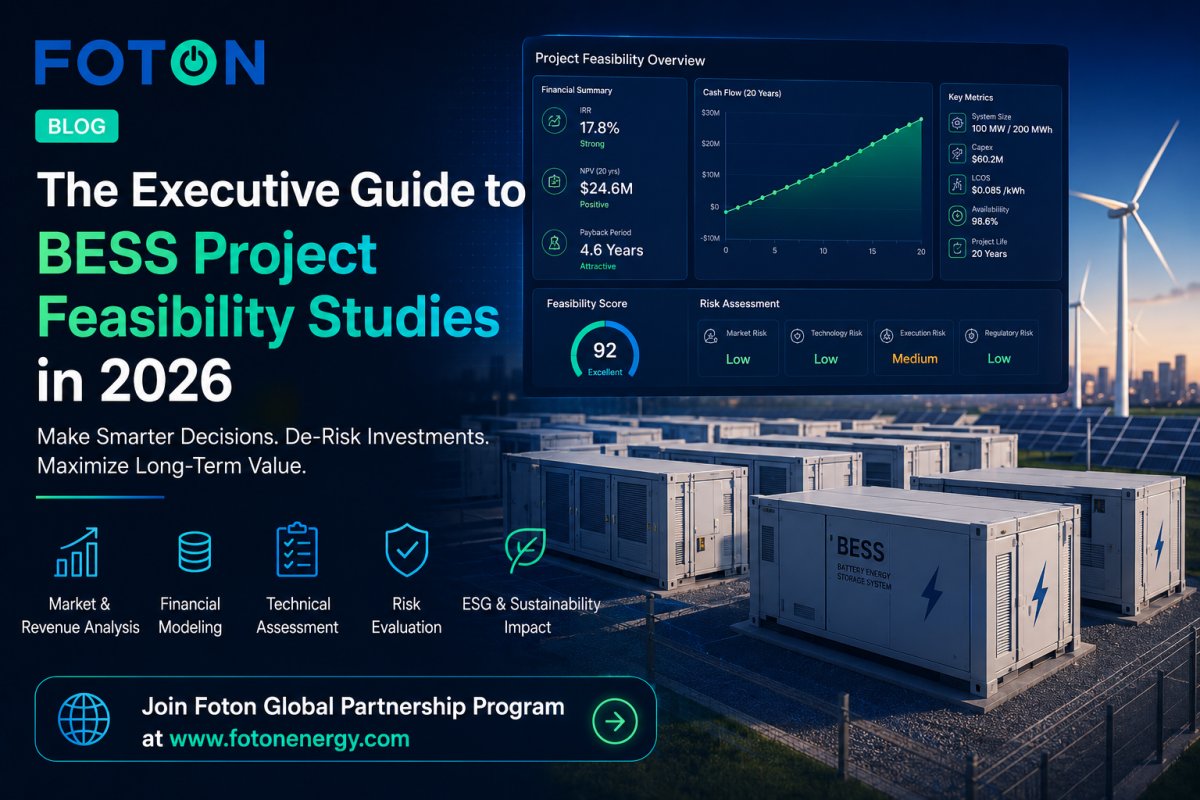
Bankability in 2026 is no longer a question of engineering capacity; it's a matter of strategic resilience. With global deployments projected to reach 459 GWh this year, the margin for error in your BESS project feasibility study has effectively vanished. You likely recognize that the transition from a conceptual design to a bankable asset requires more than just high-level projections. It demands a rigorous alignment of technical durability and sophisticated financial modeling. We're here to help you bridge the gap between ambitious energy goals and operational reality.
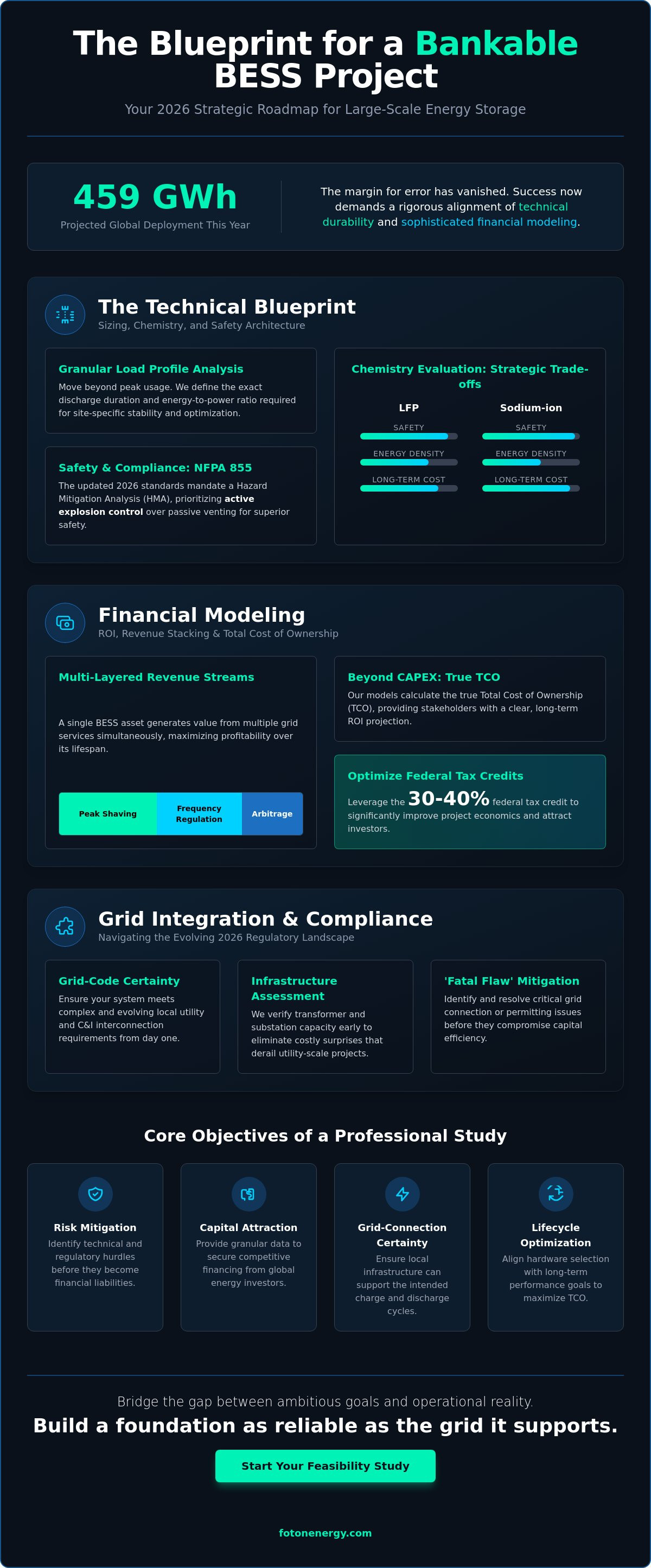
This guide provides the strategic roadmap you need to master the critical pillars of large-scale storage. We'll examine how to solve the complexities of grid-code compliance, evaluate the long-term performance delta between LFP and emerging sodium-ion chemistries, and model multi-layered revenue streams that ensure long-term value. From navigating the updated NFPA 855 Hazard Mitigation Analysis to optimizing the 30 to 40 percent federal tax credit, you'll gain the technical assurance required to satisfy the most demanding stakeholders. Let's build a foundation that's as reliable as the global infrastructure it supports.
Key Takeaways
- Identify why a modern BESS project feasibility study must transition from simple capacity sizing to sophisticated multi-revenue stream modeling.
- Evaluate the strategic trade-offs between LFP and Sodium-ion chemistries to optimize your system architecture for safety, density, and long-term cost.
- Develop a robust financial framework that moves beyond initial CAPEX to calculate the true Total Cost of Ownership and projected ROI for stakeholders.
- Navigate the evolving 2026 regulatory landscape, including complex grid-code compliance and interconnection requirements for utility and C&I applications.
- Discover how professional engineering consulting bridges the gap between initial site audits and the successful commissioning of bankable energy assets.
Defining the BESS Feasibility Study: Why Technical Rigor Matters
A professional BESS project feasibility study is a rigorous, multi-disciplinary audit of technical, financial, and regulatory viability. It's the definitive line between a speculative concept and a bankable reality. In 2026, the industry has evolved beyond basic capacity sizing. Success now hinges on sophisticated revenue stacking, where systems simultaneously manage peak shaving, frequency regulation, and energy arbitrage. A Battery Energy Storage System (BESS) is no longer just a hardware installation; it's a strategic asset that must navigate a complex energy ecosystem to remain profitable over its entire lifespan.
Strategic ambition requires stability. By leveraging the insights gained from a strong manufacturing heritage and proven engineering, you can significantly lower your project’s risk profile from the outset. Investors look for reliability backed by decades of manufacturing excellence. When your feasibility study is rooted in proven engineering and high-performance standards, you provide the "bankable" assurance that global financiers demand for large-scale infrastructure investments. We don't just guess at performance; we verify it through technical rigor and operational data.
The Core Objectives of a Professional Study
Establishing the technical "why" behind a specific site selection is paramount. We analyze the specific load profile and discharge requirements to ensure the chosen technology matches the site's unique demands. Defining the operational envelope involves predicting how different chemistries will degrade over thousands of cycles under specific local conditions. This foresight allows us to identify "fatal flaws" in grid connection or permitting early. By assessing transformer and substation capacity before breaking ground, we eliminate the surprises that often derail utility-scale projects and compromise capital efficiency.
Stakeholder Alignment: From EPCs to Financiers
Your feasibility data serves as the primary foundation for project financing. It must withstand the intense due diligence performed by global energy investors who prioritize long-term value over immediate shortcuts. Our engineering consulting focus is on translating complex technical metrics into clear commercial performance indicators. This ensures that EPCs, project developers, and lenders are all operating from the same set of verified facts. By presenting a clear roadmap for implementation and verified ROI projections, you create the momentum needed to move a project into the deployment phase with absolute confidence.
Primary objectives of this audit include:
- Risk Mitigation: Identifying technical and regulatory hurdles before they become financial liabilities.
- Capital Attraction: Providing the granular data required to secure competitive financing rates.
- Grid-Connection Certainty: Ensuring the local infrastructure can support the intended discharge and charge cycles.
- Lifecycle Optimization: Aligning hardware selection with long-term performance goals to maximize the Total Cost of Ownership.
The Technical Blueprint: Sizing, Chemistry, and Architecture
Engineering excellence starts with data. The blueprint for a successful BESS project feasibility study begins with a granular load profile analysis. We don't just look at peak usage. We identify the exact discharge duration required to maintain stability during volatile periods. This data dictates the system's energy-to-power ratio, ensuring the hardware isn't just functional, but optimized for the specific demands of the site. Following the BESS implementation guidelines provided by global authorities, we align these technical requirements with the broader project goals to ensure long-term bankability.
System architecture must account for thermal management and safety from the first draft. In 2026, the updated NFPA 855 standards require a comprehensive Hazard Mitigation Analysis (HMA) for most installations. This regulatory shift prioritizes active explosion control and prevention over simple passive venting. Whether you choose a containerized utility-scale solution or an indoor cabinet for C&I applications, the thermal management system must be engineered to handle the specific ambient conditions of the installation site. Reliability is built on these invisible, yet critical, safety layers.
LFP vs. Sodium-Ion: Situational Feasibility
Chemistry selection is no longer a one-size-fits-all decision. Lithium Iron Phosphate (LFP) remains the industry workhorse, with hardware costs for modules currently ranging between $140 and $240 per kWh. Its high cycle life makes it ideal for utility applications requiring frequent discharge. Sodium-ion batteries are emerging as a compelling alternative for data centers and extreme climates. They offer enhanced safety profiles and better performance in wide temperature ranges. Choosing the right chemistry depends on balancing these technical advantages against your specific ROI targets and the 2026 raw material pricing landscape.
Modular Design and Scalability
Scalability is the key to future-proofing your investment. A modular BESS architecture allows for rapid deployment and easier maintenance. It also simplifies the process of adding capacity as energy demands grow. When we design a site layout, we integrate safety architecture directly into the physical footprint, ensuring compliance with the latest California Fire Code updates that took effect in January 2026. If you're looking for a partner to navigate these technical complexities, our team provides customized BESS engineering consulting to move your project from a blueprint to a high-performance reality.
Financial Modeling: ROI, Peak Shaving, and Revenue Stacking
Financial viability isn't just about the initial purchase price. It requires a holistic view of the Total Cost of Ownership (TCO). While hardware costs are declining, the true value of a BESS project feasibility study lies in its ability to model complex revenue streams. Moving beyond CAPEX means accounting for the full lifecycle, from procurement to decommissioning. In 2026, successful projects don't rely on a single income source. They utilize revenue stacking. This approach combines peak shaving and load shifting for Commercial and Industrial (C&I) applications with grid services like frequency regulation and arbitrage. By integrating an Intelligent EMS, you can automate these decisions in real-time, ensuring the system always pursues the highest-value activity.
A bankable financial model must be grounded in visionary pragmatism. We look at how AI-driven optimization directly impacts the bottom line by extending battery life and maximizing market participation. Investors aren't just looking for a project that works; they want a project that's optimized for the next two decades. This requires a deep understanding of how technical performance translates into commercial performance indicators.
Quantifying Operational Expenses (OPEX)
Predicting degradation rates is essential. We model these over a 15 to 20 year horizon to understand when battery augmentation will be necessary. Annual Operations and Maintenance (O&M) costs for a commercial BESS are typically $15 to $25 per kW per year. These figures must include insurance premiums and compliance costs, which have shifted due to the 2026 updates in safety regulations. Predictive maintenance strategies, powered by data analytics, are no longer optional. They're a fundamental tool for reducing long-term OPEX and protecting the asset's health—and for comprehensive B2B fleet management to support these operations, you can check out Alliance Fleet Solutions.
Maximizing Internal Rate of Return (IRR)
Sensitivity analysis is the cornerstone of capital attraction. It demonstrates how your project will perform under various market conditions and volatility levels. Currently, the Federal Investment Tax Credit (ITC) offers a 30 to 40 percent credit on the total installed cost for standalone BESS projects. This incentive dramatically improves the Internal Rate of Return (IRR). For C&I systems, we often see a payback period between 3 and 5 years. Utility-scale projects operate on different timelines but benefit from the scale of grid-connected revenue. By presenting these verified projections through our expert engineering consulting, you provide the financial assurance that global energy investors require.
- Peak Shaving: Reducing demand charges by discharging during high-tariff periods.
- Arbitrage: Charging when prices are low and discharging when they peak.
- FCAS: Providing rapid response to maintain grid frequency stability.
- Grid Support: Offering voltage control and other ancillary services to local utilities.
Grid Integration, Compliance, and Safety Architecture
Grid integration is the final, most complex hurdle in any BESS project feasibility study. It's where technical ambition meets the physical reality of the utility network. In 2026, navigating grid-code compliance requires a deep understanding of evolving standards from bodies like FERC and regional operators. In Virginia, for instance, facilities with a capacity up to 150 MW can leverage the Department of Environmental Quality's Small Energy Storage Permit by Rule to streamline the process. Identifying these regional regulatory pathways early is essential for maintaining project momentum and avoiding the long queues typical of congested markets.
Interconnection studies go beyond simple connectivity. They assess existing transformer and substation capacity to prevent the need for expensive, project-killing infrastructure upgrades. We focus on power quality metrics, specifically voltage regulation and frequency response. These capabilities aren't just technical requirements; they're the very services that allow your asset to participate in lucrative ancillary service markets. Ensuring your system can provide these services without compromising local grid stability is a cornerstone of bankable engineering.
The Engineering of Grid Connection
Modeling the impact of a BESS on distribution and transmission networks requires high-fidelity simulations. We analyze how the system will interact with the grid, with a specific focus on mitigating harmonics and ensuring seamless transitions between grid-following and grid-forming modes. Providing these technical proof points early helps secure faster interconnection approval. It demonstrates to utilities that your project is a stabilizing force, not a liability, for the existing infrastructure.
Advanced Safety and Thermal Management
Safety architecture has fundamentally shifted with the 2026 edition of NFPA 855. The latest standards now require a Hazard Mitigation Analysis (HMA) for most BESS installations, prioritizing active explosion control and prevention over passive venting. For high-density modules, the feasibility study must evaluate the trade-offs between liquid cooling and air cooling. While liquid cooling offers superior thermal stability for intensive cycling, air cooling remains a cost-effective choice for simpler backup applications. Each choice must be validated against the 2026 California Fire Code updates to ensure long-term compliance.
For mission-critical environments like data centers, Foton’s proprietary safety architecture provides a layer of protection that exceeds standard UL 9540A requirements. This approach ensures that your backup systems remain operational even under extreme conditions. If you're ready to secure your project's technical and regulatory foundation, explore our BESS engineering consulting services to ensure your deployment meets every global standard.
Strategic Procurement: From Feasibility to Deployment with Foton
A feasibility report is only as valuable as its execution. While many consulting firms conclude their involvement once the report is delivered, we bridge the critical gap between theoretical modeling and physical deployment. The transition from a BESS project feasibility study to a commissioned asset requires a partner who understands the intricacies of the global supply chain and the nuances of hardware integration. By aligning your procurement strategy with verified engineering data, you ensure that the performance promised in the study is the performance delivered on-site.
Our end-to-end consulting services cover every phase of the project lifecycle. We begin with the initial site audit and continue through final commissioning, providing a steady, guiding hand for large-scale investors. This integrated
Transitioning Strategic Vision into Bankable Infrastructure
The path to a resilient energy future is built on technical precision and visionary pragmatism. By mastering the core pillars of a BESS project feasibility study, you've moved beyond theoretical planning and into the territory of bankable asset development. You now understand that success in 2026 requires a rigorous alignment of chemistry selection, grid compliance, and sophisticated revenue stacking. These aren't just technical benchmarks; they're the foundations of long-term commercial stability.
As the exclusive strategic partner of Tier-1 manufacturer Cospowers, we bring a manufacturing heritage that reduces your project's risk profile from the start. Our engineering expertise spans more than 70 countries, providing the global reach and local insight necessary for complex infrastructure investments. With our AI-driven EMS, we ensure your asset achieves maximum ROI through intelligent, real-time optimization. It's time to turn your strategic ambition into operational excellence.
Partner with Foton for your next BESS Feasibility Study and let's build a smarter, more stable grid together. Your vision for a cleaner future is within reach.
Frequently Asked Questions
How long does a comprehensive BESS project feasibility study take?
A professional BESS project feasibility study typically requires four to twelve weeks to complete. This timeline depends on the project's scale and the availability of granular historical load data for the site. Larger utility-scale installations often sit at the longer end of this range because they require detailed interconnection studies and complex grid-impact simulations to ensure long-term stability.
What is the difference between a pre-feasibility and a full feasibility study?
Pre-feasibility studies serve as a preliminary "go or no-go" assessment to identify high-level site viability and potential red flags. In contrast, a full feasibility study provides the granular technical blueprints and financial modeling needed for bankability. It moves beyond estimates to offer verified ROI projections and specific hardware configurations that satisfy the rigorous due diligence requirements of global energy investors.
Is Sodium-ion battery technology feasible for utility-scale projects in 2026?
Sodium-ion technology is reaching a critical milestone in 2026 as pilot production lines begin to scale globally. While Lithium Iron Phosphate (LFP) remains the dominant choice for high-density utility applications, sodium-ion is increasingly feasible for data centers and extreme climates. Its superior thermal stability and falling material costs make it a strategic alternative for specific operational envelopes where safety and temperature resilience are paramount.
How much does a professional BESS feasibility study cost?
The investment required for a BESS project feasibility study varies significantly based on the system's megawatt capacity and the complexity of the local grid. Factors such as the depth of the revenue stacking analysis and the required level of safety engineering also influence the final scope. We recommend checking with technical consultants to align the study's depth with your project's specific bankability and financing requirements.
What are the most common 'fatal flaws' found during BESS feasibility?
Insufficient substation capacity and prohibitive grid-interconnection costs are the most frequent technical hurdles identified during the audit process. Other critical issues include non-compliance with the 2026 edition of NFPA 855 safety standards or local zoning restrictions that prevent large-scale battery deployment. Identifying these hurdles early saves developers millions in potential sunk costs and prevents project stagnation in congested interconnection queues.
Can a feasibility study help in securing project financing?
A rigorous feasibility report is the primary document used to secure project financing and attract institutional capital. Lenders and green finance partners require verified data on degradation rates, revenue stacking potential, and regulatory compliance before committing funds. A study grounded in Tier-1 manufacturing data provides the "bankable" assurance that reduces a project's overall risk profile and improves loan terms.
How does AI-driven EMS impact the feasibility of a BESS project?
Intelligent EMS technology fundamentally shifts the feasibility equation by enabling real-time revenue optimization and asset protection. By automating the transition between peak shaving, arbitrage, and grid services, AI-driven systems maximize the asset's daily financial value. This technological layer also extends the battery's lifecycle through predictive thermal management, which directly improves the project's long-term internal rate of return and total cost of ownership.
What grid-code compliance standards are most critical for 2026 BESS projects?
The 2026 edition of NFPA 855 and the updated California Fire Code are now the most critical safety benchmarks for new installations. Projects must also navigate regional grid-code standards such as FERC orders and specific state-level pathways like Virginia's Small Energy Storage Permit by Rule for facilities up to 150 MW. Ensuring compliance with these evolving regulations is non-negotiable for project commissioning, insurance approval, and long-term operational safety.


