

A battery’s megawatt rating alone does not show how well it can support frequency control. When electricity supply and demand fall out of balance, grid frequency shifts. A battery can inject power when frequency drops or absorb power when it rises, helping rebalance the system. But battery storage for grid frequency control depends on how measurement, controls, power conversion and the grid connection work together.
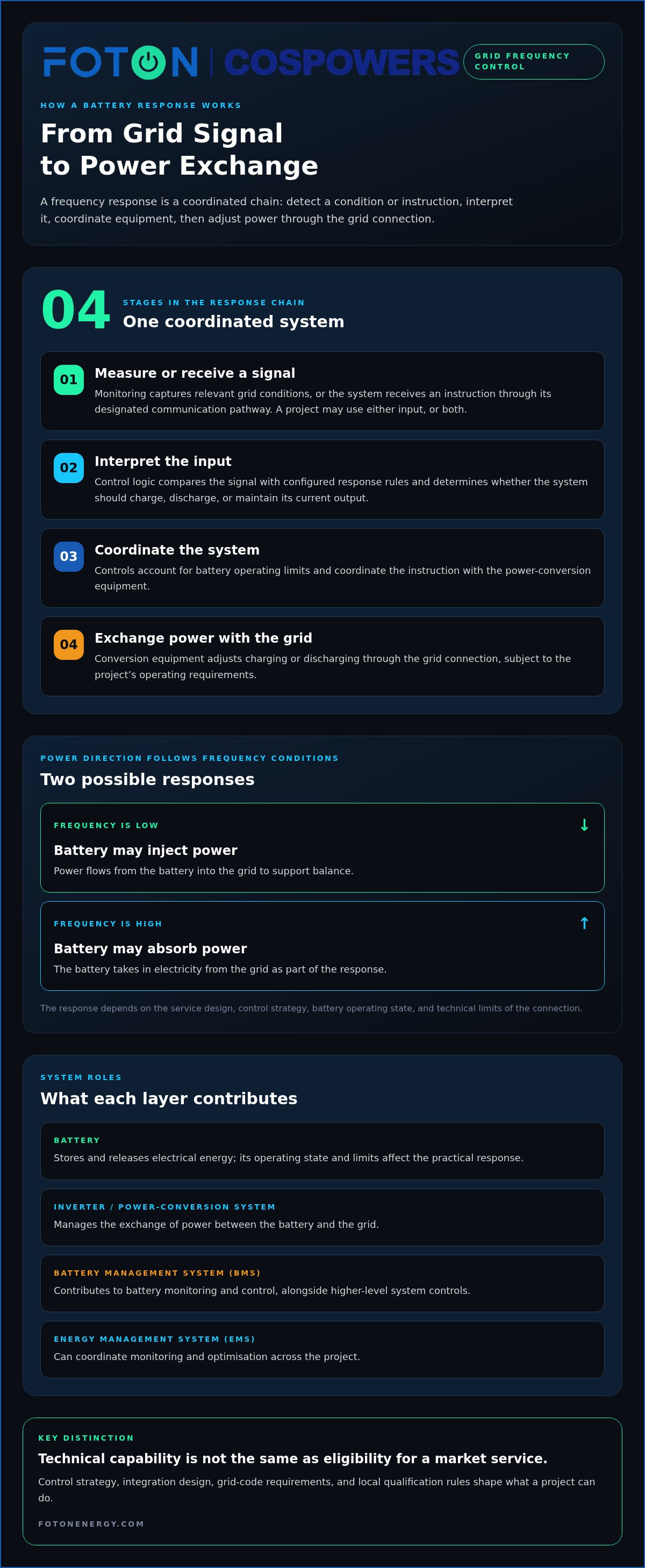
It helps to distinguish a system’s technical capability from its eligibility for a particular market service. Control strategy, integration design, grid-code requirements and local qualification rules all influence what a project can do.
This article explains how batteries support frequency balancing, what determines a project’s suitability, and how to assess a grid-connected BESS. It covers monitoring and energy management, the difference between capability and market eligibility, and practical engineering questions to address during project planning.
Key Takeaways
- Battery storage for grid frequency control adjusts power exchange to help balance supply and demand as grid frequency changes.
- Effective response depends on coordinated measurement, controls, battery operation, power-conversion equipment and the grid connection.
- A battery’s technical capability is distinct from market access, dispatch rules and qualification for a specific grid service.
- Assess a project by defining the target service, identifying local grid and market requirements, and evaluating connection and control design.
- Real-time monitoring, prediction and optimisation can support coordinated BESS operation, alongside project-specific engineering and integration.
What battery storage for grid frequency control does, and why the grid needs it
A grid-connected battery adjusts its power exchange in response to frequency conditions. It can inject electricity into the grid or absorb electricity from it, helping balance the power system as conditions change. Battery storage for grid frequency control can therefore support grid stability, but its role depends on the service and the requirements of the relevant grid.
Frequency indicates the balance between electricity generation and demand. Grid operators aim to keep it within an operating range suited to the interconnected system. When generation and demand do not match, frequency can move away from its normal operating point. If the imbalance is not managed, it can create operational challenges and place additional demands on other grid resources. Frequency control is one part of the broader set of measures used to manage these changes.
What causes grid frequency to move away from balance?
Generation and demand must remain closely balanced across the power system. If demand exceeds available generation, the imbalance tends to pull frequency downward. If generation exceeds demand, frequency tends to rise. For example, a sudden increase in consumption without a corresponding change in supply can create a need for resources that add power or reduce demand.
Changes in generation also matter. Wind and solar output can vary with weather and operating conditions, adding variability to the supply mix. This does not mean renewable generation alone causes instability. It means the system needs suitable flexibility to manage changing supply and demand. The mix of resources, grid connections and operating arrangements shapes how that flexibility is provided.
What does frequency control mean for a battery?
Frequency control is a grid service, not a battery chemistry or a standalone component. A battery energy storage system brings together cells, power-conversion equipment, controls and a grid connection. For a broader overview of these systems and their applications, see Battery energy storage system (BESS). In a frequency service, the system controls determine how it responds to frequency conditions or an operator’s signal.
When frequency is low, a battery may inject power to support the balance. When frequency is high, it may absorb power. The response depends on the service design and control strategy. The battery’s operating state and the connection’s technical limits also influence what response is practical at a given moment.
That distinction matters when planning a project. A system may be technically capable of adjusting power, while the intended service sets additional response, communication and operating requirements. Requirements differ between grids and markets. Establish the local terminology and rules before defining the battery’s role in a grid service.
How a battery energy storage system responds to frequency changes
A frequency response is a coordinated chain, not a single battery action. The system must detect a relevant condition, interpret the applicable control instruction, translate it into a power exchange, and operate within the limits of its equipment and grid connection. For battery storage for grid frequency control, the sequence depends on project controls and the requirements set by the relevant operator or market.
From frequency measurement to a control instruction
Monitoring provides the input for a response. Depending on the project design, the system may use measured grid conditions, an external operator signal, or both. Control logic interprets that input against configured operating rules and determines whether to charge, discharge or maintain its current output. Automatic response is possible when the system is designed and enabled for it, but it is not universal. The signal and control arrangement are project-specific.
- Measure or receive a signal. Monitoring equipment captures relevant grid conditions, or the system receives an instruction through its designated communication pathway.
- Interpret the input. Control logic compares the signal with configured response rules and determines the required operating action.
- Coordinate the system. Controls account for battery operating limits and coordinate the instruction with the power-conversion equipment.
- Exchange power with the grid. The equipment adjusts charging or discharging through the grid connection, subject to the project’s operating requirements.
In short, a BESS measures or receives a grid signal, translates it into a control instruction, and coordinates a power exchange through its conversion equipment and grid connection.
How power conversion and battery controls coordinate
The battery stores and releases electrical energy, while the inverter or other power-conversion system manages the exchange between the battery and the grid. These functions must work together: a control instruction alone does not move power, and the conversion equipment must operate within the parameters of the connected system.
The battery management system (BMS) contributes to battery monitoring and control. It operates alongside higher-level system controls rather than replacing them. An energy management system (EMS) can coordinate monitoring and optimisation across the project. Foton Energy’s AI-driven energy management systems guide explains how EMS functions fit into BESS operation.
This is why project teams should look beyond a battery’s headline capability. They need to understand how the control strategy, power-conversion system, BMS, EMS and grid interface are configured to work together, and whether the design aligns with the intended service. Foton Energy supplies utility-scale storage and provides engineering consulting for project design and grid-code compliance. These capabilities support teams assessing system interfaces as part of an integrated solution. Learn more about utility-scale storage and engineering capabilities.
Frequency control services, operating trade-offs, and what battery capability means
Frequency services describe roles a resource may perform for the grid. They are not interchangeable, and their names and technical definitions vary by system operator and market. The key distinction for project teams is between what a battery can physically do and what it is permitted, qualified and dispatched to do under local rules.
How frequency containment and restoration differ
Containment generally refers to limiting or arresting a frequency deviation. Restoration describes support for moving frequency back toward normal operating conditions. Reserve is a broader concept: capacity held available to respond when required, potentially supporting containment or restoration depending on the market design. These are functional descriptions, not universal product definitions.
| Service concept | General role | Project consideration |
|---|---|---|
| Frequency containment | Responds to help limit or arrest a deviation. | Assess the required control response and how the local operator defines the service. |
| Frequency restoration | Supports movement toward normal operating conditions after a deviation. | Understand the applicable signal, dispatch arrangement and operating conditions. |
| Reserve | Keeps capacity available for a future system need. | Determine how availability, energy readiness and activation are defined locally. |
The table is a conceptual guide, not a substitute for local market definitions. A service label alone does not tell a project team how often a resource may be called, how long it may need to operate, or how performance is assessed. Those details are set by the relevant operator’s rules and qualification process.
Can one battery support more than one grid service?
Potentially, but service stacking must be designed rather than assumed. A battery committed to one service may need to preserve power capability or stored energy for that obligation. A second service could draw on the same capability at the same time, creating a conflict unless dispatch rules and operating priorities account for both commitments.
Evaluate service obligations alongside other operating objectives. For example, a planned charging period for one purpose could affect how much energy is available for a later response. The EMS, control strategy and dispatch arrangements need to coordinate priorities, while the battery’s available energy and power-conversion capability must align with its intended duties.
Duration, available energy, controls and grid requirements should be assessed together. A battery’s ability to change power does not establish how long it can sustain a service, whether it meets a particular market’s qualification criteria, or whether competing commitments can be fulfilled. Utility-scale BESS procurement also involves aligning technical design and project requirements early in the process.
For battery storage for grid frequency control, the practical question is not simply whether the system can respond. It is whether the operating envelope, controls, connection design and market participation fit the target service. Establish local definitions and rules first, then assess the project against them.
How to assess a battery storage project for grid frequency control
A useful assessment starts with the service and works back to the system design. Battery capability alone does not establish that a project can participate in a particular grid service. The relevant operator, market framework, connection conditions and grid-code obligations shape the requirements. Use this sequence to turn the application into a project scope.
- Define the intended service. Identify the function the battery is expected to perform and the terminology used by the local operator. Clarify whether the project targets a defined market service or another operating arrangement.
- Map the local requirements. Establish the applicable market rules, operator instructions, connection conditions and grid-code obligations. Record response expectations and relevant communication or operating requirements.
- Assess the connection. Review how the proposed system will connect to the grid and how connection conditions shape its operation. Identify design constraints that could affect the intended service.
- Develop the system and controls. Consider battery architecture, power-conversion equipment, control strategy, monitoring and integration as one coordinated design aligned with the required operating function.
- Plan validation and commissioning. Define how the design will be reviewed and how project operation will be assessed during commissioning against relevant requirements.
Define the grid service and local requirements
Start with the system operator and market framework for the project location. Service names can differ between jurisdictions, and similar labels may have different definitions or qualification processes. Map the relevant requirements before settling the system configuration. This separates general battery capability from formal market participation: capability describes what a system may be designed to do, while participation depends on local rules and operator processes.
Build a requirements register that connects each obligation to the project design. Include the intended service, connection conditions, applicable grid-code provisions and relevant operator instructions. Capture requirements that affect controls or integration early, so they inform engineering rather than becoming late-stage design changes.
Translate requirements into system design and validation
Review the battery architecture, power conversion, controls and monitoring together. A project-specific engineering assessment should consider how these elements interface with the grid connection and intended operating mode. Technical feasibility depends on those interfaces and the assumptions made about operation. Assess commercial feasibility using project-specific assumptions rather than treating generic estimates as a project result.
Engineering review connects requirements to design. Validation and commissioning then assess how the implemented system operates against the project’s defined criteria. These steps support a disciplined evaluation, but they do not guarantee market qualification or a particular service outcome. Foton Energy provides engineering consulting for project feasibility, system design and grid-code compliance. Discuss your grid-connected storage project with Foton Energy’s team.
Where Foton Energy fits in a grid frequency control project
Frequency control is a project application, not a standalone battery feature. It brings together storage, power conversion, controls, grid integration and local operating requirements. Foton Energy supplies utility-scale storage and AI-driven energy management systems (EMS), and provides engineering consulting to support project teams assessing how these elements can fit within an integrated design.
Integrating storage, EMS, and engineering support
For a potential battery storage for grid frequency control project, Foton’s utility-scale storage and EMS can be considered alongside the intended service, grid connection and operating framework. Real-time monitoring, prediction and optimisation can support coordinated operation by helping project teams understand system conditions and inform operating decisions. Their role is project-specific; they do not establish market access or guarantee a frequency-service outcome.
Engineering support connects the application to the system design. It can cover project feasibility, design considerations and grid-code compliance, with storage, controls and grid-ready infrastructure considered in relation to the project’s requirements. Foton’s grid-ready infrastructure is compliant with global standards and grid codes. Each project still needs assessment against its applicable rules and connection conditions. Design alignment should not be confused with automatic qualification by a system operator or market.
Decisions in one part of a BESS project can affect another. The intended operating service informs control and integration needs; grid requirements shape system design; and monitoring and optimisation support coordinated operation. Reviewing these interfaces together gives project teams a clearer basis for evaluating suitability without treating a general system capability as a confirmed service commitment.
Build confidence through documented capabilities
Foton reports more than 100 utility-scale projects delivered worldwide. Listed recognitions include BNEF Tier 1, DNV Verified and NFPA Tested. These are distinct proof points and should be understood according to their specific scope. They provide context for project evaluation alongside engineering review, system integration and the local grid requirements relevant to a particular application.
As teams move from early assessment to project design, they can consider storage, EMS and engineering support as connected parts of the solution. The focus is on matching the proposed configuration to the intended operating role and technical requirements, rather than assuming one system design suits every grid or service.
Detailed pricing, datasheets and full product specifications are available to logged-in partners only. For an overview of Foton Energy’s storage and engineering solutions, explore Foton Energy’s storage and engineering solutions.
Turn a grid service objective into a project plan
Translate the frequency-control objective into a clear project brief. Set out the operating role, local grid requirements and design assumptions your team needs to resolve. Bring those requirements into the engineering discussion early, so the proposed battery storage for grid frequency control is assessed as an integrated project rather than as a battery specification alone.
Foton Energy brings utility-scale storage, intelligent energy management and engineering consulting together to support project-specific design and grid-code compliance. Its reported project experience and listed recognitions can also inform your evaluation as you move from initial scope toward a considered solution.
Ready to develop your next grid-connected storage project? Explore Foton Energy's storage and engineering solutions and take the next step.
Frequently Asked Questions
How does battery storage help control grid frequency?
Battery storage helps control grid frequency by adjusting its electricity exchange to support the power system’s balance. For example, a project may be configured to supply power under one operating condition and absorb it under another. The response depends on the project controls and applicable requirements. Battery storage for grid frequency control describes a potential grid service, not automatic eligibility for every battery system.
Can a battery provide frequency control and another grid service at the same time?
It may be possible if the project design, available energy and dispatch rules support both commitments. Consider a battery scheduled for another operating objective when an operator signal calls for a frequency response. The control strategy needs a defined priority for that situation, and the market rules must allow the commitments to overlap. Assess the combined operating scenarios rather than treating each service as if it has exclusive access to the system.
What determines whether a battery can participate in frequency regulation?
Participation depends on the local operator’s requirements, market rules, grid connection and system design. A battery’s ability to change power is not sufficient by itself. The relevant market may define a service and qualification process differently from another jurisdiction. Identify the local service definition early, then map its requirements to the system architecture, controls and connection before making participation assumptions.
Does battery storage replace conventional frequency reserves?
No. Battery storage should be considered a potential contributor to frequency services, not a universal replacement for conventional reserves. The appropriate resource mix depends on the grid’s operating needs, the service being procured and the resources available to the system operator. For a project team, the more useful question is how storage could complement existing grid resources and which defined requirement the project is designed to address.
How do renewable energy sources affect the need for frequency control?
Variable renewable output can add to the changes in supply that grid operators need to manage. Wind or solar generation may shift as weather and operating conditions change, while electricity demand also varies. Flexibility needs differ between power systems. Use the local operator’s requirements and system context to assess the application, rather than assuming renewable integration creates the same frequency-control need in every market.
What does an EMS do in a battery frequency-control project?
An EMS supports monitoring, prediction and optimisation of energy storage operation. In a frequency-control project, these capabilities can inform operational coordination, with functions shaped by the system architecture and applicable requirements. Foton’s EMS is AI-driven and provides real-time monitoring, prediction and optimisation. Detailed pricing, datasheets and full product specifications are available to logged-in partners only.
How should a project team start evaluating a battery for frequency control?
Start with a project brief that names the intended service, location and relevant system operator. Use it to identify the local market framework, grid-code obligations and connection conditions, then assess how the proposed system design aligns with them. Foton Energy provides engineering consulting for feasibility, system design and grid-code compliance. An early review helps teams identify key design questions before progressing into detailed project development.


