

A promising battery site can prove unworkable if its grid connection, system design or revenue assumptions do not align. That is the central challenge of large scale battery storage project feasibility: a sound decision depends on evidence across the project, not on one attractive use case.
It can be difficult to know what to assess first, especially when market revenues shift and technical choices depend on site and grid conditions. A structured feasibility review brings these factors together, exposes information gaps and compares options using clear, project-specific assumptions.
This guide explains how to assess the site, interconnection, battery technology, system architecture, safety considerations, operating use case and commercial case before advancing development. It also shows what evidence can support a decision to proceed, refine the project or pause for further analysis. Foton Energy provides engineering consulting for project feasibility, system design and grid-code compliance, all of which address connected technical considerations in project development.
Key Takeaways
- Use large scale battery storage project feasibility to decide whether evidence supports advancing a project, not as a substitute for detailed design or approvals.
- Assess site constraints, grid connection information and operating requirements together to identify project-specific fit and information gaps.
- Separate revenue hypotheses from verified inputs, and record the source and confidence behind each commercial assumption.
- Build a staged assessment roadmap with clear inputs, analysis, decision owners and outputs to guide the next development step.
- Connect feasibility findings with system design and grid-code considerations, including how LFP or sodium-ion storage and an intelligent EMS may fit project requirements.
What does large-scale battery storage project feasibility actually establish?
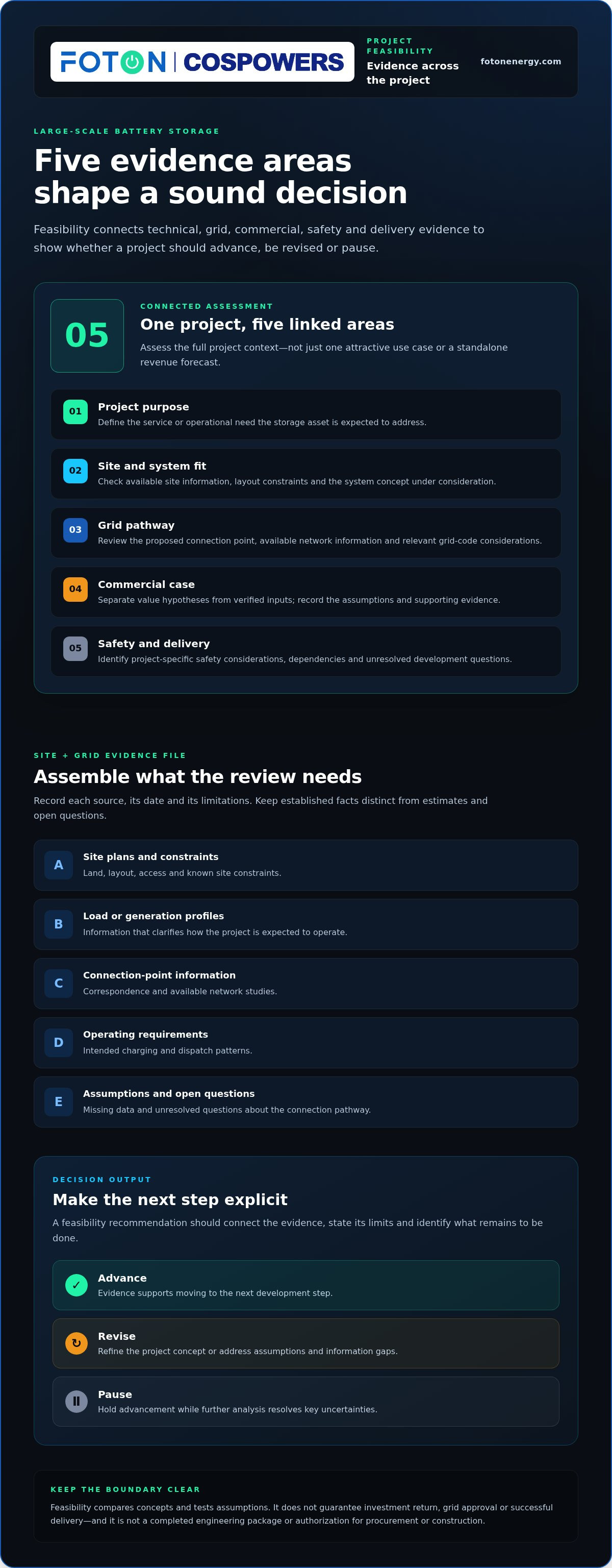
Project feasibility is an evidence-based assessment of whether a proposed battery project can meet its stated objectives under defined technical, grid, commercial, safety and delivery conditions. It supports a decision to advance, revise or pause development. It does not guarantee an investment return, grid approval or successful delivery.
For large scale battery storage project feasibility, the central question is not simply whether a battery can store and discharge energy. The assessment needs to show how the proposed system could work in its intended setting, which assumptions the conclusion depends on, and which uncertainties remain unresolved. A credible recommendation connects the evidence rather than relying on a standalone revenue forecast or technology preference.
At an early stage, map the evidence needed across several linked areas:
- Project purpose: the service or operational need the storage asset is expected to address.
- Site and system fit: available site information, layout constraints and the system concept under consideration.
- Grid pathway: the proposed connection point, available network information and relevant grid-code considerations.
- Commercial case: value hypotheses, key assumptions and the evidence supporting each one.
- Safety and delivery: project-specific safety considerations, dependencies and unresolved development questions.
The right technology also depends on the application and operating context. Start by understanding the range of grid energy storage technologies and the needs storage can serve. Then assess the options against the project’s objectives instead of assuming one configuration suits every site.
Which project question should the feasibility study answer?
Start with the use case and the outcome the project must support. A utility project might be assessed against a grid-service objective, while a renewable-integration project might focus on how storage fits the generation profile and operating plan. Other projects may have different requirements. Define who will make the decision, what evidence they need for the next step and which questions remain unanswered.
Make the objective specific enough to guide the analysis. If stakeholders have competing priorities, document them separately instead of blending them into a vague goal. This gives technical and commercial reviewers a shared reference for comparing options, identifying trade-offs and deciding which information gaps matter.
How does early feasibility differ from detailed project design?
Feasibility compares concepts, tests key assumptions and identifies issues that could change the project’s direction. It may recommend further investigation, but it is not a completed engineering package. Detailed engineering develops a selected concept further, with a level of detail suited to subsequent development decisions.
Keep the decision boundary clear. A positive feasibility finding is not grid or financing approval, and it does not authorize procurement or construction. It is a reasoned recommendation to proceed, with assumptions, evidence limitations and next-stage work made clear to the people responsible for the decision.
Assess site, grid connection and system fit before advancing a battery project
A battery concept is only as viable as its fit with the site and the grid it must connect to. A project may have a clear operating objective, yet physical constraints, network conditions or connection requirements can shape which system configurations are practical. “Site and grid conditions can change a battery project’s feasible configuration, operating assumptions and development pathway.” That is why large scale battery storage project feasibility should examine these factors together, before a preferred design becomes an assumption.
Begin with the proposed site and connection point. Review whether the available information supports the intended project footprint, access and system arrangement. Then consider how the proposed charging and discharging profile relates to the connection. Connection capacity, network impacts and grid-code requirements are project-specific questions. Early findings can flag matters for further study, but they do not replace formal grid review or approval.
What site and grid evidence should the team assemble?
Gather the available information and record its source, date and limitations. A practical evidence file may include:
- Site plans and information on land, layout, access and known constraints.
- Load or generation profiles that clarify how the project is expected to operate.
- Connection-point information, correspondence and available network studies.
- Project operating requirements, including intended charging and dispatch patterns.
- Known assumptions, missing data and open questions about the connection pathway.
Keep facts separate from estimates. For example, label a preliminary connection capacity as an assumption if it has not been established through project-specific assessment. Engineering review can then determine whether the available information is sufficient to compare concepts or whether further site investigation, network analysis or grid-code review is needed. This turns a general concern into a defined evidence gap with a practical next step.
How should the study assess technology and integration fit?
Compare technology options against the project’s operating requirements and available evidence, not broad claims about what a chemistry can deliver. LFP and sodium-ion systems can be assessed as alternatives within the project design, with the comparison reflecting the use case, site and integration requirements. Avoid treating an early preference as a final selection before the system concept and constraints are sufficiently understood.
Assess the battery, intelligent EMS, thermal management and safety architecture as connected parts of the system. Consider how the proposed configuration supports the operating plan and how controls, protection and integration requirements fit together. Foton Energy’s safety-related features include “NFPA tested”, “Safety-tested thermal control” and “Multi-layer protection with intelligent BMS, fault detection, and fire prevention.” These features are relevant design considerations, not a guarantee of project approval.
Grid-code compliance support can help align system design discussions with project requirements, while formal determinations remain part of the applicable review process. For a joined-up assessment of site, grid and system choices, explore battery engineering consulting as part of the project’s next development step.
Can a large-scale battery storage project remain viable when revenues are uncertain?
Revenue uncertainty does not make a project impossible to assess. It makes transparent assumptions essential. A single forecast or projected revenue stream cannot settle viability on its own. Market conditions, operating rules, grid access and the project’s ability to deliver its intended service all influence the commercial case. Large scale battery storage project feasibility should make these dependencies visible so decision-makers can see what supports the case and what could change it.
Separate each value hypothesis from verified inputs. A hypothesis might be that a battery can shift energy between periods, provide a grid service or support a renewable asset. The assessment then identifies the evidence needed to test it, such as relevant market or asset information, operating requirements, connection assumptions and technical capability. Record the source, date and confidence of each material input. Label estimates clearly, and do not present an assumption as an established project fact.
Feasibility tests assumptions; it does not guarantee returns. Its role is to show how a project case responds to defined conditions, not to promise a commercial outcome.
How can teams test commercial assumptions responsibly?
Map the intended operating use case to the market, grid or asset conditions it relies on. For each proposed value stream, describe the operating action required, the evidence supporting the assumption and any dependencies outside the project’s control. Then compare scenarios by changing only assumptions for which there is a reasoned basis, rather than inserting unsupported market revenues or prices.
For example, examine how the recommendation changes if a key operating assumption is unavailable, delayed or less reliable than expected. Keep the scenario logic explicit. Flag inputs that require additional market, legal, regulatory or technical diligence, and assign responsibility for resolving them before the next decision gate.
What does a credible uncertainty assessment show?
Start with the assumptions most capable of changing the recommendation. Rank them by decision influence and evidence confidence, then show what is known, what remains open and why each item matters. This directs attention to material uncertainty instead of giving every assumption equal weight.
- Manageable: uncertainty can be bounded using available evidence or addressed through planned work.
- Unresolved: evidence is insufficient, so the project needs further analysis before relying on the assumption.
- Decision-changing: a different outcome could alter the preferred concept or the recommendation to proceed.
Use downside, reference and alternative cases only when project-specific information supports them. State which inputs differ, explain the effect on the decision, and avoid implying that any case predicts actual market performance. A useful uncertainty register links each assumption to its source, confidence, owner and next action. This helps technical and commercial reviewers focus on the same evidence, challenge weak inputs early and understand what must be resolved before development advances.
How to turn a battery feasibility assessment into a decision-ready roadmap
A feasibility study earns its value when it leads to a clear, evidence-based next decision. For large scale battery storage project feasibility, the report should show how the project objective, technical assessment, grid considerations and commercial assumptions connect, then assign ownership for remaining work. A staged workflow makes the reasoning traceable and prevents unresolved questions from disappearing inside a broad recommendation.
Use decision gates that match the project’s development needs. Each stage should identify its inputs, analysis, accountable decision owner and expected output:
- Set objectives. The project sponsor defines the intended outcome and decision to be made. The output is an agreed scope and criteria for comparing options.
- Gather and qualify evidence. The project team assembles available site, grid, operating and commercial information, recording sources and gaps. The output is a usable evidence base and an initial assumptions register.
- Assess options and risks. Engineering and commercial reviewers examine the concepts against the agreed objectives, documenting constraints, dependencies and uncertainties. The output is a comparison of options and a risk register with owners and next actions.
- Review and recommend. The designated decision-maker considers the findings, unresolved questions and consequences of each option. The output is a documented recommendation to advance, refine or pause, with conditions and next-stage work.
This structure helps separate evidence from open questions. For every material risk, record the supporting information, confidence level, potential decision impact, owner and action required. Keep an assumption visibly labelled until it has been verified or accepted as the basis for a defined scenario. Foton Energy’s BESS engineering consulting guide provides related context on connecting feasibility findings with system design and grid-code considerations.
What should a feasibility report make clear?
Make the report easy to use in a decision meeting. Begin with the project objective and recommendation, then summarise the options assessed, evidence base, key assumptions and limitations. Present site, grid, system, safety and commercial considerations consistently, so reviewers can see how each affects the project case. Close with open risks, named owners and further work needed. The report should inform a decision, not imply approval or guaranteed returns.
When is a project ready to advance?
Advancement depends on whether the evidence is adequate for the next decision, whether material risks have owners, and whether the project still aligns with its objectives. Some gaps may be suitable for a later stage. Others, such as an unresolved grid or technical dependency that could change the preferred concept, may need attention first. State the distinction explicitly, including any commercial or stakeholder diligence that remains material.
When the decision moves toward procurement planning, the utility-scale BESS procurement guide can help frame that next phase. To translate project requirements into a structured engineering assessment, explore BESS engineering consulting.
Advance large-scale battery project feasibility with Foton Energy
Turn feasibility findings into a coordinated next step. Foton Energy supports large scale battery storage project feasibility through engineering consulting for project assessment, system design and grid-code compliance. This work connects project objectives and available evidence with technical choices, grid requirements and system integration considerations, helping stakeholders establish what to investigate or advance.
Project requirements differ. A utility-scale storage project, for example, may have different operating priorities and grid considerations from a battery paired with renewable generation. Foton Energy’s LFP and sodium-ion storage systems, AI-driven EMS and system-integration capabilities can be considered in relation to the project’s intended use, site context and technical needs. The assessment and system concept should fit the project rather than assume one configuration suits every case.
How does Foton Energy support project-specific assessment?
Foton Energy’s engineering support is shaped around project objectives, site context and the technical evidence available. The assessment connects feasibility questions with system design and grid-code compliance considerations, while identifying matters that need further project-specific review. This work draws on 30+ years of manufacturing heritage and experience across 100+ utility-scale projects delivered worldwide.
Safety architecture is part of that integrated view. Relevant features include “Safety-tested thermal control” and “Multi-layer protection with intelligent BMS, fault detection, and fire prevention.” Foton Energy’s listed credentials include BNEF Tier 1, DNV Verified, NFPA Tested and ESG Reported. These are considerations for project evaluation, not a promise of a particular approval or outcome.
Pricing, datasheets and project configuration are available to logged-in partners only. This keeps project discussions aligned with the relevant configuration and technical context.
What is the next step after the feasibility review?
Bring the project stakeholders together around the evidence: the intended use case, key assumptions, unresolved questions and decisions required for the next stage. A focused discussion can clarify which engineering, system design or grid-code considerations warrant further work, and how available capabilities may map to project requirements.
For projects with a commercial and industrial use case, the commercial and industrial BESS solutions guide offers related context on aligning storage solutions with C&I requirements.
Share your project objectives and feasibility questions with Foton Energy to discuss potential next-stage work. Discuss your project with Foton Energy.
Set the next development decision with confidence
Turn feasibility findings into a shared project agenda. Bring decision-makers together to agree which questions must be resolved before development advances, what evidence will answer them and who will lead each action. This keeps the work focused on decisions that matter instead of allowing analysis to expand without a clear purpose.
Revisit assumptions when site details, grid feedback or operating requirements change, and make clear whether those changes affect the preferred direction. A well-managed large scale battery storage project feasibility process helps stakeholders understand what is established, what remains open and where further work will add value.
Foton Energy can work with your team to connect project requirements with next-stage engineering discussions. Discuss your large-scale battery project with Foton Energy and take the next step toward a clear, coordinated development pathway.
Frequently Asked Questions
Is a large-scale battery storage project feasible if its revenue assumptions are uncertain?
Yes. Uncertainty does not automatically make a project infeasible. Large scale battery storage project feasibility can test whether the project still meets its objectives under different evidence-supported assumptions. Identify which inputs are uncertain, what evidence could strengthen them and what change would alter the recommendation. For example, if a proposed value stream depends on a market arrangement that is not established, assess the project case without relying on that stream and document the difference.
What happens if grid connection conditions change during a battery project feasibility study?
Update the assessment to reflect the new information and review which conclusions depend on the affected grid conditions. A revised connection limit or network requirement may influence the system concept, operating plan or further studies needed. Record the information source and version, then have the relevant technical and commercial reviewers assess the impact. If the change could alter the preferred option, bring that finding back to the project decision-makers.
How long does a large-scale battery storage feasibility study take?
There is no single reliable duration for every study. Timing depends on the agreed scope, how complete the project information is, the complexity of site and grid questions, and how quickly stakeholders can review findings. Make planning more practical by mapping workstreams, dependencies and decision gates before starting. For example, identify whether concept comparison can proceed with existing information while a separate grid question remains open.
Can a feasibility study assess both LFP and sodium-ion battery systems?
Yes. The study can compare LFP and sodium-ion options against the same project objectives and operating requirements. Use a consistent framework that covers the intended duty, system integration needs, EMS approach, safety architecture and evidence available for each option. This makes trade-offs easier to review without assuming one chemistry is the right fit in every case. An initial comparison can also show what additional technical information is needed before choosing a system.
What does a battery storage feasibility study include beyond financial analysis?
It should examine whether the project concept fits its operating purpose and physical and grid context, alongside its commercial assumptions. Depending on scope, that can include site constraints, connection considerations, system configuration, controls and EMS integration, safety architecture, delivery dependencies and information gaps. These areas matter because a commercial case relies on a system that can perform its intended role under project-specific conditions. The study should distinguish what has been assessed from what needs later design or review.
When should a large-scale battery project move from feasibility into detailed engineering?
Move forward when decision-makers have enough evidence to select a concept for further development and the remaining material risks have clear owners and next actions. The project should have a defined objective, a coherent system direction and an understanding of which grid, technical or commercial questions still need resolution. Detailed engineering can then develop the selected concept. This transition does not replace separate grid, financing or other required approvals.
What information should a project team prepare before starting a BESS feasibility assessment?
Prepare a concise project brief covering the intended use, desired outcome, site information and known operating constraints. Include available site plans, load or generation profiles, connection-point details, correspondence and relevant network studies. Add the assumptions behind expected operation or value, identify who owns key decisions, and note data gaps rather than filling them with guesses. An incomplete information pack is still useful when each item is clearly labelled as confirmed, estimated or still required.


