

Choosing industrial lithium iron phosphate batteries is only one part of selecting an industrial storage system. Product pages may show compact equipment packs alongside industrial systems, but a cell or pack alone does not show how a complete system will perform in a project. The distinction matters: industrial storage depends on how the battery, controls, thermal management, and site requirements work together.
Starting with chemistry makes sense, but chemistry descriptions can make systems seem easier to compare than they are. To assess fit, look beyond the battery and consider the application, system architecture, integration, and operating needs as a whole.
This guide offers a practical framework for doing that. You’ll learn how to distinguish industrial storage systems from small battery packs, what to assess across chemistry, architecture, and integration, and which project details to prepare for a technical discussion. We’ll also consider the roles of intelligent EMS, thermal management, and system-level protection, so you can approach industrial LFP selection with clearer questions and a stronger basis for evaluation.
Key Takeaways
- Understand how industrial lithium iron phosphate batteries fit within a complete storage system, from battery components to site-level integration.
- Compare industrial systems with small equipment packs by intended application and system scope, not by chemistry descriptions alone.
- Distinguish the roles of the BMS, EMS, thermal management, and power-conversion equipment in an integrated system.
- Prepare for project specification by documenting the site purpose, load profile, existing energy assets, and operating objectives.
- Explore Foton Energy’s separate C&I Integrated Energy Cabinet and PowerEco families. Pricing, datasheets, and project configuration are available to logged-in partners only.
What Are Industrial Lithium Iron Phosphate Batteries Used For?
Industrial lithium iron phosphate batteries are storage components within systems designed for industrial applications. They can support energy storage across commercial facilities, industrial sites, utility-scale projects, data centres, and telecommunications infrastructure. The system’s role depends on the site’s needs, such as coordinating stored energy with facility operations or providing backup for critical infrastructure.
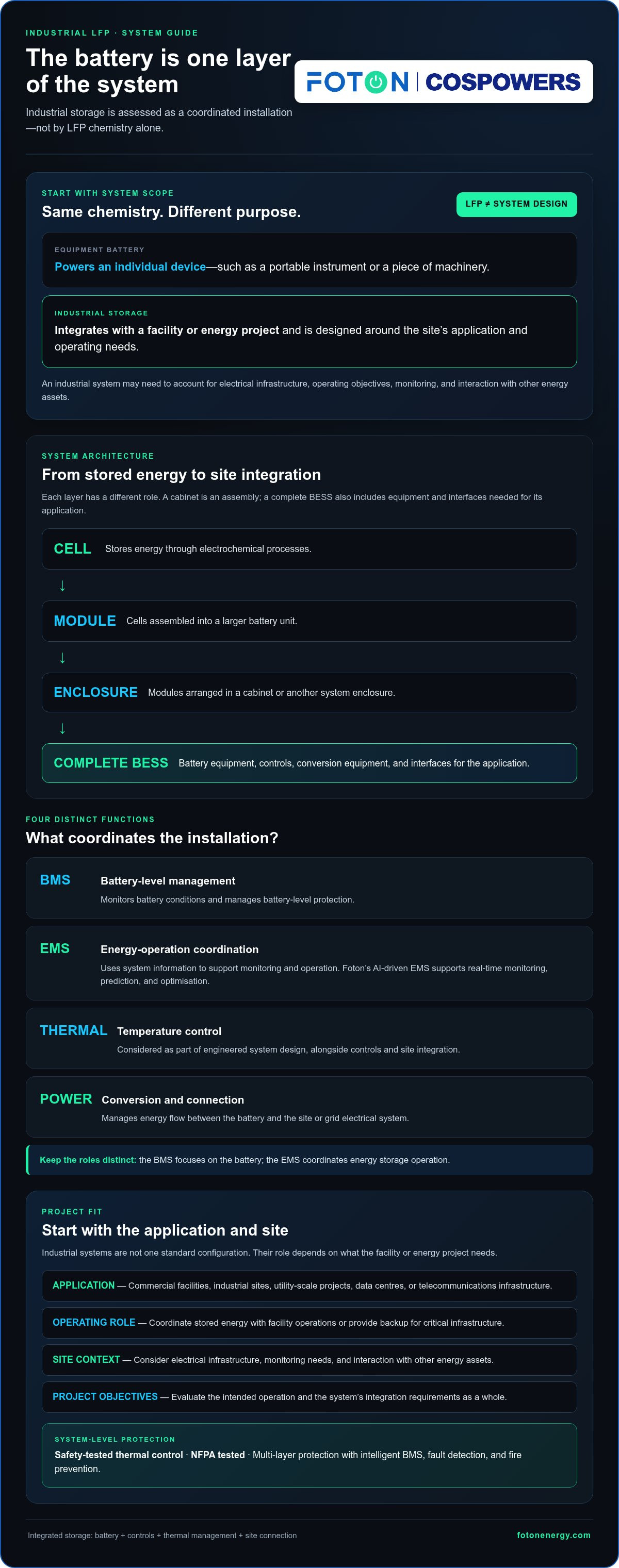
Industrial storage is designed to integrate with a facility or energy project; an equipment battery is designed to power an individual device. That distinction is more useful than the chemistry name alone. A small battery pack and an industrial storage system may both use LFP, but their intended roles and integration needs differ.
How does LFP chemistry relate to an industrial battery system?
Lithium iron phosphate describes the battery chemistry, not the complete system design. The Lithium Iron Phosphate Battery - Wikipedia overview provides background on the chemistry. For project evaluation, distinguish the main system layers: cells store energy through electrochemical processes; cells are assembled into modules; and modules are arranged within a cabinet or another system enclosure.
A battery management system (BMS) monitors and manages battery operation at the battery level. System-level controls coordinate the wider storage installation with its intended role. Depending on the design, this may include an energy management system (EMS), thermal management, and power-conversion equipment that enables energy to move between the battery and the site or grid. These components work together, but each has a different function.
What separates industrial storage from an equipment battery?
An equipment battery usually serves a defined device, such as a portable instrument or piece of machinery. Industrial storage is planned around a facility or energy application. Its design may need to account for the site’s electrical infrastructure, operating objectives, monitoring needs, and interaction with other energy assets. Requirements vary by project, so “industrial” does not describe one standard configuration.
For example, a commercial facility may assess storage in relation to building operations, while a data centre or telecommunications site may focus on how storage fits its backup architecture. An industrial site or utility project may have different integration priorities. In every case, the battery is only one part of the evaluation.
That broader scope brings coordinated monitoring, thermal management, and site integration into consideration. A cabinet is a physical system assembly, while a complete battery energy storage system (BESS) includes the battery equipment and the controls, conversion equipment, and interfaces needed for its application. The terms are not interchangeable: a cabinet may form part of a larger installation, while the complete system is evaluated against the project’s operating requirements.
How Industrial LFP Batteries Work as Integrated Storage Systems
In an industrial storage system, energy moves through a coordinated chain. The battery stores electrical energy as chemical energy; when the site or grid needs it, power-conversion equipment manages the flow between the battery and the electrical system. Controls coordinate operation according to the system’s design and intended application. The battery is the source of stored energy, but the wider system determines how it is monitored and integrated with the site.
That coordination matters for industrial lithium iron phosphate batteries because chemistry alone does not define how a storage project operates. The BMS monitors the battery, the EMS oversees energy operation, thermal management addresses temperature control, and power-conversion equipment connects the battery with site or grid electrical systems. Each layer has a distinct role.
What do the BMS and EMS each manage?
The battery management system (BMS) works at the battery level. It monitors battery conditions and manages battery-level protection. The energy management system (EMS) operates at a broader level, using system information to support decisions about how storage is monitored and operated. These systems interact, but they are not interchangeable: the BMS focuses on the battery, while the EMS coordinates energy storage operation.
An EMS monitors energy storage conditions and uses available system information to support prediction and optimisation of operation. Foton’s AI-driven EMS supports real-time monitoring, prediction, and optimisation. This gives the system an operational layer for interpreting storage information in relation to project objectives, while the BMS remains responsible for battery-level management.
How do thermal management and safety architecture fit in?
Thermal management is part of system design because battery operation takes place within an engineered installation. Consider it alongside controls and site integration, rather than as a standalone accessory. Foton’s system information includes Safety-tested thermal control and NFPA tested.
The stated system approach is Multi-layer protection with intelligent BMS, fault detection, and fire prevention. These elements describe an integrated architecture and should be considered as part of the complete system design. The BMS, thermal management, and wider controls need to be reviewed together in the context of the project.
Why does modular design matter?
A modular approach arranges storage equipment in coordinated sections, allowing project teams to consider deployment and potential future expansion as part of the system plan. Its practical value depends on how the modules, controls, power-conversion equipment, and site interfaces are designed to work together. Modularity alone does not guarantee a specific expansion path or project outcome.
For a technical discussion, map the proposed system to the site’s electrical arrangement and operating objectives. Foton’s integrated storage solutions bring system engineering, Intelligent EMS, thermal management, and protection architecture into the broader project conversation. This whole-system perspective helps keep component selection aligned with the application.
How to Compare Industrial LFP Battery Systems for Project Fit
Industrial battery selection depends on the application and system-level requirements. Chemistry is a starting point, not a complete fit assessment. Two systems using LFP may serve different roles, have different integration needs, and require different levels of operational coordination. Compare the complete system against the project’s intended use and site context.
Use the framework below to distinguish an industrial storage system from a small equipment battery pack. The comparison describes typical evaluation priorities, not a fixed specification for every project.
| Comparison area | Industrial storage system | Small equipment battery pack |
|---|---|---|
| Application | Consider the facility, industrial process, utility project, or critical infrastructure role the system is intended to support. | Consider the individual device or piece of equipment the pack is intended to power. |
| System scope | Assess the battery alongside relevant controls, power-conversion equipment, thermal management, and site interfaces. | Assess the pack in relation to its equipment and the device’s electrical requirements. |
| Integration | Review how the system connects with site infrastructure and existing energy assets. | Focus on how the pack fits and connects with its intended equipment. |
| Controls | Evaluate battery-level monitoring and system-level energy management as distinct functions. | Consider the control needs associated with the equipment application. |
| Safety evidence | Review documented architecture and evidence, including “NFPA tested”, “Safety-tested thermal control”, and “Multi-layer protection with intelligent BMS, fault detection, and fire prevention.” | Consider evidence relevant to the pack and its intended equipment context. |
| Support | Consider engineering support, modularity, and project-specific grid-code requirements. | Consider the support and documentation relevant to the equipment application. |
Which selection criteria matter beyond battery chemistry?
Start with the duty profile: how the project expects to use storage and how that use relates to site operations. Then consider operating context, integration requirements, and monitoring needs. For grid-connected projects, include applicable grid-code requirements in the technical review. Assess modularity as an architectural consideration, not as a promise of future expansion. Engineering support also matters because system choices must align with project interfaces and operating objectives.
For a safety assessment, focus on documented system architecture and evidence rather than broad claims. Compare the available system information with the project’s technical review needs, including how battery monitoring, thermal management, and fault detection fit into the overall design.
When should buyers compare LFP with another chemistry?
Consider another chemistry when the project’s application and requirements call for a broader technology assessment. Define the operating objectives and integration context first, then compare chemistry as one part of the complete system decision. Do not treat a chemistry label as proof that a system will suit a particular facility. A separate guide on sodium-ion battery commercial availability offers broader chemistry context alongside this project-fit framework.
How to Assess an Industrial LFP Battery Project Before Specification
A clear project brief turns a broad storage requirement into a focused technical discussion. Before specifying industrial lithium iron phosphate batteries, document what the site needs storage to do, how existing energy assets operate, and what the system must connect with. This gives engineering teams a stronger basis for assessing system architecture and project fit.
Use this workflow to organise the assessment:
- Define the use case. State the site purpose and the role storage is expected to play, such as supporting facility operations or fitting into a backup strategy.
- Describe the operating profile. Record the load profile, relevant operating patterns, and the objectives the project is intended to support.
- Map existing energy assets. Note on-site generation, the grid connection, and any existing storage or energy-control systems that may affect integration.
- Identify technical interfaces. Document relevant electrical connections, controls, site constraints, and the parties or systems that need to coordinate with the storage installation.
- Set review priorities. List questions for engineering review, including EMS integration, thermal management, safety architecture, and applicable grid-code and project compliance requirements.
- Prepare partner documentation. Assemble the site and operating information for technical discussion, then review project-specific configuration and supporting documents through the partner process.
What information belongs in an industrial battery project brief?
Keep the brief focused on the project context rather than assumptions about a particular battery. Record the application, site conditions, operating profile, and intended role of storage. Include the load profile and existing generation, grid connection, and control systems. Note integration requirements and operating objectives, such as how the system is expected to interact with site operations. This practical information helps shape the technical conversation around the project.
What should buyers review before system configuration?
Review the engineering approach and how the proposed system is intended to integrate with site controls and existing assets. Include EMS integration, thermal management, and the stated safety architecture in the design review. Assess grid-code and project compliance requirements as part of technical planning, since these need to be considered in the project context. Keep the review centred on documented system information and the site’s requirements.
Detailed technical and commercial materials are controlled. Pricing, datasheets, and project configuration are available to logged-in partners only. Prepare the project brief first so partner documentation can be considered against a defined application, operating profile, and integration scope.
For an industrial storage project, connect your site requirements with Foton’s project solutions and engineering support to advance the technical discussion.
Foton Energy Industrial LFP Solutions and Project Next Steps
Industrial storage is a system decision, and the solution needs to align with the project’s application, integration requirements, and operating objectives. Foton Energy (Foton Pty Ltd) delivers Tier-1 energy storage systems backed by extensive manufacturing heritage, with credentials that include DNV Verification and rigorous NFPA testing.
For C&I projects, Foton offers two distinct product families: the Integrated Energy Cabinet and PowerEco. They are separate solution categories, not interchangeable names for one product. Project stakeholders can assess each in relation to the site’s needs, system architecture, and integration requirements.
How does Foton support industrial storage projects?
Foton’s project approach connects system engineering with AI-driven EMS, thermal management, and system protection. Its EMS supports real-time monitoring, prediction, and optimisation, while the stated protection architecture includes Safety-tested thermal control and Multi-layer protection with intelligent BMS, fault detection, and fire prevention. Engineering consulting can support feasibility, system design, grid-code compliance, and commissioning as project requirements are developed.
For teams assessing industrial lithium iron phosphate batteries, the useful next step is to bring the application and integration context into the discussion. A project brief can help align the storage role, site interfaces, control requirements, and technical review priorities before configuration is considered. Foton’s system-level approach connects these project needs with the relevant C&I solution category.
What is the next step for an industrial LFP project?
Bring together the project purpose, site context, load profile, existing energy assets, grid connection, and operating objectives. These details give the technical discussion a practical starting point. Stakeholders can also review the published strategic guide to commercial and industrial BESS solutions for broader context on system planning. Keep the project brief focused on the application and integration questions that will shape the next stage.
Explore Foton Energy’s industrial storage solutions to connect project requirements with its C&I offerings and engineering support. Partner login required for pricing, datasheets, and project configuration. With the application and site information prepared, project teams can move into a focused technical discussion.
Move Your Storage Project Toward the Next Stage
Turn your site’s priorities into a focused project conversation. Before selecting industrial lithium iron phosphate batteries, align stakeholders around the outcomes the system should support and the constraints that will shape its design. A clear brief helps keep technical decisions connected to the facility’s operating needs.
Use that foundation to explore an integrated approach, with system architecture and project requirements considered together. Cospowers has over 30 years of manufacturing heritage. Foton’s product and technology information includes BNEF Tier 1, DNV Verified, and an AI-driven EMS for real-time monitoring, prediction, and optimisation. These capabilities support a considered discussion about how storage can fit your project.
Ready to take the next step? Explore Foton Energy industrial storage solutions and bring your project objectives into the conversation. A well-defined starting point can help your team move forward with clarity.
Frequently Asked Questions
What is an industrial lithium iron phosphate battery?
An industrial lithium iron phosphate battery is a battery component used in an energy storage system designed for applications such as commercial facilities, industrial sites, or critical infrastructure. The term “LFP” identifies the chemistry, not the entire installation. For a project assessment, identify whether you’re reviewing cells, modules, a cabinet, or a complete system, then consider how the equipment is intended to serve the site.
Are industrial LFP batteries different from batteries for industrial equipment?
Yes. An equipment battery is intended to power a particular device or machine, while industrial storage is planned around a facility or energy project. For example, replacing a battery in a portable instrument is a component-level task; planning storage for a commercial site involves considering how it fits the site’s electrical and operating context. The distinction is the intended role and integration scope, not simply the LFP chemistry.
How does an industrial LFP battery system work with an energy management system?
An EMS uses system information to support monitoring and operational decisions for energy storage. It can help project teams understand how storage operation relates to objectives such as coordinating with site energy use. The battery management system and EMS have separate responsibilities: the BMS focuses on battery-level monitoring and management, while the EMS works at the broader system level. Foton’s AI-driven EMS supports real-time monitoring, prediction, and optimisation.
What safety features should an industrial LFP battery system describe?
Look for clear documentation of the system’s safety architecture and the role of its controls. Foton’s stated features include “NFPA tested”, “Safety-tested thermal control”, and “Multi-layer protection with intelligent BMS, fault detection, and fire prevention.” These descriptions identify elements for a technical review. Consider them in the context of the system design and project documentation, rather than treating a single phrase as a complete assessment.
Can industrial LFP batteries be integrated with solar and grid systems?
They can be considered as part of a storage project involving solar generation and a grid connection, subject to the system design and site requirements. For an initial discussion, map how solar generation connects to the site, how the storage system is expected to interact with that arrangement, and what grid-code requirements apply. The EMS and power-conversion equipment are part of assessing how storage fits the project’s electrical architecture.
What information is needed to assess an industrial battery project?
Prepare a concise project brief with the site purpose, load profile, operating objectives, existing energy assets, grid connection, and current control systems. Add any known electrical interfaces and project compliance requirements. For example, a facility with existing generation should describe how that asset is used and what role storage is intended to play. This context helps focus engineering discussions on the project rather than assumptions about a generic installation.
How can I access Foton Energy pricing and product datasheets?
Pricing, datasheets, and project configuration are available to logged-in partners only. Partner login required. Before accessing project materials, organise your application details, site context, and operating objectives so the information can be considered alongside the project’s requirements. Public-facing product descriptions provide a high-level introduction, while partner access is required for the commercial and technical documentation relevant to project evaluation.


