

What if a battery charges when grid electricity is emissions-intensive, then discharges later and appears to support a climate target? Achieving corporate sustainability goals with BESS depends on more than installing storage. Whether it reduces emissions, helps use renewable energy or mainly delivers other benefits, such as peak management and resilience, depends on how the system charges and discharges and how its impact is measured.
This guide explains how to connect battery energy storage to defined corporate targets, assess its potential and limitations, and build a credible measurement approach. You’ll learn which data can link battery operation to energy use and emissions, why electricity source and timing matter, and what to evaluate before speaking with suppliers or project partners.
Operating strategy, energy sourcing and measurement all matter, as do system selection and integration. Technologies such as LFP and sodium-ion storage, intelligent energy management and engineering consulting can be part of the solution, but the right approach starts with your objectives and operating context, not a one-size-fits-all battery configuration.
Key Takeaways
- For achieving corporate sustainability goals with BESS, match each intended outcome to a specific battery use case and a measurable indicator.
- Check whether charging sources, dispatch timing and round-trip losses support the emissions case you plan to report.
- Build a credible evidence trail by linking battery operations to facility energy data, reporting boundaries and existing targets.
- Start planning with a baseline of facility demand, energy sources and sustainability commitments before assessing feasibility and design.
- Compare battery chemistry, safety architecture, scale and energy management against your operating needs instead of assuming one technology fits every project.
How BESS Can Support Corporate Sustainability Goals
Corporate climate commitments create a practical challenge: leaders need to turn high-level targets into operational energy decisions and show what those decisions achieve. Battery energy storage can help, but its contribution depends on how it is charged, dispatched and measured.
A Battery Energy Storage System (BESS) stores electricity and releases it later. It shifts energy across time rather than generating electricity. A facility might store surplus electricity from on-site renewables for use when generation falls, or discharge a battery during a period of high demand. These strategies can support renewable integration, energy flexibility and resilience, but each serves a different purpose.
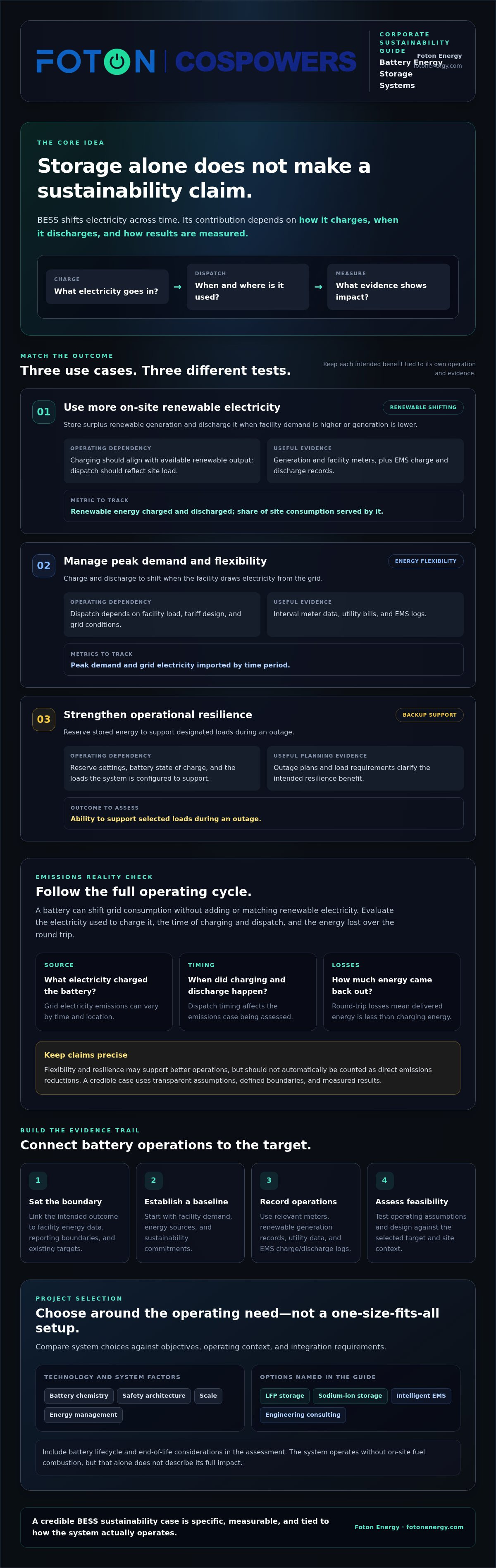
BESS supports sustainability when its charging, dispatch and measurement align with defined goals. This is the central test for achieving corporate sustainability goals with BESS: connect a specific target to an operating strategy, then identify the evidence needed to demonstrate progress.
Which corporate targets can battery storage support?
Separate the objective from the technology. Increasing renewable-energy use may involve storing on-site generation for later consumption. An operational emissions target requires evidence that battery operation reduces emissions within the organisation’s reporting boundary. Energy flexibility may focus on changing when a facility draws electricity from the grid. Resilience targets, by contrast, concern the ability to support selected loads during an outage.
Each outcome calls for different strategies and evidence. Meter data and renewable generation records can help assess energy shifting. Dispatch and electricity data can inform an emissions analysis. Outage plans and load requirements clarify the intended resilience benefit. Flexibility and resilience may support better operations, but they should not automatically be counted as direct emissions reductions.
Why doesn’t BESS automatically make a business lower-carbon?
The battery’s impact depends on the electricity used to charge it and when charging occurs. If it charges from the grid, the emissions associated with that electricity can vary by time and location. Discharging later may shift grid consumption without adding or matching renewable electricity. Round-trip losses also mean the system delivers less energy than it used to charge, so the full operating cycle matters.
Keep claims precise. Assess a renewable-energy shifting strategy against renewable generation and facility consumption data. A claim about lower operational emissions needs project-specific energy and emissions assumptions. Battery lifecycle and end-of-life considerations also belong in the assessment. They should not be overlooked because the system operates without on-site fuel combustion. No universal savings figure can replace this analysis. A credible case relies on transparent assumptions, defined boundaries and measured results.
Map BESS Use Cases to Targets, Operations, and Metrics
Turn each sustainability objective into an operating decision and a record you can verify. One headline metric cannot capture every battery benefit. Renewable-energy shifting, peak management and backup resilience serve different purposes, so they need separate indicators. Use the framework below to connect each use case to its operating conditions and evidence.
| Target | BESS application | Operating dependency | Metric | Evidence source |
|---|---|---|---|---|
| Increase use of on-site renewable electricity | Store surplus renewable generation and discharge it when facility demand is higher or generation is lower. | Charging must align with available renewable output; system dispatch should reflect site load. | Renewable energy charged and discharged, and the share of site consumption served by it. | Generation and facility meters, plus battery energy management system (EMS) charge and discharge records. |
| Improve energy flexibility and manage peak demand | Charge and discharge to shift when the facility draws electricity from the grid. | Dispatch depends on facility load, tariff design and grid conditions. | Peak demand and grid electricity imported by time period. | Interval meter data, utility bills and EMS logs. |
| Strengthen operational resilience | Reserve stored energy to support designated loads during an outage. | Performance depends on reserve settings, battery state of charge and which loads the system is configured to support. | Critical-load energy supplied and duration of support during an outage. | EMS records, site operating logs and outage records. |
Keep financial and sustainability results distinct. A reduction in demand charges is a financial outcome, not an emissions metric by itself. Report resilience through indicators such as critical-load support, rather than presenting it as a direct emissions reduction without supporting evidence.
What should companies measure when using BESS?
Record each charge and discharge event, including the energy, timing, source and operating purpose. Connect those records to facility electricity data, the organisation’s reporting boundaries and the emissions factors selected for its reporting method and year. A useful BESS sustainability KPI is a traceable metric tied to a stated target. For example, a renewable-energy target could track metered renewable energy stored and later used on site, with the calculation method documented.
How do operating models change the sustainability case?
Renewable-aligned charging prioritises charging when renewable generation is available. Grid-responsive dispatch may instead follow demand, tariffs or grid conditions. Neither approach is automatically lower-carbon. Facility load, renewable availability and applicable emissions factors help determine the result. Assess resilience separately, using indicators tied to critical loads and outage performance.
For broader project context, see the commercial and industrial BESS strategic guide. Organisations assessing feasibility, system design or grid-code compliance can also review Foton Energy’s engineering consulting as part of their planning.
Test the Sustainability Case: Emissions, Trade-Offs, and Evidence
A battery is not inherently zero-emission or automatically sustainable. Its climate impact depends on the electricity used to charge it, energy lost during operation and impacts across its lifecycle. For organisations achieving corporate sustainability goals with BESS, distinguish measured project performance from estimated, avoided or market-based emissions claims.
Start with clear boundaries. State which facilities, energy flows and reporting periods are included, then document the assumptions and data used. If a result is modelled rather than measured, label it and explain the uncertainty. This helps leaders and stakeholders understand what the evidence supports and what remains an estimate.
How should BESS emissions be assessed and reported?
Use the GHG Protocol as a reporting reference, while checking its current guidance against your organisation’s structure, reporting boundaries and applicable requirements for the reporting year. Separate operational electricity impacts from embodied and lifecycle impacts. For operational calculations, retain dispatch records, charging and discharging data, the emissions factors applied and the calculation method. Where relevant, identify whether reported electricity results use location-based or market-based methods, and explain the basis consistently.
Build an auditable record, not just a headline claim. A reviewer should be able to trace the result from source data through assumptions to the reported figure. If data is incomplete, disclose the gap and how it affects confidence.
Which trade-offs should decision-makers disclose?
Assess the charging mix alongside the battery’s purpose. Charging from renewable generation may help shift renewable electricity for later use. Grid charging can produce a different emissions result depending on timing and the applicable factor. Account for round-trip losses: the energy delivered is less than the energy used to charge the system. Report flexibility or resilience benefits separately from emissions reductions.
Lifecycle impacts also matter. Request evidence relevant to battery materials, manufacturing, expected durability and end-of-life handling, and state what is known or not yet established. Avoid implying that a certificate, offset or grid service is equivalent to a measured reduction in the organisation’s direct emissions. These may have distinct roles, but they should be described and accounted for separately.
Make the sustainability case transparent. Keep a consistent record of boundaries, data sources, emissions factors, dispatch assumptions, calculation methods and uncertainty. Revisit the assessment when operating patterns or reporting guidance change. A credible result does not depend on claiming that storage has no impact. It depends on showing the project’s contribution, trade-offs and evidence precisely.
Build a Practical BESS Roadmap for Corporate Sustainability
A credible BESS project starts with a sustainability objective, not a preferred battery configuration. For organisations focused on achieving corporate sustainability goals with BESS, a staged process connects targets to site conditions, design choices, operating records and review.
- Define the target. Specify the intended outcome, such as increasing on-site renewable-energy use, managing peak demand or supporting critical loads during outages. Set a measurable indicator and reporting period.
- Establish the baseline. Document facility demand, energy sources, reporting boundaries and existing corporate targets. Include relevant load and generation data so the project can be assessed against current operations.
- Test feasibility. Compare the target with the site’s load profile, renewable availability, grid conditions and intended dispatch strategy. Record the data and assumptions used to estimate energy and emissions outcomes.
- Develop the design. Assess system scale, integration needs, safety and thermal-management architecture, and lifecycle considerations against site requirements. Involve operational, technical, safety, sustainability and measurement stakeholders so the design reflects daily operations and reporting needs.
- Commission and verify. Confirm that monitoring and operating records can capture the information needed to assess performance. Compare actual operation with the baseline and intended strategy.
- Review and refine. Reassess dispatch, indicators and assumptions as facility demand, energy sources or corporate targets change. Keep measured results distinct from estimates.
For a closer look at feasibility and system design, consult this guide to BESS engineering and consulting.
What belongs in a sustainability-led BESS feasibility assessment?
Test whether the proposed operating model fits both the target and the site. Examine the load profile, renewable availability and grid conditions, then model the intended charging and dispatch strategy. Specify the inputs, emissions factors and assumptions used for environmental estimates, and explain how uncertainty will be disclosed. Before selecting a design, also assess safety, thermal management, electrical and control-system integration, and relevant lifecycle considerations.
How can an EMS connect strategy to operating evidence?
An energy management system can monitor and coordinate storage operation according to its configured functions. Confirm the proposed system’s available features, data access and reporting capability instead of assuming they are standard. Establish how charging, discharging and other relevant energy flows will be recorded, time-stamped and made available for operational and sustainability review. Explore the AI-driven energy management systems guide for further context.
Once the target, feasibility criteria and evidence requirements are defined, consider discussing BESS engineering consulting for your project as part of the planning process.
Align BESS Technology and Partners with Long-Term Sustainability Goals
Technology selection should follow the project’s targets and operating conditions, not a preferred chemistry or headline performance claim. For organisations achieving corporate sustainability goals with BESS, evaluate the complete system: storage scale, safety architecture, energy management, engineering, data access and support arrangements. A technically suitable system can enable a chosen operating strategy, but it cannot guarantee a sustainability outcome.
LFP and sodium-ion options both warrant application-specific assessment. Compare them against the site’s operating profile, integration needs, safety requirements and documented system specifications. The right choice depends on the project, not a universal ranking. Scale matters too: define the loads or energy flows the system needs to support, then assess whether its design and dispatch strategy align with the stated objective.
What should organisations ask a BESS supplier?
Use a consistent set of questions to test each proposal against project requirements:
- How will the system design, dispatch strategy and EMS support the organisation’s specific target?
- Which specifications, applicable certifications and safety evidence can be provided for the proposed configuration?
- How are performance claims bounded by operating conditions, assumptions and measurement methods?
- What commissioning and technical support arrangements are included, and how will the organisation access operating data?
- Who is responsible for end-of-life planning, and what information or processes support that responsibility?
Request evidence for the configuration under consideration, not general claims about a technology category. Confirm that the proposed data can support operational review and the organisation’s reporting approach.
How can Foton Energy (Foton Pty Ltd) support a project’s technical evaluation?
Foton Energy (Foton Pty Ltd) offers LFP and sodium-ion BESS, intelligent energy management systems, and engineering consulting for feasibility, system design and grid-code compliance. These are capabilities to assess against the project’s objectives and site conditions, not a guarantee of emissions reductions or sustainability certification. Verify project-specific specifications, certifications, manufacturing heritage and performance evidence during evaluation.
Bring sustainability, operations, engineering, safety and reporting stakeholders into the same review. Agree on the target, required data, system boundaries and responsibilities before comparing proposals. This makes it easier to assess whether the technology and partner can support a credible implementation over the project’s operating life.
To explore project requirements and commercial and industrial applications, read the commercial and industrial BESS solutions guide. You can also discuss your sustainability objectives, application and technical requirements with Foton Energy (Foton Pty Ltd) as part of your evaluation.
Turn Sustainability Targets into a Credible BESS Plan
Start with the outcome, then design the system around it. Battery storage can support renewable-energy use, flexibility or resilience, but those benefits depend on the operating strategy and need evidence suited to the target. A clear baseline, traceable energy data and transparent emissions assumptions help distinguish measured results from estimates and financial benefits.
That discipline is central to achieving corporate sustainability goals with BESS. Define what success means for your organisation, assess site conditions and trade-offs, and select technology and partners against documented project requirements. Review performance over time so the operating strategy remains aligned with your sustainability objectives.
Foton offers LFP and sodium-ion battery systems with intelligent energy management, alongside engineering consulting for feasibility, system design and grid-code compliance. Evaluate these capabilities against your application and technical requirements as you develop a project plan.
Discuss your BESS project requirements with Foton to take the next step toward a well-measured, practical energy strategy. With clear targets and sound evidence, your organisation can move forward with confidence.
Frequently Asked Questions
Can BESS reduce a company’s carbon emissions?
Yes, BESS can support emissions reductions when charging sources, dispatch and operating conditions align with the company’s target. A battery stores electricity; it does not generate it, and charging from a higher-emissions source may weaken the climate case. For achieving corporate sustainability goals with BESS, assess project data, energy losses, emissions factors and reporting boundaries before claiming reductions. Report resilience and cost benefits separately unless evidence connects them to emissions outcomes.
How does battery energy storage support corporate sustainability goals?
BESS can shift electricity use, help coordinate renewable generation with demand, and provide energy flexibility or backup capability. The relevant benefit depends on the company’s target and operating context. Define the intended outcome first, then select operating rules and metrics that can show progress. For example, a renewable-energy objective calls for evidence of renewable electricity stored and later used. Installing a battery alone does not prove that a sustainability commitment has been met.
What sustainability metrics should a company track for BESS?
Track energy charged and discharged, timing, energy source, operating purpose and relevant system performance. Connect these records to the organisation’s emissions boundaries, selected emissions factors and stated targets. Keep resilience and financial indicators separate from emissions metrics. Document data sources, assumptions and calculation methods, and explain uncertainty or data gaps. This makes the results easier for internal teams and external reviewers to understand, and helps distinguish metered performance from estimates.
Is BESS automatically powered by renewable energy?
No. A battery stores electricity from the sources available under its operating arrangement, so it is not automatically powered by renewables. Charging may align with renewable generation, but the outcome depends on generation availability, grid conditions, controls and timing. Confirm how the system will charge and dispatch, then retain records of energy flows. Those records are important before making claims about renewable-energy use or emissions reductions. Storage itself is not an energy source.
What should a company assess before investing in BESS for sustainability?
Begin with the sustainability target and a baseline covering facility load, energy sources and reporting boundaries. Then assess the intended use case, grid conditions, renewable availability, safety requirements, system integration and the data needed to verify performance. Compare battery options against those requirements rather than selecting on chemistry alone. A feasibility assessment should identify assumptions, limitations and evidence needs before the organisation commits to expected operating or emissions outcomes.
How can an EMS help track BESS sustainability performance?
An energy management system can monitor and coordinate battery operation, depending on its verified capabilities and integration with the wider system. Relevant records may include charging, discharging, timing and energy flows. These data can support operational analysis, but they do not establish emissions reductions by themselves. The organisation still needs defined reporting boundaries, suitable emissions factors and documented calculations that connect measured battery operation to a specific sustainability target.


