

A utility-scale battery’s value depends on more than its size. It must meet a specific grid need, dispatch at the right time and perform reliably across its operating life. That’s why utility scale battery energy storage systems should be assessed as integrated assets, not simply as containers of stored energy.
It’s reasonable to ask how a BESS creates value for the grid and what a project needs to succeed. In Australia, batteries can shift energy between periods of supply and demand and support grid services, but the right configuration depends on connection requirements, operating conditions and the intended dispatch strategy. Capacity and duration matter, as do control systems, safety architecture and lifecycle planning.
This guide explains the core system architecture and how storage participates in Australian grid operations and markets. It also outlines the technical and commercial factors to assess before progressing a project, from chemistry and integration to performance over time. Foton Energy brings together utility-scale storage, engineering consulting and energy management capabilities to connect project requirements with system design and operational needs.
Key Takeaways
- Understand the difference between a battery’s power capacity in MW and its stored energy in MWh, and why both shape its role on the grid.
- See how utility scale battery energy storage systems charge, store, convert and dispatch electricity as part of an integrated grid-connected system.
- Compare energy shifting, renewable firming, grid support and ancillary services to identify which operating objective best fits a project.
- Assess a project in sequence, starting with grid need, connection capacity, network constraints and operating profile before moving to design and operations.
- Explore how application, site conditions, integration needs and lifecycle priorities inform technology choices, including LFP and sodium-ion systems.
What utility-scale battery energy storage systems do for Australia’s grid
A grid-scale battery stores electricity and dispatches it later, connecting to the electricity network rather than serving only one home or business. A Battery energy storage system (BESS) combines batteries with equipment that enables energy to be stored, converted and supplied to the grid. In Australia, utility scale battery energy storage systems can shift energy to periods of higher demand and support a more flexible power system as generation from weather-dependent sources varies.
Two measures describe a battery’s basic capability:
- Power capacity, measured in megawatts (MW), indicates how much electricity it can deliver at a given moment.
- Stored energy, measured in megawatt-hours (MWh), indicates how much energy it can hold.
For example, a 100 MW battery with 200 MWh of stored energy could, in simplified terms, deliver 100 MW for two hours. Actual dispatch depends on usable capacity, system losses and operating limits. The example shows why both figures matter: MW relates to the rate of delivery, while MWh helps indicate how long that delivery can continue.
Australia’s project context also depends on location. The National Electricity Market (NEM) serves interconnected regions across the eastern and southern mainland and Tasmania. Western Australia operates a separate Wholesale Electricity Market (WEM) on the South West Interconnected System (SWIS). A project’s location determines which market and network arrangements apply, so assess a battery’s role in its local grid context.
How utility-scale storage differs from household and C&I batteries
Utility-scale projects connect to the electricity network to support broader system needs, with dispatch coordinated through project controls and relevant market and network arrangements. Household batteries are generally tied to an individual premises, while commercial and industrial (C&I) systems are often designed around a facility’s energy requirements. “Utility-scale” describes a system’s grid role and capacity, not one universal project size. Configuration and responsibilities vary by site.
What a grid-scale battery can and cannot do
A battery can charge when electricity is available and dispatch stored energy later, helping balance differences between supply and demand. It may also provide grid or market services, depending on its design, connection, applicable rules and dispatch strategy. Those capabilities are project-specific, not automatic.
A battery doesn’t create energy. It stores electricity supplied from elsewhere and returns it with conversion losses. Nor does storage alone guarantee uninterrupted supply: performance depends on available charge, equipment, connection conditions and system operation. Define the grid need first to establish what the battery should do and which capabilities its design must support.
How a utility-scale BESS stores energy and dispatches it
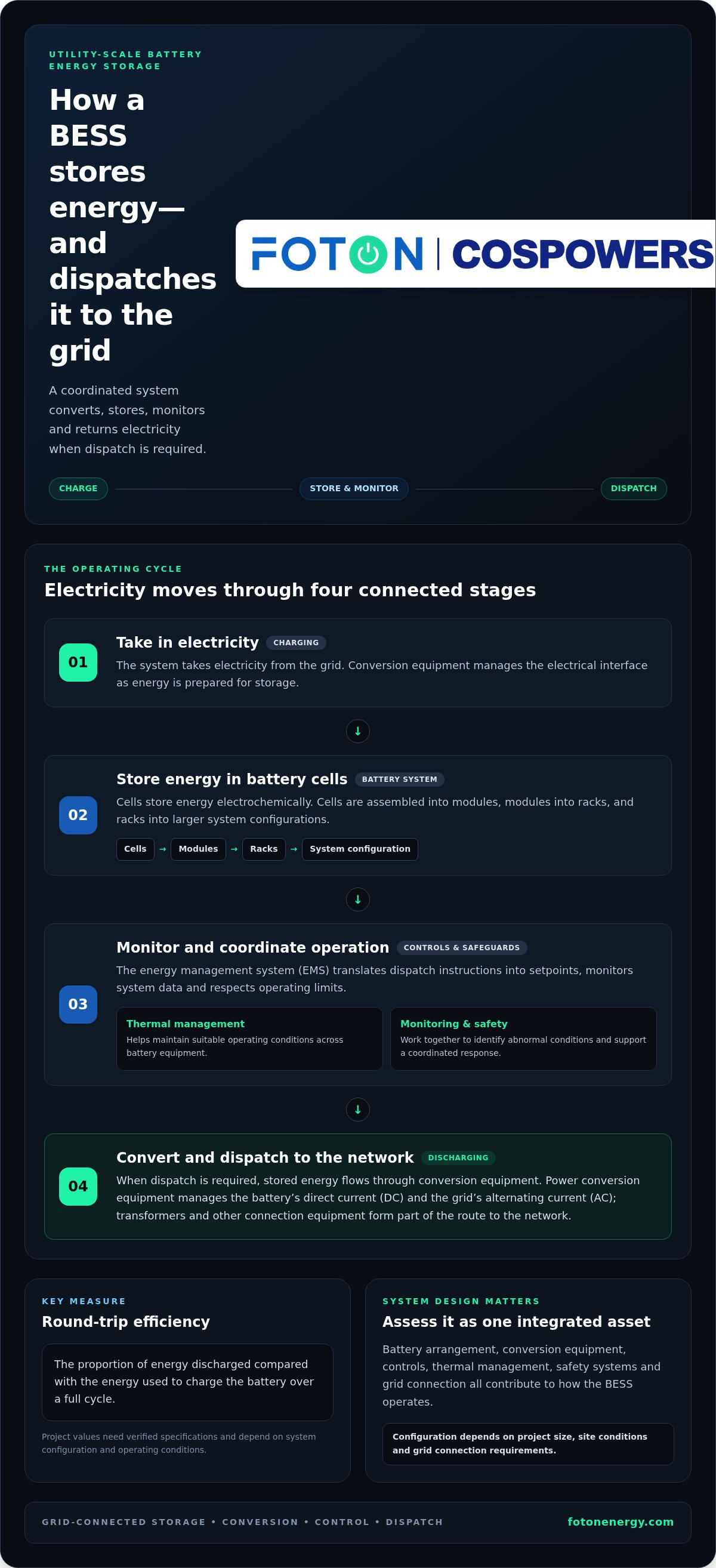
A utility-scale battery operates through a coordinated cycle: electricity flows from the grid, conversion equipment manages the electrical interface, and the battery stores energy for later use. When dispatch is required, the system releases stored energy through the conversion equipment back to the grid. Monitoring and control systems track operating conditions throughout the cycle.
The battery is built in layers. Cells store energy electrochemically; groups of cells are assembled into modules, which are combined into racks and larger system configurations. Power conversion equipment manages the interface between the battery’s direct current (DC) and the grid’s alternating current (AC). The arrangement depends on project size, site conditions and grid connection requirements. The International Energy Agency’s report, Batteries and Secure Energy Transitions, provides broader context on battery technology and its role in power systems.
From battery modules to a grid-connected system
During charging, the system takes in grid electricity and converts it into a form the battery can store. During discharge, the conversion equipment conditions the battery’s output for delivery to the network. Transformers and other connection equipment form part of the path between the battery system and the grid. Assess these components as an integrated design, rather than as separate specifications in isolation.
Round-trip efficiency is the proportion of energy discharged compared with the energy used to charge the battery over a full cycle. Project values require verified specifications and depend on the system configuration and operating conditions.
Why controls, thermal management, and safety architecture matter
An energy management system (EMS) coordinates operation by translating dispatch instructions into setpoints while respecting system limits. It can align charging and discharging with the project’s operating strategy and monitor system data. This control layer connects the battery’s physical capability with its intended grid role, while helping the system respond to changing operating conditions.
Thermal management helps maintain suitable operating conditions across battery equipment. Monitoring and safety architecture work together to identify abnormal conditions and support a coordinated response. Consider these functions across the whole system, including battery components, conversion equipment, controls and site integration, rather than treating them as add-ons.
For utility scale battery energy storage systems, reliable operation depends on how storage, conversion, connection, controls, thermal management and safety design work together. Foton Energy combines utility-scale storage, engineering support and energy management capabilities to address project-specific requirements. Find details on Foton Energy’s utility-scale storage.
Which grid services and project models suit utility-scale BESS?
Start with the grid need, not a list of services a battery might theoretically provide. The operating objective determines how the system charges and dispatches, while connection conditions, market rules and technical capability shape which services are practical. The Australian Renewable Energy Agency’s Australian Guide to Battery Storage offers broader context on storage’s role in Australia’s energy system.
| Use case | Operating objective | Key project dependency |
|---|---|---|
| Energy shifting | Charge when energy is available, then discharge during a later period of demand or higher system need. | Usable energy duration, charging access and dispatch strategy. |
| Renewable firming | Store surplus renewable generation and dispatch it when output falls or demand rises. | Generation profile, co-location or grid access, and the battery’s operating limits. |
| Grid support | Respond to local or wider system requirements that support stable network operation. | Connection location, equipment capability and network requirements. |
| Ancillary services | Provide defined system-response services, subject to market arrangements. | Technical capability, registration and applicable market rules. |
Match the battery’s role to the grid need
Energy shifting moves electricity across time. Other services focus more on system response or operational support, and may require different control settings, available power or state of charge. Renewable generation profiles help shape the plan: a battery paired with generation may charge during periods of surplus and dispatch when that output declines, subject to its connection and operating strategy.
In Australia, FCAS means Frequency Control Ancillary Services. It’s a market term for services that help manage frequency, but participation depends on current market rules, registration requirements and demonstrated system capability. Check the relevant market operator’s current guidance for eligibility and requirements. A project should not assume that a particular service is available in every region.
Front-of-meter projects and renewable energy integration
Front-of-meter storage connects to the grid or participates in the market, rather than being configured primarily around an individual site’s electricity use. A standalone battery connects as its own asset; a co-located system shares a project site with renewable generation. Co-location can align charging with generation, while standalone projects may draw from the wider grid. Both models depend on connection capacity and operating arrangements. The distinction from behind-the-meter storage is explored in Front of the Meter vs Behind the Meter Storage.
A project may combine value streams, but only where its design and dispatch plan can meet each commitment without exceeding power, energy or operating limits. Market conditions also influence how those services fit together. For utility scale battery energy storage systems, a credible use-case assessment connects grid need, project model and dispatch strategy without treating potential revenue as assured.
How to assess an Australian utility-scale BESS project
A robust project assessment moves from the grid need to the operating plan before equipment is finalised. Early feasibility can identify major opportunities and constraints, but it doesn’t replace detailed engineering, connection studies or decisions about market participation. For utility scale battery energy storage systems, site and network conditions can shape the project as much as the battery’s intended role.
Start with site, connection, and operating requirements
Define the intended grid role, likely charging source, dispatch profile and project boundaries first. Then assess the site and connection in their local Australian market context. Technical feasibility depends on project-specific engineering and network conditions, including connection capacity and constraints that may affect when or how the battery can operate. Record these assumptions early so they can be tested in engineering and connection studies.
- Define the grid need. Specify the intended service or operating objective, the expected charging source and when the battery needs to dispatch.
- Assess the site and connection. Consider land and site conditions, available connection capacity, network constraints and the relevant jurisdiction’s current connection processes.
- Build an operating profile. Map expected charging and dispatch patterns against the use case, operating limits and local market context. Treat potential service participation as an assessment, not an assumption.
- Develop the technical design. Translate project requirements into a system configuration, controls, safety architecture and integration approach. Use engineering studies to test assumptions against actual site and network conditions.
- Plan delivery and commissioning. Coordinate equipment integration, connection interfaces, control systems and commissioning activities so the complete asset can be assessed against its intended operating requirements.
- Set up long-term operations. Establish monitoring, maintenance planning and performance measures that reflect the expected dispatch profile and lifecycle priorities.
Plan for delivery and long-term asset performance
Performance assumptions should match how the battery is expected to operate. A project designed for frequent cycling, for example, needs lifecycle planning based on that intended duty, rather than assumptions suited to a different dispatch pattern. Define how operating data will be monitored and used to evaluate performance over time. Detailed compliance considerations are covered in Achieving Grid Code Compliance in Utility BESS, while Utility-Scale BESS Procurement: The 2026 Strategic Guide to Grid-Scale Storage addresses procurement in greater depth.
Foton Energy brings together engineering consulting, utility-scale storage and energy management to support project-specific requirements across assessment and integration. Learn more about Foton Energy’s utility-scale BESS capabilities.
Building a utility-scale BESS with the right technology and delivery partner
Technology selection should follow the project’s operating brief. Chemistry, system configuration and supporting equipment need to align with the intended application, site conditions, grid connection, dispatch profile and lifecycle priorities. A headline capacity or chemistry label alone can’t show whether a system is suited to its operating role.
Choose a system around project requirements, not a single specification
Compare options against defined project requirements and supplier documentation. Consider how often and when the battery is expected to charge and dispatch, the environmental conditions at the site, connection and control requirements, and the operational plan over the asset’s life. These factors make technology trade-offs specific to the project, rather than dependent on broad assumptions.
Lithium iron phosphate (LFP) and sodium-ion are distinct battery chemistries. Assess their suitability against the same project-specific criteria, using relevant technical documentation rather than blanket claims about one being better. For a closer look at chemistry and cycle-life considerations, see Evaluating LFP Battery Cycle Life for Utility Projects.
Coordinate the system, not just the battery
Project integration depends on more than cells and enclosures. Battery hardware, power conversion, energy management, thermal management, safety architecture and engineering decisions need to function as a coordinated system. An energy management system (EMS) helps align operation with dispatch instructions and operating limits, while thermal management and safety design address system conditions and protection as part of the overall architecture.
Establish that coordination early. It links the selected technology to the connection design, site requirements, controls and operating strategy, helping reduce gaps between component specifications and the project’s intended performance. Utility scale battery energy storage systems are best evaluated as integrated assets, with each design choice considered in the context of the whole project.
How Foton Energy supports utility-scale storage projects
Foton Energy (Foton Pty Ltd) is an Australian energy storage infrastructure company delivering comprehensive storage solutions. Foton Energy’s utility-scale storage capabilities bring together LFP and sodium-ion systems, AI-driven energy management, thermal management, safety architecture and engineering consulting. These capabilities connect manufacturing, engineering, system integration and energy management around project-specific requirements.
For project teams, the next step is to turn the assessment into a coordinated system concept: define the application, account for site and grid conditions, and align technology and controls with lifecycle priorities. This creates a clearer basis for progressing from project requirements into detailed design and integration.
Turn grid requirements into a project-ready storage strategy
Strong BESS projects begin with the grid need. The right project connects its operating objective, site and network conditions, system design, dispatch strategy and long-term performance plan. Utility scale battery energy storage systems create value when these elements work together, not when technology is selected by capacity or chemistry alone.
Assess connection capacity and local market context early, then align the battery configuration, controls, integration and lifecycle assumptions with the intended operating profile. Assess LFP and sodium-ion systems against project-specific requirements and technical documentation.
Foton Energy is the exclusive global strategic partner for Cospowers, a Tier-1 manufacturer with more than 30 years of manufacturing heritage. Foton combines battery systems with energy management, thermal management, safety architecture and engineering consulting to support utility-scale storage projects from technical assessment through integration planning.
For a project-specific discussion, contact Foton Energy about utility-scale storage capabilities.
Frequently Asked Questions
What is a utility-scale battery energy storage system?
A utility-scale battery energy storage system is a grid-connected asset that stores electricity for later dispatch. It combines battery equipment with power conversion, controls, monitoring and connection infrastructure. Utility scale battery energy storage systems may shift energy between different periods, support renewable integration or provide grid services. Their actual capabilities depend on system design, connection conditions, operating limits and the market arrangements that apply to the project.
How does a grid-scale battery store and release electricity?
A grid-scale battery stores electricity electrochemically during charging, using power from the grid or a connected energy source. Power conversion equipment manages the electrical interface between the battery and the grid. When dispatched, the system converts stored energy into electricity for export or grid support. An energy management system coordinates charging and discharge according to instructions, system conditions and operating limits, so controls and battery hardware need to work as an integrated system.
What is the difference between MW and MWh in a BESS?
MW measures the rate at which a battery can charge or discharge, while MWh measures the amount of energy it can store. Think of water flowing into a tank: MW is the flow rate, and MWh is the tank’s capacity. A battery’s approximate duration relates usable energy to discharge power, but actual delivery also depends on operating limits, system losses and the project’s dispatch strategy.
Can utility-scale batteries help stabilise the Australian grid?
Yes, batteries can support Australian grid needs through energy shifting and, where eligible, ancillary services. Their contribution depends on location, grid connection, controls, operating strategy and current market rules. Australia’s market arrangements vary by region, so a service available in one area shouldn’t be assumed to apply everywhere. Project teams need to assess the relevant network conditions and verify market participation requirements against current guidance.
How long can a utility-scale battery provide power?
Discharge duration depends on usable energy capacity, output power, operating limits and the battery’s intended duty cycle. For example, a system designed for frequent short dispatches may operate differently from one intended to supply energy over longer periods. Compare verified usable-energy and power specifications for the specific project rather than relying on a generic duration figure. Operating conditions and degradation assumptions also affect performance over the asset lifecycle.
What factors determine the size of a utility-scale battery?
Battery sizing starts with the grid need and intended operating profile, then considers required power, usable energy, connection capacity, site constraints and dispatch strategy. Environmental conditions, operating limits and lifecycle assumptions also inform the design. There’s no single standard size that suits every utility project. Project-specific engineering helps align the system’s power and energy capability with network conditions and the services it is intended to provide.
How do developers evaluate utility-scale BESS project value?
Developers assess intended grid services, market access, charging and dispatch opportunities, connection conditions, system performance and lifecycle needs. Project economics should use current assumptions specific to the location and operating strategy, rather than generic revenue estimates. Technical design, integration and controls affect whether the asset can deliver its intended role. Sensitivity analysis can show how project outcomes may change under different market conditions and operating scenarios.


