

What if the biggest risk in your energy plan isn’t choosing the wrong technology, but locking in choices that can’t adapt? Future-proofing industrial energy strategy means preparing for shifts in demand, energy markets and grid capacity while keeping operations reliable and commercial priorities in view.
Infrastructure decisions can shape a facility for years, while demand forecasts, supply conditions and decarbonisation priorities may change. A resilient plan doesn’t depend on one prediction or one technology. It links business risks to flexible assets, intelligent controls and supply options, and considers energy storage when project requirements support it.
This guide provides a repeatable framework for planning under uncertainty. Learn how to assess operational and market risks, prioritise investments, and consider technologies such as battery energy storage systems and energy management systems. It also outlines a phased implementation approach, with review points to help your organisation respond as conditions evolve and keep energy investments aligned with business objectives.
Key Takeaways
- Use business risks, including reliability needs and grid uncertainty, to define what your energy strategy must protect and preserve.
- Build scenarios from facility data and documented assumptions, then set review triggers instead of relying on a single demand forecast.
- Compare grid supply, generation, flexible demand, storage and controls as parts of one system. Assess BESS when project requirements support its role.
- Stage decisions from baseline assessment through commissioning, with decision gates for operational fit, integration, safety, supply and financeability.
- Make future-proofing industrial energy strategy a partnered decision by assessing a provider’s manufacturing, engineering and integration capabilities against your project needs.
Why Future-Proofing Industrial Energy Strategy Starts with Business Risk
Industrial energy decisions affect production reliability, exposure to energy markets, decarbonisation expectations and the facility’s ability to respond to changing grid conditions. A supply interruption can affect output; a change in production demand can alter what the site needs from its infrastructure. Future-proofing industrial energy strategy starts by identifying which changes could materially affect the business, rather than selecting equipment before the risks are clear.
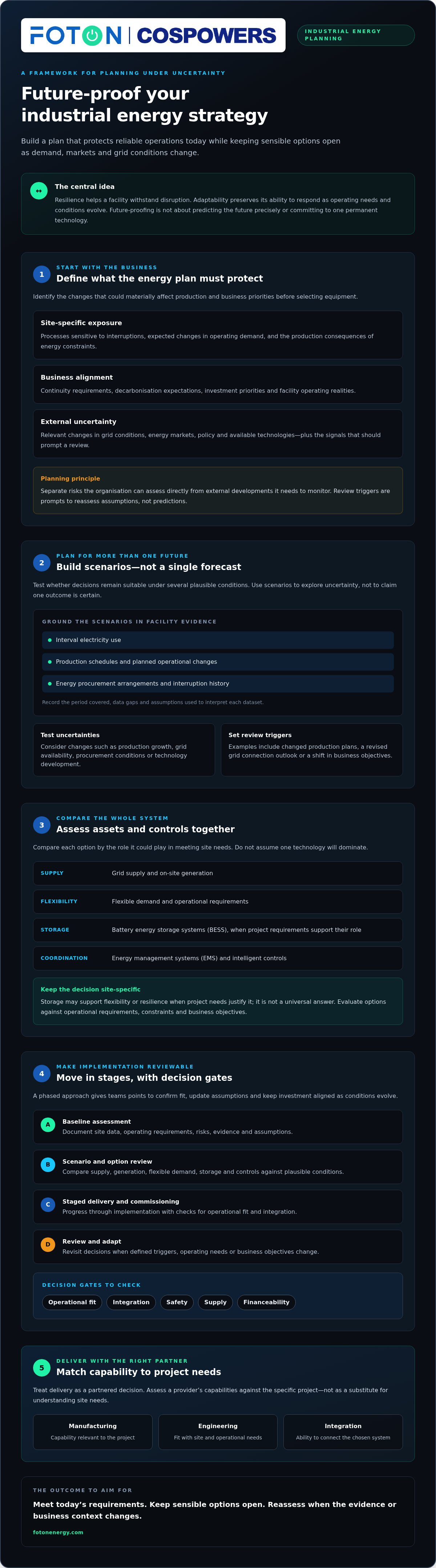
Resilience and adaptability belong together: resilience helps a facility withstand disruption, while adaptability preserves its ability to respond as operating needs and conditions change. Future-proofing means retaining sensible options as markets, technology and production requirements evolve. It doesn’t mean predicting the future precisely or committing to one technology as a permanent solution.
Which energy risks should industrial leaders plan for?
Start with the site’s exposure. Map how interruptions, demand changes and energy-market uncertainty could affect production, critical processes and business priorities. Separate risks the organisation can assess directly from external developments it needs to monitor.
- Site-specific exposure: Identify processes sensitive to interruptions, expected changes in operating demand and the consequences of energy constraints for production.
- Business alignment: Consider decarbonisation expectations alongside continuity requirements, investment priorities and the operational realities of the facility.
- External uncertainty: Track relevant changes in grid conditions, markets, policy and available technologies. Define what would prompt a review.
This separation makes the assessment actionable. Document operating requirements and risk tolerances, then assign responsibility for monitoring external factors. Review triggers might include a material change in planned production, a revised grid connection outlook or a shift in business objectives. These are prompts to reassess assumptions, not predictions that a particular event will occur.
What does a future-proof industrial energy strategy mean?
A practical strategy connects infrastructure choices to operating requirements, governance and measurable objectives. Evaluate options by the role they could play rather than assuming one technology will dominate. Battery energy storage, for example, may support flexibility or resilience when project needs justify it, but it isn’t a universal answer. The wider principles of energy management offer useful context; industrial planning must also account for each site’s priorities and constraints.
Separate durable principles from forecasts. Reliable operations, clear accountability and regular decision reviews are strategic foundations. Expectations about future demand, market conditions or technology performance are assumptions that may need updating. Record the evidence behind each assumption, who owns it and what change would trigger a fresh assessment. This gives teams a disciplined basis for adapting the plan without treating every forecast as certainty.
Future-proofing can reduce avoidable rigidity, but it can’t eliminate uncertainty. Its value is helping leaders meet today’s requirements while retaining sensible options for tomorrow.
Build an Industrial Energy Strategy Around Scenarios, Not One Forecast
A single demand forecast can create false confidence. Future-proofing industrial energy strategy is stronger when it tests decisions against several plausible conditions and identifies what evidence should prompt a review. Scenario planning isn’t about predicting one energy future. It’s a way to assess whether a decision remains suitable under credible alternatives.
Begin with a baseline grounded in site records: interval electricity use, production schedules, planned operational changes, energy procurement arrangements and interruption history. Note the period covered by each dataset, any gaps and the assumptions used to interpret it. This gives teams a shared reference point and helps distinguish measured conditions from estimates.
- Identify uncertainties: Select external and business changes that could materially affect energy requirements, such as production growth, grid availability, procurement conditions or the pace of technology adoption.
- Test scenarios: Consider how different combinations of assumptions could affect site load, production continuity, procurement choices and emissions objectives.
- Set review triggers: Agree on observable changes that warrant revisiting an assumption or decision, and assign responsibility for monitoring them.
For each scenario, ask whether the proposed approach can support the operating plan, what constraints might emerge and which decisions would be difficult to reverse. Record the evidence, assumptions and implications. A scenario is a planning tool, not a forecast or a promise about what will happen.
How should companies choose useful planning scenarios?
Choose a small set tied to material uncertainties, not every imaginable disruption. For example, compare planned growth with slower demand growth and with a case where grid availability becomes more constrained. Vary assumptions about procurement, policy or technology adoption only when they could change a real decision. Avoid extreme cases without a credible basis, as they can distract from risks the business can meaningfully plan for.
Assess each scenario using consistent questions: What happens to production requirements and site load? Could procurement arrangements remain suitable? Do emissions objectives or continuity needs change the case for an investment? Comparing the answers helps reveal which choices work across multiple conditions and which depend heavily on one assumption.
Which signals should trigger a strategy review?
Use measurable indicators linked to the assumptions: changes in site demand or production plans, updates to grid connection information, material changes in procurement arrangements, or revised business investment plans. Assign an owner to monitor each signal and report changes to the decision-makers responsible for energy and operations.
Set review intervals to suit investment lead times and operational requirements, and add reviews when a defined trigger occurs. As projects progress, stakeholders assessing storage or energy-management options may find it useful to discuss site requirements with an experienced energy storage partner.
Compare Energy Assets, Storage, and Controls as One Industrial System
Energy assets serve different roles. Grid supply provides an external source; on-site generation can add supply options; flexible demand adjusts consumption where operations allow; and battery energy storage systems (BESS) store and discharge electricity according to system needs. Controls coordinate information and decisions across these components. A future-proofing industrial energy strategy assesses how each role fits the site rather than treating technologies as interchangeable.
Use this comparison to frame project questions, then check the answers against site data, design requirements and supplier documentation.
| System element | Strategic role | Dependencies | Planning questions and evidence to verify |
|---|---|---|---|
| Grid supply | Provides electricity through the site connection. | Connection conditions, capacity and supply arrangements. | What constraints or changes are relevant to the site? Review connection information and procurement terms. |
| Generation | Adds on-site electricity supply where suitable. | Site conditions, operating profile and connection design. | How would generation align with actual demand? Verify output assumptions, interfaces and operating requirements. |
| Flexible demand | Adjusts consumption when processes can accommodate it. | Production schedules, process limits and operational approval. | Which loads can shift without compromising production? Confirm flexibility with operations teams. |
| BESS | May support flexibility, resilience or energy management when project needs justify it. | Load profile, controls, safety architecture and integration design. | What use case supports the investment? Verify system specifications, thermal management, safety provisions and maintenance requirements. |
| Controls | Monitor assets and coordinate operational decisions. | Data quality, interfaces, control logic and authorised operating parameters. | Which assets can communicate, and who can change settings? Review interface documentation and operating procedures. |
Where can battery storage fit in an industrial strategy?
For a behind-the-meter project, assess the facility’s load profile, operating priorities and connection constraints to determine whether storage has a defined role. Utility-scale projects have a different context, including their intended system application and connection arrangements. Neither context guarantees a particular financial or resilience outcome; those require project-specific evidence. For more context on site applications, see this commercial and industrial BESS strategic guide.
Why do controls and integration matter alongside hardware?
An energy management system (EMS) can coordinate monitoring and operational decisions across storage, site loads, grid connections and other installed assets. Its value depends on reliable data, compatible interfaces, clear control priorities and procedures that suit the facility. Consider safety architecture, thermal management, maintainability and operating responsibilities as part of system design, not as separate hardware checks. Explore the AI-driven energy management systems guide for more EMS context.
Turn the Industrial Energy Strategy into a Phased, Reviewable Roadmap
A strategy becomes actionable when each investment has a defined stage, accountable owner and decision gate. A phased roadmap helps an organisation test technical and commercial assumptions before moving from planning to commitment. It makes future-proofing industrial energy strategy a disciplined process rather than a one-time plan that becomes difficult to adjust.
Structure the work around clear stages:
- Baseline: Confirm site requirements, operating profile, current assets and business objectives.
- Feasibility: Assess viable options, grid context, integration constraints, risks and evidence gaps.
- Design: Develop the preferred system concept, including interfaces, safety considerations and operating responsibilities.
- Procurement: Verify supplier scope, technical documentation, delivery assumptions and commercial requirements before commitment.
- Commissioning and review: Confirm the system is ready for its intended operation, then review performance against agreed objectives and assumptions.
Decision gates help keep due diligence in view as a project progresses. Before moving to the next stage, confirm operational fit, integration requirements, safety considerations, supply assumptions and project financeability. Assign responsibilities across operations, engineering, finance and procurement, and clarify where external delivery partners contribute. Record the evidence reviewed, unresolved issues, approval owner and conditions that would pause or change the project at each gate.
What should a robust energy project feasibility review cover?
Check the site’s operating profile and requirements alongside grid connection context, existing assets, interfaces and physical or operational constraints. Identify applicable compliance requirements with qualified local advisers, since obligations can differ by jurisdiction and project. Before procurement, document the assessment’s assumptions, evidence gaps, risks and owners. For projects involving storage, the BESS engineering consulting guide offers additional context on feasibility and engineering considerations.
How can teams keep a long-term strategy adaptable?
Use stages justified by project evidence, with explicit choices to proceed, revise, defer or stop at each gate. Define measures relevant to the project, such as operating fit, agreed energy objectives, system availability requirements or integration performance, and specify who reviews them. Revisit assumptions when operating needs, project scope or external conditions change instead of treating the original plan as fixed.
Where energy storage is under consideration, project stakeholders can discuss site requirements and engineering considerations with Foton Energy’s BESS engineering team. This is one option for technical input; the project’s feasibility review and decision criteria should guide whether storage is appropriate.
Make Future-Proofing Industrial Energy Strategy a Partnered Delivery Decision
Choosing an energy storage partner involves more than selecting hardware. Manufacturing capability, system integration, engineering input and clearly defined support responsibilities all affect whether a project fits site requirements. As part of future-proofing industrial energy strategy, assess a potential partner against your project’s decision criteria and request evidence for claims that affect design, safety, delivery and operation.
Industrial buyers should ask:
- Design fit: How does the proposed system respond to the site’s operating profile, integration needs and intended use?
- Safety and thermal management: What design provisions address these considerations, and what project-specific evidence is available?
- Delivery scope: Who is responsible for engineering, procurement interfaces, commissioning, monitoring and ongoing support? Clarify what is included and where responsibilities transfer.
- Claims and credentials: Which technical specifications, certifications and delivery capabilities apply to this project, and what documents substantiate them?
These questions help distinguish general capability statements from evidence relevant to the site. They also bring gaps to light before procurement, when design assumptions and responsibilities can still be reviewed.
What should industrial buyers ask a storage partner?
Request project-specific documentation and confirm who will resolve interface issues across the storage system, site loads and other installed assets. Ask how operating requirements inform system design, how safety and thermal management are addressed, and what commissioning and support responsibilities each party accepts. Check technical claims and certifications against the project and its jurisdiction rather than assuming a general statement applies everywhere.
How can Foton Energy (Foton Pty Ltd) support an adaptable storage strategy?
Foton Energy (Foton Pty Ltd) is an energy storage infrastructure partner, not a solar panel manufacturer or electricity retailer. Its portfolio includes LFP and sodium-ion storage, C&I and utility-scale BESS, intelligent energy management and engineering consulting. Neither battery chemistry is right for every project; suitability depends on the application, operating requirements and verified system specifications. Consider intelligent EMS, engineering input, safety architecture and thermal management as connected parts of project planning, not isolated claims.
Foton Energy (Foton Pty Ltd) works alongside established Tier-1 energy storage manufacturers with extensive industry heritage to deliver robust infrastructure solutions. Request supporting evidence for these proof points and confirm how the manufacturer’s role relates to the proposed project. Assess manufacturing, integration and engineering capabilities alongside commissioning and post-delivery support, with responsibilities clearly documented.
With your evaluation criteria established, discuss your site requirements and potential storage applications with Foton Energy (Foton Pty Ltd). Discuss your energy storage requirements as a next step in assessing whether an integrated storage solution fits your project.
Build an Energy Strategy That Can Evolve
Resilient industrial energy planning starts with business risks, not assumptions about which technology or market condition will prevail. Test decisions against credible scenarios, compare generation, grid supply, flexible demand, storage and controls as an integrated system, then progress through clear project stages and review points.
That’s the practical value of future-proofing industrial energy strategy: preserving options while aligning infrastructure decisions with operating requirements and business objectives. Battery storage may contribute when the project case supports it, but its role should be assessed alongside integration, safety, controls and engineering needs.
Foton Energy provides energy storage hardware, intelligent energy management systems and engineering consulting. It is the exclusive global strategic partner of Cospowers, a Tier-1 energy storage manufacturer. For project stakeholders assessing whether storage fits their site and strategy, discuss your energy storage requirements with Foton.
Start with the evidence, make decisions in stages and keep your strategy ready to adapt. To assess whether storage fits your project, discuss your energy storage requirements with Foton.
Frequently Asked Questions
What does future-proofing an industrial energy strategy mean?
It means making energy decisions that can adapt as operating needs, markets, grid conditions and technologies change. A future-proofing industrial energy strategy aims to reduce avoidable rigidity, not predict the future or eliminate uncertainty. It connects infrastructure choices to production requirements, business objectives and clear review points. For example, teams can document the assumptions behind an investment and identify what change would prompt them to reassess it.
How can industrial companies plan for energy uncertainty?
Start with a baseline built from credible site data, including energy use, production schedules and planned operational changes. Identify uncertainties that could affect demand, grid access, procurement or business plans, then test a small number of plausible scenarios. Record assumptions rather than treating scenarios as predictions. Assign owners to monitor measurable signals and set review triggers so decision-makers can revisit the strategy when conditions materially change.
Which technologies should an industrial energy strategy consider?
Consider technologies by the role they play in the site’s energy system, not as interchangeable options. Grid supply provides electricity through the connection; generation can add on-site supply; flexible demand may adjust consumption where operations allow; storage can shift energy use; and controls coordinate monitoring and decisions. Compare each option against the facility’s operating profile, integration needs, safety requirements, maintainability and objectives before selecting or combining solutions.
Can battery energy storage help future-proof an industrial site?
Battery energy storage can contribute to flexibility, resilience or energy management when a project’s requirements support that role. Its suitability depends on factors such as site load, operating priorities, grid connection context, system integration and safety provisions. Storage isn’t a universal solution, and benefits shouldn’t be assumed without project-specific evidence. Assess the intended use case alongside other options, and verify technical specifications and operating requirements before making an investment decision.
How often should a company review its energy strategy?
Set review intervals that reflect investment lead times and operational requirements, then add reviews when important assumptions change. Triggers might include a material shift in site demand, production plans, grid connection information, procurement arrangements or business priorities. Assign an owner to monitor each signal and bring relevant changes to decision-makers. The review should confirm whether the strategy remains fit for purpose, not simply repeat the original assessment.
What should an industrial energy project feasibility study include?
A feasibility study should assess site requirements, operating profiles, grid connection context, existing assets and integration constraints. It should also examine the proposed system’s operational fit, safety considerations, supply assumptions and commercial viability. Document evidence, uncertainties, risks and decision owners before procurement. Identify applicable compliance requirements with qualified local advisers, since requirements vary by jurisdiction and project. Verify technical claims against current documentation rather than relying on general descriptions.
How do energy management systems support industrial energy planning?
An energy management system (EMS) can monitor energy use and coordinate operational decisions across connected assets, such as site loads and battery storage. This can give teams information to assess how the system is operating against its intended objectives. Effective planning requires attention to data quality, system interfaces, control priorities and operating responsibilities. Evaluate an EMS as part of the wider energy system, not as a substitute for sound engineering or site-specific planning.


