

What makes an LFP battery safe enough for a commercial or industrial project: the chemistry, the safeguards, or the evidence behind them? LFP’s greater thermal stability can reduce some hazards, but it doesn’t make a battery energy storage system risk-free. That distinction matters when thermal runaway could affect people, operations, and nearby assets.
It’s understandable to look first at battery chemistry. Yet LFP battery safety features for C&I need to be assessed across the complete system, not inferred from cell characteristics alone. Battery management, thermal management, system design, installation, and ongoing monitoring all contribute to how risks are controlled. Safety claims carry more weight when supported by relevant test data and evidence for the project configuration.
This guide offers a practical framework for evaluating those layers. You’ll learn what LFP chemistry can and can’t tell you, how system safeguards fit together, and how to interpret standards and test evidence without confusing a test method with system certification. We’ll also outline technical questions to raise early in project engineering. Foton provides C&I BESS, safety architecture, thermal management, energy management, and engineering consulting to support integrated, project-specific designs.
Key Takeaways
- Assess battery chemistry separately from the safeguards and controls that shape complete-system safety.
- Evaluate LFP battery safety features for C&I as coordinated layers, including battery management, thermal management, and system integration.
- Compare chemistry trade-offs and system design on their own merits rather than assuming one chemistry is universally safest.
- Build a project review sequence around site context, design documents, relevant test evidence, and operating plans.
- Use traceable evidence tied to the intended application and system configuration to support informed project decisions.
What LFP Battery Safety Means for C&I Energy Storage
LFP, short for lithium iron phosphate, describes the chemistry of a battery cell. It doesn’t, by itself, describe the safety of a complete commercial and industrial battery energy storage system (BESS). A project also includes connected cells and modules, enclosures, controls, thermal management, electrical equipment, and the site where the system operates. Evaluating LFP battery safety features for C&I means looking at how these elements work together, not treating a chemistry label as a safety verdict.
Layered battery safety is the coordinated use of design measures, monitoring, controls, and site planning to reduce hazards and limit their consequences if something goes wrong.
How LFP chemistry relates to battery safety
LFP cells have chemistry-level characteristics associated with greater thermal stability than some other lithium-ion chemistries. That can be a meaningful consideration when assessing heat-related hazards, but relative stability is not immunity: LFP cells can still experience thermal runaway under adverse conditions. For a general overview of the chemistry and its applications, see Lithium iron phosphate battery.
Cell design, manufacturing quality, and operating conditions matter too. Damage, electrical faults, or operation outside a cell’s intended limits can affect risk. Distinguish what is true of LFP as a chemistry from what evidence demonstrates about the specific cells and system under consideration. No chemistry label establishes how a particular installation will perform in every scenario.
Why C&I safety is a system-level question
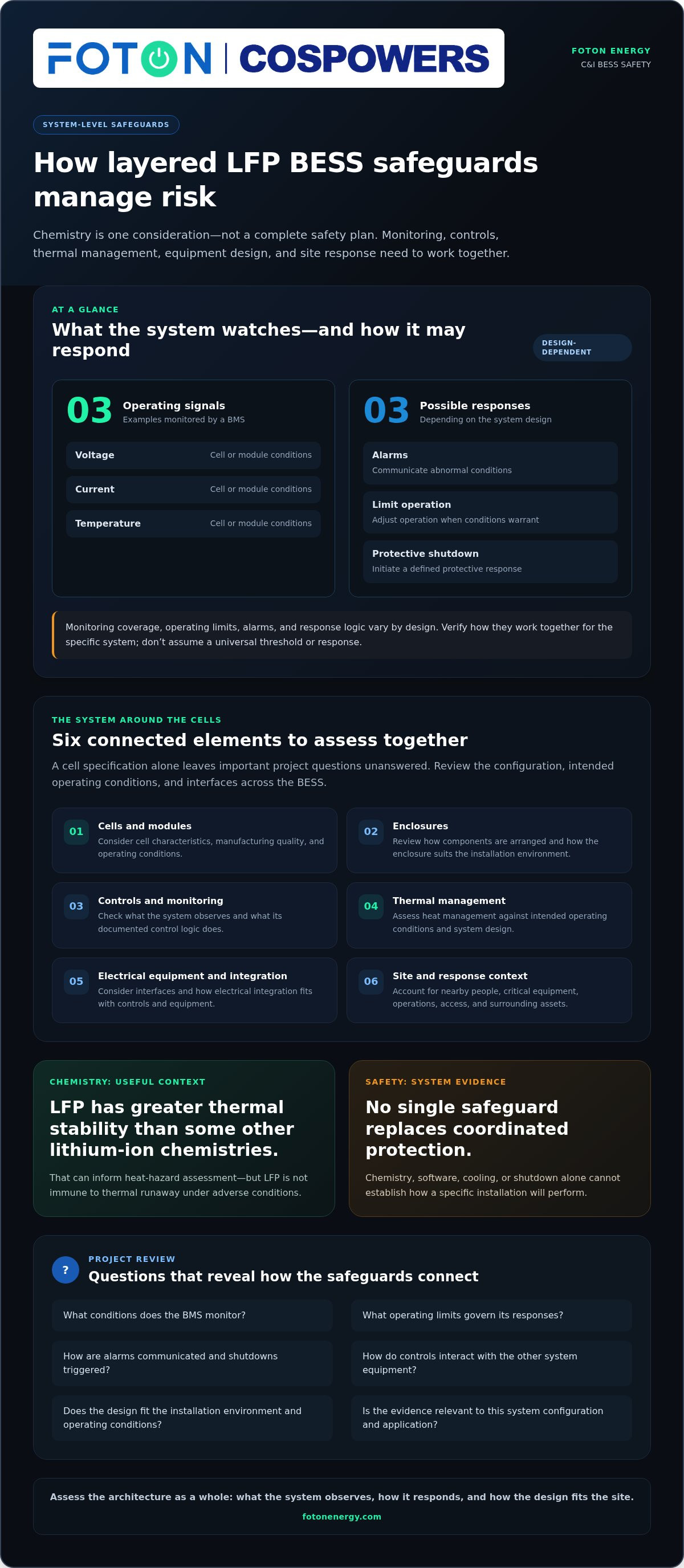
In a BESS, cells are assembled into modules and housed within enclosures, while monitoring and control equipment manages system operation. Thermal management, electrical integration, and site layout add further design considerations. A weakness or mismatch at one layer can affect how the others perform, so a cell specification alone leaves important questions unanswered. Evaluate the system configuration alongside its intended operating conditions.
Risk also has two dimensions: the battery hazard itself and the project’s exposure to its possible consequences. A system near occupied work areas, critical equipment, or essential operations presents different planning considerations from one in a more separated location. Access for emergency response, surrounding assets, operating schedules, and the role of storage in site operations all shape project decisions. These factors don’t change the cell chemistry, but they do affect how safety measures should be selected and integrated.
Evaluate commercial and industrial BESS solutions against the facility’s actual needs and constraints. The next step is to examine how safeguards combine to monitor conditions, manage heat, and respond to abnormal operation.
How Layered LFP BESS Safeguards Manage Risk
A battery energy storage system relies on safeguards that work together. Chemistry can influence how cells respond to heat, but it cannot monitor operating conditions, isolate an electrical fault, manage heat across an enclosure, or account for the site around the system. No single safeguard, whether cell chemistry, monitoring software, cooling equipment, or a protective shutdown, can replace system-level protection that coordinates design, controls, equipment, and site response.
For project teams, the practical questions are how the layers connect, what the system observes, what happens when readings move outside permitted operating limits, and how the equipment responds. Safeguards and their sequence depend on system design, so evaluate the architecture as a whole rather than assuming every BESS responds in the same way.
Monitoring, BMS controls, and fault response
A battery management system (BMS) monitors cell or module operating conditions, which can include voltage, current, and temperature. Those readings help the system identify abnormal conditions and apply the response defined in its control logic. Depending on the design, responses may include alarms, limiting operation, or initiating a protective shutdown. The relevant evidence is not simply that a BMS exists, but how its monitoring and controls are intended to work together.
Review how alarms are communicated, what operating limits govern responses, and what conditions can trigger shutdown. Ask how the response sequence is documented and how the controls interact with other system equipment. Limits, monitoring coverage, and response logic vary by design, so assess them in the context of the offered system rather than assuming a particular threshold or action applies universally.
Enclosure, thermal management, and system integration
Enclosures and thermal management should suit the system’s intended operating conditions and installation environment. Heat management can support normal operation, while enclosure design and system layout influence how components are arranged and how the system interfaces with its surroundings. Consider these choices alongside electrical integration and control behavior, rather than treating them as standalone features.
Limiting the potential for a cell-level event to affect other components is a design objective, not an outcome to assume from the use of LFP or an enclosure alone. Project teams need evidence relevant to the system configuration and application to understand how propagation risks are addressed. Detailed discussions of fire suppression and cooling-system types belong in dedicated guides; here, focus on how those measures fit into the BESS’s broader safety architecture.
This coordinated review makes LFP battery safety features for C&I meaningful at the project level. For a facility-specific assessment, consider how project-specific C&I BESS design aligns controls, thermal management, and site requirements in one integrated approach.
LFP Safety Compared: Evaluate Chemistry and System Design Separately
A useful comparison separates two questions: what does the cell chemistry contribute, and what safeguards does the complete system provide? LFP’s relative thermal stability is relevant to safety evaluation, but it doesn’t establish how a particular BESS will respond to a fault or perform at a specific site. Compare evidence at both levels, then assess whether the design suits the project.
LFP chemistry advantages and limitations in context
LFP has a safety-relevant chemistry characteristic compared with some other lithium-ion chemistries: relative thermal stability. That’s a point of comparison, not a guarantee against fire, failure, or thermal runaway. Cell design, manufacturing quality, and operating conditions also influence cell-level behavior. Sodium-ion is another chemistry that may appear in technology comparisons, but assess its safety on its own documented evidence rather than infer it from the chemistry name or assume it matches LFP.
Even a well-characterized cell is only one part of the installation. Enclosure design, controls, thermal management, electrical integration, installation conditions, and emergency planning influence how a project addresses hazards and their possible consequences. A chemistry comparison cannot substitute for reviewing these system and site factors.
What a meaningful C&I system comparison includes
Use a consistent comparison framework. Distinguish chemistry claims from system-level documentation, and compare systems intended for a similar application and operating profile. For each option, consider:
- Documented safeguards: Which protective measures are described, and what evidence supports claims about the offered configuration?
- Operating envelope: What intended operating conditions are stated, and how do they relate to the project’s duty cycle?
- Monitoring and controls: What system conditions are monitored, and how are alarms or protective responses described?
- Integration and site fit: How do enclosure, thermal management, electrical design, and installation constraints work together?
- Project requirements: What local requirements and site-specific considerations shape the design and its review?
For example, a facility that depends on storage during defined operating periods should compare systems against that use case and the site’s environmental and operational constraints. A feature list alone won’t show whether the design, controls, and supporting evidence apply to the project as configured. Check traceability: safety documentation should relate to the system being evaluated, not only to a cell or a different configuration.
Keep the decision in scope. Detailed lifecycle economics and chemistry-versus-cost analysis deserve their own evaluation; they don’t answer the safety question on their own. The right choice depends on duty cycle, site conditions, system design, and relevant evidence. That’s the practical basis for comparing LFP battery safety features for C&I without claiming any chemistry is universally safest.
How to Verify LFP Battery Safety Features Before Project Selection
Safety claims become useful only when you can connect them to the project’s operating needs and the system being proposed. Use a consistent review sequence: define the application, examine the design, assess test and standards evidence, then check operational readiness. This helps identify gaps, such as a test report for a different configuration or a certificate that doesn’t cover the intended installation.
- Set the project context. Document the intended duty cycle, operating environment, facility constraints, nearby activities, and the role the BESS will play. Use these details to judge whether the design and its evidence apply to your use case.
- Review the system documentation. Request design documents that identify the system configuration, components, operating envelope, safeguards, and relevant limitations. Check that the configuration described matches the system proposed for the project.
- Trace the test and standards evidence. Identify what was tested, at what level, by whom, and under which edition or procedure. Confirm project and jurisdictional relevance with the appropriate technical and permitting stakeholders.
- Assess operating readiness. Review commissioning records and procedures for monitoring, maintenance, alarms, fault response, and emergency coordination. Consider how these processes fit the site’s layout and operating practices.
Review tests, standards, and configuration-specific evidence
Evidence at one level doesn’t automatically prove performance at another. Cell-level or module-level test results describe the tested component and conditions; they don’t establish how the complete BESS behaves as installed. Read each report for its scope, configuration, limitations, test method, date, and issuing organisation, then check whether it applies to the offered system and intended application.
Standards address different questions. IEC 62619 concerns the safety of industrial lithium cells and batteries. UL 9540 relates to system-level safety listing, while UL 9540A is a test method for evaluating thermal runaway behavior. NFPA 855 addresses installation of stationary energy storage systems. Their applicability depends on the project, jurisdiction, relevant edition, and review by the authority having jurisdiction. Don’t treat a test method as a certification or assume a document satisfies local project requirements.
Assess operating procedures and project readiness
Documents should connect design intent with real operating practice. Look for procedures describing who receives alarms, how faults are handled, what maintenance activities are planned, and how commissioning verifies the system’s intended operation. Review the site plan for access, surrounding equipment, and coordination with facility and emergency-response procedures. Separation distances and other installation provisions require jurisdiction-specific review, not a generic rule applied without context.
A disciplined evidence review helps establish whether LFP battery safety features for C&I are supported by project-relevant information rather than broad claims. For a project-specific assessment that brings feasibility, system design, and integration into the review, engage Foton for BESS engineering consulting.
Integrating LFP Safety into a C&I BESS Project with Foton
A sound safety review should carry through the project, from early feasibility to ongoing asset management. Foton Energy brings engineering, system design, safety architecture, thermal management, and energy management into a project-specific approach to C&I battery storage. The goal is to align design decisions with the facility’s requirements, not to assume one configuration suits every site.
From project requirements to an integrated design
Start with how the facility intends to use storage. The application, operating goals, site constraints, and grid requirements all inform system design. A facility focused on managing energy use may have different integration priorities from one that relies on storage for backup. Those priorities help shape the system configuration and how its safety measures fit together.
Foton provides project feasibility, system design, and grid-code compliance support. Safety architecture and thermal management are coordinated engineering considerations, while monitoring and EMS integration support operational oversight. Assess capabilities against the system configuration and intended use rather than treating them as universal features.
- Feasibility: Establish the project’s goals, site context, and key constraints.
- System design: Align the proposed BESS and safety architecture with the application and facility.
- Integration: Consider how controls, thermal management, and grid requirements connect within the system.
- Commissioning and operations: Carry design intent into commissioning and long-term asset management.
This continuity helps project teams keep the evidence review connected to practical implementation. It also gives the team a structured way to consider LFP battery safety features for C&I as part of a complete project, rather than as a standalone cell-level claim.
Planning the next step with an engineering partner
Project planning can bring several workstreams together: feasibility, system design, compliance support, commissioning, and long-term asset management. Foton’s engineering consulting supports this process, with safety architecture, thermal management, and an AI-driven EMS among its C&I BESS capabilities. The scope and integration approach are shaped around each project’s requirements.
Foton is the exclusive global strategic partner of Cospowers, a Tier-1 energy storage manufacturer with more than 30 years of manufacturing heritage. That history provides manufacturing context, not proof of a particular system certification or safety result. Project-specific evidence remains essential when evaluating the offered configuration and its intended application.
Bring your site requirements, operating goals, and safety questions into the early engineering discussion. Discuss your C&I battery storage project with Foton to explore a project-specific path from feasibility and design through commissioning and asset management.
Turn Safety Review into a Project-Ready Plan
Make the next step a clear project brief. Record the intended application, site constraints, operating priorities, evidence already available, and questions that need engineering input. This gives stakeholders a shared basis for reviewing the proposed system and helps keep safety decisions connected to the project from early planning through implementation.
The value of assessing LFP battery safety features for C&I lies in how well evidence and design fit the facility’s real conditions. A practical review can reveal where assumptions need validation, which documents should be tied to the selected configuration, and what operational considerations belong in project planning. Treat those findings as inputs to engineering, not as a checklist to complete in isolation.
Foton works with Cospowers as its exclusive global strategic partner, bringing a connected perspective to commercial and industrial storage projects. Bring your requirements and open technical questions into the next planning conversation. Map your C&I project requirements with Foton and take a confident next step toward a design shaped around your site.
Frequently Asked Questions
Is an LFP battery completely safe from fire?
No. LFP isn’t fireproof, and no battery chemistry removes every fire risk. Chemistry describes cell-level characteristics, while the outcome also depends on system design, operation, installation, and site conditions. For example, a battery’s location relative to occupied areas can affect project planning even if the cells use LFP. Evaluate risk controls across the complete BESS, using evidence that matches the proposed configuration and intended application.
Can LFP batteries experience thermal runaway?
Yes. LFP cells can experience thermal runaway under certain failure or abuse conditions. Cell-level behavior alone doesn’t predict what could happen across an installed system, so review how the design addresses abnormal conditions and their possible effects. Consider how monitoring, protective controls, thermal design, propagation mitigation, and project-specific safety planning work together. Check whether the evidence reflects the same system configuration being considered for the site.
What safety standards apply to a C&I LFP battery system?
Applicable standards depend on the system, project location, electrical connection, and approval requirements. IEC 62619, UL 9540, UL 9540A, and NFPA 855 may be relevant in particular contexts, but they address different scopes and aren’t interchangeable universal requirements. Confirm the current edition, the document’s scope, and local applicability with project engineering and relevant authorities. A standard named in a brochure alone doesn’t establish that it applies to your installation.
How do I verify an LFP battery supplier's safety claims?
Request documentation tied to the specific system configuration and application, then identify whether each item covers cells, modules, or the complete system. Review the test scope, conditions, limitations, date, and issuing organisation. A chemistry label or broad marketing statement isn’t a substitute for traceable evidence. If a report describes a different enclosure or system arrangement, establish whether its conclusions apply to the configuration proposed for your facility.
Does an LFP battery management system prevent every battery failure?
No. A battery management system monitors operating conditions and can support protective responses, but it can’t eliminate every fault or replace other safeguards. Its role depends on factors such as sensor coverage, control logic, integration with system equipment, and maintenance. In a project review, examine how the BMS communicates abnormal conditions and how its response connects with operating procedures. Treat it as one layer of the safety architecture, not a standalone guarantee.
Are LFP batteries safer than other lithium-ion chemistries for C&I projects?
LFP has distinct chemistry-level characteristics, but a blanket ranking can mislead project decisions. Safety also depends on system design, operating conditions, installation, and the evidence available for the proposed configuration. Compare documented safeguards and application fit, not chemistry labels alone. Assess whether each system’s stated operating envelope aligns with the facility’s use case, and avoid treating any chemistry as universally safest without considering project-specific evidence.
What should a C&I LFP battery safety review include?
A thorough review should examine configuration-specific test evidence, monitoring and control documents, thermal and enclosure design, commissioning and maintenance procedures, site conditions, and emergency coordination. Consider whether access routes and response procedures account for the BESS location and nearby operations. Applicable standards and authority requirements vary with jurisdiction and project scope, so involve qualified project engineering when interpreting documents and planning the review.


