

One battery can create value in more than one electricity market. Value stacking with battery energy storage combines services such as energy arbitrage, capacity support and frequency regulation, so a single system can earn or save value in different ways. The mix depends on the battery’s operating limits and the demands of the market it serves.
That potential is compelling, but stacking is not simply a matter of assigning a battery to every available service. Each commitment affects when energy is stored, how much capacity remains available and whether the battery can respond when called upon.
This article explains how energy, capacity and frequency-regulation services work together, and why their commercial value varies by location and application. It also covers how battery controls coordinate competing demands, account for system constraints and help decision-makers assess which revenue streams suit a project.
Key Takeaways
- Compare the value of charging during lower-price periods with using or selling stored energy when prices rise.
- Assess energy, capacity and frequency regulation together, while accounting for the battery’s operating limits and existing commitments.
- Use coordinated controls to balance market opportunities, site demand, battery degradation and resilience needs.
- Evaluate revenue streams against the specific location, application and electricity-market rules; the best mix varies by project.
- Connect the commercial strategy to the right storage system, such as C&I BESS for business and industrial applications.
What is Value Stacking in Battery Energy Storage?
Value stacking with battery energy storage combines multiple uses of one battery to create savings or revenue across electricity markets. Residential batteries can shift household consumption, commercial systems can reduce peak grid demand, and utility-scale assets can trade energy or support grid services. The available mix depends on tariffs, market access and operating limits.
Energy Arbitrage Approaches
Energy arbitrage means charging a battery when electricity is cheaper and discharging it when electricity is more valuable. This lets stored energy serve a site or market at a more useful time.
Spot-market arbitrage responds to changing wholesale prices: operators schedule charging during lower-price intervals and discharge during higher-price intervals. Time-of-use arbitrage follows a utility tariff’s defined price periods, storing energy outside peak periods and using it during costlier periods. The distinction is practical: spot prices move with market conditions, while time-of-use periods follow the customer’s tariff.
Electricity Price Arbitrage
Electricity price arbitrage captures a price difference by buying or storing energy at a lower price and using or selling it at a higher price. The size of that difference helps determine whether the operating decision creates value.
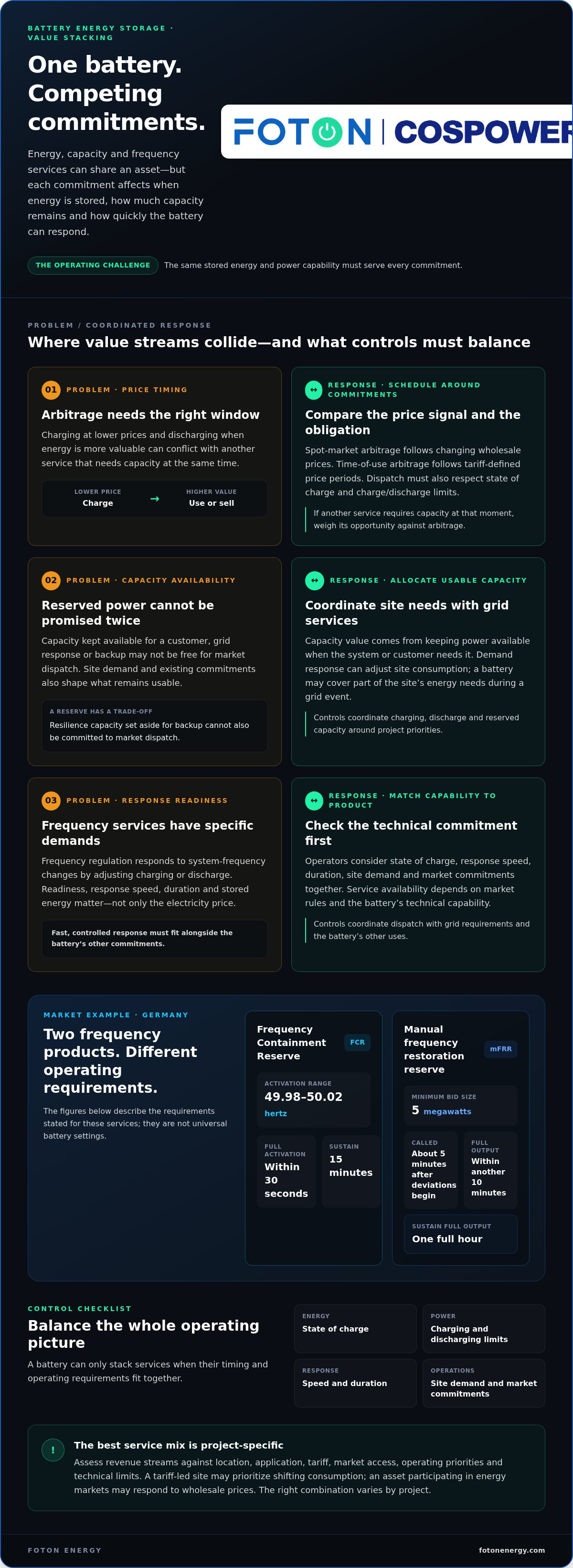
This example illustrates the price spread, not a universal outcome. Actual dispatch must also respect the battery’s state of charge, charging and discharging limits, and other commitments. If another service requires capacity at the same time, the operator must weigh that opportunity against arbitrage.
Value Stacking Across Battery Scales
Value stacking applies the same principle across residential, commercial and utility-scale storage systems, but each serves different needs. Tariff structures, operating priorities and access to energy markets shape which value streams can be combined.
A residential battery can shift household consumption around time-of-use prices and store excess solar energy for later use. A commercial battery can reduce demand during peak periods while supporting demand response, where program participation allows strategic adjustments to site consumption. A utility-scale battery can trade energy and provide services that help balance grid supply and demand.
In each case, usable capacity must be allocated carefully. A resilience reserve set aside for backup, for example, cannot also be committed to market dispatch. Battery controls coordinate charging, discharge and reserved capacity around the project’s priorities. This is central to value stacking with battery energy storage: combining uses works only when their timing and operating requirements fit together.
For a project team, a useful starting comparison is the electricity tariff, expected price patterns and operating needs. A business facing time-of-use charges may prioritize shifting consumption, while an asset participating in energy markets may respond to wholesale prices. In both cases, the investment case depends on the value of each use and whether the battery can deliver it without conflicting commitments.
Energy, capacity and frequency regulation services
A battery can combine energy-market activity, capacity availability, demand response and frequency regulation. This allows one asset to serve site needs while contributing services that support the wider electricity system.
Energy revenue comes from charging and discharging in response to market prices. Capacity value comes from keeping power available when the system or a customer needs it. Frequency regulation and other ancillary services compensate rapid, controlled responses that help balance supply and demand. Demand response can add value when a site adjusts consumption during a grid event.
These streams compete for the same stored energy and power capability. A battery reserved for a grid response cannot always be dispatched for another purpose at that moment. Operators consider state of charge, response speed, duration, site demand and market commitments together. Which services are available depends on market participation rules and the battery’s technical capability.
Demand response can connect operational flexibility with grid support. A business may reduce or shift consumption when called, while a battery helps cover part of the site’s energy needs. This can limit the curtailment required to participate while creating value through the program. Frequency regulation is different: controls respond to system-frequency changes by adjusting battery charging or discharge, requiring fast, coordinated control.
In Germany, Frequency Containment Reserve is activated when system frequency leaves the range from 49.98 to 50.02 hertz. It must reach full activation within 30 seconds and remain at full activation for 15 minutes. These requirements illustrate how frequency products differ from energy arbitrage: they prioritize readiness and response performance, not only when electricity is cheapest.
Manual frequency restoration reserve provides another service with distinct operating demands. In the described market, its minimum bid size is 5 megawatts. It is called about five minutes after frequency deviations begin; assets must then deliver full output within another ten minutes and sustain it for one full hour. A battery’s available power and stored energy must support that commitment.
Local flexibility services can help manage grid demand, while frequency services support system stability. Software coordinates dispatch with these requirements and the battery’s other commitments. That estimate reflects the modeled case, not a universal project outcome.
Stacking can also improve utilization when a battery operates seasonally or infrequently. Additional services may create value during periods when its primary application has limited demand. Before combining commitments, compare each service’s timing, response requirements and impact on reserved capacity.
Optimization and analytics for revenue stacking
Revenue optimization coordinates a battery’s market commitments, site demand and physical limits. The aim is to select compatible revenue streams without sacrificing capacity required for operations.
Cross-Market Optimization and Control
Cross-market optimization compares services across electricity markets and schedules the battery for the combination that best fits its constraints. This matters because one asset may face a demand charge, a market opportunity and a reserve commitment at once.
Real-time control updates the schedule as tariffs, incentives, demand response opportunities and building energy-use patterns change. For example, software can charge when site demand is low, then preserve available power for a grid service. The plan must also account for battery chemistry, sizing and degradation, since repeated cycling affects usable capacity.
Portfolio selection depends on location, application and market design. A site with a demand charge may value peak reduction, while a grid-connected asset may have access to market services. Operators can offer services in sequence or in parallel, depending on whether their timing and technical requirements are compatible.
Revenue Stacking Risks
Revenue-stacking risks arise when a forecast counts incompatible services or dispatches the same capacity twice. A battery cannot discharge the same stored energy for both a site peak and a market commitment simultaneously.
Dispatch conflicts can also occur when one service requires charging while another requires discharge. A clear operating schedule assigns available power and energy to each commitment while preserving any required reserve. This makes the trade-off visible before dispatch.
Uncertain revenue is another planning risk because tariffs, incentives, demand response opportunities and market prices can change. Treat forecasts as scenarios, not simultaneous guaranteed income. Compare how the portfolio performs under different price patterns and service availability, and distinguish committed value from opportunities that depend on market conditions.
Analytics should model the battery’s operating limits alongside expected service value. A useful comparison tests each portfolio against the same inputs: tariff structure, site load, market access, equipment sizing and degradation. The Brattle Group identified more sophisticated software systems as a technical need for capturing multiple energy-storage benefits.
During operation, controls can monitor state of charge, scheduled power and site demand, then adjust dispatch as conditions shift. For example, if a facility’s load rises unexpectedly, the controller can protect the site’s operating needs before committing remaining capacity elsewhere. This prevents a revenue forecast from obscuring infrastructure requirements.
There is no standard method for optimizing every service portfolio. Project teams can compare candidate combinations, identify overlapping commitments and select a strategy aligned with the asset’s purpose. This structured analysis clarifies the value of each service while keeping revenue assumptions separate from operational constraints.
Battery storage value stacking across electricity markets
Electricity-market structures determine which services a battery can offer and how its value is measured. Tariffs, wholesale participation rules and local grid needs shape opportunities to stack energy, capacity and renewable integration services.
There is no single best U.S. state or market for every battery project. The strongest opportunities align local price patterns, customer consumption, tariff design and access to relevant services. The Brattle Group’s report focused on California, and its authors said their conclusions applied generally to the United States. It offers a useful framework, not a universal ranking.
U.S. rules also affect who can own storage and which services it can provide. In some states, utilities are permitted to own energy storage only to provide distribution services. FERC Order 841 and Order 2222 affect stacking through the market-participation framework; project revenue depends on how applicable rules address eligibility, aggregation and the ability to offer multiple services.
Wholesale electricity trading creates opportunities beyond a customer’s retail tariff. Batteries can participate in energy markets by charging and discharging in response to market conditions, while other commitments may preserve capacity for grid services. Market access and dispatch requirements determine how these activities fit together. A portfolio must distinguish services that can operate in parallel from commitments requiring the same power or stored energy.
Market structures vary internationally. EPEX, the European power exchange, traded 868 terawatt-hours (TWh) on its spot market in 2024. In Germany, day-ahead auctions accept bids for each 15-minute interval of the following day until 12 noon. German intraday auctions take place at 3 p.m., giving operators another opportunity to adjust positions as forecasts and renewable output change.
Retail rates create a separate route to value. The Brattle Group described a three-part rate with a monthly customer charge, a cents-per-kWh charge and a demand charge based on maximum demand during system-peak hours. A battery can reduce grid demand during costly periods, while energy shifting can respond to time-varying electricity prices. Commercial and industrial customers often receive three-part rates, and residential customers could also qualify.
Rate structures can also recognize several kinds of value. According to the U.S. Environmental Protection Agency, the Value Stack tariff accounts for energy, capacity and environmental value. This illustrates how a tariff may recognize services associated with stored energy and renewable generation alongside conventional consumption charges.
To compare markets, map the project’s tariff, wholesale access, service eligibility and operating obligations. Then test whether the same battery capacity can meet each commitment at the required time. This separates accessible revenue streams from theoretical opportunities and grounds investment decisions in the rules and consumption patterns that shape each project.
There is no single best state or market for every battery project. California was the focus of the cited analysis, but the strongest opportunities depend on how local price patterns, customer consumption, tariffs, grid needs and market-access rules align.
Battery energy storage value stacking
Stacking creates durable project value only when each service fits within the battery’s physical limits. A useful assessment separates protected capacity from energy available for economic operation, then matches each portion to a compatible use.
Consider an example system with 1,000 kWh of nameplate energy capacity and a 650 kWh reserve needed to meet its minimum resilience goal. That reserve is set aside for backup, not counted again for market services or solar self-consumption. During normal grid-interactive operation, 150 kWh is available for economic functions. The remaining capacity allocation must respect the project’s operating requirements rather than being treated as fully dispatchable.
This distinction changes the revenue forecast. If an analyst models all 1,000 kWh as available for market dispatch, the projection overstates usable energy and may conflict with the resilience objective. A more robust model assigns capacity to resilience first, then evaluates what remains for bill management, renewable energy use or market participation. The maximum available for each service shifts with operating conditions and the project’s priorities.
Utilization matters, too. An asset used for about 200 hours per year may have periods when its primary application leaves it idle. Additional services can make productive use of those windows, provided their dispatch does not compromise the designated reserve. Dynamic scheduling therefore considers both service timing and the energy that remains available after each commitment.
Renewable energy integration offers another practical example. A system can store excess solar generation for later consumption, while its controls balance that purpose against other eligible services. The sequence matters: forecast generation and site demand, preserve required reserve, then allocate available capacity to compatible opportunities. This turns the operating strategy into a portfolio rather than a list of independent revenue claims.
Value recognition can also depend on tariff design. According to the U.S. Environmental Protection Agency, the Value Stack tariff accounts for energy, capacity and environmental value. The agency also identifies avoided ancillary-service costs and reduced wholesale market clearing prices among potential electric-system benefits. These system-level benefits are distinct from a project’s directly earned revenue.
The core takeaway is to model usable capacity, not just nameplate capacity, and to keep each value stream tied to a real operating window. That approach makes the investment case clearer by distinguishing reserved energy, directly monetized services and broader grid benefits. For project-specific storage planning, explore storage project options aligned with your operating priorities.
Foton Energy (Foton Pty Ltd): C&I BESS
Foton Energy (Foton Pty Ltd) offers C&I BESS for organizations assessing how storage can support site operations and energy-market participation. It is a natural next step when your analysis identifies opportunities to manage demand, store renewable energy for later use or evaluate compatible value streams.
Project planning can align the storage system with your load profile, resilience priorities and market context. Foton Energy also offers Residential Storage Systems and Utility-Scale Storage for projects with different scales and operating requirements. The right application depends on the battery’s role, including which capacity must remain reserved and which services can share available operating capacity.
To discuss a storage project aligned with your operating priorities, contact Foton Energy (Foton Pty Ltd).
Turn a Storage Strategy Into a Project Plan
The next step is to translate value stacking with battery energy storage into an operating strategy grounded in your site’s priorities. Define what the system must support first, which outcomes matter most, and how available capacity should be allocated. That hierarchy gives project discussions a clear foundation and helps distinguish practical opportunities from services that compete for the same capability.
Foton Energy (Foton Pty Ltd) offers C&I BESS, Residential Storage Systems and Utility-Scale Storage. Each offering supports a different scale of storage planning, from an individual site’s needs to larger grid-connected applications. Start by defining the role the battery should play in your energy infrastructure.
Bring your project priorities into the next conversation and explore the storage pathway that fits them. Contact Foton Energy to discuss your energy storage project.
Frequently Asked Questions
How does value stacking impact project engineering?
Value stacking affects system sizing, controls, metering and grid-connection design. Engineers translate each intended service into operating requirements, then check that power, usable energy and response capability can support the combined schedule. For example, a project reserving energy for backup must keep that reserve separate from market commitments. This coordination influences equipment selection, control logic and how the project measures performance across site and grid operations.
What is value stacking for battery energy storage?
Value stacking with battery energy storage means assigning one system to compatible uses that create distinct operational or financial benefits. A facility might use stored power to support critical loads, reduce demand charges and participate in a demand response program. The strategy coordinates when the battery charges, discharges or holds capacity. The practical test is whether each use fits the system’s limits and the site’s priorities.
What are typical revenue ranges for battery energy storage value stacking in the U.S.?
There is no single typical revenue range for U.S. battery projects. Project revenue depends on market access, tariff structure, dispatch opportunities, system capability and how often services can be delivered without conflict. A useful estimate models each stream separately, applies its operating constraints and combines only compatible outcomes. Keep expected market revenue distinct from bill savings and resilience value, since they arise through different mechanisms.
How do battery costs, efficiency, degradation, and warranties affect value stacking profitability?
These factors determine how much value remains after system investment and operation. Upfront costs set the financial hurdle, while energy losses reduce the amount available for later use or sale. Degradation changes usable capacity over the asset’s operating life, affecting dispatch assumptions. Warranty terms also shape the operating strategy, because permitted use and coverage conditions influence how frequently and intensively the system can cycle.
How do utility tariffs, demand charges, and time-of-use rates affect battery value stacking?
Tariffs determine which site savings a battery can capture and when. A demand charge based on peak grid consumption creates value by reducing the measured peak; time-of-use rates reward shifting consumption away from higher-priced periods. A project model should use the customer’s actual tariff and load profile, then compare battery dispatch with the applicable billing periods and peak-demand rules.
How can a battery owner model and prioritize stacked revenue streams?
Start with the site’s load data, tariff, market access and operating priorities. Model each service against the battery’s available power, energy and timing constraints, then remove combinations that require conflicting dispatch. Compare net project value across operating scenarios, including periods of lower market opportunity. Rank services by their contribution and operational fit, treating reserved backup capacity and other essential requirements as constraints rather than dispatchable revenue.
Which U.S. states and electricity markets offer the best opportunities for battery value stacking?
California is identified as economical for stacked storage at current costs, with revenue from generation, capacity and ancillary services. Opportunities otherwise vary by location, application and market design; the material does not identify other states as the best.


