

The opportunity extends beyond selling stored energy: participating in frequency regulation markets with BESS can mean bidding into energy and ancillary-service markets, including frequency regulation, peak shaving, and black-start services. In PJM, frequency regulation clears hourly. Which markets a battery can enter depends partly on its location and the rules that apply there.
Fast response is essential, but speed alone doesn’t determine a battery’s value in regulation markets. The system must also track control signals accurately and move power in both directions, absorbing electricity when needed and injecting it when the grid needs support. These demands make market access, operating limits, and energy recovery important parts of the commercial picture.
This article explains which markets BESS can participate in, with a closer look at PJM frequency regulation. You’ll see how response speed, tracking accuracy, bidirectional operation, and state of charge shape a system’s role, and why participation depends on more than battery capacity alone.
Key Takeaways
- Map potential energy and ancillary-service markets to the battery’s location, since participation rules vary across regions.
- Assess regulation capability through response speed, signal-tracking accuracy, availability, and the ability to absorb or inject power.
- Understand how fast frequency response supports the grid immediately after a disturbance, while other control services restore balance over a longer interval.
- In PJM, frequency regulation clears hourly, and the RegD signal calls for flexible operation in both directions.
- Compare market opportunities with operating limits, energy recovery needs, and battery degradation to build a more complete view of project value.
On which Energy Markets do Battery Energy Storage Systems (BESS) participate?
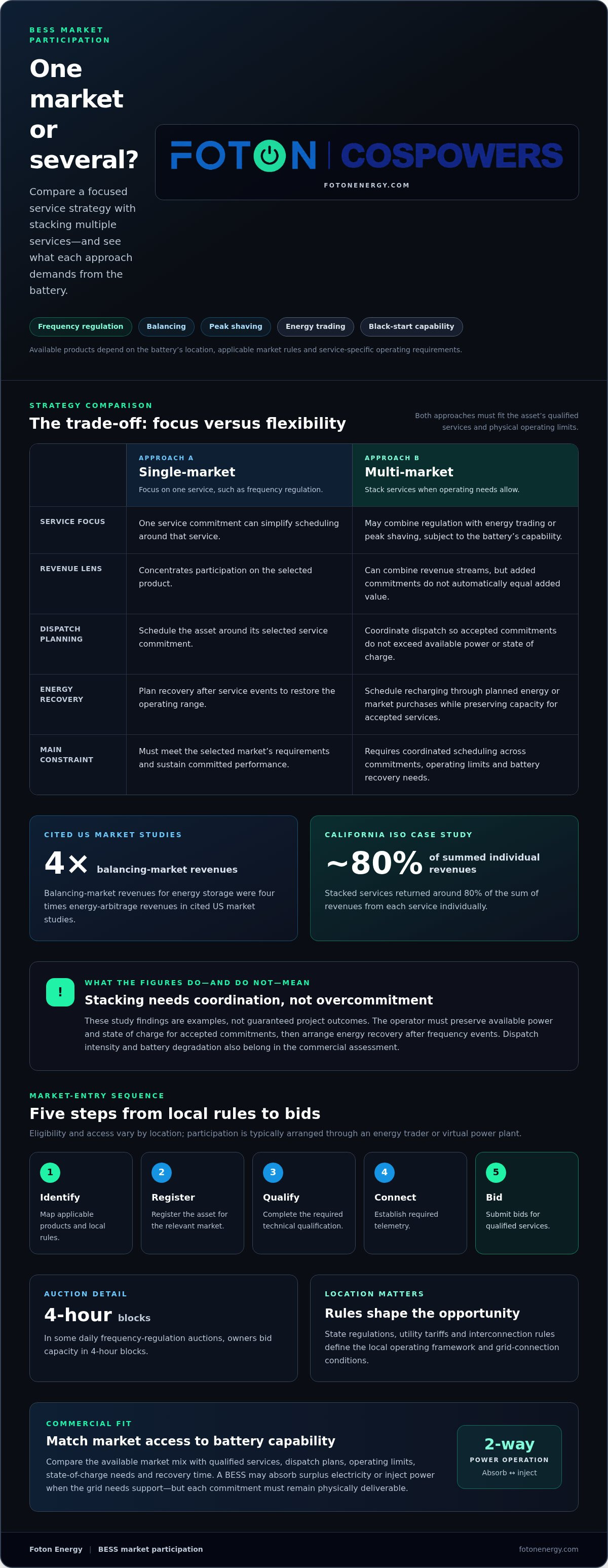
BESS can participate in electricity and ancillary-service markets, including frequency regulation, balancing, and peak shaving. In some daily frequency-regulation auctions, owners bid capacity in 4-hour blocks.
Ancillary-Service Procurement and Performance Revenue
Ancillary-service procurement lets grid operators contract resources to balance supply and demand, while performance-based revenue rewards delivered service. A BESS can absorb or inject active power within milliseconds, supporting frequency correction when generation and demand diverge. For operators, the commercial question is not simply whether a battery can respond, but whether it can meet the market’s service requirements and sustain its committed performance.
Market Participation Rules and Qualification Steps
State regulations, utility tariffs, and interconnection rules shape eligibility by defining the local operating framework and grid-connection conditions. To enter a market, an operator identifies applicable products, registers the asset, completes technical qualification, establishes required telemetry, then submits bids. These steps matter because rules vary by location, and access is typically arranged through an energy trader or virtual power plant.
Market access can include balancing services managed for a transmission system operator, as well as frequency reserves and other ancillary products. The available mix depends on the battery’s location and market rules. A BESS may also provide black-start capability, but each service has distinct operating requirements. Mapping the market is a practical first step before selecting a participation strategy.
A single-market strategy can focus the asset on one service, such as frequency regulation, and simplify scheduling around that commitment. A multi-market strategy can stack services, combining regulation with energy trading or peak shaving when operating needs allow. In cited US market studies, balancing-market revenues for energy storage were four times energy-arbitrage revenues. A California ISO case study found stacked services returned around 80% of the sum of revenues from each service individually.
Service stacking requires coordinated dispatch, not simultaneous promises that exceed the battery’s capability. The operator must preserve available power and state of charge for accepted commitments, then schedule recharging after frequency events through planned energy or market purchases. For example, a battery delivering regulation may need to replenish energy before its next scheduled service. This coordination helps balance revenue opportunities against physical operating limits.
For operators participating in frequency regulation markets with BESS, bidirectional operation creates options for both upward and downward balancing needs. Charging absorbs surplus electricity; discharging supplies power when the grid requires support. Intelligent scheduling can align those actions with energy-market positions and ancillary-service commitments while accounting for recovery needs. The strategy should reflect the asset’s location, qualified services, and dispatch plan.
Battery response speed, accuracy, and bidirectional operation
In frequency regulation, a battery’s value depends on how promptly and accurately it follows dispatch. Battery energy storage systems can respond to frequency fluctuations in 100-500 milliseconds. Power electronics and control logic allow power to be absorbed or injected within tens to hundreds of milliseconds. That response supports grid reliability as renewable energy sources change generation and net demand.
Speed is only one performance measure. Operators also assess tracking accuracy, delivered energy, availability, and response duration. A control system compares the requested set point with actual output, then adjusts inverter dispatch to close the gap. Response-time and accuracy logs, together with delivered-energy records, can document performance. Grid-operator validation may also examine ramp accuracy, sustained output, and recovery behavior.
Bidirectional operation gives the battery two distinct roles. When the grid needs less generation, charging absorbs power; when supply falls short, discharging injects power. The response available in either direction depends on state of charge, inverter limits, and thermal conditions. For example, a battery near its upper charge limit has less room to absorb power, while a unit with little stored energy has less capacity to sustain discharge.
State-of-charge scheduling influences both market availability and battery life. Dispatch plans must preserve enough energy for the expected direction of regulation while leaving room for the opposite response. After a service event, scheduled energy or market purchases can restore the operating range. Because battery capacity cannot be held indefinitely, a strategy must balance committed availability against recovery time and operating limits.
Degradation changes the economics of stacking services. In a cited Sweden study, multi-FCR participation produced annual battery capacity loss of 1.7%. The same study found that including degradation in optimization reduced battery aging by 29% without significantly affecting profit. These results show why revenue projections should account for aging, replacement costs, and dispatch intensity, rather than treating every additional market commitment as equivalent value.
Battery sizing and operating strategies also influence usable performance. A study tested rated power sizes of 0.4, 0.8, 1.2, 1.6, and 2 MW in its January revenue sensitivity analysis. Power capacity determines how quickly a unit can deliver a response; energy capacity shapes how long it can sustain that output. These dimensions differ, so project models should test service combinations against inverter, state-of-charge, and thermal limits. For a broader system-level view, explore energy storage project planning.
Fast frequency response and rate of change of frequency
Frequency changes when electrical supply and demand become unbalanced. Fast Frequency Response (FFR) helps arrest that movement before slower control actions take effect.
Droop Control for Frequency Response
Droop control adjusts a resource’s power output in proportion to the difference between measured frequency and its reference value. This gives the battery a defined response as frequency moves away from its target. A configured droop characteristic helps coordinate its output with other grid resources, rather than treating each frequency change as an unrelated event.
The rate of change of frequency (RoCoF) describes how quickly frequency shifts after a disturbance. A steep RoCoF signals a rapid imbalance, so local controls can assess frequency against set thresholds over tens to hundreds of milliseconds. This measurement informs the response decision, while droop determines how strongly the battery changes power as the deviation grows.
Fast Frequency Response Services
FFR is an initial frequency-support response that acts within 1-2 seconds. It can bridge the interval before primary control responds within seconds and slower balancing processes restore the system. For a grid with variable renewable generation, this speed can help contain a disturbance while conventional resources adjust their output.
Fast response does not replace sustained control. Secondary frequency control operates over tens of seconds to minutes, changing resource set points to help restore balance. A BESS strategy needs to distinguish the initial FFR action from later regulation duties, including the energy required to maintain output and recover afterward.
Control architecture links measurement, decision, and dispatch. Local frequency-response logic evaluates the measured signal, compares it with configured thresholds, then directs the inverter to absorb or inject power. These steps can occur over tens to hundreds of milliseconds. The response must still respect inverter, state-of-charge, and thermal limits, which shape available output.
FFR methods differ by market definition and grid needs. Some services emphasize a rapid initial response; others require a specified response profile or sustained delivery. Qualification processes and product rules determine which characteristics matter. A project assessing FFR should match its control settings and measured performance to service requirements, rather than relying on a generic speed claim.
Renewable generation can change the balance between supply and demand, while a frequency disturbance can develop before slower resources respond. BESS controls can be configured to detect local frequency changes and deliver a fast electrical response. Optimization must coordinate this action with later services, state of charge, and recovery scheduling, so the initial response does not compromise subsequent commitments.
The practical decision is whether the asset can meet the market’s response profile and sustain its assigned role. Review the measurement method, droop settings, inverter limits, and dispatch records together. Response-time logs and evidence of delivered output help demonstrate system performance across both the initial FFR interval and subsequent frequency-control actions.
BESS participation in the PJM frequency regulation market
PJM clears frequency regulation hourly, creating a market-specific schedule for energy storage systems. A battery’s capacity is valuable only when operators can follow the assigned signal and maintain available output. PJM’s RegD signal ranges from −1 to 1, representing commands in opposite directions. This makes bidirectional response central to a battery’s role, rather than an optional operating mode.
RegD asks participating resources to adjust output as grid conditions change. A positive or negative instruction moves the battery toward injection or absorption, subject to its operating limits. In a study, the PJM RegD signal had a resolution of 2 seconds. That fast instruction cycle makes control response and signal tracking important parts of performance, alongside the reserve capacity offered into the market.
Signal averages can obscure the movement an asset must follow. Most 15-minute mean values of PJM’s RegD signal fall between −0.3 and 0.3, but the signal itself ranges from −1 to 1. A BESS therefore needs to be planned against the full dispatch profile, not just a typical average. State of charge, inverter capability, and energy recovery influence the output available across changing instructions.
Revenue analysis should distinguish market performance from projected results. One proposed BESS formulation increased revenue by approximately 23% compared with a conventional framework. That is a study result, not a PJM revenue guarantee. It indicates how a different operating formulation can affect modeled value, while actual performance depends on the bid, signal response, capacity, and operating strategy.
Scenario analysis can help operators test that strategy against variable regulation signals. One method generated 1000 scenarios, then selected 10 typical regulation scenarios for revenue calculations. In tested BESS size groups, its monthly revenue percentage error did not exceed ±4%. These figures describe that method’s tested performance; they don’t establish a universal forecast for every PJM asset or operating period.
Competition also shapes the commercial case. Some frequency response services have experienced price declines of up to 80% as BESS deployment and competition increase. That makes a single revenue assumption risky. Operators can compare regulation participation with other uses of the asset, then assess how market stacking affects dispatch, capacity availability, and battery wear.
The practical takeaway is to model PJM’s hourly clearing alongside RegD’s two-way signal, response capability, and energy recovery. Test more than one operating scenario, and separate study outcomes from project assumptions. For energy storage systems, a strong participation strategy aligns available reserve and output with the signal while accounting for changing market conditions.
How do batteries compare with other resources in frequency regulation performance and cost?
Batteries bring fast, bidirectional control to frequency regulation, while conventional generators typically respond through mechanical governors. Fast frequency response can act within sub-second to a few seconds, giving storage a role in the initial response after a disturbance. That speed doesn’t establish overall superiority: each resource must be assessed against the market’s response profile, sustained-output needs, and availability requirements.
Performance comparisons should distinguish response time, tracking accuracy, and duration. A BESS can adjust output quickly through power electronics, but its available energy depends on state of charge. A generator may provide sustained output through fuel and operating capacity, while a battery must manage charging and discharging limits. These differences influence which resource can meet a specific service obligation and for how long.
Cost comparisons also need a full operating picture. For batteries, dispatch can contribute to degradation and future replacement costs; the value of regulation must be weighed against those effects. A cited Sweden study found that including degradation in optimization reduced battery aging by 29% without significantly affecting profit. That result illustrates how dispatch strategy can influence lifecycle economics, rather than proving the same outcome for every project.
Market competition affects revenue for storage and other resources. Some frequency response services have experienced price declines of up to 80% as BESS deployment and competition increase. That makes a past market price a weak standalone basis for comparing technologies. Operators should assess how market demand, response requirements, reserve availability, and expected service hours shape each resource’s potential contribution.
Service stacking can improve the commercial case, but it adds operating trade-offs. A California ISO case study found that stacking energy-storage services returned around 80% of the sum of revenues from providing each service individually. The gap reflects the practical constraints of assigning one asset across multiple commitments. A fair comparison should include dispatch conflicts, recovery needs, and the capacity reserved for regulation.
For a project-level comparison, model each resource against the same service and operating assumptions. Include response capability, tracking performance, duration, availability, and degradation costs for BESS; evaluate the corresponding operating limits for generators. The cited Sweden study reported annual capacity loss of 1.7% under multi-FCR participation, reinforcing why battery aging belongs in the model. Compare net operating value, not response speed alone.
Use the results to decide whether a battery’s fast response offsets its energy and degradation constraints in the target market. For example, a service requiring rapid adjustments but little sustained energy may suit storage differently from a reserve product requiring longer delivery. Compare each resource’s output profile with the service requirements before selecting a participation strategy.
Foton Energy (Foton Pty Ltd): C&I BESS
Foton Energy (Foton Pty Ltd) offers C&I BESS for commercial and industrial projects evaluating storage alongside energy-market participation. A battery’s value depends on how its power, available energy, and operating strategy align with the services under consideration. Project assessment can help frame those requirements before investment decisions.
For other applications, Foton Energy also offers Utility-Scale Storage, Residential Storage Systems, and Data Centre & Telco Backup. These offerings serve different project contexts, so the appropriate system depends on the intended use and site requirements. Frequency regulation participation also involves market access and qualification beyond the storage equipment itself.
If you’re assessing a storage project, contact Foton Energy to discuss the application and its requirements.
Turn Market Potential Into a Project Plan
The next step is to translate market opportunity into a project brief. Define the asset’s intended role, the services it may support, and the operating limits that shape dispatch. Then align technical design, market access, and commercial strategy around a coherent investment case. This moves teams from the broad question of participating in frequency regulation markets with BESS to a focused assessment of project fit.
Foton Energy (Foton Pty Ltd) offers C&I BESS, Residential Storage Systems, and Utility-Scale Storage for different project contexts. The right starting point depends on the site and its energy objectives. A structured discussion can help clarify which storage application aligns with your plans.
Contact Foton Energy to discuss your energy storage project. Take the next step with a clear view of your objectives and a practical path forward.
Frequently Asked Questions
What drives power system frequency stability?
Frequency stability depends on keeping electricity supply and demand balanced across a power system. If demand exceeds generation, frequency falls; if generation exceeds demand, frequency rises. Operators coordinate resources to correct these imbalances and maintain the grid’s operating frequency. For a BESS project, the relevant opportunity depends on the grid and market where it connects, since frequency products and operating rules vary by location.
How do battery energy storage systems participate in frequency regulation markets?
Battery energy storage systems participate by offering grid operators controllable power for balancing, directly or through an energy trader or virtual power plant. The market route can shape how bids are submitted, scheduled, and settled. Before selecting a route, consider whether the asset will operate alone or as part of an aggregated portfolio, and how dispatch instructions will reach its controls.
What technical requirements must a BESS meet to provide frequency regulation?
A BESS needs controls that can measure grid frequency, receive dispatch instructions, and command inverter output. Measurement may use a local phasor or analog-to-digital converter, while a phasor measurement unit can support wider-area measurement. Grid-operator interfaces and telemetry also matter; IEC 60870 is one signaling standard identified for communication between operators and assets. Performance records can document delivered response and accuracy.
How do frequency regulation capacity and performance payments work in US markets?
Market designs can separate payment for making capacity available from compensation tied to delivered performance. The exact arrangement depends on the product and market rules, including how bids are cleared and responses evaluated. For a BESS, revenue analysis should distinguish committed capacity from actual dispatch, then account for whether the asset can track instructions and remain available throughout its obligation.
What are recent frequency regulation prices and revenues by US ISO or RTO?
Prices and revenues vary by ISO or RTO, product, time period, bid strategy, and competition, so a single figure cannot represent current market value across the United States. PJM clears frequency regulation hourly, while other market structures may differ. For a project comparison, use the relevant market’s product definition and settlement data, then model revenue against expected dispatch, availability, and operating constraints.
What battery degradation, state-of-charge, and cycling risks arise from frequency regulation?
Repeated charging and discharging add battery throughput, while regulation duties can shift state of charge away from the level needed for the next instruction. A battery also cannot hold capacity indefinitely, so scheduling must preserve room for both upward and downward response. Operators should account for energy recovery, operating limits, and aging in dispatch decisions, rather than treating every available interval as usable capacity.
How can a BESS optimize energy, ancillary services, and frequency regulation revenues?
A BESS can optimize participation by comparing each service’s expected value with its effect on available power, state of charge, and recovery opportunities. An energy management system can coordinate schedules and dispatch constraints, while operators prioritize commitments that fit the asset’s capability. The key is to avoid allocating the same capacity to incompatible obligations and to reassess the strategy as market conditions and operating needs change.
Which US ISOs and RTOs procure frequency regulation, and what are their market rules?
PJM procures frequency regulation, which clears hourly.


