

Storage is more than backup power: it can help businesses control when they draw electricity from the grid. Selling energy storage solutions to businesses is most effective when the case connects operating needs with measurable benefits, including peak shaving, which can reduce demand charges by up to 36%. The right system capacity matters because it shapes how much power a business can shift or keep available during an outage.
For business decision-makers, the appeal is clear: energy costs, peak demand and power continuity all affect operations. But storage isn’t a one-size-fits-all investment; its value depends on how a facility uses energy and what it needs the system to do.
This guide explains how commercial batteries can help manage peak demand, provide backup power and work alongside solar, and how system capacity affects each use. It also outlines the factors that help match storage to a business’s operating profile, so you can assess the opportunity on practical commercial grounds.
Key Takeaways
- Learn how peak shaving can reduce demand charges and which aspects of a business’s load profile shape its value.
- See how battery storage can support critical operations during outages and help businesses plan for power continuity.
- Understand how solar and storage work together to shift energy use and make more of on-site generation.
- Compare energy cost management strategies, including time-based energy use and investment deferral.
- Explore why system capacity should match a facility’s power needs, operating patterns, and intended storage applications.
Commercial demand-charge reduction through peak shaving
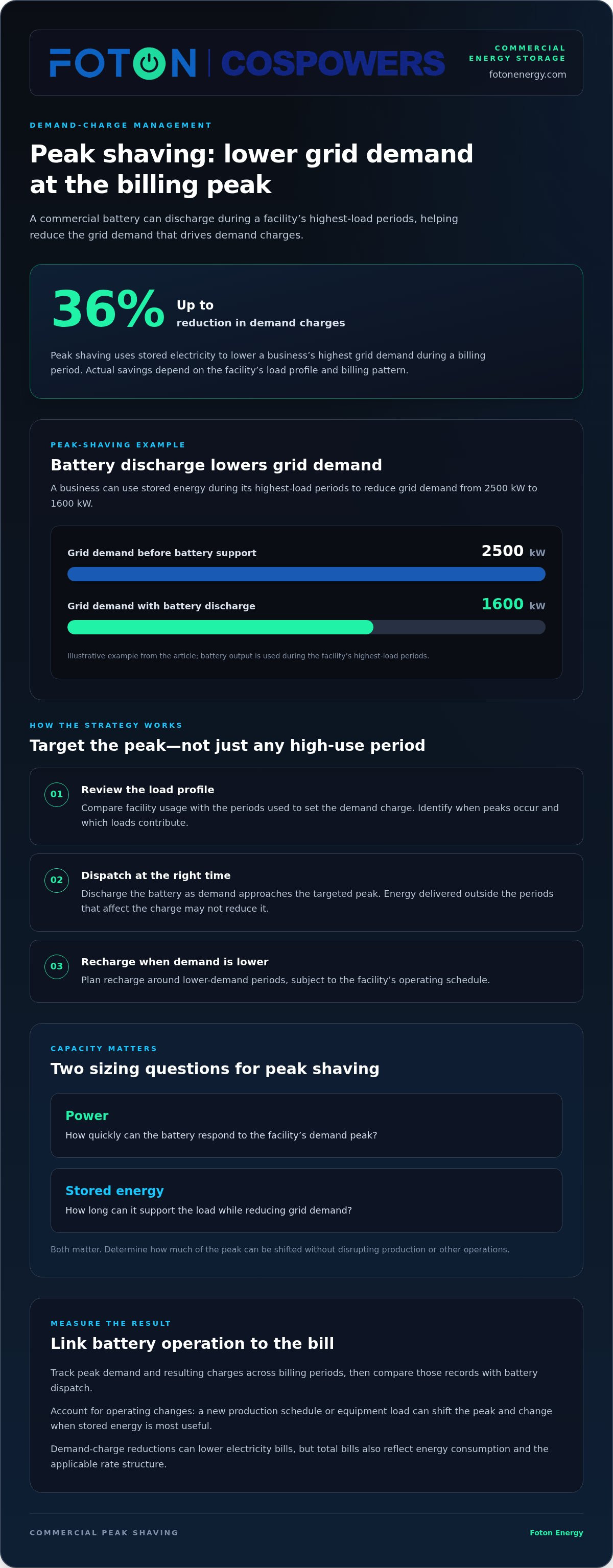
Peak shaving uses stored electricity to lower a business’s highest grid demand during a billing period. Commercial battery storage can reduce demand charges by up to 36%, making the facility’s load profile central to energy cost management.
Managing Demand Charges for Large Customers
Demand charge management means controlling a facility’s highest electricity draw to reduce charges tied to peak grid demand. A brief period of heavy equipment use can set the billing peak, even if demand is lower for the rest of the month. Review interval usage to identify when peaks occur and which loads contribute. This analysis gives a storage strategy a clear operational target.
Peak Shaving Strategies
Peak shaving reduces grid demand by discharging a battery when a facility’s electricity use approaches a targeted peak. For example, a business can lower peak demand from 2500 kW to 1600 kW by using stored energy during its highest-load periods. The battery then recharges when demand is lower, subject to the facility’s operating schedule. Matching discharge timing to actual peaks is essential: energy delivered outside those periods may not reduce the demand charge.
Start by comparing the facility’s load profile with the periods used to set its demand charge. Then determine how much of the peak can be shifted without disrupting production or other operations. Battery power affects how quickly the system can respond; stored energy affects how long it can support the load. Both matter when assessing peak shaving.
Electricity Bill Savings
Demand-charge reductions can lower electricity bills, but the total bill also reflects energy consumption and the applicable rate structure. Any savings example illustrates potential, not a universal result. Compare the expected demand-charge reduction with the facility’s actual billing pattern.
To assess demand-charge reductions, track peak demand and resulting charges across billing periods. Compare those records with battery dispatch to see whether discharge coincides with the peaks that affect the bill. Account for operating changes too: a new production schedule or equipment load can shift the peak and change when stored energy is most useful. This ongoing analysis links battery operation to measurable electricity savings instead of assuming every discharge lowers costs.
Energy storage for business backup power
Battery storage can supply selected business loads when grid electricity fails, helping protect critical operations. Commercial energy storage systems can also participate in demand response programs and sell excess energy to wholesale markets, linking backup planning with other operating priorities.
When evaluating energy storage proposals, compare each one with the facility’s critical-load list, required backup duration, battery power and available stored energy. Review how the system prioritizes loads during an outage, then assess its controls, grid connection and intended operating modes.
Resilience planning starts with defining what must keep running. A data centre may prioritize computing equipment, cooling and network infrastructure, while a factory may focus on controls and essential production lines. Listing these loads distinguishes critical services from equipment that can pause. That distinction guides sizing: the system needs enough power for simultaneous demand and enough stored energy for the required backup period.
Power and energy answer different sizing questions. Power describes how much electricity a battery can supply at once; energy describes how much it can deliver over time. A facility with high start-up loads needs a system that can serve those peaks, while a longer outage places greater emphasis on usable stored energy. The load sequence matters too: starting every system at once can create higher demand than restoring equipment in stages.
Outage resilience also depends on how the battery connects to facility operations. Identify which circuits require backup, how the system detects a grid interruption, and how priority loads are restored. A documented operating plan should account for changing facility demand and the possibility that an outage lasts longer than expected. In North America, grid frequency is maintained at 60 Hz for reliability, so system integration must support stable operation alongside the electrical supply.
Continuity has a measurable business context. Most U.S. businesses experience more than five major power outages each year. These figures underline why a backup plan should identify operational consequences, not just total site consumption. Lost production, interrupted services and unavailable systems can have different priorities.
For facilities where communications continuity is central, Data Centre & Telco Backup is a relevant storage application. Aligning the system with critical loads, operating priorities, and outage scenarios gives businesses a clearer basis for comparing backup proposals.
Commercial battery storage combined with solar PV
Solar PV generates electricity when sunlight is available, while a battery stores energy for later use. Together, they can help business owners use more on-site generation, manage peak demand, and support backup power during outages.
Pairing Batteries With Solar PV
A solar-plus-storage system stores surplus solar generation for use when production falls or facility demand rises. This can reduce reliance on grid electricity and make solar power available beyond its generation window. In one example, grid use falls from 55% with solar alone to 30% with solar and a battery. California installations also show the relevance of storage: solar-plus-storage made up 60% of solar installs a year into NEM3.0.
Sizing Batteries for Peak Demand
Battery sizing matches the system’s power and stored energy to a facility’s load profile and intended operating tasks. A 1 MW / 2 MWh system is an example of a battery that can shave 20-30% off peak demand. The power rating determines how much load it can serve at once; the energy capacity influences how long it can provide that output. Solar generation patterns and backup requirements also shape the design.
Remote monitoring can help operators observe system performance and identify changes in charging, discharging or operating conditions. Battery chemistry and battery management system safety features are important design considerations. Review warranty terms for requirements involving temperature controls, charge and discharge rates, and Wi-Fi connectivity.
Financing and Service Options
Financing, leasing and energy-as-a-service arrangements determine who funds, owns and operates a storage project. Compare how payments relate to system ownership, maintenance responsibilities and the value created through energy management. An energy-as-a-service arrangement is organized around delivering an energy service rather than simply transferring equipment ownership. The contract structure determines how costs and responsibilities are allocated.
Permits, Incentives, and Fire Codes
Permitting, grid interconnection, and fire-code review shape how a commercial battery project is designed and connected. Requirements depend on the project’s location, system configuration, and the authorities overseeing the site and grid connection. In the United States, the Inflation Reduction Act provides battery energy storage owners with a 30% investment tax credit for 10 years. Incentive eligibility and applicable approvals are separate considerations.
Safety, warranty, maintenance and degradation risks depend on system design and operating conditions. Battery chemistry, management-system safety features, temperature controls and charge and discharge rates all matter; warranty terms describe relevant usage requirements. Owners can also plan maintenance around operating data and system performance instead of treating backup power as a set-and-forget function.
Mobile battery rental is a separate option utilities may consider for temporary storage needs. It differs from a permanent solar-plus-storage installation, which is designed around a site’s generation, demand and backup priorities.
Cost avoidance, investment deferral, and energy arbitrage
Energy storage can shift electricity use, reduce exposure to costly periods and support grid services. The economic case depends on local tariffs, demand charges, operating patterns and available incentives.
Self-Consumption and Time-of-Use Arbitrage
Self-consumption uses stored energy on site, while time-of-use arbitrage charges during lower-rate periods and discharges during higher-rate periods. Both strategies help businesses align electricity use with tariff structures. For example, a facility facing higher evening rates from 5pm-9pm can store energy earlier and use it during that window. The value depends on the rate difference, charging opportunities, and how much stored energy the business can use.
Arbitrage and Grid Services
Energy arbitrage creates value by shifting stored energy between periods with different electricity prices; grid services can provide another revenue stream. A battery may charge when market prices are lower, then discharge when prices rise. Some systems can also provide frequency regulation, with payments set through wholesale market operator auctions. The operating strategy must account for competing uses, since energy committed to one service may not be available for another.
Retail and wholesale markets work differently. A business on a time-of-use tariff responds to the rates on its electricity bill, while wholesale participation depends on market rules and available programs. The price difference illustrates why local tariffs matter to arbitrage value.
Cost Avoidance and Investment Deferral
Cost avoidance means using storage to reduce purchases or charges; investment deferral means managing demand with a battery instead of immediately expanding electrical infrastructure. At a facility approaching a capacity limit, stored energy can help cover periods of high demand. Its value depends on when constraints occur, how often they recur and whether discharge can address the load. Combining these uses can strengthen the business case, but requires coordinated dispatch.
Incentives can also change project economics. NYSERDA offers commercial storage incentives in New York for qualifying projects up to 5 megawatts in power capacity and 20,000 kilowatt-hours. Incentive amounts vary by region and change over time, so project economics should account for the applicable program and eligibility criteria.
Payback and Storage Economics
Commercial energy storage users typically recover their investment in four to seven years. Payback and ROI depend on electricity rates, demand charges, operating patterns and incentives. Compare projected bill reductions and other revenue against project costs over time. Higher demand charges or a larger difference between peak and off-peak rates can increase the value of shifting energy.
State programs affect the calculation through eligibility rules and incentive levels. According to NYSERDA, qualifying projects must be new, permanent and stationary, and incentive amounts vary by region. Include these conditions alongside tariff savings and potential market revenue when assessing a commercial storage project.
Commercial energy storage product capacity
Businesses can buy behind-the-meter battery systems for on-site use or front-of-the-meter systems connected to the grid. The right capacity depends on the intended use, such as lowering peak demand, storing solar generation or serving selected loads during an outage. Capacity is not a single figure: power and stored energy describe different system capabilities.
Behind-the-meter systems often range from 5 kilowatts to 5 megawatts. Power, measured in kilowatts or megawatts, describes how much electricity the system can deliver at once. Energy capacity, measured in kilowatt-hours or megawatt-hours, describes how much electricity it can store. A facility seeking to manage short demand peaks may prioritize discharge power, while longer backup needs place greater emphasis on stored energy.
Front-of-the-meter systems are usually at least 5 MW in size. These systems serve grid-connected applications rather than a single facility’s behind-the-meter load. That distinction changes how capacity is evaluated: a commercial site may size storage around its own demand profile, while a grid-scale project must align its output with its intended grid application. The connection point helps define the system’s role.
For teams selling energy storage solutions to businesses, explaining capacity means distinguishing three project needs:
- Power: Identify the facility’s highest load or the largest load that must operate during discharge.
- Energy: Estimate how long the system must supply that load before recharging or ending discharge.
- Application: Define whether the system is intended for peak demand management, solar use, backup, or grid support.
A factory may want to reduce demand charges during a brief production peak, while a commercial building may prioritize longer backup for selected equipment. These uses can require different power-to-energy relationships, even when facilities have similar total electricity consumption. Selecting capacity from annual consumption alone can miss the timing and intensity of the loads that matter.
Oversizing can leave capacity underused, while undersizing can prevent a system from meeting its target. Review load data, the expected discharge pattern, charging opportunities and any reserve needed for backup. Then compare those needs with the system’s usable power and energy ratings. For teams selling energy storage solutions to businesses, this comparison connects a proposal with the buyer’s intended application.
Explore energy storage system options in relation to the capacity and application your project requires.
Program eligibility can also shape capacity planning. The listed PG&E capacity bidding program criteria require a minimum manufacturer warranty of three years, an existing service account with at least 12 months of billing and usage history, and the ability to poll PG&E’s virtual top node at one-minute intervals.
NYSERDA incentive-eligible commercial battery storage systems must be installed by a NYSERDA-approved Participating Contractor. NYSERDA commercial energy storage incentive amounts per kilowatt-hour vary by region and change over time. In Connecticut, commercial customers can receive incentives of up to 50% of a storage installation project's cost.
Foton Energy (Foton Pty Ltd): C&I BESS
Foton Energy (Foton Pty Ltd) offers C&I BESS for businesses assessing storage to manage energy costs, peak demand or operational resilience. It is a relevant next step when a facility has identified a clear use case and needs a commercial storage solution aligned with its operating requirements.
Project priorities differ. One business may focus on reducing demand charges, while another may want to store solar generation or strengthen backup planning. Foton Energy also offers Utility-Scale Storage and Data Centre & Telco Backup for projects with those applications.
If your business is evaluating commercial storage, discuss how C&I BESS could align with its energy requirements and intended application. Contact Foton Energy to explore the next step for your project.
Turn Your Storage Strategy Into a Project
Turn your operating priorities into a clear project brief. Identify the outcomes that matter most, the loads or operations the system should support, and how storage could fit into wider energy plans. A focused brief gives technical discussions a practical starting point and helps align system design with business objectives.
For businesses exploring C&I BESS, Foton Energy (Foton Pty Ltd) offers solutions for commercial and industrial storage requirements. Its wider portfolio also includes Residential Storage Systems and Utility-Scale Storage, each serving a distinct application. These offerings are relevant to organizations selling energy storage solutions to businesses or evaluating storage for their own operations.
Bring your project priorities into the conversation and explore how a storage solution could fit your requirements. Contact Foton Energy to discuss your next step. A considered project brief can help move your energy strategy forward with clarity and purpose.
Frequently Asked Questions
How can businesses size an energy storage system for peak shaving, backup power, and load shifting?
Size the system against each operating case, then assess whether it can serve those uses without conflicting dispatch priorities. A facility could reserve stored energy for critical circuits while scheduling remaining capacity for peak shaving or load shifting. Use interval load data, a critical-load inventory, outage scenarios and charging windows to model these modes together. Compare the required discharge power and energy for each case before selecting a configuration.
How do lithium-ion, flow, and other commercial energy storage technologies compare?
Compare technologies by application, system design, operating profile and integration needs, not chemistry name alone. Lithium-ion includes chemistries such as lithium iron phosphate (LFP); flow batteries store energy in liquid electrolytes held in tanks, while sodium-ion is another option. Foton Energy offers LFP and sodium-ion systems. Compare each system proposal with site constraints, the intended discharge pattern, safety design and maintenance requirements.
What are the main safety, warranty, maintenance, and degradation risks of business battery storage?
Consider battery chemistry and the battery management system’s safety features. Review warranty requirements for installation and use, including temperature controls, charge and discharge rates, and Wi-Fi connectivity.


