

Battery storage's biggest supply risk is concentration across the supply chain. The Lithium Triangle, comprising Chile, Argentina and Bolivia, holds more than 75% of global lithium supply, making mineral extraction and refining potential bottlenecks. The supply chain risks for battery storage components also include constrained supplier capacity, price shifts and geopolitical changes.
That concentration matters when project schedules and budgets depend on reliable movement of components from raw materials through manufacturing and delivery. Alternative chemistries can change exposure to particular minerals, but they also bring different supply-chain considerations.
This article explains how mineral bottlenecks, supplier constraints, price volatility and geopolitics can affect battery storage projects, and how chemistry choices shape those risks. It covers pressures that influence component availability and cost, why sourcing resilience matters, and what to consider when comparing battery technologies. The goal is to support clearer project planning and supply-chain risk assessment.
Key Takeaways
- Map mineral sourcing and refining dependencies to identify where bottlenecks could affect component availability and project schedules.
- Assess supplier capacity alongside manufacturing growth: more facilities can expand supply, but they don’t remove every sourcing constraint.
- Consider how price shifts and geopolitical changes may affect procurement, and how alternative chemistries can alter exposure to specific materials.
- Look beyond battery cells to components such as inverters and transformers when evaluating concentrated supply chains.
- For residential projects, Foton Energy’s Residential Storage Systems provide a relevant next step when supply-chain resilience is part of the system decision.
Critical-mineral extraction and refining bottlenecks
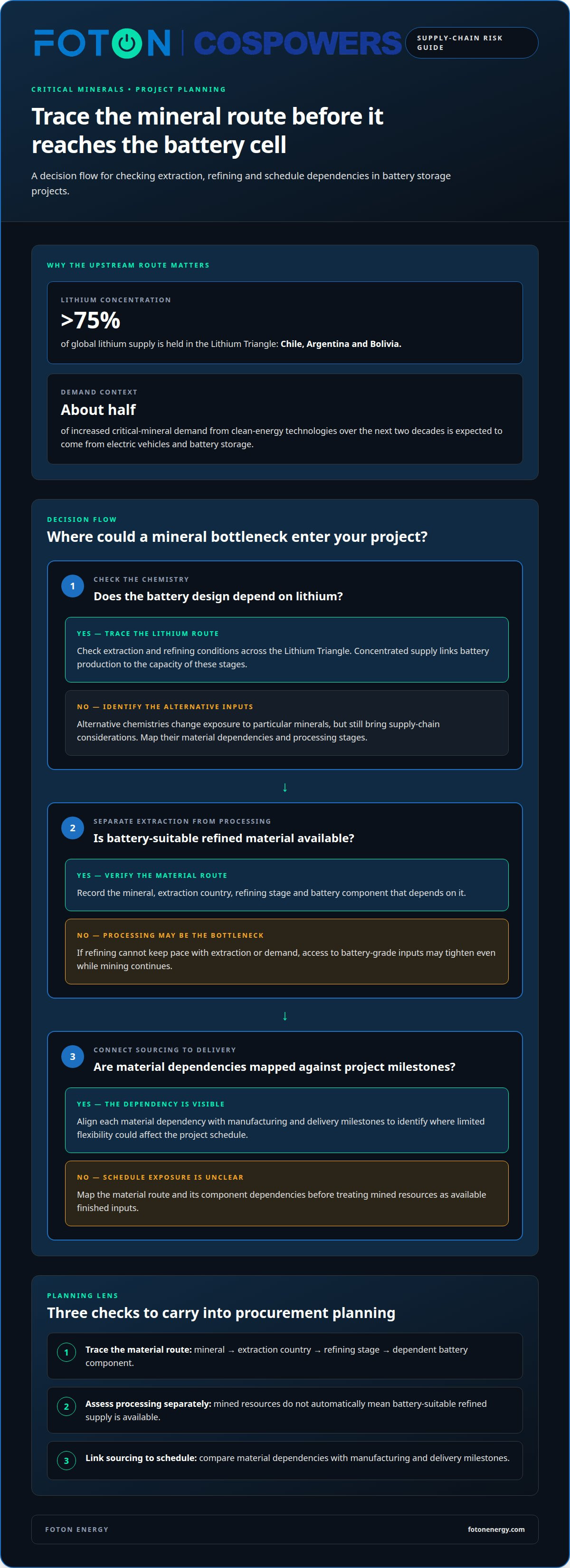
Battery supply chains begin with minerals, but mining is only the first dependency. The Lithium Triangle, comprising Chile, Argentina and Bolivia, holds more than 75% of global lithium supply. That concentration links battery production to extraction conditions and processing capacity across three countries. A disruption at either stage can affect how reliably lithium reaches cell manufacturers.
Extraction and refining are separate steps. Lithium-bearing material must be processed into forms suitable for battery production, so mineral resources do not automatically translate into usable supply. If refining capacity cannot keep pace with extraction or demand, processing becomes a bottleneck. Manufacturers may then face tighter access to battery-grade inputs, even while mining continues.
Demand adds pressure across several clean-energy industries. Electric vehicles and battery storage are expected to account for about half of increased critical-mineral demand from clean-energy technologies over the next two decades. Battery projects are therefore part of wider competition for materials, and rising demand can affect procurement planning well before construction begins.
- Trace the material route: identify the mineral, extraction country, refining stage and battery component that depends on it.
- Separate mining from processing: assess whether usable refined material is available, rather than treating mined resources as finished inputs.
- Connect sourcing to schedule: map each material dependency against manufacturing and delivery milestones.
These steps help identify where a project has limited flexibility. For example, a battery design that depends on lithium remains exposed to the capacity of the relevant extraction and refining chain. The risk is not simply that a mineral comes from a concentrated region. Disruptions, processing constraints or stronger demand can restrict the usable material reaching manufacturers.
Alternative chemistries can change which minerals matter, but they do not remove the need to assess upstream inputs. Compare options by identifying their material dependencies and required processing stages. Then consider how those dependencies align with procurement timing and project component requirements. This makes mineral concentration a practical planning issue: teams can identify which inputs need closer sourcing attention and where constraints could affect delivery.
Limited lithium-ion battery supplier availability
U.S. exposure to imported battery storage components varies by component, rather than following one uniform measure. DOE CESER and Idaho National Laboratory assess foreign-manufactured components across battery energy storage systems, inverter-based resources and transformers.
Supplier availability is also a capacity issue. A manufacturer may produce cells but have limited output for the required configuration, delivery window or project scale. The United States had one sodium-ion battery manufacturing facility. Approximately two dozen battery storage manufacturing facilities were expected to come online in the United States in the next few years. New factories can expand domestic options, but commissioning takes time and does not immediately supply every component.
For lithium-ion projects, the number of potential suppliers alone does not show whether a system can be delivered. Battery cells, enclosures, inverters and grid transformers each have their own production schedules. A delay in one critical item can hold up integration, even when other equipment is ready. Map component dependencies early, then align procurement milestones with installation and commissioning.
Inverters and power electronics bring distinct risks because they connect battery output to the electrical system. Grid transformers add another dependency at the point of connection. If these components come from constrained or foreign manufacturing sources, limited production capacity or transport disruption can affect schedules. The DOE CESER and Idaho National Laboratory assessment treats foreign-manufactured components as part of the broader storage supply chain, not as secondary equipment.
Shipping, permitting, labor and manufacturing capacity can delay U.S. projects in different ways. Shipping disruptions can postpone equipment arrival; permitting can affect when site work proceeds; labor availability can constrain construction or commissioning; and limited factory capacity can extend delivery schedules. Their combined effect matters: a late component may leave installation crews or other equipment waiting.
- Map dependencies: connect cells, inverters, transformers and installation milestones.
- Track delivery interfaces: identify which component must arrive before integration or commissioning can advance.
- Plan around capacity: align procurement timing with manufacturing schedules and project sequencing.
For utility-scale storage, a component-level view helps clarify whether the main constraint is cell supply, power conversion, grid connection or delivery timing. Residential systems also have dependencies: equipment availability and installation sequencing shape project readiness. Reviewing each item from manufacturing through transport to site integration makes schedule exposure easier to manage.
U.S. exposure to imports varies by component, rather than following a single measure. Foreign manufacturing of cells, inverters, transformers and other system components can affect supplier availability and delivery schedules.
The International Air Transport Association classifies high-capacity lithium-ion batteries as Class 9 dangerous goods. This designation is a useful prompt to check transport requirements alongside supplier capacity and delivery timing. Project teams can include battery movement in procurement planning, coordinate component arrival with installation milestones, and account for handling needs before equipment is ready for integration. A supplier’s availability therefore needs to be considered together with the practical steps required to move the battery to the project site.
Price volatility, export restrictions, and geopolitical shifts
Procurement exposure can change as trade relationships and manufacturing strategies shift. TruGrid says the Inflation Reduction Act and changing relationships with foreign suppliers are driving momentum for domestic-content manufacturing. For U.S. projects, this can influence sourcing decisions as developers weigh supplier availability and component origins. This does not establish a specific tariff, tax-credit amount or domestic-content threshold.
The U.S. government will bar the Department of Defense from purchasing batteries made by six leading Chinese manufacturers starting in October 2027. This restriction applies to Department of Defense purchasing. It illustrates how geopolitical decisions can alter the eligible supplier pool for a defined buyer, while commercial projects face their own procurement considerations.
Prices and lead times for cells, inverters and transformers depend on component specifications, supplier capacity, material inputs, transport and project timing. Disruptions involving lithium, graphite, nickel and cobalt can tighten access to relevant inputs or increase pressure on manufacturing costs, depending on the chemistry and component.
Material shocks do not affect every battery design in the same way. A lithium disruption directly concerns lithium-based chemistries, while exposure to graphite, nickel and cobalt depends on the materials used in a particular cell. The impact can move through the chain: constrained inputs affect manufacturing, which can influence availability and procurement timing. Project teams should connect chemistry choices with supplier and delivery assumptions.
Trade policy can also shift the balance between imported and domestic sourcing. The IRA forms part of the context behind the domestic-manufacturing momentum TruGrid describes, but project decisions still depend on procurement goals and available components. Rather than treating “domestic” as a complete solution to supply risk, assess where each component is made and whether its production capacity and delivery schedule suit the project.
A practical review can separate these exposures rather than combining them into one general contingency:
- Material exposure: map lithium, graphite, nickel and cobalt dependencies to the selected chemistry.
- Trade exposure: record relevant supplier origins and the procurement rules that apply to the buyer.
- Schedule exposure: connect component lead times with manufacturing, shipping and installation milestones.
- Price exposure: identify which inputs, component specifications and sourcing decisions could change procurement assumptions.
These distinctions help U.S. project teams understand whether a change affects cost assumptions, delivery timing or supplier eligibility. For a project-level perspective, align procurement choices with battery storage project planning and the system’s technical requirements.
The IRA and shifting trade relationships are contributing to momentum for domestic manufacturing. As a result, project teams may weigh supplier availability and component origin when sourcing. Trade policy can shift the balance between imported and domestic options, but this does not establish a specific tariff, credit amount or domestic-content threshold.
Cobalt mining in the Democratic Republic of Congo
The Democratic Republic of Congo is an important point to consider when assessing cobalt exposure in battery supply chains. The effect on a storage project depends on whether its selected cell chemistry uses cobalt and how manufacturers source, process and document that material. A country-level connection alone does not show how much cobalt a particular battery contains or where its supply originated.
Trace cobalt through the supply chain rather than stopping at the mine. Extracted material moves through trading, refining and battery-material processing before it enters cell manufacturing. Each handoff can make the origin and processing route harder to trace. For project teams, this matters because disruption at one stage may affect downstream availability even when other stages continue operating.
Start with the battery chemistry. Identify whether the cell uses cobalt, then connect that requirement to the manufacturer’s sourcing and processing chain. A design with no cobalt requirement has different direct exposure from one that relies on cobalt-bearing battery materials. This helps distinguish project-specific material risk from broader headlines about mining in the Democratic Republic of Congo.
A supply-chain review can then focus on specific questions: which supplier provides the cells, which material processors support production, and what information accompanies the material at each transfer? Clear records help procurement teams understand dependencies and identify where disruption could affect manufacturing. If a supplier’s chain includes cobalt from the Democratic Republic of Congo, traceability can clarify the route without assuming every project has the same exposure.
- Confirm chemistry: identify whether the chosen cell design relies on cobalt.
- Map the chain: connect the cell supplier with relevant material processors and sourcing stages.
- Review documentation: establish what origin and processing information follows cobalt through supplier handoffs.
- Assess alternatives: compare chemistry options by their material dependencies and system requirements.
These steps support a more precise risk assessment than treating cobalt as a universal battery input. If a project’s selected chemistry does not rely on cobalt, a cobalt-specific disruption has a different direct effect than it would for a cobalt-dependent design. Other materials and components still need their own sourcing review.
The practical outcome is a chemistry-linked sourcing map. It shows where cobalt enters the chain, which suppliers handle it, and where further documentation can clarify exposure. For battery storage projects, this provides a structured basis for procurement decisions, supplier discussions and contingency planning, without treating the Democratic Republic of Congo as the only source of risk or assuming every battery uses the same materials.
Which battery storage components have the most concentrated global suppliers?
Supplier concentration needs to be assessed component by component. The DOE CESER and Idaho National Laboratory report assesses foreign-manufactured components across battery energy storage systems, inverter-based resources and transformers. These categories identify key supply-chain areas to examine, but concentration can differ by component, manufacturer and project requirements.
Battery cells and modules deserve attention because their chemistry and configuration shape the rest of the system. China’s battery production in 2023 was sufficient to meet global demand. That scale makes the country significant to the battery manufacturing landscape, but it does not establish that every storage project depends on Chinese cells. The relevant question is how a project’s chosen supplier and cell design connect to production locations and alternative sources.
Inverters and other power electronics are another important category. They convert and manage electrical output, so their availability affects system integration as well as procurement. A project may have battery modules ready but still be waiting for compatible inverter equipment. Assessing suppliers for these components separately helps reveal reliance on a narrow manufacturing base or constraints tied to specific technical requirements.
Grid transformers also warrant separate analysis. Because they connect storage assets to electrical networks, their manufacturing and delivery schedules affect project readiness. DOE CESER and Idaho National Laboratory include transformers alongside battery systems and inverter-based resources in their supply-chain assessment. An analysis focused on cells alone can miss exposure elsewhere in the project’s equipment chain.
Build a component map recording each item’s manufacturer, production location, upstream dependencies and delivery interface. Then distinguish direct suppliers from upstream sources. A battery supplier may assemble modules using cells or materials sourced through other companies. This layered view can reveal dependencies that a simple vendor list misses and help teams identify which components offer the least sourcing flexibility.
- Separate categories: assess cells, modules, inverters, power electronics and transformers independently.
- Trace dependencies: connect each supplier to relevant manufacturing and upstream stages.
- Test flexibility: identify whether an alternative component can meet the project’s technical requirements.
- Align schedules: connect each item’s delivery sequence to integration and grid connection milestones.
This approach turns supplier concentration into a project-specific assessment, not a general assumption about one country or technology. To align component choices with a project’s requirements, discuss storage project planning and the equipment dependencies that shape delivery.
Check whether alternative suppliers can meet the same technical and delivery requirements, and record any qualification or transport constraints that narrow those options.
Global utility-scale battery storage deployments increased by 43% in 2025, while global utility-scale battery storage is projected to grow at an average annual rate of 10.8% from 2024 to 2034. Global electricity storage capacity was 230 GW in 2022, and the G7 climate ministers agreed in principle to increase global electricity storage capacity to 1,500 GW by 2030. For air freight, lithium-ion batteries must have a state of charge no greater than 30%. Delivery and transport conditions are relevant alongside supplier location when evaluating sourcing flexibility.
Foton Energy (Foton Pty Ltd): Residential Storage Systems
Foton Energy (Foton Pty Ltd) offers Residential Storage Systems for homeowners considering battery storage as part of their energy plans. Component availability, chemistry and sourcing exposure can all inform a residential system decision. Start with practical questions: which system suits the project’s requirements, and how do its component choices align with intended use? Foton Energy’s Residential Storage Systems are relevant when evaluating home storage in the context of your requirements. For larger applications, Foton Energy also offers Utility-Scale Storage and Data Centre & Telco Backup. Contact Foton Energy (Foton Pty Ltd) to discuss your residential storage requirements.
Turn supply-chain insight into project readiness
The next step is to turn supply-chain risks for battery storage components into decisions that fit your project. Define the system’s purpose, technical requirements and procurement priorities, then connect those choices to the components that must work together. A clear project brief helps focus discussions on sourcing exposure, chemistry and delivery dependencies while keeping operational needs in view.
Foton Energy (Foton Pty Ltd) offers C&I BESS, Residential Storage Systems and Utility-Scale Storage. These solutions serve different applications, so the right starting point depends on your project’s scale and purpose. Share your requirements and discuss how storage options align with them.
Contact Foton Energy (Foton Pty Ltd) to discuss your battery storage project. A focused conversation can help turn supply-chain considerations into a practical next step.
Frequently Asked Questions
What are the main supply chain risks for battery energy storage system components?
The main supply chain risks for battery storage components are disruptions affecting material inputs, manufacturing, transport and component compatibility. For example, a battery may be available while a compatible inverter or transformer is delayed, affecting integration. Chemistry also shapes exposure to particular materials. To manage these risks, map component dependencies and identify which equipment must arrive before integration can proceed.
What are the risks of relying on Chinese battery storage suppliers in the United States?
For U.S. projects, supply chain risks for battery storage components sourced from Chinese suppliers include exposure to supplier capacity and geopolitical or procurement changes. China’s battery production in 2023 was sufficient to meet global demand. Starting in October 2027, the U.S. government will bar the Department of Defense from purchasing batteries made by six leading Chinese manufacturers. This restriction applies to Department of Defense purchasing, not all U.S. projects.
How do U.S. tariffs, tax credits, and domestic-content rules affect battery storage sourcing?
The Inflation Reduction Act and changing relationships with foreign suppliers are driving momentum for domestic-content manufacturing, influencing sourcing decisions as developers weigh component origins and supplier availability.


